The Cheapest Million: Why the Dells’ $250 Gift Is the Right Idea

Michael and Susan Dell just did something worth celebrating, and worth copying.

Through their foundation, they’ve committed $6.25 billion to drop $250 into investment accounts for up to 25 million American kids — children age 10 and under, born before January 1, 2025, with a Social Security number, living in ZIP codes where the median household income is $150,000 or less. The money goes into the new federal “Trump Accounts” (the Invest America program), which otherwise seed $1,000 for babies born from 2025 on. The Dells’ gift is aimed squarely at the kids who missed that window — the ones who’d otherwise start with nothing. Parents just have to open the account; the $250 lands automatically.

That’s the whole thing. No strings, no lecture, no means-tested paperwork maze. Open an account for your kid, and a stranger puts $250 in it. It’s one of the largest single acts of philanthropy ever aimed at ordinary American families, and it’s built on the one financial idea that actually works without fail: start early and let time do the work.

What “25 million” actually means — and why the design is clever

It’s worth clearing up what that 25 million number is, because it’s easy to misread. It is not a count of how many kids that age exist in America, and it’s not an arbitrary slice the Dells decided to stop at. It’s simply what $6.25 billion buys at $250 a head: $6.25 billion ÷ $250 = 25 million grants.

Here’s the important part: that number was sized to cover essentially the entire eligible group, not a lucky fraction of it. By the Dells’ own accounting, the money will reach nearly 80% of all American children age 10 and under who were born before 2025 — across about 75% of the country’s ZIP codes. So this isn’t a lottery for a few. It’s built to reach almost every kid in the target range, first-come until the 25 million are activated, with any leftover funds going to children older than 10. The honest answer to “did they fund enough for all the kids that age?” is: yes, near enough — they funded the whole target group, minus the wealthiest slice.

And that targeting is the quietly smart part of the whole thing:

  • It’s income-screened, but barely. To qualify, a child has to live in a ZIP code where median household income is $150,000 or less. That excludes only the richest areas — the families who’d notice a $250 deposit least — while still sweeping in the overwhelming majority of American kids. Nearly everyone qualifies; only the very top is left out. It’s a means test light enough that it doesn’t turn into the usual paperwork gauntlet, but real enough that the money flows toward the kids who need it.
  • It doesn’t duplicate the government. The $250 goes specifically to kids who missed the federal $1,000 newborn deposit — those born before 2025. No child double-dips, and the private money fills exactly the gap the federal program leaves open. The Dell gift and the Treasury seed interlock instead of overlapping.
  • It’s nearly automatic. Parents open or activate a Trump Account, and the $250 arrives. No essay, no caseworker, no proving your hardship.

Put those together and it’s about the most efficient targeting you could design: near-universal reach, a feather-light means test that skips only the rich, and a clean dovetail with the existing federal program so not a dollar is wasted paying twice. Whatever you think of the branding, the mechanism is thoughtful.

The charity Give Directly built its reputation on an idea that sounded almost heretical to the aid world: instead of routing help to the poor through layers of programs, staff, and overhead, just give people the money directly and trust them with it — an approach that keeps holding up in controlled studies against more paternalistic alternatives. The Dell gift is that same instinct, pointed at the future instead of the present. No agency, no strings, no overhead skimming the top; the $250 lands straight in the child’s own account and starts working. The only twist is that it’s locked and invested, so “direct cash” becomes “direct capital” — compounding for decades instead of spent today.

Why $250 at age zero is worth more than it looks

Here’s the thing about that $250. Left untouched until adulthood and invested in a low-cost index fund, it becomes a very different animal than $250 handed over as cash — because you’ve given it the one input money can’t buy back: decades.

At a 7% return above inflation — a reasonable long-run number for a broad stock index, stated in today’s dollars — here’s what a single seed becomes if it’s left alone:

Starting seedAt age 18At age 60At age 65
$250 (the Dell gift)~$845~$14,500~$20,300
$1,000 (federal newborn deposit)~$3,380~$57,900~$81,300
$18,000 (a committed family seed)~$60,800~$1,040,000~$1,460,000

All figures in today’s dollars (e.g., a 7% return above inflation). This is the purchasing power the money would have in the future: invest $18k for your child today and they’ll have $1 million of purchasing power, in today’s dollars, at 60. The actual account balance will be multiple millions, due to inflation.

The $250 alone won’t retire anyone. By 18 it’s worth a used laptop. But that was never the point. The point is that the account now exists, it has a balance, and the kid grows up watching it grow. Dell said it plainly in his own interviews: kids with accounts — even with modest sums in them — tend to have better outcomes than kids without. The dollars are the smaller half of the gift. The bigger half is that a child now has a stake in the future and a front-row seat to compounding.

The number that should keep you up at night

Look at the bottom row again. Eighteen thousand dollars, put in at birth and never touched, becomes roughly a million dollars in today’s purchasing power by age 60. Not nominal, inflated-away dollars — a real million.

That’s the cheapest million any of us will ever have access to, and almost nobody uses it. Not because $18,000 is unreachable — plenty of families spend more than that on a single vehicle — but because the window that makes it work slams shut a little more every year the account sits empty. The same $18,000 started at age 10 instead of age 0 loses roughly half its ending value. Started at 20, you’ve thrown away three-quarters of it. Time is the ingredient, and it’s the only one you can’t buy later.

That’s what makes the Dells’ move so smart. They didn’t try to solve poverty with the size of the check. They attacked the timing — getting a seed into the ground for millions of kids while those kids still have 60-plus years of compounding ahead of them. It’s the highest-leverage philanthropic dollar there is.

It would take 72 people

Here’s another thought

The Dells gave $250 per kid. But run the same idea can go further. Consider a $18,000 seed, the amount that compounds into a real million by age 60 — and the total for all 25 million eligible kids comes to $450 billion.

That sounds impossibly large until you divide it by what the Dells already proved one family will give: $450 billion ÷ $6.25 billion = 72. Seventy-two more gifts the exact size of the Dells’ would fully fund an $18,000 head start for every eligible child in the country.

One note before the numbers below: every net-worth figure in this piece is from the Forbes 400 as of September 1, 2025. I deliberately froze the math to one dated, settled snapshot so it stays internally consistent — but fortunes at this altitude move fast, and several of these are already very different today (some dramatically so). Read them as a fixed reference point I had to pick, not a live quote. Many of these people’s net worths have grown greatly in that time.

Seventy-two. Out of a group that is not remotely that small:

  • The 400 richest Americans are worth a combined $6.6 trillion. The entire $450 billion is less than 7% of that one list.
  • The top 20 Americans alone hold about $3 trillion — nearly half of all U.S. billionaire wealth. The whole program would cost 15% of just their fortunes, and nothing of anyone else’s.
  • The Dells’ own $6.25 billion came out of a fortune well north of $100 billion.

And the number that shows how within reach this really is: that same Forbes 400 got $1.2 trillion richer in a single year. The entire cost of giving 25 million American kids a genuine shot at a million-dollar retirement is less than half of what this group gained last year alone.

It’s also worth sizing $450 billion against what the country spends without blinking. To be clear, I’m not pointing at the billionaires alone and saying “you should fund this” — I’m just laying out the math for the many possible routes to funding it. The United States spends about $1 trillion on its military every single year. The full cost of handing 25 million kids an $18,000 head start is less than half of one year’s defense budget — and, crucially, it’s a one-time event, not an annual line item. The military costs that much again next year, and the year after. This would happen once and then compound on its own for sixty years. Measured against the U.S.–Iran war of 2025–26 — which the Pentagon’s own accounting put at roughly $29 billion (independent estimates run higher, near $40 billion; war-cost figures are contested and still moving) — $450 billion is on the order of fifteen of those wars. Same money, wildly different afterlife: one version is spent and gone; the other sits in twenty-five million children’s names, growing, for the rest of their lives.

The money already exists, concentrated in a few hundred hands. The Dells showed it can be done and exactly how to do it. The only thing missing is 71 more people willing to sign the same check.

Or: everyone gives the same slice

The version above treats a $12 billion fortune and a $428 billion fortune as if they should write the same check. They shouldn’t. So here’s another option — draw a line, and everyone above it could decide to give the same percentage of what they have.

Put the line at $12 billion. For scale: the cutoff just to make the Forbes 400 at all is $3.8 billion — the poorest people on the entire list are worth that much (2025’s floor includes newcomers like early AppLovin investor Eduardo Vivas, at exactly $3.8 billion). A $12 billion floor therefore asks nothing of roughly the bottom 330 names and leans entirely on the very top.

That leaves about the 70 wealthiest Americans, worth a combined ~$4.2 trillion. (The top 50 alone are worth $3.9 trillion, and the 50th-richest American — Jerry Jones — is still worth $19.6 billion, so the $12 billion club runs roughly twenty names deeper than the published top 50. I’ve estimated that tail from the $19.6 billion mark down to the floor; the exact total drifts with the market.)

Raising $450 billion from a $4.2 trillion pool, with everyone contributing the identical share of their wealth, comes to about 10.6% — a tenth of their net worth, paid once. Up and down the ladder, that looks like this:

Person (2025 rank)Net worthGift at ~10.6%
Elon Musk (#1)$428B~$45B
Jeff Bezos (#4)$241B~$26B
Michael Dell (#10)$129B~$14B
Alice Walton (#15)$106B~$11B
Stephen Schwarzman (#20)$51.9B~$5.5B
Jerry Jones (#50)$19.6B~$2.1B
Anyone at the floor$12B~$1.3B

Read down the ladder and the pattern is simple: the larger the fortune, the larger the check, but the percentage is identical for everyone — a tenth, once. That’s the whole point of splitting it by share instead of by flat dollar amount. It scales to what each person actually has, so the same gesture asks the same thing of everyone on the list. And it could be scaled even further down — to people worth a mere $100 million, if they wanted in. It’s all opt-in; again, I’m just showing the potential math, and maybe someone richer will run with it.

What about just one year’s newborns?

Now shrink the question down. Forget the 25 million older kids for a moment. What would it cost to give every single baby born in the United States in one year the full $18,000 — the seed that becomes a real million by age 60?

In 2024, 3.63 million babies were born in the U.S. At $18,000 each, funding the entire cohort — every newborn in America, rich or poor, no exceptions — costs about $65 billion.

The federal government already does a shrunken version of exactly this: it seeds each newborn’s Trump Account with $1,000, which runs about $3.6 billion a year. Going from $1,000 to $18,000 — from a nice token to a genuinely life-altering sum — would cost roughly $61 billion more per birth-year. And doing it every year, forever, for every new class of American babies? About $65 billion annually. That’s less than 1% of the annual yearly US government budget.

The Social Security angle

Here’s where that $65 billion a year gets genuinely interesting.

Social Security is the single largest program in the federal budget — it paid out about $1.6 trillion in 2025 to roughly 70 million people, close to a fifth of everything the federal government spends. And it’s in well-documented trouble. The 2025 Trustees Report projects the retirement trust fund runs dry around 2033 — and a 2025 law has since nudged that to late 2032. When it happens, incoming payroll taxes will cover only about 77% of promised benefits, meaning an automatic 23% cut for everyone, unless Congress raises taxes or trims benefits first. The program’s shortfall over the next 75 years is estimated at roughly $25 trillion.

Now set the newborn-seeding number next to that. Funding an $18,000 account for every baby born in a year costs about $65 billion — a little over 4% of a single year’s Social Security spending. For roughly four cents on every dollar Social Security already pays out, you could hand every American newborn a seed that grows, untouched, into about a million dollars of real retirement money by their sixties.

Be honest about what that does and doesn’t fix. It does nothing for the 2033 cliff. The babies seeded today don’t retire for sixty-plus years, so current retirees and the near-term shortfall need their own answer.

It is a structural fix on a long delay. Social Security’s core problem is demographic: it’s pay-as-you-go, and there are fewer workers standing behind each retiree every decade. Seeding newborns attacks the squeeze from the other end. A generation that reaches retirement already holding a private million — money that compounded on its own, entirely outside the payroll-tax system — is a generation that leans on Social Security far less. That opens doors a cash-strapped program can’t otherwise touch: you could means-test more comfortably, restructure benefits, or simply let a partly self-funded cohort take pressure off the system without pushing anyone into poverty. Run the seeding for twenty years and it totals on the order of $1.3 trillion — a fraction of the $25 trillion hole, except it doesn’t plug the hole so much as slowly make the hole matter less.

As one piece of the long-run answer, “give every citizen a funded head start on their own retirement” is among the few ideas that gets cheaper and more powerful the earlier you start it. Which is the same lesson as everything else in this piece — only here it’s aimed at the whole country at once.

Not everyone will cheer

A gift like this draws two reactions, and they tell you a lot about the person reacting.

The first is gratitude — the obvious one. Someone with more money than they could spend in ten lifetimes put a real asset into the hands of a child who had nothing, and asked for nothing back.

The second is the reflex to turn it into an indictment: see, this proves a handful of people have too much; the answer is to tax them, not thank them. That argument isn’t crazy on its face. Fortunes this size do sit alongside real need, and $250 or $325 million is a rounding error against the wealth behind it. Reasonable people can debate the tax code, and they should — on its own terms.

But look at what that reflex actually does. If the public answer to a man putting $6.25 billion into poor kids’ investment accounts is “this is why we need higher taxes,” you’ve just told every other billionaire in the country that generosity buys them an attack instead of goodwill. That is precisely how you get less of it. Nobody writes the next check to become the villain in someone else’s argument.

The better response — the one that produces more seeded kids, not fewer — is to treat this as unambiguously good and say so loudly. Brad Gerstner, one of the people behind the program, has framed it as a “50-state challenge”: philanthropists claiming states one by one, a friendly race to see who can set up the most kids. That’s exactly the right energy. A billionaire who funds a whole state’s worth of children should get the headline they’d actually want.

And be honest about mixed motives, because they matter less than critics think. Some of these gifts are partly PR. Some companies signing on have political favors in mind. Fine. The four-year-old with a share of stock locked away until adulthood does not care what was in the giver’s heart — the compounding works the same either way. When the urge to look generous produces actual generosity aimed at kids who need it, the smart move is to lean into the incentive, not sneer at it.

None of this is an argument against government or policy. It’s an argument against poisoning a genuinely good act — because the reflex to do so costs the exact children everyone claims to be worried about.

The list is already growing

The Dells started something, and they’re no longer alone. A roster of people has stepped up to put real assets into kids’ accounts, and it’s worth naming them — setting a child up for a lifetime of compounding deserves to be on the record.

  • Gwynne and Robert Shotwell. The president of SpaceX and her husband gave one share of SpaceX stock to each of more than two million children aged 11 to 17 in lower-income areas — worth roughly $320 million, tilted toward kids near their central Texas home. Every one of those children now literally owns a piece of a rocket company, locked away until they turn 18.
  • Ray and Barbara Dalio. The Bridgewater founder and his wife pledged $250 apiece for roughly 300,000 children across Connecticut.
  • Brad Gerstner. The Altimeter Capital investor — one of the program’s architects — is seeding accounts for Indiana kids under five, some 400,000 of them, and is the one pushing the 50-state challenge.
  • Kraken. The crypto exchange is sponsoring an account for every single child born in Wyoming in 2026.

Then there’s the corporate wall. Dozens of companies — the Treasury counted more than fifty by late August — are matching the government’s $1,000 for their employees’ newborns. The usual financial giants are in (JPMorgan, Bank of America, Wells Fargo, Citi, Goldman Sachs, Morgan Stanley, BlackRock, Schwab), but so is a crowd that should catch the eye of anyone who cares about sound money: Coinbase, Circle, Robinhood, Jack Dorsey’s Block, and — going furthest of all — Michael Saylor’s Strategy, the largest corporate holder of bitcoin, which is adding $250 a year for every U.S. employee’s child under 18, not just newborns.

There’s something fitting in that. The people who talk the most about hard money and long time horizons are the ones lining up to fund 60-year compounding accounts for children. That’s the whole argument of this blog in miniature: put a good asset in early, then get out of time’s way.

And the lane is wide open for the giving-focused to do more. Gates, MacKenzie Scott, Jack Dorsey — people who’ve built their public identities around giving money away — could each seed entire states without feeling the dent. Shotwell already proved you don’t even need cash: you can gift the asset itself. Picture a child’s account holding a share of Amazon, a share of Block, or a sliver of bitcoin — bought once and left alone for eighteen years. (The mechanics for donating stock and other assets are still being finalized, but the door is open.) The tools exist. What’s missing is more people willing to walk through it, and a culture that claps when they do.

One name missing from the list

There’s a conspicuous absence on the donor roll, and it’s worth naming precisely because the accounts carry his name. President Trump created the program, headlines its summits, and has personally called on the country’s business leaders and philanthropists to fund it — his Treasury even branded the ask a “50-State Challenge.” Yet as of this writing there’s no public record of Trump putting in a dollar of his own.

That stands out for two reasons. First, it’s literally his name on the accounts — if anyone’s own money belongs in there, it’s his. Second, he can obviously afford it: he sits at No. 201 on the very Forbes 400 this piece is built around, and his estimated net worth jumped from about $4.3 billion to $7.3 billion in a single year of being president. The presidency has made him dramatically richer.

So the optic isn’t just striking — it’s backwards. The man asking everyone else to fund the kids’ accounts with his name on them hasn’t opened his own wallet, while a hedge-fund manager, a rocket company’s president, and a software CEO have. If the whole game is making generosity contagious, the person whose name is at the top of the letterhead should be first in line, not missing from it — even a symbolic $250-a-kid gesture somewhere would do more for the cause than another summit. He can plainly afford it, and it’s his name on the door. He should write the check.

We should want a lot more of this

So here’s the encouragement, and it runs four directions:

To other people with means: this is the template. You don’t need $6.25 billion. Employers can seed accounts for employees’ kids. Wealthy families, foundations, churches, hometown boosters, and small-business owners can seed the accounts of the kids around them. A $250 gift to a newborn is worth more to that child’s life than a $2,500 gift at their high school graduation, and it costs a tenth as much. Match the Dells’ idea at whatever scale you’ve got.

To grandparents and parents: you already have the most powerful version of this, and it requires no billionaire. Watch how fast the target fills once everyone does a little. A child born today gets $1,000 from the Treasury. If a parent’s employer is one of the dozens now matching, that’s another $1,000 — the account is at $2,000 before the family has saved a dime. That leaves $16,000 to reach the $18,000 that becomes a real million. A grandparent’s $1,000 in year one. A birthday that’s a deposit instead of more plastic. An aunt, an uncle, a godparent adding what they can. Spread across a childhood and left to compound, $16,000 isn’t a mountain — it’s a handful of small, deliberate deposits by people who love the kid. If you’re going to give a child money anyway, give it to them at age 2, not age 22.

To everyone else: you don’t need a kid of your own to do this. Any child with an account can receive a contribution from anyone. If you know a young family stretched thin, the highest-return gift you will ever hand them is a few hundred dollars in their child’s account before that child can walk — plus a nudge to open one if they haven’t. Give to the accounts of the kids in your life. You can even contribute directly to any child’s Trump Account with a QR code the account generates — a genuinely useful feature. The money never touches the parents, never gets spent on something else, and never gets forgotten: it’s auto-invested. It’s a great account and a great tool.

To the kid, eventually: the account teaches the lesson the money can’t. A child who watches $250 quietly turn into $845, then keeps adding, learns in their bones what most adults never internalize — that patient capital beats almost everything, and that the earliest dollar is always the most valuable one.

And for anyone weighing whether to do this at scale, it’s worth being honest about the upside to the giver, too. This is one of the rare gifts almost impossible to read as anything but good — no downside headline, no “but was it really effective” hand-wringing, no overhead quietly eating the donation, just a child, by name, with an account that grows for sixty years. The Dells, the Shotwells, the Dalios didn’t only set kids up; they attached their names to about the most defensible act of generosity available anywhere right now. In a moment when great wealth mostly attracts suspicion, funding a generation’s head start earns something rarer and harder to buy: goodwill nobody can argue with. It’s good for the kid and good for the giver at the same time — which is exactly what should make it an easy yes.

Michael and Susan Dell found the single most efficient thing you can do with a philanthropic dollar and did it 25 million times. The right response isn’t just applause. It’s imitation.

Give a kid a head start. The math is on your side, and it never gets cheaper than today.

The S&P 500 Is a Savings Account — But Only Some People Can Open It -A true deflationary money would give everyone the inflation escape that index investors already enjoy (Deflationary Money – Short)

If you hold index funds, you are already using a savings account that beats inflation. That is what the S&P 500 quietly is for the people who own it: not just an investment, but a place to store value against a dollar designed to lose it. Park money there, leave it alone, and over any long horizon it outruns the currency in your checking account. It is, in effect, a deflationary money — something that gains value by being held — sitting inside a brokerage app.

Which is worth pausing on, because the standard argument says this shouldn’t work. The fear is that if money gains value simply by being held, no one will spend it: purchases get deferred, demand collapses, the economy freezes. It is the usual case against Bitcoin, and against deflation in general.

But we can watch it not happen. Millions of people hold an appreciating, inflation-beating asset right now, and they still spend. The entire financial-independence movement is built on exactly this: accumulate an asset that compounds faster than the dollar, then spend it down to fund a life. Nobody hoards to zero — they accumulate in order to decumulate. Holding a deflationary store of value does not stop people from buying groceries, paying rent, or retiring early. It just gives them something better than cash to spend from. The spiral never comes, because people have lives that happen now.

So the S&P works as a de facto savings account. The problem is who gets to use it.

That door only opens for the roughly 60% of American households who own equities. To walk through it you need income beyond your bills, a brokerage account, and enough financial confidence to use one. The other 40% are left holding the depreciating dollar, because it is the only money they have. Inflation is a tax, and we have quietly built a system where the people best equipped to escape it do, and the people least equipped to escape it can’t. The FIRE playbook is real and it works — but it is a playbook for people who already have surplus, access, and know-how.

A true deflationary money erases that divide. A base money that simply holds its value asks for none of the prerequisites: no minimum balance, no account to open, no permission, no know-how. Everyone who holds it is saving by default — whether or not they ever buy a single share of anything. The protection the index investor buys for themselves would belong to the person living paycheck to paycheck too, in the currency they already earn and spend.

That is what Bitcoin is reaching for. Its supply is fixed at 21 million coins, so there is no issuer who can print more and dilute what you hold — the same anti-erosion property that makes the S&P attractive, without the volatility of owning companies. And it needs no gatekeeper: no brokerage, no bank approval, no income test. A phone and an internet connection are the whole prerequisite. I won’t pretend it is finished — it is still volatile, still early, still being adopted, and the stable everyday savings money is the destination rather than the current state. But the two properties that matter, no debasement and no gatekeeper, are already true today for anyone who wants them.

The S&P 500 proved the demand: hundreds of millions of people already treat an appreciating asset as the place they store their money, and the economy did not seize up. It just left out everyone who couldn’t get in the door. A deflationary money finishes the job — it turns a savings account for the few into one nobody can be locked out of.

Cedar Falls Planning & Zoning Commission: March 25, 2026 – Bitcoin Mining, Zoning, CFU Power Plant.

Separating the Issues in the Cedar Falls Mining Debate

After reviewing the Planning & Zoning meeting from March 25th, 2026 where Bitcoin minnig, Zoning and a new CFU powerplant wer dicussed, it’s clear that several different issues were being discussed at the same time. When those get mixed together, it becomes difficult to evaluate the project clearly.

I think it helps to separate the discussion into four distinct categories.


1. Zoning & Land Use

This is the most important and most durable question.

Concerns about noise, building type (containers vs. permanent structures), water systems, and proximity to neighborhoods all fall into this category. These are not Bitcoin-specific issues — they apply to any industrial use.

If the concern is that this site should not be rezoned from light industrial to heavy industrial, that’s a legitimate argument. It sets precedent and affects long-term land use decisions for the city.


2. Power Plant

There are also concerns tied to the new power plant itself — environmental impact, scale, and whether it should be built at all.

That’s a separate policy decision.

If the concern is emissions or the role of a peaker plant, those questions should be addressed directly:

  • When does the plant run?
  • What is the cost of running it versus buying power from the grid?
  • How often is it expected to operate?

Those are important questions, but they are not inherently tied to Bitcoin mining.


3. Governance & Process

Some of the strongest concerns raised were about process and oversight.

The city, CFU, and the applicant are closely connected, which raises reasonable questions:

  • Is there sufficient independent review?
  • Has there been a third-party analysis of costs, noise, and environmental impact?

These are solvable issues:

  • Independent studies
  • Clear contract structures
  • Ongoing monitoring and transparency

4. Utility Economics (Where Bitcoin Actually Enters the Picture)

Only at this stage does Bitcoin mining itself become relevant.

CFU described miners as an interruptible load:

  • They consume electricity when it is cheap and abundant
  • They shut off when prices spike or the grid is stressed

This matters because utilities buy electricity at varying prices. If a flexible customer uses low-cost energy and avoids high-cost periods, it can reduce the utility’s average cost of power.

As one CFU representative explained, this dynamic lowers the average cost of power by reducing the need to purchase expensive electricity during peak periods.

That doesn’t guarantee lower bills, but it does suggest that mining — when structured correctly — is not inherently a cost burden and may improve system efficiency.


A Simple Test

One question that helps clarify the discussion:

If this facility were in a fully enclosed building, met all noise standards, and used a closed-loop system — would there still be strong opposition?

If the answer is yes, then the issue may not be the impacts themselves, but the perception of Bitcoin.


Closing Thought

There are legitimate concerns in this discussion, particularly around zoning, noise, and long-term planning. But many of the arguments raised in the meeting were not aligned with how the system was actually described.

If this decision is going to be made well, it should be grounded in:

  • land use
  • infrastructure planning
  • contract design
  • and measurable impacts

Not generalized assumptions about Bitcoin.

Link to the Cedar Falls Planning & Zoning Commission: March 25, 2026 where bitcoin mining, zoning and he new powerplant are discussed.

I also use the below link

YouVideoToText

to generate a transcript. You can then investigate the transcipt with ChatGPT or other LLM’s.

I have also already generated that PDF if you just want to download it yourself.

Bitcoin Is Good for the World—In Ways Most People Haven’t Considered

Bitcoin Is Good for the World. Here’s the Case Most People Miss.

The typical Bitcoin conversation goes like this: someone brings it up, someone else calls it a scam or an environmental disaster, and the conversation collapses into noise before anything interesting gets said. What gets lost in all that noise is that Bitcoin is quietly doing things that genuinely matter — things that have nothing to do with the price chart. Specifically:

  • What Bitcoin mining is doing to stabilize the power grid
  • What it’s doing to reduce emissions in the atmosphere
  • What Bitcoin is doing to subsidize the creation of green energy assets (solar, wind, hydro)
  • What it’s doing for people living under governments that would rather they had no financial options at all

The Grid Problem Nobody Talks About

Here’s something that doesn’t get enough attention: the modern electric grid has a flexibility problem. Renewable energy sources like wind and solar are intermittent by nature. The wind doesn’t blow on command. The sun doesn’t shine at peak demand. So grids end up with these awkward mismatches — too much power when nobody needs it, not enough when everyone does.

The traditional fix involves “peaker plants” — gas-burning facilities that sit idle most of the time and fire up when demand spikes. They’re expensive to build and costly to run.

Bitcoin miners are different.

Unlike most industrial loads, they can scale down quickly when the grid is stressed and ramp back up when surplus power returns. That makes them one of the few large energy buyers that can absorb excess power without demanding constant priority from the grid.

A Duke University Nicholas Institute report found that the U.S. grid could accommodate 76 gigawatts of flexible load — roughly 10% of peak demand — with expected annual curtailment of just 0.25%.
👉 https://nicholasinstitute.duke.edu/sites/default/files/publications/rethinking-load-growth.pdf

That matters because electricity demand in the U.S. is rising again, driven by AI data centers, manufacturing, and electrification. Traditional data centers require continuous power and add stress at exactly the wrong times.

Bitcoin mining is the opposite.

It soaks up energy when the grid has too much and steps back when the grid needs relief.

It doesn’t just consume electricity — it makes the system more flexible.

And this isn’t just theoretical.

At a recent city council discussion in Cedar Falls, Iowa, the local utility (CFU) explained that their Bitcoin mining partner actually helps lower electricity costs for residents.

Their reasoning was simple:

  • The miner uses excess power when it’s cheap
  • It shuts down when power is expensive
  • That reduces the utility’s need to buy high-cost electricity

As one CFU representative put it during the meeting (timestamp 2:05:57):

“That lowers the average cost of power because we’re buying a lot less.”

👉 https://youtu.be/JcxxYyh2FoI?t=7508

That’s the part most people miss.

It’s not true that Bitcoin miners automatically raise electricity prices.

It depends entirely on how the contracts are structured.

In Cedar Falls, the utility itself is saying the opposite:

👉 The miner helps lower average costs for residents.

That’s not a theory.

That’s happening in practice.


The Methane Story Is Even More Interesting

If you’ve heard that Bitcoin is bad for the environment, you’ve probably heard the energy consumption number. What you likely haven’t heard is what Bitcoin mining can do with one of the most potent greenhouse gases on the planet: methane.

When oil is drilled, natural gas often comes up with it. In places where there’s no pipeline infrastructure nearby, operators may vent it or flare it. Both are bad outcomes. Methane has a much stronger warming effect than CO₂, and imperfect flaring leaves a meaningful share unburned.

The White House Office of Science and Technology Policy acknowledged this directly in a 2022 report:
👉 https://bidenwhitehouse.archives.gov/wp-content/uploads/2022/09/09-2022-Crypto-Assets-and-Climate-Report.pdf

Bitcoin mining offers a third option: put that gas to work.

Companies such as Crusoe deploy systems that use otherwise-wasted gas to generate electricity on site.

One widely cited analysis estimated that:

➡️ 9,482 tons of CO₂-equivalent emissions can be reduced per megawatt per year

👉 https://dergigi.com/assets/files/2022-09-03-arcane-research-how-bitcoin-mining-can-transform-the-energy-industry.pdf

Peer-reviewed research has also shown Bitcoin mining can help finance methane mitigation at landfills:
👉 https://www.sciencedirect.com/science/article/pii/S0959652624029652

Instead of releasing methane, it gets destroyed — and turned into useful energy.

Bitcoin doesn’t just use energy — it can clean up wasted energy.


Bitcoin Is Quietly Funding the Green Energy Build-Out

This is the angle that almost never makes it into mainstream coverage, and it’s arguably the most important one for long-term climate outcomes.

Building a renewable energy project is expensive and financially risky. One of the toughest windows is the period after the project is capable of generating electricity but before it is fully interconnected and earning reliable revenue from the grid.

During that phase:

  • Energy is being produced
  • But there may be no reliable buyer

That’s a problem.

A Cornell-led study published in ACS Sustainable Chemistry & Engineering found that Bitcoin mining can materially improve project economics during this phase. In Texas alone:

  • 32 planned renewable projects
  • Could generate $47 million in additional profit
  • By using Bitcoin mining before grid integration

👉 https://pubs.acs.org/doi/10.1021/acssuschemeng.3c05445

It also works after grid connection.

In parts of Texas, electricity prices can go negative.

Why?

  • Too much power
  • Not enough transmission
  • Not enough local demand

When that happens, producers may be forced to:

👉 Sell electricity at a loss
👉 Or shut down production

One West Texas solar plant had to sell 10.1% of its energy at a loss because of this.

Bitcoin mining changes that.

Instead of dumping excess energy into an oversupplied market, the plant can redirect that power into mining — creating a buyer of last resort and a price floor for surplus energy.

In that case, adding Bitcoin mining increased total site revenue by 3.7%.

👉 https://finance.yahoo.com/news/theres-no-catch-bitcoin-mining-200335729.html

Bitcoin turns stranded energy into revenue.

And that makes more projects viable.


Money as a Tool of Oppression

Most people in the developed world think of money as a neutral tool. But in many countries, financial systems are instruments of surveillance and control.

That’s why the Human Rights Foundation has spent years supporting Bitcoin tools and education for activists, journalists, and dissidents:
👉 https://hrf.org/program/financial-freedom/bitcoin-development-fund/

Bitcoin allows people to:

  • Receive money
  • Send money
  • Store savings

Without needing permission.

In 2026, HRF announced a new round of funding supporting projects helping billions of people living under authoritarian regimes:
👉 https://hrf.org/latest/hrfs-bitcoin-development-fund-announces-support-for-26-projects-worldwide/

Not as speculation.

As survival.


The Part Most People Miss

People tend to look at Bitcoin through their own lens.

They interpret it based on what they already understand — their background, their assumptions, their biases.

Some see a speculative asset.
Some see an environmental topic.
Some see a political idea.
Some see a technological curiosity.

But that lens often misses what’s actually happening.

Bitcoin is creating a new kind of demand for energy — one that is flexible, location-agnostic, and always willing to buy excess supply.

At the same time, it’s creating a form of money that doesn’t rely on permission.

Those two things don’t seem connected at first.

But they are.

And together, they’re quietly improving how energy is used, how infrastructure gets built, and how people access financial systems.

That story doesn’t show up in the price.

But Bitcoin is slowly improving the world — one miner and one transaction at a time.

Bitcoin Is Honest Money. Prove Me Wrong.

👉 View the full immersive version of this essay

← MyWheelLife.com
Essay · Money · Philosophy

Bitcoin Is Honest Money.
Prove Me Wrong.

By Axel Hoogland

Every serious objection to Bitcoin has already been thought through — and answered. This is a challenge to critics to find one that hasn’t.

2026  ·  A challenge to skeptics  ·  Not financial advice

“The root problem with conventional currency is all the trust that’s required to make it work.”

— Satoshi Nakamoto, 2009

What Is Honest Money?

Money, at its core, is a technology for storing and transferring value across time and space. For thousands of years humans have searched for a form of money that couldn’t be corrupted — that couldn’t be debased by kings, inflated away by central banks, or confiscated by governments with printing presses and good intentions.

Gold came closest. Fixed supply. Scarce. No one could create more by decree. But gold has real problems — it’s heavy, hard to divide, difficult to verify, and nearly impossible to transmit across borders without trusting intermediaries. The very institutions gold was meant to protect us from ended up holding it for us. And once they held it, they printed paper on top of it. And once they printed paper, they removed the gold backing entirely.

This is not conspiracy theory. This is history. It happened in 1971. The dollar has lost over 98% of its purchasing power since the Federal Reserve was created in 1913.

Bitcoin is the first monetary technology in human history that combines the scarcity of gold with the transmissibility of the internet — and does so without requiring trust in any institution, government, or person. That is what makes it honest money. The rules are in the code. The code is public. No one can change the supply schedule. No one can freeze your coins without your keys. No one can print more.

Fixed supply of 21 million coins. Predictable issuance schedule. Decentralized — no single point of control or failure. Permissionless — no one can deny you access. Censorship resistant — no one can stop a valid transaction. Verifiable — anyone can audit the entire system.

Bitcoin as Money: The State of Adoption Argument

Critics love to point out that Bitcoin fails the three classical tests of money: store of value, medium of exchange, and unit of account. They’re not entirely wrong — yet. But this critique completely ignores that every monetary technology in history went through an adoption curve where these properties emerged gradually.

The dollar wasn’t always trusted. Gold wasn’t always liquid. The internet wasn’t always fast. Pointing at Bitcoin’s current limitations as though they’re permanent is like critiquing the iPhone in 2007 for not having an app store.

The sequence of monetary adoption is predictable and Bitcoin is following it precisely:

Stage 1 — Collectible / Speculation

Early adopters buy it because they believe others will value it later. This is where Bitcoin spent most of its early years. It still has some of this character today but has largely moved beyond it.

Stage 2 — Store of Value

Institutions, sovereigns, and sophisticated investors hold it as a hedge against currency debasement. This is where Bitcoin is now. BlackRock’s ETF alone holds over $86 billion. Strategy holds over 762,000 coins — more than 3% of the entire supply. Nation states are building reserves.

Stage 3 — Medium of Exchange

As volatility dampens with deeper liquidity and wider adoption, transacting in Bitcoin becomes practical. Layer 2 solutions like Lightning Network are already enabling this. As the price stabilizes at higher levels, the incentive to spend rather than hold increases.

Stage 4 — Unit of Account

Prices denominated in satoshis. This is the final stage and the most distant — but not implausible in a world where Bitcoin has achieved reserve asset status globally.

21M Maximum Supply. Ever.
3-4M Estimated Lost Forever
762K Coins Held by Strategy
$170B US Spot ETF Assets

Bitcoin as Philosophy

Bitcoin is not just a financial instrument. It is a philosophical statement — arguably the most important one made in the field of money since Bretton Woods.

Distrust of institutions is not paranoia. The 2008 financial crisis demonstrated that the institutions entrusted with the monetary system could be catastrophically wrong, spectacularly rewarded for failure, and bailed out with money created from nothing. The genesis block was not subtle about this. Satoshi embedded a newspaper headline about bank bailouts directly into Bitcoin’s first block.

Sovereignty over your own wealth is a human right. The ability to hold value that cannot be confiscated, frozen, or inflated away without your consent is not a radical idea. It is the natural extension of property rights. Bitcoin makes that right technologically enforceable for the first time in history.

Scarcity is not the enemy of prosperity. The dominant monetary philosophy of the 20th century held that money supply should be managed. Bitcoin rejects this entirely. Its scarcity is not a bug but the central feature. Scarcity is what gives money its meaning as a store of value across time.

Rules over rulers. Perhaps the deepest philosophical claim Bitcoin makes is that mathematical rules enforced by cryptography are more trustworthy than any human institution. Not because humans are evil — but because humans are fallible, corruptible, and mortal. Code, once deployed and sufficiently decentralized, is not.

The Environmental Argument — Already Answered

Bitcoin uses an enormous amount of energy. This is true. What critics leave out is what kind of energy, and what Bitcoin does with it.

Bitcoin miners are uniquely flexible electricity consumers — they can be switched on and off instantly, making them ideal buyers of stranded and curtailed renewable energy that would otherwise be wasted. Wind farms and solar arrays frequently produce more power than grids can absorb. Bitcoin absorbs the excess, making previously uneconomic renewable projects viable.

More compellingly: Bitcoin miners are increasingly deployed to combust methane — the gas vented from oil wells and landfills that would otherwise enter the atmosphere directly. Methane is roughly 80 times more potent as a greenhouse gas than CO2 over a 20-year period. Using it to mine Bitcoin converts it to CO2, dramatically reducing net emissions. This is not spin. It is chemistry and thermodynamics.

The environmental argument against Bitcoin is a legacy talking point that has not kept pace with how mining has actually evolved. The narrative persists not because it is accurate but because it is politically useful to those with incentives to undermine Bitcoin’s legitimacy.

The Objections — And Why They’ve Been Answered

What follows is an honest accounting of the most serious objections to Bitcoin, and the responses that Bitcoin thinkers have developed over 17 years of adversarial scrutiny. These are the actual strongest arguments — tested against people who have spent careers trying to find the fatal flaw.

Objection: Quantum Computing Will Break Bitcoin’s Cryptography

A sufficiently powerful quantum computer could theoretically derive private keys from public keys, compromising holdings.

Quantum computing is an existential threat to every cryptographic system on earth — every bank, every government database, every secure communication. Bitcoin is actually among the more adaptable systems since it can hard fork to quantum-resistant algorithms, which already exist and are being standardized. This objection proves too much — if quantum breaks Bitcoin, it breaks everything.
Objection: Transaction Fees Can’t Sustain Miner Security After Halvings

Block rewards halve every four years until ~2140. At zero issuance, miners must be compensated by fees alone. If fees are insufficient, hash rate drops and the network becomes vulnerable.

This objection ignores the difficulty adjustment — one of Bitcoin’s most elegant mechanisms. If hash rate drops, difficulty adjusts down, making mining profitable again at a new equilibrium. At $1 million per coin, even tiny fees in BTC terms are substantial in dollar terms. The security budget concern disappears at scale.
Objection: A Superior Competitor Will Replace Bitcoin

Technology has network effects that shift. Something better could emerge and Bitcoin could become MySpace.

This analogy fundamentally misunderstands monetary network effects. MySpace lost to Facebook because Facebook was more useful in ways users could immediately feel. Monetary network effects are far stickier — the value of money IS the network. Gold held its monetary premium for 5,000 years. Bitcoin may have crossed a similar threshold.
Objection: Governments Will Ban It

Sovereign monetary authorities will not permit a parallel monetary system to challenge their control.

China has “banned” Bitcoin multiple times. It still trades in China. Bans on information and mathematics don’t work. More importantly, the US regulatory posture has reversed dramatically. Spot ETFs are approved. SAB 121 has been rescinded. Institutional banks can now custody digital assets. The world’s largest capital market is opening, not closing.
Objection: Bitcoin Is Too Volatile To Be Money

Something that drops 70% in a year cannot function as a reliable store of value.

Volatility is a function of market depth and adoption, not an intrinsic property of Bitcoin. Every asset becomes less volatile as liquidity deepens. Gold was volatile when its market was thin. Bitcoin’s volatility has been declining measurably each cycle as institutional participation deepens. This objection describes the present state and projects it as permanent — a logical error.

The Real Challenge

After seventeen years of adversarial scrutiny by some of the sharpest minds in cryptography, economics, and computer science — every major objection to Bitcoin has been examined and answered.

The honest answer to “what could derail Bitcoin?” is the unknown unknown — the thing no one has thought of yet. That’s intellectually serious. That’s the right answer.

The challenge to skeptics is simple: find a serious objection that the Bitcoin community hasn’t already examined in depth and answered.

Even Fidelity — one of the world’s largest asset managers — has concluded that ignoring Bitcoin is no longer a prudent approach. The burden of proof has shifted. It is no longer on Bitcoin advocates to justify owning it — it is on skeptics to justify owning zero.

Most people who try to find a fatal flaw end up owning Bitcoin instead.

The Structural Buying Pressure Nobody Is Talking About

Beyond the philosophical and technical case, there is a mechanical reality forming in markets that deserves attention. Fidelity’s 2026 research finds that Bitcoin has delivered the highest risk-adjusted returns of any asset class over both five and ten year horizons — and that even a 1-3% allocation has historically produced meaningful portfolio improvements.

Companies like Strategy have pioneered a model where corporate balance sheets treat Bitcoin as a primary treasury reserve asset, funding ongoing purchases through equity and non-margin debt instruments. Strategy alone holds over 762,000 coins — more than 3.6% of the total supply — and has structured its balance sheet specifically to avoid any forced liquidation scenario. This is a one-way accumulation machine.

This is happening simultaneously with the halving-driven supply reduction — the programmatic 50% reduction in new Bitcoin issuance that occurs every four years. Less new supply entering the market. More institutional demand absorbing existing supply. ETFs holding billions on behalf of pension funds, endowments, and retail investors who will never touch a private key.

These forces compound. They do not reverse without a fundamental change in the thesis — and the thesis has only gotten stronger with time.

The Honest Remaining Risks

Intellectual honesty requires acknowledging what is genuinely uncertain.

The unknown unknown. Bitcoin could fail in ways no one has conceived. This is true of any system. It is taken seriously precisely because it cannot be dismissed — but also cannot be acted upon. You cannot hedge against what you cannot imagine.

A catastrophic BIP. The Bitcoin Improvement Proposal process is the mechanism by which protocol changes are proposed and adopted. Conservative governance makes bad changes unlikely — but not impossible. The community’s demonstrated ability to resist even well-intentioned changes (the block size wars) suggests this risk is managed, not eliminated.

Partial success. The most likely “disappointing” outcome is not failure but incomplete success — Bitcoin becomes a globally recognized store of value held by institutions and sovereigns, reaching prices that would have seemed absurd a decade ago, but never fully displacing fiat as the unit of account for everyday life. This would be an extraordinary outcome for holders while representing a partial failure of the original vision.

Conclusion: The Game Theory of Honest Money

You don’t have to believe Bitcoin will succeed to understand why it might.

A small number of people who deeply understand the monetary system, the history of currency debasement, and the technical properties of Bitcoin will continue to accumulate. Their accumulation drives price. Rising price attracts attention. Attention drives adoption. Adoption deepens liquidity. Deeper liquidity dampens volatility. Dampened volatility enables broader use as money. Broader use as money drives further adoption.

The masses don’t need to understand sound money theory for this to play out. They never do. They didn’t understand TCP/IP to use the internet. They didn’t understand double-entry bookkeeping to trust banks. They will not need to understand elliptic curve cryptography to hold Bitcoin.

History doesn’t require universal understanding to move in a direction. It requires enough people who understand to make it inevitable for everyone else.

The question is not whether Bitcoin is perfect. No monetary system is. The question is whether it is more honest than what we have — and whether honest money, once available, can ultimately lose to dishonest money in a world where information moves freely.

If you’ve found a flaw the Bitcoin community hasn’t already answered, the world is listening.


This essay represents the author’s analysis and philosophical perspective. It is not financial advice. Bitcoin is a volatile asset. Past performance does not guarantee future results. Do your own research. Hold your own keys.

By Axel Hoogland

MyWheelLife.com

Bitcoin Is Honest Money · 2026  ·  Not your keys · Not your coins

bitcoin_honest_money_wordpress (2).html

Bitcoin Maps and a Simple Observation

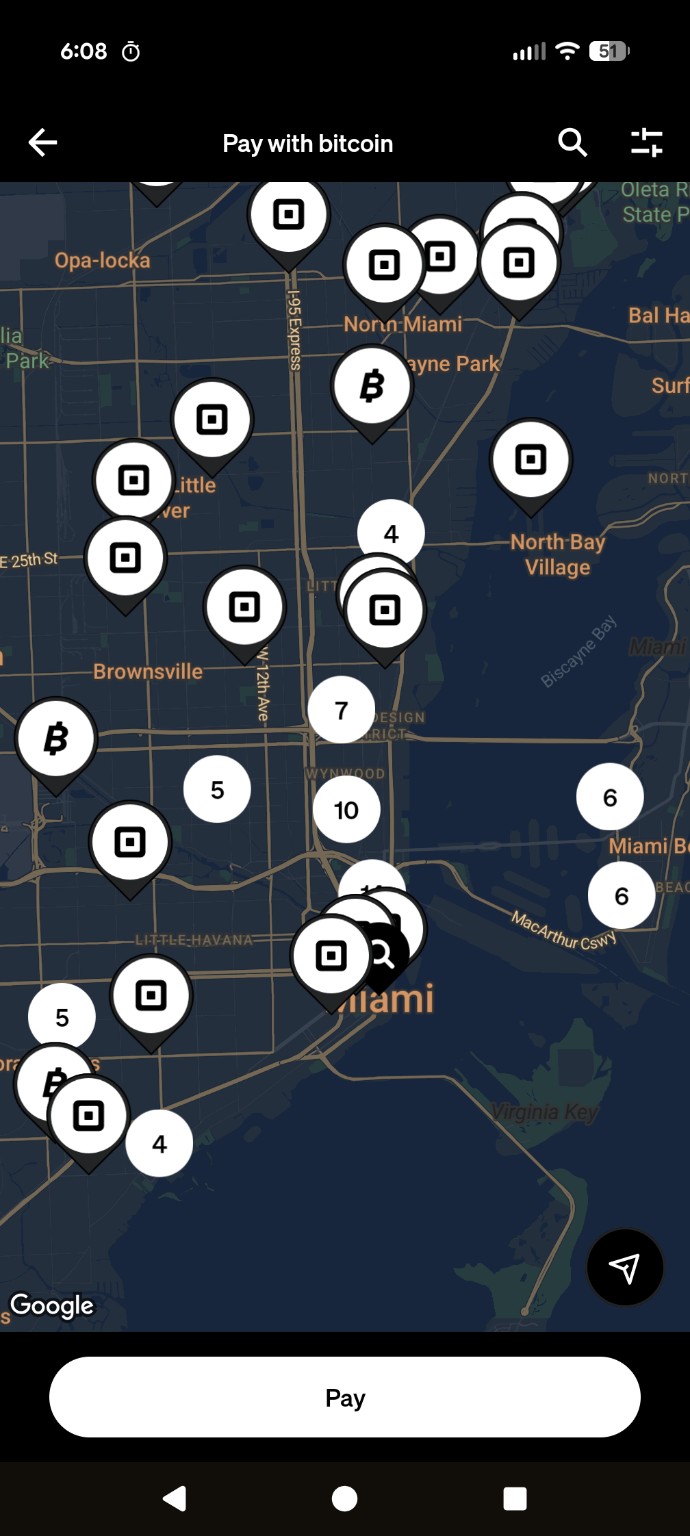
I opened the Bitcoin map inside Cash App today.

Then I opened https://btcmap.org.

Both maps showed the same thing.

A large number of businesses.

Restaurants, shops, and local services spread across the city.


For a long time, the common assumption has been that Bitcoin is mostly held, not used.

But when you look at these maps, that assumption becomes harder to maintain.

These are not theoretical use cases.

They are physical businesses that have made the decision to accept Bitcoin as a form of payment.


What Happens When a Business Accepts Bitcoin

When a business enables Bitcoin payments, something else happens at the same time.

It gets listed.

On Cash App, it appears on the local Bitcoin map.
On BTC Map, it becomes part of a global directory.

In both cases, the business becomes easier to find.


A Different Type of Customer

Most marketing is broad.

Businesses advertise and hope the right customer eventually sees it.

These maps work differently.

Someone opening a Bitcoin map is already looking for a place to spend.

That is a narrower and more specific type of demand.

The business is not trying to attract attention.

It is being surfaced directly to someone who is already interested.


A Small but Growing Effect

Each individual business making this decision is not a major event.

But the pattern is noticeable.

A few businesses appear.
Then a cluster forms.
Then an area becomes dense.

That pattern shows up on both maps.


Larger Businesses Are Starting to Participate

This is not limited to small or experimental businesses.

Steak ‘n Shake now accepts Bitcoin.

That does not mean universal adoption is imminent.

But it does suggest that accepting Bitcoin is moving from the edge toward something more normal.


Why Early Adoption Matters

There is a practical advantage to being early.

When fewer businesses are listed:

  • Each one is more visible
  • Each one stands out more clearly

As more businesses adopt, that visibility becomes more diluted.

This is true for most discovery platforms.


A Simple Takeaway

Bitcoin adoption is often discussed in abstract terms.

But these maps show something more concrete.

Businesses are choosing to accept it.
And when they do, they become easier to find.

That is a small change at the individual level.

But repeated many times, it starts to look like a system forming.


Final Thought

You do not need to assume that Bitcoin will replace existing systems to notice what is happening.

You can simply open a map and observe:

Businesses are adopting it.

And the ones that do it earlier are easier to see.

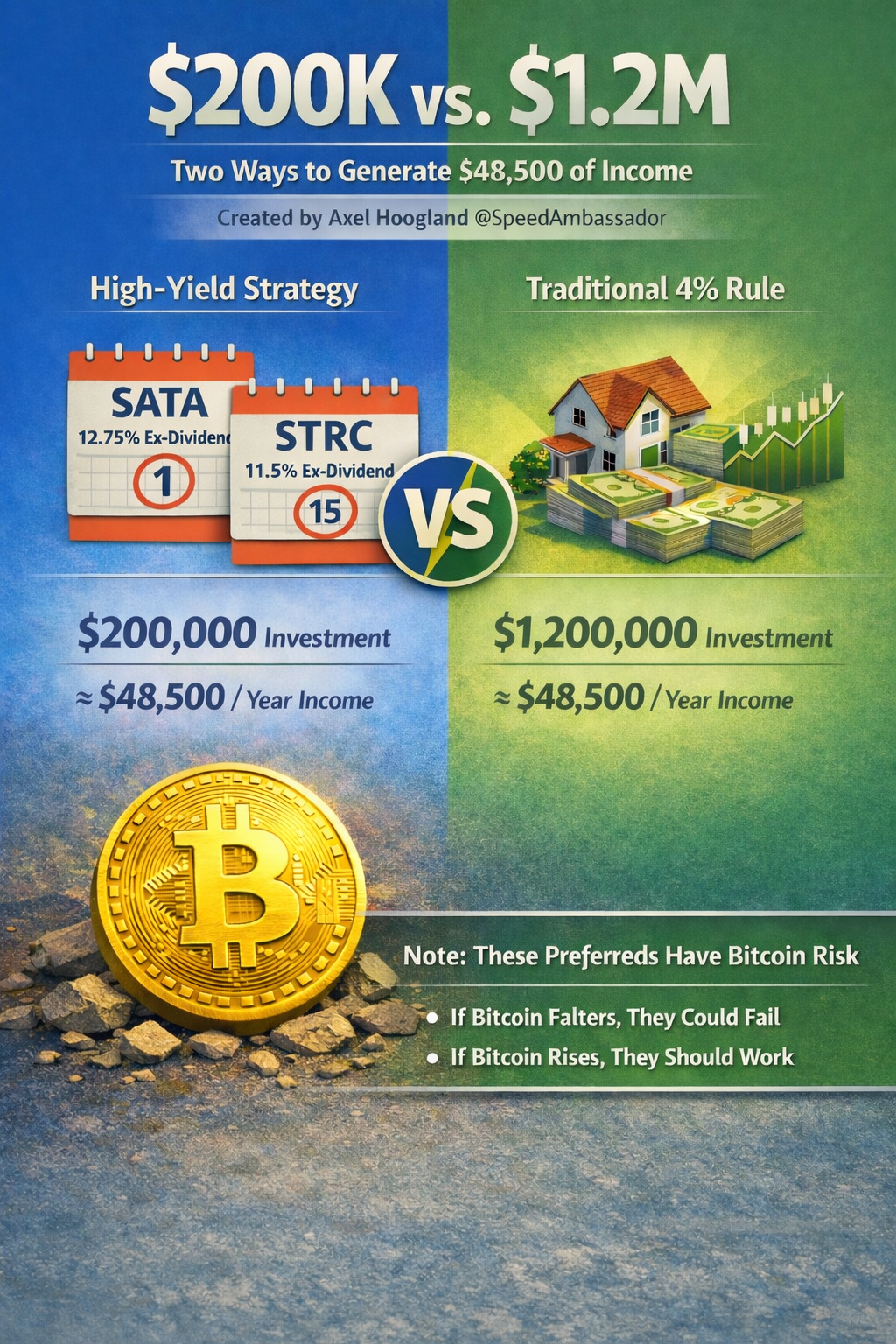
$200K vs $1.2M: A SATA + STRC Thought Experiment on Reaching F.I.R.E.

For years, the standard framework for retirement income has been the 4% rule.

The idea is simple: if you want $48,500 per year of spending, you would typically need roughly:

$48,500 × 25 = $1,212,500

In other words, about $1.2 million invested in a diversified portfolio to sustainably withdraw that income.

But recently I came across an interesting thought experiment involving two relatively new preferred securities.

Before diving into the math, it’s important to note that these securities ultimately sit within financial structures connected to Bitcoin, so they carry some exposure to the long-term success of Bitcoin itself. More on that later.


Two High-Yield Preferred Securities

Two securities caught my attention:

  • Strategy Series C Preferred (STRC) – currently yielding about 11.5%
  • Strive Asset Management Preferred (SATA) – currently yielding about 12.75%

Both are preferred securities issued by companies building financial products around Bitcoin treasury strategies.

An interesting feature is their dividend timing.

  • STRC has an ex-dividend date around the 15th of the month
  • SATA has an ex-dividend date around the 28th of the month

The actual cash payment arrives roughly 15 days later, but what matters for dividend eligibility is simply holding the shares on the ex-dividend date.

After that date passes, an investor can sell the shares and still receive the dividend.


The Rotation Idea

Because the ex-dividend dates occur at different times of the month, a strategy some investors discuss is rotating between the two securities:

  1. Hold STRC through its ex-dividend date (~15th)
  2. After the ex-date passes, sell and move into SATA
  3. Hold SATA through its ex-dividend date (~28th)
  4. Then rotate back to STRC and repeat

In theory, this rotation attempts to capture both dividend streams each month.


The Yield Math

Using approximate yields:

SATA: 12.75%
STRC: 11.5%

Combined:

12.75% + 11.5% = 24.25%

If an investor pays roughly 24% tax on the income:

24.25% × 0.76 ≈ 18.4% after tax

That’d give this investor $18,400 per a year income on $100k or $36,400 per a year on $200k.


The Early Retirement Thought Experiment

Suppose an early retired investor allocated $200,000 to this strategy.

At a 24.25% gross yield, the income would be:

$200,000 × 0.2425 = $48,500 per year

Under the traditional 4% rule, producing that same income would require:

$48,500 × 25 = $1,212,500

So the comparison looks like this:

StrategyCapital Required
Traditional 4% rule~$1.2 million
Preferred rotation idea~$200,000

That’s roughly a 6× difference in required capital.


Even More Interesting for Early Retirees

For some early retirees who structure their income carefully, qualified dividend income can fall within the 0% federal tax bracket.

In that scenario, the full 24.25% yield could theoretically flow through without federal income tax.

Using the same $200,000 example:

InvestmentYieldAnnual Income
$200,00024.25%$48,500

That level of income could cover a meaningful portion of living expenses for many households.


The Bitcoin Connection

It’s important to understand what ultimately sits underneath these securities.

Both STRC and SATA are part of financial structures built around companies holding significant amounts of Bitcoin on their balance sheets.

At the base of these preferred securities is therefore some degree of Bitcoin risk.

If Bitcoin were to fail as an asset class entirely, the underlying business models supporting these preferreds would likely fail as well.

However, if Bitcoin continues to grow and remain valuable over time, these structures should continue to function as designed.

It is also possible that as demand for these types of securities increases, the dividend yields could gradually decline. Markets tend to compress yields when large numbers of investors compete for the same income-producing assets.

So the yields discussed above should be viewed as the current state of the market, not necessarily a permanent condition.

Finally there is company risk. Strive (ASST) issues SATA and Strategy (MSTR) issues STRC. Either company could fail for some generic business reason and that woudl also be a risk, just like any business.


Final Thoughts

For decades, the 4% rule has been a useful guideline for thinking about retirement income.

But financial markets are constantly evolving, and new structures occasionally appear that change the math in interesting ways.

This rotation idea may or may not prove durable over the long run. But it highlights how emerging financial instruments—especially those tied to Bitcoin treasury strategies—are beginning to create entirely new types of income assets.

And sometimes, when you run the numbers, it’s worth pausing and asking:

Could the future of income investing look different than the past?

As of 3-16-2026 I started an account to do this specifically. I will share the results in a few months or at the end of the year to see how it’s gone and if anything has changed since I started this experiment.

All prices in the below table are per share. multiple the # shares x any price to get the total amount. I started with 10x $97.22 = $972.20 and a purchase of 10 shares of SATA. I borrowed money for this experiment from a HELOC at a rate of 6.25% starting.

4-9-2026 I borrowed another $1k and purchased $2k of STRC. As of this date my current plan is to work up to $12k invested with this test.

$12k x (.1275+.115) = $2,910/year in dividends.

$2910x 22% tax = $640.20 in taxes

$12,000 x 6.25% interest loan = $750

$2910-$750-640.20 = $1,519.80/year income.
If i have to make 4 trades (2x/month + 2x sell/month) x 12 months = 48 trades/year, if the trades each toook 1 hour, which they ceratinly do NOT, but hypotentically $1,519.80/48 = $31.66/hour, if you wanted to compare this back to a wage job. Since it’s completely borrowed money and not my standard cash I think this is useful comparison to determine if this is worth the time. This also scales more $/hr with more money as the amount of time to trade 100k shares vs 10 shares should be the same. As the market matures I will continue to learn more about this.

None of this takes into account buying STRD every 3rd month instead of STRC to get a 3 month quarterly payout vs the monthly STRC payout. I will be doing that in June 2026 and keeping track of that data here also. That should significatinly improve all the metrics, in theory. Adding STRD every 3rd months will hypothetically add 13% return to the total plan. But you have to subtract 1/4 of the 11.5% since you are missing a monthly STRC payout so 11.5%/4 = 2.875% so 13% – 2.875% ~ 10% added on top. So at $12k/year x 10% = $1,200 which is about as much as the total previous plan! adding that in

(.10+.115+.1275) = 0.3425 *$12k =$4,110 x .22 tax = $904.2 taxes

the same loan applies though $12,000 x 6.25% interest loan = $750

so $4,110-$904.20-$750 = $2455.80 vs $1,519.80 for a total final increase of $936 / $12k =7.8% real improvement. and $2455.80/48 hrs = $51.16 /hr.

We will see in 12 months if this is working!

$12k also makes sense for me as it is <1% of my net worth. So I wouldn’t be in a catastropic position if this failed. Risk/reward should be considered for anyone doing anything like this. Do your own research. Not Financial advice.

4-28-2026 https://www.strategy.com/strc/vote

Proposing to Pay STRC Dividends Semi-Monthly
Strategy is proposing to pay semi-monthly dividends on STRC, instead of monthly. If approved and adopted, we believe this would lead to reduced reinvestment lag, enhanced liquidity, market efficiency, and increased price stability.

Proposed Amendment Timeline
April 17: Preliminary Proxy Filed
April 28: Definitive Proxy Filed(1) Voting Opens
June 8: Meeting Date Voting Completes
June 30: First Record Date under New Cadence(2)
July 15: First Payment Date under New Cadence(2)

STRC is planning to pay 2x / month. This would be good for the stability of STRC. But it would make it harder to do this strategy of moving between the 2 stocks, STRC and STRD each month.

Also in the month of April my purchase of STRC (20 shares) happened at $100/share but selling was $99.50 for a loss of $0.50/share. The dividend should be $0.96/share for a profit of $0.46 but that is still a lot below the goal. We will see in a couple days how this plays out. SATA is also discussing going to semi monthly payouts. If both were doing semi monthly on alternating weeks it might still allow the rotation but with 2x the work. The price might be more stable. I will continue this experiment for some time further.

5-14-2026 – SATA (Strive) has come out with the plan to pay DAILY dividends. This is a huge idea but also negates this rotation strategy. I will hearby cancel this rotation strategy for these dividends. It seems it wasn’t particualry successful since the stocks were falling and not quite recovering during the time needed to buy back for the next stock.

Stock# sharesDate PurchasedDate SoldPurchase Price Sell Priceprice appreciationDividend PD Dateloan interest rateDividend
SATA103-16-264-1-26$97.2297.89+$0.674-15-266.25%$10.63
STRC204-9-20264-28-2026$100.005$99.50-$0.504-30-266.25%$19.17
SATA204-29-26$99.976.25%

This article is for informational purposes only and should not be considered investment advice.

Calling MSTR a Ponzi Scheme Shows a Fundamental Misunderstanding of Finance

Understanding Ponzi schemes, Bitcoin carry trades, and how new financial instruments are evolving

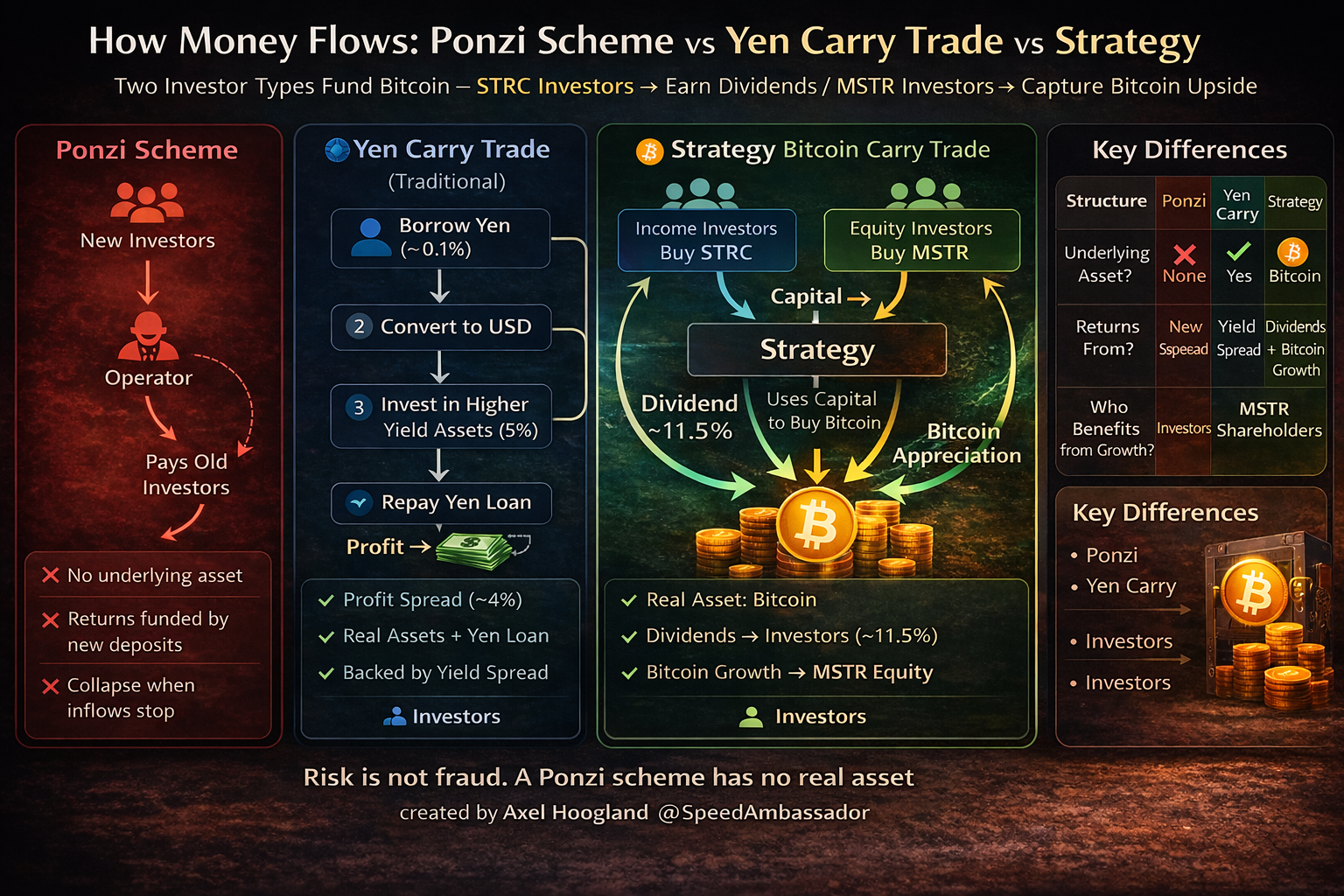
Recently there has been a wave of posts online claiming that MicroStrategy and securities like STRC are “Ponzi schemes.”

That claim misunderstands both what a Ponzi scheme actually is and how these instruments work.

Before labeling something a Ponzi scheme, it helps to start with a clear definition.


What Is a Ponzi Scheme?

A Ponzi scheme is a fraudulent investment structure where:

  1. Investors are promised returns
  2. Those returns are not generated by real economic activity
  3. Early investors are paid using money from new investors
  4. The scheme collapses once new inflows stop

The defining characteristics are:

  • No real underlying asset
  • No productive activity generating returns
  • Fabricated account statements or hidden losses
  • Mathematical collapse once new money stops coming in

The most famous example is Bernie Madoff, who fabricated account balances while paying existing investors with money from new clients.

If there is no real asset and no real economic activity, you may be looking at a Ponzi scheme.


An Interesting Contrast: Social Security

Ironically, one of the closest structures many Americans participate in that resembles a Ponzi-style payment system is **Social Security Administration’s Social Security program.

Social Security works by:

  • taxing current workers
  • using those taxes to pay current retirees

There is no large invested pool backing the system. Instead, it relies on a continuous stream of new contributors to fund previous participants.

Government projections show the trust funds are expected to become depleted within the next decade, after which benefits would have to be reduced or taxes increased to maintain payouts.

This is not fraud — it is a demographic funding system created by law — but it illustrates an important point:

Money flowing from new participants to previous participants does not automatically make something a Ponzi scheme.

A Ponzi scheme specifically requires deception and fake returns.

Now let’s look at MicroStrategy.


What MicroStrategy Actually Does

MicroStrategy is a publicly traded company that:

  • issues equity and debt securities
  • uses the proceeds to purchase Bitcoin
  • holds that Bitcoin on its balance sheet

The underlying asset is Bitcoin, which is publicly verifiable on the blockchain.

Investors buying MicroStrategy securities know exactly what they are purchasing.

Nothing is hidden.
Nothing is fabricated.
The underlying asset exists and can be independently verified.

You may disagree with the strategy.

But it clearly does not meet the definition of a Ponzi scheme.


What STRC Actually Is

STRC is a preferred stock issued by MicroStrategy that pays a monthly dividend currently around 11.5% annually.

The capital raised from selling STRC is used to purchase additional Bitcoin.

Conceptually, the structure resembles a carry trade.


A Bitcoin Carry Trade

For decades global investors used the Yen carry trade.

The strategy worked like this:

  1. Borrow Japanese yen at extremely low interest rates
  2. Convert yen into higher-yielding assets (often U.S. dollars)
  3. Capture the yield difference

STRC works in a somewhat similar way — but with Bitcoin.

Instead of:

Yen → USD

The structure is effectively:

USD → Bitcoin

Investors provide capital and earn roughly 11.5% yield, while MicroStrategy accumulates Bitcoin.


What the Market Has Actually Shown

STRC began trading in July 2025.

Around August 2025, Bitcoin traded near $120,000.

Since then Bitcoin has experienced significant price volatility.

Yet STRC has generally continued trading near its $100 reference price.

That doesn’t prove the structure will work forever.

But it does show something important:

So far, the instrument has functioned roughly as designed.

Financial markets tend to expose broken structures quickly.


The Lindy Effect

There is a concept known as the Lindy effect.

The Lindy effect suggests:

The longer something survives, the longer it is likely to continue surviving.

We see this with technologies, institutions, and financial instruments.

Gold has survived thousands of years.
Stock markets have survived more than a century.
Bitcoin itself has now survived multiple boom-bust cycles.

Each month that STRC:

  • maintains its price near $100
  • pays its dividend
  • continues operating normally

…the probability that the structure works increases slightly.


What Are the Real Risks?

None of this means STRC or MicroStrategy are risk-free.

But the risks are often misunderstood.

The real risks are tail risks — low-probability but high-impact events.

For example:

1. Catastrophic failure of Bitcoin

If Bitcoin were somehow fundamentally broken — a critical cryptographic flaw, catastrophic protocol failure, or a coordinated global ban that destroyed liquidity — the entire thesis behind MicroStrategy’s balance sheet would be undermined.

2. Corporate catastrophe unrelated to Bitcoin

Another possibility would be some major event affecting the company itself:

  • fraud inside the company
  • regulatory disaster
  • management misconduct
  • or some unforeseen corporate collapse

These risks exist for every public company.

3. Extreme financial system disruption

In a severe financial crisis, credit markets can temporarily freeze. Any company that relies on capital markets — including MicroStrategy — could be affected.


Risk Is Not Fraud

The irony in many of these debates is that the word “Ponzi” often gets used as a general insult for anything people don’t understand.

Real Ponzi schemes involve deception, fake assets, and fabricated returns.

MicroStrategy and STRC involve transparent securities backed by a publicly verifiable asset.

Whether someone believes in Bitcoin or not, the structure is visible to everyone.

In fact, one of the broader trends of the past decade has been the opposite of a Ponzi scheme: systems where the underlying asset is more transparent than ever before.

Bitcoin’s supply is public.
Bitcoin’s transactions are public.
Bitcoin’s monetary policy is fixed.

Financial instruments like STRC are simply new ways that traditional capital markets are interacting with that asset.

You may think the strategy is aggressive.
You may think the trade will fail.

But the difference between risk and fraud still matters.

And confusing the two only makes it harder to understand what is actually happening in financial markets today.

The $2K Stimulus, the 50-Year Mortgage, and the Fiat Trap

Why Americans Deserve Better — and Why Bitcoin May Be the Only Way Out

President Trump recently proposed a $2,000 payment to every American, excluding “high-income individuals.” The idea sounds generous, but it’s also a symptom of a much deeper disease: a government that spends money it doesn’t have—causing inflation in the process and actually hurting the very people who receive the payment.


The Math Behind the Madness

In 2024 alone, the U.S. government ran a $1.8 trillion deficit.
Let’s put that in perspective:

  • There are 128 million households in the United States.
  • There are 340 million individuals.

If we divided that $1.8 trillion evenly, that’s $14,000 per household or $5,294 per person.

So when politicians talk about sending you a one-time $2,000 check, remember — they’re already spending about 2.5 times that amount per person every single year.
If the government simply stopped wasting and borrowing, you’d already be thousands of dollars richer annually — without a single new program or “stimulus.”

That’s money our government already spent—above and beyond the taxes you and I pay. It wasn’t earned. It was created out of thin air by the Treasury and the Federal Reserve. Every time that happens, the dollars in your wallet become worth a little less. That’s why groceries, cars, and homes cost more every year, no matter how hard you work.


The Mirage of the 50-Year Mortgage

Now the U.S. housing authorities are exploring 50-year mortgages, following the path of Japan and even some European countries.
Japan went so far as to experiment with 100-year mortgages, often passed from parents to children. Did that make homes more affordable? No—it made them more expensive.

When you stretch the loan term, monthly payments drop slightly, but total debt rises massively. Sellers raise prices to match what buyers can “afford” on paper. The result: higher prices, higher leverage, and lifelong debt servitude.

The 50-year mortgage is not a solution. It’s an illusion. It’s another way to avoid facing the real issue: our monetary system rewards debt and punishes saving.


Where Does the Money Go?

When we spend $1.8 trillion more than we take in, where does it all go?

  • To foreign wars and endless “operations” that rarely make Americans safer.
  • To subsidies and bailouts for politically favored industries.
  • To bloated bureaucracies that exist to perpetuate themselves.
  • To interest payments on the national debt—now one of the largest single line items in the federal budget.

Meanwhile, our manufacturing jobs were shipped overseas, first to Mexico and China, now to Vietnam and India. Communities that once built real wealth are hollowed out. Young people drown in debt while imported goods fill our stores. The average American is left with higher prices, lower stability, and fewer ways to build lasting capital.

Why does this keep happening? It’s not just bad policy — it’s baked into the structure of the global financial system.
Because the U.S. dollar is the world’s reserve currency, foreign countries must hold dollars to trade internationally. That means America must constantly send dollars abroad — through trade deficits and offshored production — to supply the world with liquidity.

This is known as the Triffin Dilemma: to maintain the dollar’s global dominance, the U.S. has to export jobs, import goods, and print money. It’s a system that benefits global finance, not the American worker.


A Balanced Budget Is Not Just Accounting — It’s Freedom

If the U.S. government lived within its means, you’d instantly gain purchasing power. Prices would stabilize, wages would go further, and the value of your savings would stop eroding.
You wouldn’t need a $2,000 stimulus check—because your dollar would already be strong.

The truth is simple: either we live within our means voluntarily, or reality will force us to.

Now, to be fair, we probably can’t slash spending overnight without causing serious shock to the economy. But we don’t have to.
What if we simply froze federal spending at 2025 levels and let tax revenue grow naturally with the economy? Within a few short years, the budget would balance itself—no chaos, no default, just discipline.

That’s not austerity. That’s responsibility.
And it’s the only peaceful way to restore faith in the dollar while keeping it as the world’s reserve currency.
The other option—the one emerging whether Washington likes it or not—is Bitcoin.


Bitcoin and the End of Fiat Illusion

“I don’t believe we shall ever have a good money again before we take the thing out of the hands of government, that is, we can’t take it violently out of the hands of government, all we can do is by some sly roundabout way introduce something that they can’t stop.”
— F.A. Hayek

Some believe there’s only one peaceful way out of this cycle: a return to sound money—money that cannot be printed at will.

That’s what Bitcoin represents.
It’s not a speculative token or a tech fad—it’s a monetary rebellion against endless inflation, debt-based growth, and political manipulation of money. In a Bitcoin world, politicians can’t quietly steal your savings through inflation. They must tax you honestly or spend less.

That’s accountability.
That’s discipline.
That’s freedom.

Even some in government see this potential. Senator Cynthia Lummis has proposed that the United States create a strategic Bitcoin reserve, allowing America to hold a real, non-inflationary asset on its balance sheet.
That move alone could begin rebuilding trust in the U.S. financial system—and might be the only peaceful way out of this mess.


My Message to Congress

If you truly want to help Americans:

  • Stop using debt as a crutch for broken policy.
  • Reject gimmicks like 50-year mortgages that only inflate prices.
  • Commit to a balanced budget and an honest monetary system.
  • Bring back real production, not financial engineering.
  • End foreign interventions that waste our treasure and divide the world.
  • Support sound money legislation like Senator Lummis’ Bitcoin reserve proposal.

Let the American worker, saver, and builder rise again—on a foundation of real value, not printed promises.


My Message to Every American

Don’t wait for Washington to fix this.
I urge you to learn about the problems with fiat money—how inflation quietly steals your time, labor, and savings—and to understand why Bitcoin solves these problems at their root.

The path forward is clear: either reform the dollar through fiscal discipline, or transition to a world built on honest, decentralized money.
The choice is ours—but the clock is ticking.


Send This Letter to Your Representatives

If this message resonates with you, copy the following text and send it to your senators and congressperson. You can find their contact info at https://www.congress.gov/members.


Subject: Support Fiscal Responsibility and Sound Money

Dear Senator/Representative,

I’m writing to express my concern about the growing national debt, inflation, and the policies that continue to devalue the U.S. dollar. In 2024, the federal deficit was $1.8 trillion—equal to roughly $14,000 per household. Instead of one-time stimulus checks, we need a long-term commitment to balanced budgets and sound money.

Please support policies that:

  • Freeze federal spending at 2025 levels until tax revenue naturally balances the budget.
  • End inflationary monetary expansion that hurts working Americans.
  • Reject 50-year mortgages and other short-term “fixes” that only inflate asset prices.
  • Support legislation like Senator Cynthia Lummis’s proposal for a Bitcoin strategic reserve, ensuring the United States has a sound, non-inflationary store of value.

Fiscal responsibility and sound money aren’t partisan issues—they’re American values.

Sincerely,
[Your Name]
[Your City, State]


Spain’s Silver, Japan’s Bonds, America’s Deficits: Why Easy Money Kills Real Work And Hollows Out The Middle Class


(inspired by this episode of Bitcoin for Millennials)

Big idea: Spain found a mountain of silver in Bolivia, spent like crazy, stopped building real industries—and the bill came due. The same thing is happening today, just with money printers instead of mines.


1) The mountain

In 1545, Spanish explorers struck the richest silver deposit in history: Cerro Rico, “the rich mountain,” in what’s now Bolivia.
A city called Potosí exploded out of the rock. At its height, it was larger than London or Paris.
For two centuries, roughly two-thirds of the world’s silver came from that one mountain. Spain looked unstoppable.


2) Easy money, hard problems

So much silver poured into Europe that prices began rising year after year.
For nearly a thousand years, prices in Europe had been flat. Then suddenly, everything—from bread to rent—started costing more.
Historians call it the Price Revolution.

Spain thought it was getting richer. In reality, its silver was just buying less and less.


3) The addiction loop

Spain borrowed against future silver shipments, funded endless wars, and built palaces to show off its power.
Sound familiar? Borrowing against your future is exactly what modern governments do when they run deficits every single year—financing today’s comfort with tomorrow’s labor and taxes.
And those “endless wars”? Spain fought them across Europe. The U.S. fights them across the globe. Different century, same playbook.


4) “Free” silver, “free” money

The silver was basically free to Spain—mined with forced labor that cost almost nothing.
That “free” flow of money metal fueled reckless spending and inflation.

Today, printing money is even freer. No mines, no ships, no workers—just a digital entry at the central bank.
But the result is the same: more money chasing the same goods, rising prices, and wealth concentrating in financial assets instead of productive work.


5) The wage spiral

When silver poured into Spain, mining and trade paid far more than farming or manufacturing.
Workers chased the high wages, and everyone else demanded raises to keep up.
That wage inflation pushed up local costs across the board.

It soon became cheaper to buy foreign goods than to make them at home.
English and Dutch craftsmen could undersell Spanish products even after shipping them across the sea.
Local factories and farms couldn’t compete. Spain’s economy drifted from production to consumption—spending instead of building.

You can see the same thing happening today.
Money printing and easy credit inflate salaries in finance, tech, and government while driving up housing, energy, and labor costs everywhere else.
Manufacturing can’t keep up, so we import the difference.
The result? A strong currency, cheap goods, and a shrinking middle class.


6) The next chapter — Japan

What if the next Spain isn’t America yet—but Japan?
As this interview with macro analyst Roberto Rios explains, Japan is further down the same path:
zero interest rates, quantitative easing, and government debt so large that the central bank must choose between saving its currency or saving its bond market.

For decades, Japan has printed money to prop up its financial system, even buying stocks outright to keep prices from falling.
That free liquidity created an illusion of stability—until inflation returned and the yen began collapsing.
Now Japan faces the impossible choice every over-leveraged empire eventually faces:
protect the currency and crash the system, or print the money and destroy the currency.

It’s the same dilemma America is approaching, just delayed by our global reserve-currency privilege.
The “free silver” of the 1500s became “free paper” in the 1900s and “free digital dollars” in the 2000s. The pattern never changed—only the technology did.


7) The simple lesson

Resources aren’t wealth. Printing money isn’t wealth. Making things is wealth.
When prosperity feels “free,” it’s usually borrowed from the future.


8) Today’s echo

Easy credit. Quantitative easing. Deficit spending.
Each promises painless prosperity—more liquidity, more growth, no trade-offs.
But it’s the same story Spain wrote 500 years ago: short-term abundance, long-term decay.

Spain’s “free” silver built an empire that rotted from within.
Japan’s “free” money is imploding quietly.
And America’s “free” dollar is next in line—just with better branding and digital ink instead of metal.


9) Bitcoin and the Dollar Endgame

What if Japan’s collapsing bond market isn’t just a regional crisis but a preview of America’s financial future?

In the Bitcoin for Millennials episode, host Bram talks with macro analyst Roberto Rios (“Peruvian Bool”), who has been tracking this “dollar endgame” for years.
While most people fixate on Bitcoin’s short-term price swings, Rios zooms out to the structural problem: every central bank is trapped between saving its currency or saving its bond market. Japan is simply the first to hit the wall.

He calls this dynamic financial gravity—the idea that once debt and money creation expand far enough, gravity pulls everything toward a neutral asset that can’t be printed.

Rios’s core argument:

  • The global monetary system has reached a point where debt can never shrink; it can only be monetized.
  • Central banks will print until confidence breaks.
  • When trust in both sides of the fiat balance sheet—bonds and currencies—collapses, capital will flee into something outside the system entirely.

That’s where Bitcoin enters the picture.

While central banks and institutions still view gold as the “neutral” reserve, Rios argues Bitcoin is the superior version of gold:

  • Fixed supply, instantly verifiable, infinitely divisible.
  • Borderless and digital—no vaults, shipping, or intermediaries.
  • Immune to political capture or forced demand (“fiat” in the literal let-there-be sense).

As he puts it, the Japanese bond crisis could actually trigger the biggest Bitcoin bull run ever.
Once Japan’s carry trade unwinds and the yen weakens further, global liquidity shocks will push central banks to print again—reviving the same inflation loop that began with Spain’s silver.
Each cycle of monetary rescue drives more people to seek an exit from the system itself.

From silver to paper to code:
Spain’s “free” silver created Europe’s first inflation.
Japan’s “free” money is collapsing under its own weight.
Bitcoin is the gravity well everything eventually falls into.