
Bitcoin Only Goes Up (And Other Things I’ve Never Said) -The Long Case for Bitcoin’s Endpoint

Podcast Episode: Bitcoin Only Goes Up (And Other Things I’ve Never Said) -The Long Case for Bitcoin – An experimential auto generated podcast based on this post. Just trying things!

I have a friend who likes to needle me. Every time Bitcoin comes up, he says: “Bitcoin only goes up.”

I have never said that. Not once. What I actually say sounds nothing like it.

Only invest what you can leave invested for at least five years.

That one isn’t even Bitcoin advice. It’s how I think about any position I take. Money you might need in two years has no business in an asset that can move 40% in a quarter. That has nothing to do with Bitcoin specifically — it’s just the difference between investing and gambling with a deadline attached.

Invest only what you can afford to lose. Assume it’s going to zero.

Expect it to drop 50% tomorrow. If you wouldn’t be fine with that, don’t invest in Bitcoin.

Read those again and notice what they have in common. Every single one leads with the downside. Assume zero. Assume the crash. Assume you might need the money before it works. That is the opposite of “only goes up.” My friend is mocking a position I’ve never held. The naive bull says the price can’t fall. I say plan for it to fall, size accordingly, and only then talk about the upside.

So let’s talk about the upside — because there is one, and it’s the whole point.

I expect Bitcoin to reach $13 million per coin, in today’s dollars, which means you don’t need to risk much to get an outsized return.

This is where people assume I’ve quietly rejoined the “number go up” crowd. I haven’t. That figure is not a moon target. It’s the output of an assumption, and it has a ceiling.

The upside is capped — and that’s a feature

Bitcoin’s price isn’t set by hope. Over a long enough horizon it’s set by how much monetary premium it pulls away from other assets — the portion of gold, bonds, real estate, and cash that people hold not to use, but simply to store value across time.

That pool is enormous, but it is finite. There is only so much store-of-value wealth in existence to migrate. Divide the share you think Bitcoin absorbs by a supply that is fixed at 21 million coins, and you get a price. At $13 million per coin, the whole network is worth on the order of $270 trillion in today’s dollars — a large fraction of global store-of-value wealth, but a fraction. Change your assumption about how much premium migrates and the number moves. What the number cannot do is run away to infinity.

Bitcoin cannot be worth a quadrillion dollars per coin in today’s dollars. There isn’t that much monetary premium on Earth to absorb. So the upside is bounded — not by sentiment, but by arithmetic. That’s what makes it a bet worth sizing carefully rather than a lottery ticket: capped, known downside on one side; a large but calculable ceiling on the other.

I’ll admit the timeline is the soft part. It might take 15 or 20 years to get there. But here’s the thing most people miss — they already have that long. They’re saving for retirement anyway. They’re going to wait thirty years regardless. If you’re already waiting, waiting a little longer in an asset with this asymmetry costs you almost nothing and could change the outcome entirely.

Where the price comes from right now

None of that describes today’s price. Today’s price is driven by sentiment and speculation. It’s reflexive — it goes up because it’s going up, and down because it’s going down. That’s not a flaw I’m hiding; it’s just what the price is in this phase.

Underneath the speculation is a floor, and the floor is driven by adoption. The people who buy every week regardless of price — the DCA crowd, people like me — don’t chase the euphoric spikes. We can’t set the top. But steady, price-insensitive buying does set a base. Historically that base has tracked something like the 200-week moving average: far below the manic highs, and Bitcoin has spent very little of its life beneath it. I won’t call it a guaranteed floor — the 2022 bear market pierced it by roughly 25% for a few months, so it’s a gravity zone, not a law of physics — but the mechanism is real. Persistent buyers put a bid under an asset that speculators periodically abandon.

So the two prices live at once: the euphoric price sentiment prints on the way up, and the adoption price the steady buyers can actually defend. The gap between them is the volatility everyone’s afraid of.

The part nobody wants to hear

Most people never engage with any of this, and I understand why. They have more immediate concerns — rent, childcare, the next paycheck. Monetary theory feels like a luxury when you’re focused on this month.

But here’s what I’d gently point out: a lot of the immediate concerns are downstream of the money itself. Asset prices outrunning wages, so a house costs more years of labor than it did for your parents. Savings that quietly lose ground every year you hold them. A whole economy pulled toward the short term because holding cash is a slow leak.

That last one has a name: time preference — how much you value having something now versus later. When your money holds its value, when a dollar saved today still buys as much in twenty years, the rational move is to defer, save, and build things that pay off slowly. Good money lowers your time preference; it makes patience pay. Debased money does the reverse. When every dollar you hold is quietly bleeding out, saving becomes a mistake and spending now becomes the smart play. That raises time preference across an entire society — and a high-time-preference society stops building for a future it no longer trusts its money to reach. Shorter horizons, thinner savings, more debt, less patience, less long-term anything. You can watch it happen without ever naming the cause.

People point at these problems and blame a dozen other things. Many of them trace back to a money that can be expanded at will. Most people never make the connection, because the tax is invisible — it doesn’t show up as a line item, it shows up as a life that costs more than it should.

You don’t have to accept the whole worldview to notice the mechanism. That’s all I’m asking anyone to do: notice it.

The long-term vision

Here’s where I think this goes.

Bitcoin is in a monetization phase. An asset that starts with no monetary value and slowly acquires it doesn’t move in a straight line — it moves in violent, speculative waves, because the market is arguing, in real time, about what it’s worth. That argument is the volatility. Every cycle, a little more of the monetary premium gets absorbed and becomes permanent. The floor rises. The speculative froth on top gets smaller relative to the base underneath it.

The endpoint isn’t a number screaming upward forever. The endpoint is boring. As the market cap grows and the premium fills in, the swings compress. The thing that today feels like a rollercoaster settles into a savings technology — something you hold the way earlier generations held land or gold, without checking the price every morning. The speculators leave because there’s no longer a fast trade in it. What’s left is money that holds its value across decades because no one can print more.

When that happens, the adoption price and the market price finally converge. There’s no more gap for volatility to live in. Bitcoin stops being a bet and becomes what it was always trying to be: a place to put the economic energy you earned this year and get it back, intact, in twenty.

And there’s a symmetry worth sitting with. The people who understand this early are the ones who get the outsized return — but they’re also the ones building the floor. Every steady buyer accumulating through the fear is being paid for being early and pulling the endpoint closer. The adoption that eventually makes Bitcoin boring is the same adoption that makes it valuable now. So early understanding is rewarded twice: once in your own return, and once in how much sooner the whole thing arrives. You’re not just front-running the monetization — you’re part of it.

And when it arrives, the question itself changes. Today everyone asks what one Bitcoin is worth in dollars, because dollars are the measuring stick. The endpoint is where the stick flips. You stop asking how many dollars your Bitcoin is worth and start asking what it buys — and under a money that can’t be printed, that answer grows every year instead of shrinking. As the world gets more productive, things get cheaper measured against a fixed supply. Your savings don’t just hold their ground; they quietly buy more of the world each year you leave them alone.

That’s the actual invitation. Not get rich in dollars and cash out — help build the thing that makes “cash out” a strange idea, because the money is finally worth keeping. Every person who understands it early pulls that day closer for everyone else.

That’s the whole thesis. Not “it only goes up.” It goes up and down violently, for now, for a reason — and the reason ends. Plan for the down. Size for the zero. And understand that the volatility scaring everyone off is simply the price of being early to something that intends to become boring.

I’ve never said Bitcoin only goes up. What I say is less comforting and more useful: assume the worst, size for it, and let the math do the rest. But once the downside is handled, you’re free to look past the price at what’s being built — a money that can’t be debased, savings that buy more each year instead of less, a future that arrives a little sooner every time one more person understands it. That’s the part worth joining. Not the trade — the thing on the other side of it. It’s early, and there’s room. Come help build it.
The Patience Subsidy -Destin Sandlin’s Smarter Scrubber, “made in America,” and the fiat-money problem the video skips

Destin Sandlin (Smarter Every Day) just put out a follow-up to his “can you make a grill scrubber entirely in America?” project, and it’s worth your time: Still Trying to Make it in America . It’s a great engineering story, and an unusually honest one about how hard reshoring actually is. What follows isn’t a rebuttal — it’s the two layers I think the video stops just short of.

Destin Sandlin’s second grill-scrubber video is a genuinely good piece of engineering storytelling. He walks through three real manufacturing problems — a knob, chain mail, a laser etcher — and solves each one on camera in America. Then he asks the question the whole project was built around: can you make a product in America and be competitive in the market? His answer is “unequivocally yes.”

I don’t think his own case proves that. It proves something narrower and more interesting, and getting the difference right matters more than the scrubber does.

The number he uses to brag is the number that gives it away

Late in the video, John mentions that a normal e-commerce product converts visitors to buyers at about 3%, and the Smarter Scrubber runs around 8%. He offers this as evidence the product is special. But he immediately explains why the number is high: people aren’t stumbling onto it, they’re arriving already sold. Somebody told them about it, or they watched the video, and they came to the site to buy the thing they’d already decided to buy.

That 8% isn’t a product metric. It’s a platform metric. It’s what happens when your customer acquisition cost is roughly zero because your marketing is a 4-million-subscriber YouTube channel that people watch for fun. The single hardest, most expensive problem in almost every real business — getting a stranger to find out you exist and trust you enough to pay — was solved for him years before the scrubber existed, and solved for free.

Strip that away and the picture changes completely. A normal founder trying to do exactly what Destin did has to buy every one of those customers, can’t charge a story-driven premium because there’s no story wrapped around the product, and can’t run at a loss through years of back orders and iteration. Destin could. He self-financed years of prototyping, bought out a retiring molder’s injection machine, bought two lasers, funded a custom 16-position robotic laser cell, ran a CNC lathe in his garage, and flew to Texas — and he never once tells us what all of that cost. It is comfortably into six figures of capital before you count the years of his own labor. The whole video is an argument that reshoring is viable, delivered by a man who never discloses the size of the subsidy that made his version of it viable.

And some of that subsidy wasn’t even money. When his metal-insert supplier wouldn’t tool up in time, Titans of CNC bailed him out at a live event, for free, as a favor between YouTubers. Mantle collaborated on the mold. Those doors open because of the platform too. A machinist in Ohio with the same problem and no audience gets a quote and a lead time, not a rescue.

So the honest version of his conclusion is: a person with a large pre-sold audience, patient capital, free customer acquisition, and access to favors can manufacture a premium product in America and be competitive. That’s true. It’s also survivorship bias with the survivor doing the narrating. We’re watching the one guy who had every tailwind, and we don’t see the thousand people without a channel who tried the same thing and quietly went under. Starting any business is brutal. Starting one while voluntarily banning yourself from the cheapest inputs on earth is harder still. He absorbed that penalty with an asset almost no one else has.

And then he stops one layer short

Here’s the part that, for a blog like this one, is the real omission. Destin builds a whole toy — the “profit prioritization Perambulator” — to explain why nearly every product you’ve ever loved decays into a crappier version of itself. He borrows Cory Doctorow’s word for it, softens it to “encrappification,” and lands on a diagnosis: short-term thinking, greed, “they’re not good people.” It’s an ethical explanation. Bad actors keep choosing extraction over quality.

But look at what he’s actually describing. This isn’t a few bad apples scattered randomly. It’s a near-universal directional pressure — almost every product drifts the same way, toward extraction, over time. A random distribution of good and bad people doesn’t produce a one-way ratchet. A one-way ratchet is the signature of an incentive gradient, and you have to ask what’s tilting the floor.

The tilt is monetary. Under a currency that loses value every year, time preference is structurally raised for everyone at once. A dollar of profit today is worth measurably more than a dollar five years from now, so the rational move is always to pull profit forward and defer investment — to strip the alloy, skip the QC, offshore the tooling, and not spend three years apprenticing the tool-and-die wizard whose knowledge dies with him (a loss Destin himself mourns, without connecting it to the incentive that caused it). Cheap, abundant credit compounds this: it makes financial engineering — the debt-load-and-extract playbook — more profitable than making good things. Quarterly return pressure on public companies is the same force wearing a suit. “Short-term thinking” isn’t a character flaw people keep freely choosing. It’s the equilibrium behavior that soft money selects for. It is what a rising discount rate looks like at the scale of a whole economy.

Which is exactly why sound money is the actual lever under everything he’s pointing at. When the unit of account holds its value, the penalty on the future disappears, time preference falls, and long-term thinking stops being a luxury and becomes the default rational strategy. You don’t have to moralize businesses into building durable products and training apprentices; you stop punishing them for it. Jeff Booth’s whole argument is that technology is relentlessly deflationary and honest money would let us keep those gains instead of inflating them away — the same mechanism, viewed from the price side.

An engineer already drove this road to the end

Let me put this the way one engineer would say it to another, since I’m one too, and since Destin keeps framing the whole saga as an engineering project that turned into an ethics project. If it’s really an ethics-and-systems problem, the move isn’t to invent a hand-drawn Perambulator from scratch — it’s to go read the engineer who already thought it all the way through. That’s Buckminster Fuller.

Fuller spent his life on Destin’s exact question: how to do more with less, how to design systems that serve people instead of extracting from them. And he didn’t stop at “be less greedy.” He went to the money. His diagnosis was that fiat currency had severed money from real wealth, and that wealth is energy — not gold, not paper, but the actual capacity to do work. In Critical Path he proposed a global energy-accounting system in which costing would be expressed in kilowatt-hours, watt-hours, and watt-seconds of work. Asked once how you’d end international conflict without violence, he answered that you’d wire the planet into one energy grid, and that our new economic basis wouldn’t be gold or dollars — it would be kilowatt-hours.

That’s the missing half of Destin’s video, delivered by a fellow engineer decades early. Fuller understood that if you want people to stop cheapening the alloy and skipping the QC, you don’t lecture them into virtue — you fix the measuring stick. Tie money to something real and conserved, and the short-term games stop paying.

Fuller never got to build it; the tools didn’t exist yet. They do now. Bitcoin is the first money actually anchored to energy — its proof-of-work spends real-world kilowatt-hours to settle the ledger, and its supply is fixed rather than something a central bank can conjure into existence. It’s the first working version of the thing he was reaching for: money you can’t fake, denominated in work you can’t skip. That is precisely the tool that would hand the machinist in Ohio the patience Destin’s audience handed him for free.

And notice how neatly this closes the loop. How did Destin get to think long-term when everyone else can’t? His platform gave him patient capital and free demand — a private pocket of hard-money-like patience carved out inside a soft-money world. His two blind spots are the same blind spot. He mistook a structural monetary problem for a personal ethical one, and he mistook his own audience-granted immunity from that structure for a strategy anyone could copy.

So here’s my challenge to him, engineer to engineer: you’ve already done the hard part, which is noticing that the system produces bad outcomes even when the people in it aren’t villains. That’s the exact intuition that leads to the root cause. Don’t stop at “encrappification” and “be less greedy” — that’s the symptom. Follow the incentive gradient down one more level, to the money itself, the way you followed the knob down to the tool-and-die knowledge chain. The tools you’d cross-examine here aren’t lathes; they’re arguments. Read Saifedean Ammous (The Bitcoin Standard) on how sound money lowers time preference, Lyn Alden (Broken Money) on how the plumbing of the monetary system actually works and why it centralizes, and Robert Breedlove’s inverview series with Michael Saylor (MIT engineer) on treating money as an engineering and energy problem rather than a political one. It’s the same investigative instinct that made the scrubber videos great, pointed at the layer underneath all of it.

And if you ever want to talk it through with someone who’s an engineer too and has spent years chasing exactly this thread, I’m genuinely up for it. I think you’d take to this stuff fast — it’s an engineering problem wearing an economics costume.

To be clear, though

None of this is a knock on him for using what he built. He earned that audience over a decade of making excellent, honest videos, and there is nothing illegitimate about deploying an asset you built to do something you believe in. It’s genuinely good that he did it. There is now injection molding happening in Alabama that wasn’t happening before, jobs and knowledge in his community that didn’t exist, and a product that doesn’t send wire bristles into people’s food. He is doing things instead of just talking, and he’ll keep making neat things — that instinct is worth celebrating regardless of the platform question.

The point isn’t that he cheated. It’s that his case can’t carry the weight of the universal claim he hangs on it, and that the real lesson is hiding in the two things he doesn’t say: that his audience quietly subsidized the patience, and that the reason everyone else lacks that patience isn’t a shortage of ethics — it’s the money. Fix the money, and you don’t need four million subscribers to afford the long view.


Links & references

Bitcoin Is Good for the World—In Ways Most People Haven’t Considered

Bitcoin Is Good for the World. Here’s the Case Most People Miss.

The typical Bitcoin conversation goes like this: someone brings it up, someone else calls it a scam or an environmental disaster, and the conversation collapses into noise before anything interesting gets said. What gets lost in all that noise is that Bitcoin is quietly doing things that genuinely matter — things that have nothing to do with the price chart. Specifically:

  • What Bitcoin mining is doing to stabilize the power grid
  • What it’s doing to reduce emissions in the atmosphere
  • What Bitcoin is doing to subsidize the creation of green energy assets (solar, wind, hydro)
  • What it’s doing for people living under governments that would rather they had no financial options at all

The Grid Problem Nobody Talks About

Here’s something that doesn’t get enough attention: the modern electric grid has a flexibility problem. Renewable energy sources like wind and solar are intermittent by nature. The wind doesn’t blow on command. The sun doesn’t shine at peak demand. So grids end up with these awkward mismatches — too much power when nobody needs it, not enough when everyone does.

The traditional fix involves “peaker plants” — gas-burning facilities that sit idle most of the time and fire up when demand spikes. They’re expensive to build and costly to run.

Bitcoin miners are different.

Unlike most industrial loads, they can scale down quickly when the grid is stressed and ramp back up when surplus power returns. That makes them one of the few large energy buyers that can absorb excess power without demanding constant priority from the grid.

A Duke University Nicholas Institute report found that the U.S. grid could accommodate 76 gigawatts of flexible load — roughly 10% of peak demand — with expected annual curtailment of just 0.25%.
👉 https://nicholasinstitute.duke.edu/sites/default/files/publications/rethinking-load-growth.pdf

That matters because electricity demand in the U.S. is rising again, driven by AI data centers, manufacturing, and electrification. Traditional data centers require continuous power and add stress at exactly the wrong times.

Bitcoin mining is the opposite.

It soaks up energy when the grid has too much and steps back when the grid needs relief.

It doesn’t just consume electricity — it makes the system more flexible.

And this isn’t just theoretical.

At a recent city council discussion in Cedar Falls, Iowa, the local utility (CFU) explained that their Bitcoin mining partner actually helps lower electricity costs for residents.

Their reasoning was simple:

  • The miner uses excess power when it’s cheap
  • It shuts down when power is expensive
  • That reduces the utility’s need to buy high-cost electricity

As one CFU representative put it during the meeting (timestamp 2:05:57):

“That lowers the average cost of power because we’re buying a lot less.”

👉 https://youtu.be/JcxxYyh2FoI?t=7508

That’s the part most people miss.

It’s not true that Bitcoin miners automatically raise electricity prices.

It depends entirely on how the contracts are structured.

In Cedar Falls, the utility itself is saying the opposite:

👉 The miner helps lower average costs for residents.

That’s not a theory.

That’s happening in practice.


The Methane Story Is Even More Interesting

If you’ve heard that Bitcoin is bad for the environment, you’ve probably heard the energy consumption number. What you likely haven’t heard is what Bitcoin mining can do with one of the most potent greenhouse gases on the planet: methane.

When oil is drilled, natural gas often comes up with it. In places where there’s no pipeline infrastructure nearby, operators may vent it or flare it. Both are bad outcomes. Methane has a much stronger warming effect than CO₂, and imperfect flaring leaves a meaningful share unburned.

The White House Office of Science and Technology Policy acknowledged this directly in a 2022 report:
👉 https://bidenwhitehouse.archives.gov/wp-content/uploads/2022/09/09-2022-Crypto-Assets-and-Climate-Report.pdf

Bitcoin mining offers a third option: put that gas to work.

Companies such as Crusoe deploy systems that use otherwise-wasted gas to generate electricity on site.

One widely cited analysis estimated that:

➡️ 9,482 tons of CO₂-equivalent emissions can be reduced per megawatt per year

👉 https://dergigi.com/assets/files/2022-09-03-arcane-research-how-bitcoin-mining-can-transform-the-energy-industry.pdf

Peer-reviewed research has also shown Bitcoin mining can help finance methane mitigation at landfills:
👉 https://www.sciencedirect.com/science/article/pii/S0959652624029652

Instead of releasing methane, it gets destroyed — and turned into useful energy.

Bitcoin doesn’t just use energy — it can clean up wasted energy.


Bitcoin Is Quietly Funding the Green Energy Build-Out

This is the angle that almost never makes it into mainstream coverage, and it’s arguably the most important one for long-term climate outcomes.

Building a renewable energy project is expensive and financially risky. One of the toughest windows is the period after the project is capable of generating electricity but before it is fully interconnected and earning reliable revenue from the grid.

During that phase:

  • Energy is being produced
  • But there may be no reliable buyer

That’s a problem.

A Cornell-led study published in ACS Sustainable Chemistry & Engineering found that Bitcoin mining can materially improve project economics during this phase. In Texas alone:

  • 32 planned renewable projects
  • Could generate $47 million in additional profit
  • By using Bitcoin mining before grid integration

👉 https://pubs.acs.org/doi/10.1021/acssuschemeng.3c05445

It also works after grid connection.

In parts of Texas, electricity prices can go negative.

Why?

  • Too much power
  • Not enough transmission
  • Not enough local demand

When that happens, producers may be forced to:

👉 Sell electricity at a loss
👉 Or shut down production

One West Texas solar plant had to sell 10.1% of its energy at a loss because of this.

Bitcoin mining changes that.

Instead of dumping excess energy into an oversupplied market, the plant can redirect that power into mining — creating a buyer of last resort and a price floor for surplus energy.

In that case, adding Bitcoin mining increased total site revenue by 3.7%.

👉 https://finance.yahoo.com/news/theres-no-catch-bitcoin-mining-200335729.html

Bitcoin turns stranded energy into revenue.

And that makes more projects viable.


Money as a Tool of Oppression

Most people in the developed world think of money as a neutral tool. But in many countries, financial systems are instruments of surveillance and control.

That’s why the Human Rights Foundation has spent years supporting Bitcoin tools and education for activists, journalists, and dissidents:
👉 https://hrf.org/program/financial-freedom/bitcoin-development-fund/

Bitcoin allows people to:

  • Receive money
  • Send money
  • Store savings

Without needing permission.

In 2026, HRF announced a new round of funding supporting projects helping billions of people living under authoritarian regimes:
👉 https://hrf.org/latest/hrfs-bitcoin-development-fund-announces-support-for-26-projects-worldwide/

Not as speculation.

As survival.


The Part Most People Miss

People tend to look at Bitcoin through their own lens.

They interpret it based on what they already understand — their background, their assumptions, their biases.

Some see a speculative asset.
Some see an environmental topic.
Some see a political idea.
Some see a technological curiosity.

But that lens often misses what’s actually happening.

Bitcoin is creating a new kind of demand for energy — one that is flexible, location-agnostic, and always willing to buy excess supply.

At the same time, it’s creating a form of money that doesn’t rely on permission.

Those two things don’t seem connected at first.

But they are.

And together, they’re quietly improving how energy is used, how infrastructure gets built, and how people access financial systems.

That story doesn’t show up in the price.

But Bitcoin is slowly improving the world — one miner and one transaction at a time.

Metaplanet – Japanese Public Company Buying Bitcoin as a Treasury Reserve Asset

Metaplanet  – Japanese Public Company Buying Bitcoin as a Treasury Reserve Asset

Metaplanet is a publicly traded company in Japan that has set Bitcoin as its primary treasury reserve asset. You can read about it here. You will have to click on their link to their “official disclosure” or you can link directly to the PDF of the official disclosure here. 

You can listen to Dylan LeClair, the Director of Bitcoin Strategy at MetaPlanet, here talk about MetaPlanet and their Bitcoin Strategy. The link takes you to the correct timestamp in the Youtube Video.

 I highly recommend everyone reads this. It lays out in simple, clear language, the benefits to the company of buying bitcoin as their treasury reserve asset. Most of their reasoning applies to individuals also.  I’d like to repost it here directly, but they have requested no reproductions. I have emailed them asking if it’s possible to repost it and will if they allow it. But if not, you can read at the link above. It’s only a 3 page document. 

Metaplanet is the first public company in Japan I am aware of that has started using Bitcoin as it’s treasury reserve asset. But it wasn’t the first worldwide and I’m sure it won’t be the last. 


Here is a previous article I wrote about companies and pension funds starting to buy Bitcoin. 

A short list of those companies is below.

Metaplanet – Metaplanet direct link to PDF

Microstrategy 

Mara – Bitcoin miner

Semler Scientific

Onemed

Block (formally Square, owns Square processing points and Cashapp app)

Private company –

Tahini’s (corporate page) – Restaurant in Canada – Tahini bitcoin article

As well as all these companies continually buying bitcoin, there are 2 US state pension funds that have bought bitcoin they have disclosed so far.

Wisconsin Pension Fund

Michigan Pension Fund

And one, Arizona, that has a resolution for their pension fund to learn about it. Here is the resolution directly.

There are a few other countries that are involved in mining bitcoin. 

Bhutan 

Oman

Ethiopia

Finally, El Salvador is the first country to adopt bitcoin as legal tender. It is also committed to buying 1 bitcoin a day. You can follow directly in their bitcoin address. 

Again, it was the first ,but I doubt it will be the last. 

At this link is a list of all companies holding bitcoin. The above lists are more recent companies and companies that are actively proclaiming that they are accumulating more bitcoin aggressively. 

A second link with entities holding bitcoin. 

0.1 Bitcoin

There are about 8 billion (8,000,000,000) people in the world. 

According to Kiplinger, globally there are about 59 million millionaires. 

59,000,000/8,000,000,000 = 0.007375 =  0.7375% of people in the world are millionaires. So less than 1% of people are millionaires. 

If you divided the 21 million (21,000,000) bitcoin among the 8 billion people

21,000,000/8,000,000,000 = 0.002625

0.002625 x $60,000/btc = $157.50

You only need to buy $157.50 worth of bitcoin to get “your share” today. 

There are 21 million bitcoin that will ever be made. 

There are 59 million millionaires. So it’s not possible for every millionaire to have 1 bitcoin. 

If we divide the 21 million bitcoin by 59 million millionaires we get 

21/59 = 0.35593220 btc per millionaire.

 0.35593220 x $60,000/btc = $21,355.93 if every millionaire wanted to get “their share” of bitcoin and it was only split among millionaires.

If we go down to units of 0.1 bitcoin then 210 million people could own 0.1 bitcoin.

That is still only 

210,000,000 people/ 8,000,000,000 people = 0.02625 = 2.625% of people would have 0.1 bitcoin.

0.1 bitcoin x $60k/bitcoin = $6,000 to buy 0.1 bitcoin today.

If I was someone with no bitcoin today I’d think hard about setting a goal of getting to 0.1 bitcoin. 

The market capitalization of Gold is $16,590,000,000,000 ($16.59 Trillion) as of 8-11-2024 when I write this.  Note that this changes daily as the price of gold fluctuates and as more gold is mined each year. 

If bitcoin was to attaining the same market capitalization  

$16,590,000,000,000/21,000,000 bitcoin = $790,000 per bitcoin

$790,000 x 0.1 bitcoin = $79,000

If bitcoin was to reach a value of $10 million per Bitcoin then 0.1 bitcoin would be worth $1 million. 

Plenty of people have made a prediction in the millions for the future price of bitcoin. You will have to do research for yourself to determine if you think this is reasonable. But I would encourage you to be inquisitive about why people are prediction such a high price for Bitcoin. 

This isn’t all to tell you you have to buy bitcoin. But it’s to encourage you to look into why many people think bitcoin has value. 


There is not much bitcoin and we are still early as far as world wide adoption. You don’t need to buy much (0.1 bitcoin = $6k today) to potentially have $1 million in the future. 


Of course, only buy as much as you are able to lose! Many people are able to have a risky bet of $6k and if it did happen to go to $0 (which is of course a possibility) they’d still be fine. 

But if that is not you then definitely DON’T buy bitcoin. 


But if you are a person who has sufficient assets, you might try thinking about why so many people have such a high conviction in bitcoin. 

1 Bitcoin Per Day

El Salvador, the first country to make Bitcoin legal tender, but unlikely to be the last, is buying 1 bitcoin a day. 

You can track their purchases here. 

https://bitinfocharts.com/bitcoin/address/32ixEdVJWo3kmvJGMTZq5jAQVZZeuwnqzo-nodusting

El Salvador actually started doing this on Nov. 18, 2022, when the bitcoin price was $16,600! Today it is $60,000.

There are 450 new bitcoin created each day through mining. There will only ever be 21 million created. Only 19,747,693.75 have been mined as of this writing (6-26-2024). 94%. The last bitcoin will be mined in 2140. 

El Salvador, a tiny country, is buying almost 1 full day’s worth of new bitcoin mined each year. Imagine how many other countries and companies could start buying this soon? 

I’ve already shared with this post, how many companies and pension funds have started buying bitcoin this year. 

The Wisconsin pension fund bought $160 million worth of bitcoin. 450 new bitcoin a day x $60k/btc = $27 million. So Wisconsin bought 5.9 days of new bitcoin supply. 

Do you think the state of Wisconsin will be the last Pension to buy bitcoin?

2024 Bitcoin Adoption

Bitcoin adoption has been progressing rapidly in the first 6 months of 2024. 

Wisconsin’s pension fund has added bitcoin to its balance sheets, buying more than $160 million worth of shares in two newly approved funds earlier this year.

While $160 million is a lot of money, Krause said it’s a small fraction of Wisconsin’s overall pension fund. At the end of December, SWIB held more than $155 billion in assets, with the vast majority of that representing assets in the Wisconsin Retirement System.

“Like any good portfolio manager, you want to diversify,” Krause said. “And now that bitcoin has been around for well over a decade, we’re aware that not only does it offer pretty strong returns — sometimes over periods of time quite phenomenal returns — but it also has diversification capabilities. It doesn’t move directly, in tandem with stocks and bonds.”

I suspect this won’t be the last pension to buy bitcoin,  especially since “The Arizona State Senate is considering a proposal to encourage the Arizona State Retirement System (ASRS) and the Public Safety Personnel Retirement System (PSPRS) to explore the inclusion of Bitcoin ETFs in their investment portfolios.”

Also, Japan’s Government Pension Investment Fund (GPIF), the world’s largest pension fund by assets under management, announced that it is seeking information on “illiquidity assets,” including bitcoin, as part of its exploration into potential new investments. 


In addition to various pension funds, more companies have started using bitcoin as their treasury reserve asset. 

The Japanese company, Metaplanet, has set bitcoin as it’s treasury reserve asset. 

The Metaplanet, treasury, was christened with the 1 billion Japanese Yen (worth approximately $6.5 million) injection into Bitcoin by the former. Metaplanet said it is set to make Bitcoin its treasury asset moving forward. It said it will start making Bitcoin bets to mimic the related embrace of the coin by American business intelligence and software firm MicroStrategy.

Another company, Semler Scientific, Inc. (Nasdaq: SMLR), a pioneer in developing and marketing technology products and services to healthcare providers to combat chronic diseases, announced today that its board of directors has adopted bitcoin as its primary treasury reserve asset. In addition, Semler Scientific announced that it has purchased 581 bitcoins for an aggregate amount of $40 million, inclusive of fees and expenses.

The pioneer company of this strategy, Microstrategy, has also Acquired 11.9K More Bitcoin for $786M in June 2024. This is after in March 2024, the company added 9,245 BTC for $623 million after raising money in a similar debt issuance.

In addition to launching 12 Bitcoin Spot ETFs in the USA in January 2024, other countries are continuing to also launch Bitcoin Spot ETF. Australia was the latest. 

Finally, some interesting nation state interest has been shown in Bitcoin. 

El Salvador’s President Nayib Bukele, has been reelected for a 2nd 5 year term. He made bitcoin legal tender in El Salvador in 2021. No country has followed, yet. But there have been many positive developments since then in El Salvador. It seems only a matter of time before another country makes it legal tender. 

Perhaps Argentina?

During an exchange on X (formerly Twitter), he (Argentina’s President) declared: “There will be a free competition of currencies, so if you wish to use Bitcoin, there will be no problem.”

Bitcoin Miner Marathon Digital Signs Deal With Kenya to Invest in Green Energy Projects

The company will help monetize stranded energy in the African country and help manage its renewable energy production.

The “problem bitcoin solves” is described in this article. 

Many people are obviously waking up and realizing that bitcoin solves a problem they have.
 

Bitcoin, A Withdrawal of Productive Capacity To A Fair Arena

Atlas Shrugged is a 1,000+ page novel that most people will never read, so I don’t feel bad “spoiling” it here. An important part of the book centers around the question “Who is John Galt?”

It turns out John Galt is an inventor who is tired of having his work stolen, taxed or taken advantage of by the government and society. 

As a result John Galt organizes a protest of sorts, by hard working people. They all physically withdraw to Galt’s Gulch, a hidden valley where they set up their own society. They are all productive and trade value for value. They don’t take advantage of each other and they don’t print new money from a central bank to dilute the value that others have worked to store!

Bitcoin, in principle and in action, is a way for smart people to create their own productive society alongside the current society. We don’t need to physically withdraw ourselves. We merely need to withdraw our productive capacity and wealth from the system. You simply do this by buying some bitcoin and poof! You have entered the secret society where value is preserved!

Why would you want to enter this society though? Ask yourself “If I want to save $100 today to spend in 2 years how do I do that?”

It is actually a MUCH harder question to answer than it seems at first glance.

Sure you can just put a $100 bill under your mattress but as we have experienced in the last 2 years, you could lose 10% a year or more, and that is just in the USA. In places like argentina (until recently) you could see inflation of 100% a year meaning prices double each year.
You could put it in the stock market, which has a 75% chance of being up any 1 year. But it also has a chance of going down.
You could buy a bond but with changing interest rates it’s hard to know if you would actually have the same amount of money next year or not!

You could buy gold, but short term it has trading fees in and out and might be up or down in any 2 year period.
There is just no really good way to store value! This is all due to central banks and governments printing more money everyday!

As they print more money, the cash you hold becomes less valuable!

People just accept that this is the way things have to be. But it is not! Bitcoin has the potential to be an asset that slowly gains value every year. There is a fixed amount of bitcoin ever to be created, 21 million. These 21 million bitcoins measure the value of all goods in the world. As there is more abundance the value of the fixed amount of bitcoin continues to increase!

Many of the smart, productive, people that I know have purchased at least some bitcoin to join the community. They purchase goods and services from each other in bitcoin. You too can join this exclusive community of productive, smart people. Shoot me an email or leave a comment asking any questions you have about bitcoin!

Why Bitcoin? And Why Social Security Is Awful.

Why do I spend so much time reading about Bitcoin and writing about Bitcoin and telling others about Bitcoin? I do it because I want the world to be a better place. Historically, I have given money to many charities to try to make the world a better place. I think that is still a good thing to do. But I’ve always wondered why the world is so messed up in the first place? Many things don’t seem to work. 

At a more naive point in my life I told a friend “I want to work to get rid of money.” Because I had this feeling that somehow money was making the world a worse place. I have obviously grown in my thinking immensely since then.
I now see money as the clear tool it is to foster trade and specialization. Money is actually imperative to a functioning society.
Trade and specialization increase efficiency and make the world a more abundant place.

Unfortunately, the money we have is not functional itself. There are over 100 fiat currencies in the world, Yen, Yuan, USD, Euro, and a hundred more.
So while there is more abundance for some, the abundance is actually concentrated and many are exploited.

Each currency is dysfunctional in the same way. New units are created everyday, reducing the value of each existing Dollar, Euro, Yen, etc.
It is no wonder that there are so many issues in the world when an entity, (the Government) is able to print money and manipulate the market to purchase as much as they want for any pet project that a politician has.

Just 1 example that I am highly against is Social Security.
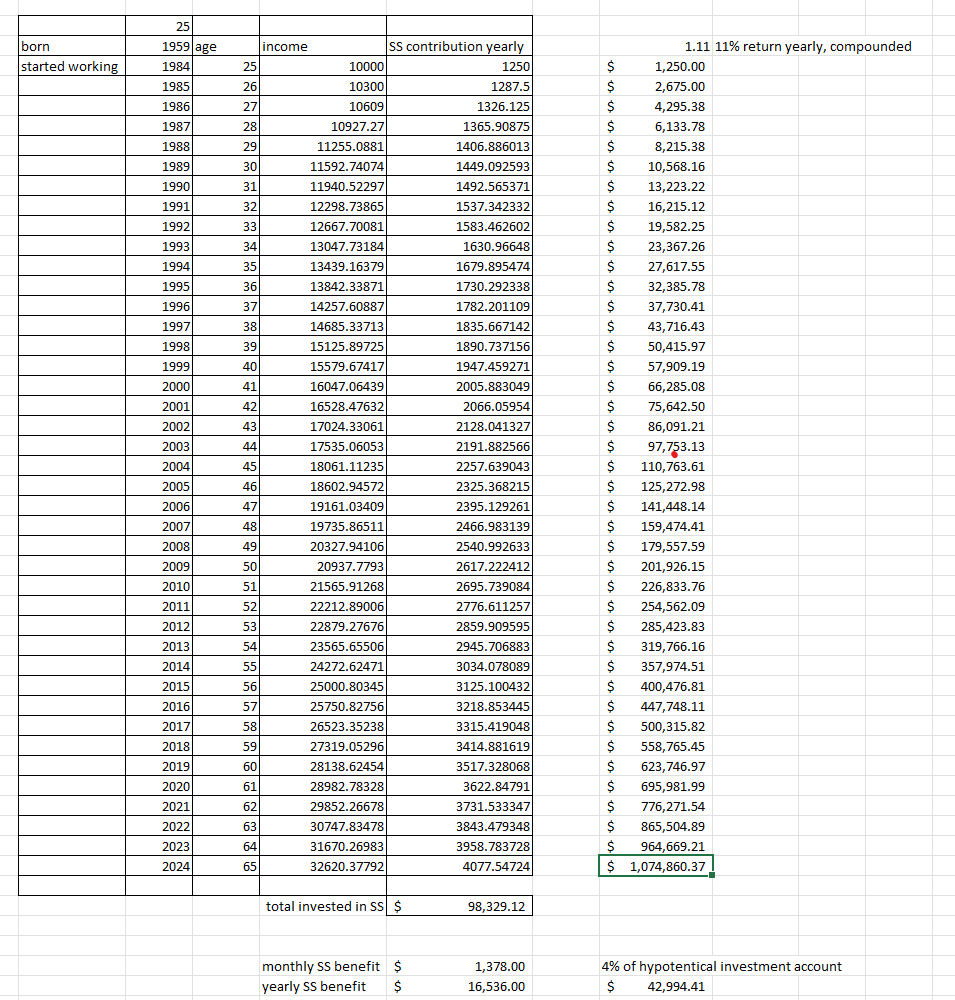
I went through and created a hypothetical person who started working in 1984 at the age of 25 (after being born in 1959). 

If that person started making $10k in 1984 that would be equivalent to $30k/year in 2024.
I gave this person a 3% raise a year. You can see that in the “income column” below. So this person would have ended working in 2024 with a salary of $32k/year (being 65 years old).

The next column shows the 12.5%/year that this person + their employer is paying into Social Security. After 40 years this person would have paid $98k into Social Security.
I went through and put all the earnings data into the Social Security website benefit calculator, found here. 

https://www.ssa.gov/benefits/retirement/planner/AnypiaApplet.html

It provided an estimate of $1,378/month or $16,536/year. 

I provided an alternative column, where you would instead take that 12.5%/year and invest that in the S&P 500 for 40 years.

As of January 26, 2024, the S&P 500’s price is 4,890.97. If you invested $100 in the S&P 500 at the beginning of 1984, you would have about $6,606.25 at the end of 2023, assuming you reinvested all dividends. This is a return on investment of 6,506.25%, or 11.14% per year.
This person would have $1,074,860.37  in their 401k. They could safely withdraw $42,944/year from this (4%) as well as having a portfolio worth $1 million dollars! This is making a relatively low $30k per year equivalent for 40 years!

But most people I know who have made $30k a year for 40 years do not have a million dollar portfolio. Why is that?

It’s because they are unable to invest 12% of their salary a year, because it is required to go to the government and the Social Security Fund. This is robbing millions of workers of $25k/year in their retirement. 

You could go through this same exercise. Simply go to https://www.ssa.gov/benefits/retirement/planner/AnypiaApplet.html

And input the dollar amount in the table for each year to find the benefit. 

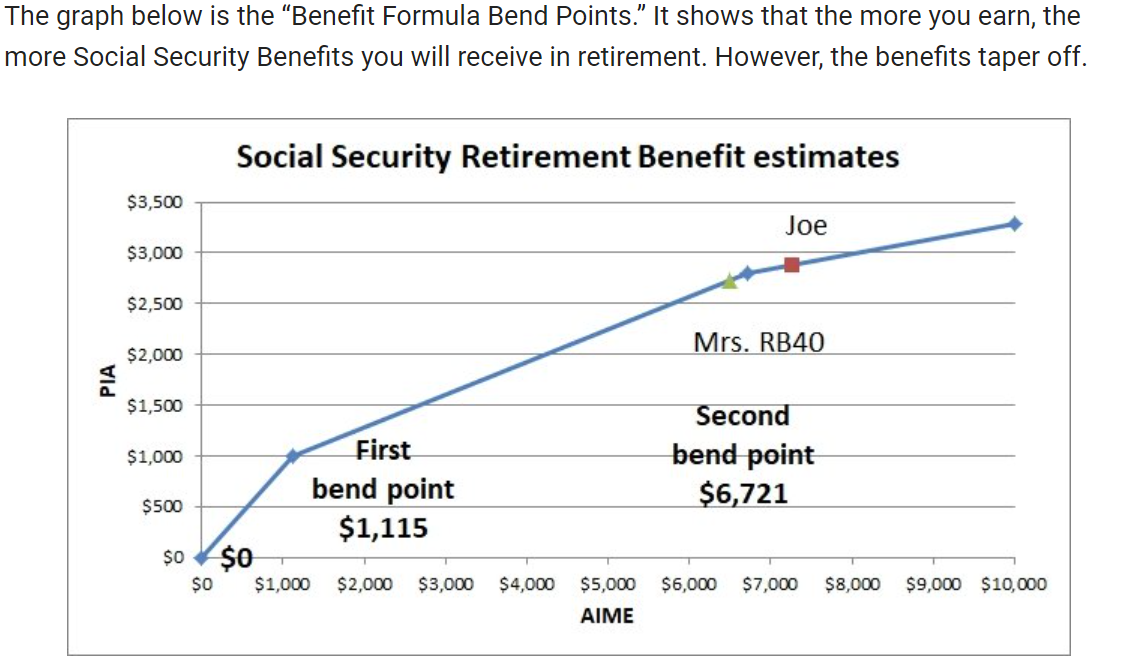
This is bad enough for a $30k/year equivalent worker. The more money you make though, the worse of a deal Social Security is. This is because of the “knee points” in the Social Security return table. The more you pay in, the less you get out. https://retireby40.org/early-retirement-impact-social-security-benefit/

While Social Security being a terrible return on your money is something of a first world problem, there are plenty of other instances of money losing value in other countries that really hurts people in those countries. 

You can read from Alex Gladstein to learn about some of those. 

“The rate of inflation in the U.S. is paltry compared to many other countries worldwide. The chief strategy officer for the Human Rights Foundation, Alex Gladstein highlighted this issue on Monday in a series of tweets. Gladstein is also a bitcoin (BTC) proponent and has been an evangelist for the leading crypto asset for quite some time.

“Many might think that extreme inflation is a rare occurrence in today’s modern world,” Gladstein said to his 27,000 Twitter followers on Monday. “That’s simply not the case. There are 1.2 billion people currently living in countries experiencing double or triple-digit inflation,” Gladstein insisted.”

https://news.bitcoin.com/1-2-billion-people-live-under-double-digit-inflation-many-have-found-escape-in-bitcoin-says-hrfs-alex-gladstein/

Why Bitcoin Makes The World Better – The Bitcoin Layer and “How My Co-worker Identified the Issues Without Identifying The Causes”

F.A. Hayek in 1984: “I don’t believe we shall ever have a good money again before we take the thing out of the hands of government, that is, we can’t take it violently out of the hands of government, all we can do is by some sly roundabout way introduce something that they can’t stop.”

First 15 minutes of the podcast “Why Bitcoin Makes The World Better – The Bitcoin Layer”- I think this is a great 15 minute video to learn about “why Bitcoin” if you aren’t sure what “problem Bitcoin is trying to solve”.

Full episode – Why Bitcoin Makes The World Better – The Bitcoin Layer

Inflation/money printing by the government is a hidden tax, or more nefariously, theft of your savings.

I received the below email from a coworker related to this home for sale.

https://www.homesofiowa.com/idx/listing/IA-WCFMLS/20233854/4426-Granite-Ridge-Road-Cedar-Falls-IA-50613

I was walking the dog tonight and there are several new houses down the street. I looked up what they go for. There is a video of it on the page, it’s a just a house.  Nothing huge, with some basement finished. – coworker

I shared the below picture with this coworker. If you are measuring the world in USD then things are getting more expensive. But if you are measuring in Bitcoin, things are getting cheaper, as Jeff Booth explains in the initial Youtube video I shared above. 

Below is the rest of my reply to this coworker. 

You could always try to put multiple families together in one house, as times will get desperate. That would be the historic solution. And as you said, as people are poorer, they will just have to do it again.

There are plenty of very poor both in the USA and abroad already living this way.

As referenced from the trip I just got back from India from.

Most of the world is ALREADY poor. The USA has benefited from being able to export inflation to the rest of the world for the last 50 years.

We do this by everyone having to buy USD to buy oil. Then every country has a huge pile of US treasuries/dollars. Then we print more.
Printing money is effectively stealing value from people who hold dollars.
That is why NO ONE ever wants to have cash for longer than they have to.

Don’t you think that’s kind of crazy that no one actually wants US dollars “money”?

We buy bonds, gold, real estate, stocks, anything to store the value because we know that dollars lose value over time. It’s wild!

It’s even more obvious in countries like Argentina or Turkey where they have REALLY awful money. But our money also sucks for preserving value over time.

It all started with 1971 and removing the gold backing of the USD. Well really that started in 1930 with executive order 6102 which the government confiscated people’s gold. Paid them $20.67/oz of gold. Then repriced the dollar to $35/oz! they literally stole $15 worth for every oz of gold they took. It is crazy!

$15 was real money back then!

So I’m just saying you are noticing the results, extremely high home prices. Things getting more expensive. I am telling you there is a clear history to how we got here. And there is literally 1 solution to this problem. Well 2 but 1 will never happen.

If the US government quit over spending and printing new dollars that would fix it. But that will NEVER happen.
So the alternate solution is to save in a currency that has a maximum limit, 21 million bitcoin.

If we DON’T support the bitcoin network we will continue down this path of everything getting more expensive.
I have read so many books about the history of money and governments messing with money. It always happens this way.

The Romans debased their money, see below.


See quote below.

I really encourage you to learn more about bitcoin. It is our only hope.

Super short book, 2 hours on audible, but it’s really great.

The Bullish Case for Bitcoin Paperback – May 8, 2021

by Vijay Boyapati (Author)

F.A. Hayek in 1984: “I don’t believe we shall ever have a good money again before we take the thing out of the hands of government, that is, we can’t take it violently out of the hands of government, all we can do is by some sly roundabout way introduce something that they can’t stop.”