Toward A Shareholder Society: How We Actually Raise The Floor

A lot of the recent surge in socialsm is understandable based on the blatant grift of the current administration. The economy doesn’t seem to be working for many. I wanted to share some thought about some potential paths to make everyone an owner in our society. I think it’s good on many levels. It gives people ownership and a stake in the society. It gives people hope that they’ll actually be able to retire someday. It’s not a perfect proposal. I am still working on my thoughts on this. But I think this is directionally useful to show people some of the current numbers for the stock market. It’s more useful than the “tax the billionares” rehetoric which doesn’t actually help the bottom 50%. This also proposes some solutions of how to help fix the Social Security insolvency issue. I hope to see more dialog on these issues. Thank you for reading.

This was all prompted by the below 3 videos along with many years of thinking on these topics.

AI and a Universal Basic Income. A note on the economy.

STOP Saving To Buy A House! Do THIS Instead

People Have No Idea What’s About To Happen…

“The only way to raise the poor from poverty is to give them better tools to produce more.” — something I wrote here back in 2018. I still believe it. This is the next piece of that argument.

Where we actually are

The U.S. stock market is worth somewhere around $75 trillion today. Depending on exactly what you count and which day you look, you’ll see figures from about $75 trillion up to $78 trillion. Call it $75 trillion to be safe.

There are roughly 343 million people in this country, about 277 million of them adults, and something like 255 million adults who are citizens. If you took that whole $75 trillion and split it evenly across every adult citizen, everyone would get about $294,000. At the higher market-cap number it’s closer to $306,000. So call the number roughly $300,000 of stock market wealth per adult.

That is a real number and it’s worth sitting with for a second. If every adult citizen owned an equal slice of American business, each of us would be sitting on about $300,000 in equity. Not income — equity. A claim on the machines, the brands, the buildings, the software, and the future profits of the entire American economy.

Now here’s the part that should stop you cold. Almost nobody has anything close to that.

That $300,000 is a mean — total pie divided by number of people. It is not what the typical person has, because the pie is not split evenly. It is split about as unevenly as it has ever been split in the history of the data:

  • The top 10% of households own about 87% of all stocks.
  • The top 1% alone own about half of all equities — more than the entire bottom 90% combined.
  • The bottom 50% of Americans own about 1% of stocks, worth around $590 billion out of $75 trillion.
  • Measured across all wealth, not just stocks, the top 1% hold about 32% of net worth, a record high, while the bottom half hold about 2.5%.

And ownership isn’t even that widespread to begin with. About 58% of adults own any stock at all, and that number recently ticked down. Most of the people who do own stock own it through a 401(k) and don’t own very much of it. The median American household has roughly $39,000 in financial assets outside their home. Among families that actually have a retirement account, the median balance is around $87,000 — but roughly half of households have no retirement account at all, and once you count those zeros, the median retirement savings across all households falls to somewhere around $27,000.

So we have a country where the average adult’s “fair share” of the stock market is $300,000, and the typical person’s actual share is a small fraction of that. That gap — between the mean and the reality — is the whole problem in one picture.

What I am not arguing

I want to be clear up front, because this is where most people get the argument wrong.

I am not saying we should take the top’s shares and hand them out. I said in 2018 that redistribution of wealth isn’t sufficient to fix poverty, and I still mean it. If someone built a company from nothing, added value people actually pay for, and got rich doing it, taking their stake away is both wrong and beside the point. It also doesn’t scale — as we’ll see in a minute, there literally isn’t enough at the top to hand everyone a comfortable life, and the moment you start confiscating you kill the thing that makes the pie grow in the first place.

I am also not arguing for equality. I don’t care very much whether the gap between the top and the bottom is wide. What I care about is the floor. The right question is not “how big is the gap” but “is the person at the bottom continually getting access to more — clean water, a roof, transportation, energy, the next useful thing?” If the floor keeps rising, the gap can stay wide and I’m fine with that. Inequality of outcome at the top is the price of a system that keeps inventing things. Inequality of access at the bottom is the thing we should attack.

So the goal isn’t to flatten anything. The goal is a shareholder society: an economy where everyone owns a piece of the productive machine, everyone therefore has a claim on what it produces, and — this is the part that matters most to me — everyone gets a vote through those shares in what the machine actually does. Especially as more and more of the work gets done by machines and fewer people are needed to run a company, ownership becomes the way ordinary people stay connected to the economy at all. If your labor isn’t needed, your shares are how you eat and how you’re heard.

Trump Accounts: a genuinely good start

This is why I’m actually encouraged by the new Trump Accounts.

Here’s the mechanism. Every American citizen child born from 2025 through 2028 gets a one-time $1,000 seed from the Treasury, invested in a low-cost, broad U.S. stock index fund with the expense ratio capped at 0.10%. Families can add up to $5,000 a year. At 18 it converts into a traditional IRA. The Treasury’s own projection is that a single $1,000 deposit grows to roughly $500,000 by age 60.

Structurally, this is the shareholder society in miniature. Auto-enrolled. Index-based. Every citizen kid holding a stake in American business from the day they’re born. It is the closest thing we’ve built to “everyone’s an owner,” and it starts people compounding at the one moment they have the most valuable asset of all: time.

I want to give it real credit, because the mechanism is right. But I also want to be honest about what it does and doesn’t do.

What the $1,000 actually becomes

Let’s be careful with the Treasury’s half-million-dollar headline. $1,000 growing to $500,000 over 60 years works out to about an 11% annual return, and that’s a nominal number — not adjusted for inflation. In the dollars you actually spend, it’s a lot smaller.

Let’s use an honest, conservative assumption instead: 7% return above inflation, which is roughly what U.S. stocks have delivered over the long run. A single $1,000 seed, left completely alone, no further contributions, grows to about $58,000 in today’s dollars over 60 years.

Fifty-eight thousand dollars. From one thousand, with nobody adding a cent.

Is that enough to live on? No. Not remotely. But here’s what should land: $58,000 from a single untouched $1,000 seed is more than what a typical American has saved for retirement after an entire working life. Among families that have a retirement account, the median is around $87,000 — but about half of households have no account at all, and counting everyone, the median retirement savings is closer to $27,000. So a birth seed that just sits there and compounds would end up ahead of where the typical household lands after 40 years of trying.

That comparison isn’t a brag about the seed. It’s an indictment of how little we accumulate — and it points straight at the real lever. The seed “wins” not because $1,000 is a lot, but because it gets 60 uninterrupted years of compounding, and most people never give themselves that. Time in the market is the scarce resource, and most of us start decades too late. Hold onto that, because it’s the key to the whole thing.

Setting the goal: what “enough” actually looks like

Let me put a real target on the table, because I think you have to name the goal before you can talk about how to reach it. And I want to be clear about what this next part is: it is a goal, not a demand that we get there tomorrow. If the honest path to this goal is funding today’s kids and letting them grow into it over a lifetime, that is completely acceptable. Goals are supposed to be out ahead of you.

Here’s the exercise. Pick the nest egg a person needs at 65 to actually live off of — on top of Social Security, which averages about $24,000 a year. Then work backward: every younger person should hold the amount that, growing at 7% a year above inflation, lands them at that target by 65. Retirees get the full amount, because they’re out of time to compound. I split the adult population into the normal age bands and ran it.

One thing I want to flag before the numbers, because it matters for the whole design: I’m leaning on Social Security to fill part of the floor, and Social Security is itself insolvent. Its trust fund is projected to run dry in the early 2030s, at which point benefits get automatically cut by roughly a quarter unless Congress acts. And the way we’ve always “fixed” it is the same move every time — take more from the people working now to pay the people retired now, then come back in a couple of decades and take more from workers again. That’s not a solution, it’s a treadmill. It’s an endless cycle of taking more from each new generation of workers to cover a promise the last generation never funded. The whole point of saving real, owned, compounding money for young people is to get off that treadmill — to fund the floor with an asset that grows on its own instead of a claim on the next worker’s paycheck. So when I put Social Security in the math below, read it as the shaky thing we’re trying to supplement and eventually lean on less, not the thing we’re counting on forever.

Target: $750,000 at 65 (throws off about $30,000 a year at a safe 4% withdrawal, so roughly $54,000 a year with Social Security — a genuinely livable floor):

Age bandAdultsStake needed per personYears left to growCost of the band
18–2431.6M$38,200~44$1.2T
25–3448.4M$70,200~35$3.4T
35–4445.9M$138,200~25$6.3T
45–5442.4M$271,800~15$11.5T
55–6445.2M$534,600~5$24.2T
65–7436.7M$750,0000$27.5T
75+26.8M$750,0000$20.1T
Total277M$94.3T

Look at the total: $94.3 trillion. The entire U.S. stock market is about $75 trillion. So at a $750,000 floor, you cannot get there by dividing up what already exists — the bill is bigger than the whole pie. There isn’t enough equity in America to put every adult on a decent-retirement track today. This is my 2018 point landing with a number attached: there is not yet enough wealth, so the pie has to grow. You can’t slice your way there.

Run it leaner, at a $500,000 target (about $20,000 a year from the portfolio, roughly $44,000 a year with Social Security):

Age bandStake needed per personCost of the band
18–24$25,500$0.8T
25–34$46,800$2.3T
35–44$92,100$4.2T
45–54$181,200$7.7T
55–64$356,400$16.1T
65–74$500,000$18.4T
75+$500,000$13.4T
Total$62.8T

At $500,000 the whole thing costs about $62.8 trillion, which does fit inside $75 trillion. But notice what “fitting” would mean if you tried to do it by confiscation: you’d be handing over about 84% of the entire stock market. And even that extreme wouldn’t create equality — the remaining 16%, about $12 trillion, would still sit largely with the people at the top, which per person is still an enormous amount. So even the nuclear option leaves us unequal, just less concentrated than today. Which is fine by me — remember, I don’t care about the gap. But it also proves the point: distribution doesn’t even get you to equality, and there isn’t enough to go around anyway. Confiscation is the wrong tool.

Now compare either target to what people actually have — and here you have to be careful which number you quote, because there are two very different pictures. Among households aged 55–64 that have a retirement account, the median balance is about $185,000. That sounds like a real head start until you remember it leaves out everyone with nothing. And a lot of people have nothing: roughly half of American households have no dedicated retirement account at all. Count those zeros back in, and the median 55–64 household drops to somewhere around $71,000. Across all families of every age, counting everyone, the median retirement savings is closer to $27,000.

So take your pick, and both are worth saying out loud. The typical near-retiree who managed to save has maybe $185,000. The typical near-retiree including everyone who didn’t has more like $71,000. Against a goal of $500,000–$750,000, that’s a gap of three to four times for the savers, and seven to ten times once you count the people who reached the end of a working life with almost nothing. The second number is the one a floor is supposed to be about — the floor isn’t measured by the people who already have an account, it’s measured by the people who don’t. That is the size of what we’re trying to close. It’s big. But naming it honestly is the only way to size the solution.

And here’s the thing the table reveals that changes everything about how you’d do it: the young are absurdly cheap to fund, and the old are what breaks the bank.

  • Everyone under 35 — about 80 million people, nearly a third of all adults — costs just $4.6 trillion to fully fund at the $750,000 target. That’s about 6% of the market for a third of the population.
  • The three bands 55 and up cost $71.8 trillion — 76% of the entire market.

The whole difference is compounding. A 21-year-old needs only about $38,000 today to reach $750,000 by 65, because 44 years of growth does the other $712,000 of the work. A 68-year-old needs the full amount in cash right now, because they have no time left. Time does the heavy lifting, and the young have all of it. That is exactly why seeding people young is the smart, cheap, powerful move — and why funding today’s retirees is the expensive transition problem that no seed can solve. The goal points us straight at the strategy: start people at birth.

The six-point framework

Everything I’ve argued fits into one simple idea. The livability of your floor is basically a fraction:

Floor = income ÷ cost of living.

You raise the floor by pushing on either term. Raise what people can claim, or lower what living costs. Do both and they multiply — a modest stake in a cheap world beats a big stake in an expensive one. Here’s the whole framework in six points:

  1. The measure is the floor, not the gap. Success is the bottom’s absolute access rising over time. Inequality at the top can persist; that’s fine. We watch the floor, not the ceiling.
  2. Floor = income ÷ cost. Two levers, not one. Everything else is either raising the numerator or lowering the denominator.
  3. Lower the denominator through disruption. New products win by competing against non-consumption — serving people who were priced out entirely, at a price point that didn’t exist before. That’s how the poor get their first car, their first clean water, their first anything. Cheap beats fancy when cheap reaches people fancy never could.
  4. Where prices won’t fall, something is usually blocking them. When a necessity stays expensive decade after decade, the cause is almost always an artificial constraint — regulation, licensing, a credential monopoly, a subsidy — not physics. Find the constraint, remove it, and let disruption reach the good.
  5. Raise the numerator through universal ownership. As automation thins out wages, shares replace the paycheck as the ordinary person’s claim on output. This is what Trump Accounts start — and the ownership stake matters most in exactly the categories where cost stays stubbornly high and disruption can’t finish the job.
  6. The shares have to carry a real vote. Ownership without governance is just a dividend check. In an economy increasingly run by machines, whoever votes the shares runs everything — so the vote has to reach the actual citizen. (More on how below.)

Raising the income side: seed the kids

The income lever is ownership, and the model above already told us the smart way to do it: fund people when they’re young and let time do the work. So let’s cost that out honestly, because the number is genuinely surprising.

I ran the compounding: $18,000, invested once at 7% above inflation, grows to about $1 million in 60 years. One deposit. In today’s dollars. A newborn seeded with $18,000 would retire a millionaire in real purchasing power, without another cent added, without depending on whether their parents could afford to contribute.

Let me be clear that I’m using $18,000 as a modeling number, not a proposal I’m ready to plant a flag on. Honestly, I suspect it’s too much — it’s the figure that fully funds a $1-million outcome from a single deposit, so think of it as the upper end of the range, the “what would it take to do the whole job at birth” number. The real program probably lands well below it. But it’s worth pricing out the full version, because the total is smaller than you’d guess.

So what would it cost to seed every American child at that level? About 3.6 million babies are born in this country each year. At $18,000 each, that’s roughly $65 billion a year.

Hold that up against the federal budget, which ran about $7 trillion last year. Sixty-five billion is a bit under 1% of what the government already spends. Even the maximum version of this idea — full funding to a million-dollar outcome — costs less than a penny on the federal dollar. The current $1,000 Trump Account seed, by comparison, runs about $3.6 billion a year for a birth cohort and grows to that $58,000 we talked about. So the whole realistic range, from the $1,000 we’re already doing up to the $18,000 that finishes the job, fits between a rounding error and 1% of the budget.

But the budget isn’t even the right yardstick. The right comparison is the retirement promise we’ve already made and haven’t funded. Social Security’s unfunded obligation — the gap between what it’s promised and what it’s projected to collect — is about $29 trillion over the next 75 years in present-value terms, and by the infinite-horizon measure closer to $73 trillion, roughly twice the size of the entire economy. Per household, the 75-year shortfall works out to about $192,000. The trust fund is projected to run dry around 2033, at which point benefits get automatically cut by roughly a quarter unless Congress acts.

That is the number to weigh a seed program against. We are already on the hook for tens of trillions in an unfunded, pay-as-you-go promise — one where today’s taxes pay today’s benefits and the shortfall gets pushed onto future workers. A seed account is the opposite kind of obligation: it’s pre-funded and compounding, a real asset that grows on its own and eventually needs nobody to tax. Sixty-five billion a year is about two-tenths of one percent of the $29 trillion hole we’re already standing in. So the honest question isn’t “can we afford to seed kids” — we’re already committed to something vastly larger and shakier. The question is whether it makes sense to build a small, funded, self-growing stake alongside the unfunded one, and over time lean more on the thing that pays for itself. I think that’s at least worth a serious argument.

This is the cheap end of the income lever, and it’s cheap for one reason: it uses the kids’ 60 years of compounding, so a little money now does the work that would cost a fortune later. It does not fund today’s retirees — that’s the hard transition problem, where the existing safety net and a growing pie have to carry the load. But for everyone not yet born, or newly born, a real ownership stake is within reach for a fraction of what we already spend, and a fraction of what we’ve already promised.

I’m going to leave the hard question of exactly where the money comes from for another day — this article is about the goal and the shape of the solution, not the appropriations fight. It’s a real question and it deserves its own piece; for now, take the seed as a line item to be funded like any other priority, and let’s not pretend I’ve solved that part here. What I’ll say is that the structure matters as much as the source: the growth should come from a broad, universal feed rather than from what each family can spare, and it should land in your own account, not one giant government pool. Norway built a roughly $1-trillion sovereign fund from oil that now holds around $200,000 per citizen — proof the scale is achievable. The difference in my version is that the shares, and the votes attached to them, belong to individuals, not to a fund that votes on everyone’s behalf.

This is also why the idea that we’re heading for a moneyless, post-scarcity utopia is wrong. I like Elon, but “we won’t need money” is a dumb prediction. There is always something genuinely scarce — the best land, the most skilled human care, the next thing nobody’s invented yet — and for whatever is truly scarce you need a price, and you need money to ration and signal it. Maybe most goods get cheap enough to feel free someday. But there’s always a residual, and money is how we handle the residual. The ownership stake exists precisely to give ordinary people a claim on that residual.

Lowering the cost side

Here’s the good news the income side needs: you don’t have to hit the full target if the cost of a decent life keeps falling. Remember the fraction — floor equals income over cost. Everything you knock off the denominator lowers the numerator you have to fund. If a decent life costs $400,000 to sustain instead of $750,000, the whole retirement model suddenly fits with room to spare. The two levers aren’t independent; cutting costs is what makes the ownership stake affordable.

And for a huge range of goods, costs have been falling, hard. Electronics, computing, information, communication, media — the price of all of it has collapsed. Things that were luxuries a generation ago are now in nearly every pocket in the country. Nobody took a rich person’s phone and handed it to a poor person. The price fell until it reached everyone. That’s the floor rising through disruption, exactly as point 3 describes — and cheap electric cars and automated transportation are the next necessity crossing from “priced out” to “everyone can have it.”

Now the bad news, and the real work. The categories that actually decide whether someone’s floor is livable — housing, healthcare, education, childcare and eldercare — have gone the other way. Prices there have risen for decades while everything digital got cheaper. If the floor is going to keep rising, these are the targets. For each one, the framework says: identify what specifically is holding the price up, and ask whether that constraint is captured or real.

  • Housing. Mostly captured, not physical. Land near jobs is scarce, but the bigger driver is policy: zoning that bans density, lot-size minimums, parking mandates, permitting delays, reviews weaponized to block building. Construction is one of the only industries that got less productive over 50 years, partly because you can’t mass-produce a house when every town has different rules. The fix is nameable: factory-built and modular housing plus zoning reform. Our most winnable stubborn category.
  • Healthcare. Part real, mostly captured. Yes, it takes highly trained people. But we cap the supply of those people (residency slots, scope-of-practice laws that stop nurses and pharmacists from doing what they’re trained for), we hide prices so the market can’t work, and we tie insurance to employers so nobody sees the cost. The disruption path — pushing care down the chain from specialist to GP to nurse to app to self-care — mostly exists. What’s missing is permission.
  • Education. Largely captured and already half-disrupted. The information is free now. What costs money is the credential, protected by accreditation and inflated by subsidized loans. The fight is whether an alternative credential can beat the incumbent’s signal.
  • Childcare and eldercare. The most genuinely real constraint. A lot of the value is literally a human being present and paying attention, and that resists automation by its nature. Some cost is regulatory, but even stripped down it’s people-heavy.

See the pattern? The categories that stayed cheap were the ones we allowed to be disrupted. The ones that got expensive are the ones where the cheaper competitor is often literally illegal — you can’t build the dense housing, can’t let the nurse practice, can’t sell the un-accredited course. They’re expensive because someone captured the rules to keep them that way, not because we can’t make them cheaper.

That gives the two halves of the framework a clean division of labor, which is really the whole thesis in one sentence:

Deregulate to let falling prices reach the goods that are only expensive because the rules are rigged — and use the universal ownership stake to carry the floor across the few goods whose costs are genuinely, irreducibly real.

Disruption handles most of it. The shareholder stake exists for the residual — the human care, the truly scarce land, the physics floor on real things — that no amount of innovation drives to zero. That’s what the shareholder society is for. Not equalizing everyone. Backstopping the part of the floor that deflation can’t reach, and giving every citizen a vote in the machine while we’re at it.

Index funds don’t have to take away your vote

Here’s how voting works today. If everyone owns index funds, the vote gets swallowed by the big asset managers, because the fund is the legal shareholder of record and the fund company casts all the proxies. That’s a real concentration of power — a handful of firms voting a huge share of corporate America on everyone else’s behalf. But fixing it is simple arithmetic.

If you own an index fund and that fund holds 8% of its money in Nvidia, and you have $100,000 in the fund, then you own $8,000 of Nvidia. Simple as that. So you should get to vote $8,000 worth of Nvidia shares. Your ownership looks through the fund to the underlying companies, and your vote looks through right along with it, in exact proportion to what you actually own. Do that across every holding and every fund, and every shareholder — down to the person with a few thousand dollars in a Trump Account — votes their real, proportional slice of every company they’re invested in.

That’s the whole principle. It’s not a new theory of corporate law; it’s just pass-through voting, weighted by the dollars you hold. The asset manager stops being the one who decides and goes back to being what it should be — a middleman that administers your shares and casts the votes you direct.

And the mechanics are straightforward. Brokerages already know exactly who owns what, down to the share, across hundreds of millions of accounts — they have to, that’s the whole business. The look-through is grade-school arithmetic: your share of the fund times the fund’s share of each company. The plumbing to record it and pass the votes along already exists; the big managers have even started offering “voting choice” programs that do a version of it. The only thing missing is the decision to make it the default. You look through the fund. Your money’s already there; the vote should follow it.

Where this leaves us

Put it together and it’s not complicated, even if it’s ambitious:

Set the goal honestly — a real, livable ownership stake for every citizen, on the order of half a million to three-quarters of a million dollars at retirement. Accept that we can’t hand that out today, because there isn’t enough and confiscation would wreck the engine anyway. Then reach the goal from three directions at once. Seed the young, where even the full-freight version — enough to grow into a real million by retirement — costs well under 1% of the budget a year and a rounding fraction of the tens of trillions we’ve already promised through Social Security, because time does the work. Grow the pie, so there’s more to own tomorrow than there is today. And drive down the cost of living, breaking the captured rules that keep housing, care, and schooling artificially expensive, so that “enough” becomes a smaller number. Give every one of those shares a real, proportional vote. And let the ownership stake carry the floor across the handful of things that stay genuinely scarce.

We don’t win by making others lose. We win by raising the floor from both sides at once — driving the price of the next useful thing down until it reaches everyone, and giving every person a real, voting stake in the machine that makes it. The $1,000 seed is a start. Now let’s set the real goal, and go finish it.

Let’s Win Iowa, Zach Wahls — A Moderate Voter’s Letter

Yesterday, I attended a talk by Zach Wahls at the Octopus in Cedar Falls. Zach is running for the U.S. Senate as a Democrat, and many people will recognize him from the speech about his family that first brought him into national politics.

I went in as a persuadable voter — not looking to cheer or jeer, but trying to understand how Democrats plan to win competitive general elections in places like Iowa. I agree with Zach on some important issues, especially his opposition to members of Congress trading individual stocks and his support for term limits. Those positions signal seriousness about institutional integrity, and they’re part of why I’m paying attention.

At the same time, I left with unresolved questions about strategy, coalition-building, and whether the Democratic Party is learning the right lessons from recent losses. The letter below is something I decided to write — and share publicly — because I suspect many moderate voters are wrestling with similar thoughts but don’t often articulate them clearly.

This isn’t an attack, and it isn’t an endorsement. It’s a good-faith attempt to ask whether the path Democrats are on is actually capable of winning broad support — and whether candidates inside the party see the same risks that voters outside its core increasingly do.

What follows is the letter I wrote to Zach after the event.

Zach,

I appreciated you taking the time to speak yesterday at the Octopus in Cedar Falls. I also want to say up front that this note is coming from a place of genuine engagement, not opposition. I’m thinking seriously about this race and about what it will actually take to win it.

As I listened, I kept coming back to a concern I’ve had for a while — one I’ve written about privately — which is some version of: what got us here may not get us there.

Before your presentation even began, a moment stood out to me. Right when you walked in, a question was posed from the back of the room asking why Democrats don’t simply double down on “Democratic things.” I understand the instinct behind that question, but to me it highlights a deeper strategic tension. You’re in a real conundrum: you need to demonstrate to primary voters that you’re Democrat enough, while also maintaining enough appeal to win people who don’t already identify with the party.

I was sitting right next to the person who asked that question, and I immediately asked the opposite — why Democrats don’t spend more time appealing to a broader coalition. I understand there wasn’t time to fully respond, but that exchange stuck with me because it captures a real strategic tension in this race.

That connects to a broader issue I see among moderate voters like myself. Even when intentions are good, the perception of cultural overreach — often grouped under labels like “wokeness” or DEI maximalism — has become a real barrier for a lot of people in the middle.

I do think it’s fair to say that some parts of your story and political origins are perceived as culturally radical by a meaningful share of voters — regardless of intent. Your family background and the speech that launched you into politics are powerful and authentic, but they also place you squarely inside a set of cultural debates that many moderate voters experience as polarizing. That doesn’t negate your message, but it does raise the bar on how deliberately you have to signal openness, restraint, and pluralism to people outside the Democratic base.

One book I’d genuinely recommend, if you haven’t read it, is What’s Our Problem? by Tim Urban. He’s not a radical-right figure, and the book isn’t a polemic. But he does a good job explaining why a growing number of people perceive illiberal pressure from the left — especially in cultural and institutional spaces — as a larger threat than they expected. Even if you disagree with his conclusions, I think it’s useful for understanding how that perception forms outside typical political bubbles.

Related to that, I think moderation and clarity in a few areas could meaningfully expand the Democratic coalition: credible immigration enforcement, a more serious posture toward persistent deficits, and cultural signaling that reassures voters you’re focused on governing a pluralistic society rather than enforcing ideological conformity.

I also want to be clear about areas where I strongly agree with you. Your opposition to stock picking by members of Congress and your support for term limits both genuinely resonated with me, and they’re part of why I’m taking your candidacy seriously. Those positions signal seriousness about institutional integrity, not just partisan alignment.

One final observation: while attacking Trump aligns with Democratic talking points, it hasn’t proven to be a compelling affirmative case for persuadable voters in the middle. Democrats need to seriously reckon with the fact that the party has now lost two presidential elections to Trump — arguably one of the weakest general-election candidates in modern history. In both cases, the losses weren’t just about Trump’s strength, but about Democrats running candidates selected through processes that many voters experienced as undemocratic or disconnected from broad enthusiasm. Hillary Clinton emerged from a system dominated by superdelegates when a more populist alternative clearly resonated, and Kamala Harris was ultimately elevated without a competitive primary despite widespread unpopularity. I hope this is something you can see clearly from within the party — and that you’re actively working to fix rather than repeat it.

I say all of this as a 37-year-old moderate who doesn’t feel firmly claimed by either party and who is still very much listening. I want to understand how you see the coalition that actually gets you to 50%+1 in Iowa — and how you plan to persuade people who aren’t already convinced.

Thanks again for taking the time to speak and for engaging with people who are thinking through these questions rather than cheering reflexively.

Letter to Senator and Congressperson about current Administration (Trump) Actions

I don’t know if writing politicians really works. I’ve written a lot of letters over the years and almost always get canned, meaningless responses.

But what else are we supposed to do?

Apparently marching in the streets now risks people being shot by federal agents. Silence clearly isn’t working either. So at a minimum, I’m encouraging people to email their Senators and Congressperson and force this onto the record.

You don’t need to reinvent the wheel. You can copy the message below, add your name and ZIP code, and send it. Even if it feels futile, it still matters — because the alternative is doing nothing while this keeps escalating.

if you are in Iowa here are your State Senators – https://www.senate.gov/states/IA/intro.htm


Dear Senator [Last Name] / Representative [Last Name],

I am writing as your constituent to express my deep concern and outrage over the recent fatal shooting of a Minneapolis resident by a federal immigration agent as part of the ongoing enforcement operation in that city. Recent incidents — including the deaths of Alex Pretti on January 24 and Renée Good earlier this month — have sparked national protests and raised serious questions about the use of force by federal agents. In the case of Ms. Good, the Hennepin County Medical Examiner has formally ruled her death a homicide resulting from multiple gunshot wounds by law enforcement, intensifying public concern about transparency and accountability in these operations. (opb)

These events are not isolated. They reflect an escalation in federal enforcement tactics that threaten public safety, undermine community trust, and may violate civil rights — especially when independent investigations are limited or delayed.

Americans are sick of watching President Trump break the law with impunity while Congress shrugs. We are sick of federal agents using lethal force in domestic enforcement operations with little transparency and no meaningful accountability. We are sick of investigations that stall, reports that are hidden, and responsibility that is endlessly deferred.

This administration has shown repeated contempt for the rule of law — from January 6 and the subsequent release and pardoning of those convicted for their role in it, to the sweeping use of pardons for numerous other convicted criminals, to ignoring court rulings, abusing executive authority, and politicizing federal agencies. Trump ran on transparency, yet the Epstein files remain unreleased, stonewalled, and unexplained. The public was promised truth. Instead, we got silence.

What makes this even more disturbing is that the President now openly attacks members of his own party when they show independence or principle. Representative Thomas Massie — a Republican with a long, consistent conservative voting record — has been publicly targeted simply for dissent. Even Marjorie Taylor Greene, who has shown strong past support for him, has been attacked when she deviates even slightly. This is not leadership. It is intimidation.

The same pattern extends to the Federal Reserve. President Trump is now threatening Jerome Powell — the Fed Chair he himself appointed — for failing to bend monetary policy to his political demands. Undermining the independence of the Federal Reserve is dangerous, destabilizing, and reckless.

At the same time, the President openly threatens U.S. allies — including absurd and dangerous rhetoric about invading Greenland — behavior that would have been unthinkable from any previous administration. This is not strength. It is instability, and it damages U.S. credibility and national security.

Congress was not elected to be a spectator. Your oath is to the Constitution, not to a man.

I expect you to:

  • Demand a full, independent investigation into the Minneapolis ICE shootings and related use-of-force incidents
  • Hold public hearings on ICE and DHS enforcement practices
  • Push for immediate transparency and release of the Epstein files
  • Reassert congressional authority against executive overreach and intimidation
  • Defend the independence of institutions like the Federal Reserve
  • Publicly reject threats of aggression toward U.S. allies

Silence and inaction are choices — and voters are watching. I expect you to act.

Sincerely,
[Your Name]
[City, State]
[ZIP Code]

Email To Congressperson Regarding Epstein Files

Sent this to my Congress Representative Ashley Hinson- I hope she does the right thing.

I am writing as a concerned constituent to urge you to support the Epstein Files Transparency Act, led by Rep. Thomas Massie and Rep. Ro Khanna. This bipartisan bill would require the Department of Justice to release all unclassified records related to Jeffrey Epstein and Ghislaine Maxwell, while protecting victims’ identities. Congress has already reached the 218-signature threshold to force a vote, and the American people overwhelmingly want transparency.

Here’s why this matters:

  • Past Promises: High-profile figures in the Trump administration—including Pam Bondi, Kash Patel, and JD Vance—publicly pledged to release these files when President Biden was in office. They even held meetings and photo ops promising transparency. Why have those promises evaporated now?
  • The Hoax Narrative Doesn’t Add Up: If this is all a “Democratic hoax,” as President Trump now claims, why is Ghislaine Maxwell serving a 20-year sentence for sex trafficking minors? Her conviction was based on evidence of a real criminal conspiracy, not political theater.
  • Gaslighting the Public: President Trump is actively discouraging Republicans from supporting transparency, calling the effort a “trap” and a “hoax.” If there’s nothing to hide, why fight so hard to keep these files secret?

Please do not deflect by asking “why didn’t the Democrats release it when they were in power.” That is gaslighting. You NOW have the power to release the files and do the right thing. Be on the right side of history.

This is not about partisanship—it’s about justice and accountability. Survivors deserve answers, and the public deserves to know the truth about who enabled Epstein’s crimes. Shielding powerful individuals from embarrassment is not a valid reason to withhold information.

Please vote YES on the Epstein Files Transparency Act and stand on the side of transparency, justice, and the rule of law.

Thank you for your time and service.

Tracking the “Political ETFs” — My Ongoing Experiment

Members of Congress have long faced accusations of trading on insider information — buying and selling stocks in companies they help regulate.
It’s a bipartisan problem: Republicans and Democrats alike have profited from privileged access and timing the rest of the public could never match.

That’s not just bad optics — it’s corruption.
It undermines faith in both the markets and the integrity of government.

To highlight how deep this problem goes, I’ve started an experiment tracking three ETFs:

  • NANC — the Unusual Whales Subversive Democratic Trading ETF, built around stocks traded by Democratic lawmakers.
  • GOP — the Unusual Whales Subversive Republican Trading ETF, reflecting trades made by Republican lawmakers.
  • SPY — the SPDR S&P 500 ETF Trust, serving as a neutral market benchmark.

My goal isn’t to glorify these funds — it’s to show in real numbers how political trading compares to the broad market, and to call out why this system needs reform.


Policy Context

This issue connects directly to Senator Josh Hawley’s proposal to ban individual stock trading by members of Congress.
His bill wouldn’t ban investing altogether — lawmakers could still own broad mutual funds or ETFs, just not trade individual stocks that might be affected by their votes.

That distinction matters. It allows long-term wealth building without the appearance or reality of insider trading.
📎 Read Hawley’s bill here


Performance Snapshot (Feb 10 2023 → Oct 27 2025)

SymbolETF NameDescriptionStarting Price*Current PriceTotal Return
NANCUnusual Whales Subversive Democratic Trading ETFTracks stocks favored by Democratic members of Congress$24.69$46.15+86.9%
GOPUnusual Whales Subversive Republican Trading ETFTracks stocks favored by Republican members of Congress$24.96$37.20+49.0%
SPYSPDR S&P 500 ETF TrustBaseline for overall U.S. market$408$685+67.9%

*Starting prices from Google Finance (Feb 10 2023, ETF inception date). Current prices as of Oct 27 2025.


The Takeaway

Both “political ETFs” have gained since launch, but that doesn’t justify congressional trading.
When lawmakers can personally profit from decisions they influence, public trust erodes — no matter how well the market performs.

This experiment is my small way to expose how close politics and profit have become — and to advocate for a system where leadership means stewardship, not stock tips.


The Earmark Era: How Washington Rewards Spending, Not Stewardship — and Why the Federal Budget Keeps Breaking

Earlier in 2024, I read a local article about Washington’s senior senator proudly announcing how much federal money she had brought home to the state. Her list ran dozens of pages — hundreds of millions in Congressionally Directed Spending, better known as earmarks.

She’s not alone. Nearly every senator submits earmark requests, which you can browse on the Senate Appropriations Committee’s official list. Each item sounds worthy enough: a wastewater upgrade, a community arts incubator, a “therapeutic court.” But taken together, these line items add up fast.

According to the Peter G. Peterson Foundation, Congress approved 8,098 earmark projects costing $14.6 billion in FY 2024—about the same as FY 2023—and still under one percent of total discretionary spending. In context, that’s roughly 0.2 percent of total federal outlays.

It’s easy to shrug and say, “So what? That’s peanuts in a $6.8 trillion budget.”
But the issue isn’t the size. It’s the signal.


The Round-Trip Problem

When money takes the round trip — federal tax → congressional politics → earmark → local grantee — it leaks. Every stop adds overhead, lobbying, and political friction.

If a project’s benefits are local, fund it locally. Save federal dollars for truly national needs—and make any remaining federal grants competitive and audited.

That’s not ideological; it’s basic hygiene. Less leakage, less pork, more accountability.


The GAO’s Quiet Crusade

The Government Accountability Office (GAO) has spent over a decade documenting federal overlap, duplication, and inefficiency. Between 2011 and 2023, its recommendations produced about $667 billion in cumulative savings—roughly $51 billion a year.

That sounds impressive… until you set it beside annual deficits averaging $1.2 trillion over the same period. Even if every GAO fix were implemented perfectly, it would only offset a few cents of every deficit dollar. We celebrate small wins while ignoring the structural math.


The Trillions That Run on Autopilot

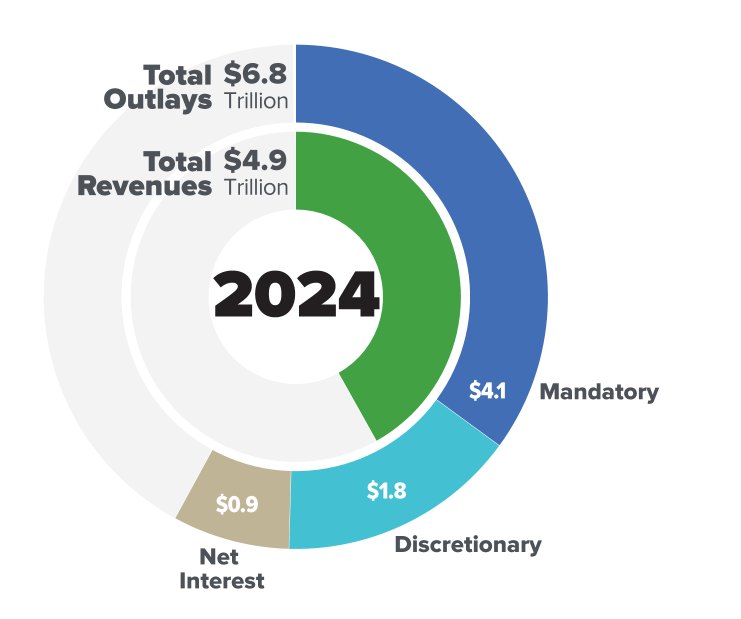
To understand that math, look at the 2024 federal budget as a whole (data from the Congressional Budget Office’s Budget and Economic Outlook: 2024–2034):

  • Total Outlays (FY 2024):$6.8 trillion
  • Total Revenues:$4.9 trillion
  • Mandatory Spending:$4.1 trillion (60%) — Social Security, Medicare, Medicaid, and other entitlements
  • Discretionary Spending:$1.8 trillion (26%) — defense, education, housing, infrastructure, research
  • Net Interest:$0.9 trillion (13%) — the fastest-growing line item in the budget

Source: Congressional Budget Office, “Budget and Economic Outlook: 2024–2034.”

All the fights over earmarks, audits, and waste reports happen inside that discretionary slice, the part Congress actually votes on each year.
The other 70 percent runs on autopilot — driven by demographics, healthcare inflation, and debt.

So yes, we have a trillions problem, not a billions problem.
But pretending the billions don’t matter ensures the trillions never get fixed.


The Cultural Incentive to Spend

Politicians are rewarded for bringing money home. A senator who resists earmarks looks “ineffective.”
That same incentive—spend now, borrow later—is what prevents any real reform on the mandatory side.

If Congress can’t resist handing out $14 billion in earmarks to score headlines, how will it ever take on the hard reforms that actually matter?


The Real Problem

The problem isn’t that earmarks alone bankrupt the country — they don’t.
The problem is that they reveal a mindset: Washington still rewards politicians for spending, not stewardship.

Every senator gets praised for what they bring home, not for what they turn down.
That’s the same mindset that makes real entitlement reform politically impossible and deficit reduction unthinkable.

Earmarks aren’t bankrupting the U.S., but they show why the U.S. can’t stop bankrupting itself.

Until that incentive changes — in Congress, in media, and among voters — the numbers will keep getting bigger, and the excuses will too.


Sources:

2024 Congressional Pig Book Summary
32nd “TheBook Washington Doesn’t WantYou to Read”
CITIZENS AGAINST GOVERNMENT WASTE

The Congressional Pig Book is CAGW’s annual compilation of earmarks in the appropriations bills and the database contains every earmark since it was first published in 1991. All items in the Congressional Pig Book meet at least one of CAGW’s seven criteria that were developed by CAGW and the Congressional Porkbusters Coalition:

  • Requested by only one chamber of Congress;
  • Not specifically authorized;
  • Not competitively awarded;
  • Not requested by the President;
  • Greatly exceeds the President’s budget request or the previous year’s funding;
  • Not the subject of congressional hearings; or,
  • Serves only a local or special interest.

The Politics of Envy: How Bernie Sanders Uses Billionaires to Distract from Washington’s Failures — and Keep People Angry

Blaming billionaires is easy. Fixing bad policy, broken incentives, and decades of fiscal irresponsibility isn’t — so Bernie Sanders keeps the outrage machine running instead.

A lot of people — Bernie Sanders in particular — hate billionaires because they assume billionaires stole their wealth.
But that belief comes from misunderstanding how value is actually created.


💵 Creation vs. Printing

Bernie and the government “create money” by printing it — literally out of thin air — which steals purchasing power from everyone who already has dollars.
That’s not value creation. It’s value redistribution by dilution.

So when that’s your frame of reference, you start to believe that everyone who gets rich must have taken something from someone else. Because that’s how you create “money” in politics — you print it or tax it away.

But wealth in a free market isn’t created by decree. It’s created by building, coordinating, and innovating — by making something others voluntarily trade for.


📈 Value Creation Is Not Theft

Larry Ellison, for example. One day Oracle stock went up, and his net worth jumped by $100 billion. Bernie acts like Larry ran around stealing $100 billion from working people.
But that’s not what happened. That value didn’t exist before — it was created.

Wealth in the market represents new value built through skill, innovation, and coordination, not theft.
If you’re stranded on an island with a billion dollars, it’s worthless. You need resources, tools, and knowledge to turn that “money” into something useful.

The problem is, people who’ve never built or created real value assume no one else can either.
So they see wealth as theft instead of creation. That’s the confusion at the heart of modern politics.


⚠️ Bernie’s Game: Blame, Not Solutions

And that’s where Bernie Sanders comes in.
He isn’t actually helping working people by pointing to billionaires as evil — he’s manipulating them.

By giving people a villain to hate, he distracts from the real causes of economic pain — bad money, wasteful government, and decades of inflation that quietly rob savers and workers.
He rallies frustration around a scapegoat instead of a fix.

If Bernie genuinely wanted to help, he’d talk about restoring fiscal discipline, reducing waste, and making it easier for regular people to build wealth — not demonizing those who already have.
But he doesn’t. Because blaming billionaires is politically easy.
Fixing the system would mean questioning the very machine that gives him power.

So instead of solving problems, he feeds resentment — keeping people angry, divided, and dependent on him to express that anger.


🧮 The Fantasy of the “Billionaire Tax”

In a recent Time article titled “I’m a Millionaire. No One Needs More Than $30 Million”, the author argues that a Billionaire Income Tax could raise $557 billion over ten years and “jump-start a permanent safety net.”

That sounds impressive — until you look at the math.

The U.S. government currently runs a $2 trillion annual deficit.
That’s $20 trillion in overspending every decade.
So this “transformative” billionaire tax covers less than 3 % of the hole. It’s fiscal rounding error.

The problem isn’t a lack of billionaire money — it’s a lack of discipline and accountability.


🏛 The Real Problem Isn’t “Too Much Money” — It’s How It’s Used

The Time article goes on to argue that wealth beyond $30 million stops being about living well and becomes about wielding power — influencing elections, buying media outlets, and suppressing competition.

That part isn’t entirely wrong. Money can corrupt politics.
But the author’s solution — capping wealth — misses the point completely.

If the issue is that money manipulates the system, then the answer is to make the system harder to manipulate, not to confiscate wealth after the fact.

We should make elections harder to buy, not success harder to earn.
Reform campaign finance, close regulatory loopholes, stop insider lobbying — that’s how you stop abuse.

The same goes for the “buy, borrow, die” loophole that allows the ultra-wealthy to avoid realizing gains.
If that’s the concern, close the loopholes directly — don’t destroy the entire structure of value creation to fix a tax code glitch.

And even then, no system will ever be perfect.
Smart, ambitious people will always find new ways to optimize around the rules — that’s part of what makes them successful.
Every time you close one loophole, innovation and adaptation create another.
The goal shouldn’t be to eliminate advantage; it should be to keep the playing field open and the incentives productive.

And far from “locking others out,” large pools of wealth are what fund the next generation of builders.
People don’t lose the chance to innovate because billionaires exist — they lose it when regulation, bureaucracy, and bad policy make it impossible to start or scale.
Just look at Europe: it leads the world in regulation, but none of the world’s biggest or most dynamic companies are European.
They’ve made it harder to fail, but also impossible to truly win.
Capital isn’t a finite pie being hoarded; it’s the byproduct of trust, savings, and productive investment.
Destroy that, and you destroy the fuel for future innovation.

Blaming “too much money” is a lazy shortcut that lets broken institutions off the hook.


💥 What Happens If You Actually Take It

Let’s pretend we go full Bernie and seize every dollar of billionaire wealth in America — all $6 trillion of it.

Here’s what happens:

  1. That covers just three years of deficit spending at current rates. Then what? You’re out of billionaires, and the deficit keeps growing.
  2. Most of that wealth isn’t cash. It’s ownership stakes in companies — Tesla, Oracle, Amazon, Microsoft, etc.
  3. If the government forces liquidation, prices collapse. No one can buy trillions in stock without tanking the market.
    • Even a 50 % drop cuts the haul to $3 trillion — barely 18 months of deficits.
  4. Who buys the assets? The next-richest class. Inequality reshuffles briefly, then reforms.
  5. Meanwhile, innovation stalls. Investment dries up. Everyone gets poorer.

You can’t fund a government by destroying the productive capital that funds everything else.


⚙️ The Real Issue Isn’t Wealth, It’s Value

Wealth isn’t evil — it’s a signal that someone created something valuable enough for millions of people to trade their time or money for it.
That’s fundamentally different from printing dollars and calling it “stimulus.”

If we want a stronger, fairer economy, the solution isn’t confiscation — it’s creation.
Encourage building, innovation, and hard work, and you’ll raise living standards for everyone.
Punish them, and you’ll end up with equality through shared decline.


🧭 Final Thought

Bernie isn’t fighting for the working class. He’s fighting to stay relevant to it.
You don’t fix inequality by burning down the factory.
You fix it by letting more people build factories of their own.


Bitcoin and the Triffin Dilemma: Why Wages Would Adjust Fairly Under a Neutral Money

Most people don’t realize that many of the economic problems facing Americans today trace back to something called the Triffin dilemma. Politicians like Trump rage about trade deficits or promise to bring back jobs, but they rarely understand the underlying monetary system that makes those promises impossible to keep. And because they don’t understand it, millions of middle-aged workers in the U.S. are left angry and disillusioned.

But here’s the good news: the problem is solvable. And Bitcoin, combined with Buckminster Fuller’s vision of a “world accounting system,” offers a way forward.


The Triffin Dilemma in Plain English

Robert Triffin pointed out a paradox in the 1960s: if one country’s currency becomes the world’s reserve currency, that country must constantly supply it to the rest of the world. For the U.S., that means running trade deficits and flooding the globe with dollars.

The catch is that what looks good globally causes pain domestically. To meet the world’s demand for dollars, the U.S. must run deficits, borrow more, and tolerate an overvalued dollar. That makes American exports less competitive, hollows out manufacturing, and weakens wage growth.


The Cost of Supplying the World with Dollars

To keep the global economy running on dollars, the U.S. has to keep sending them out. There are only two main ways that happens: by running trade deficits (importing more than we export) or by borrowing (issuing Treasuries that foreigners buy with their surplus dollars). Both of these mechanisms keep the world awash in dollar liquidity — but they impose heavy costs on American workers.

  • Persistent deficits mean more borrowing. Every trade deficit eventually gets financed with U.S. debt. Foreign governments and investors recycle the dollars they earn back into U.S. Treasuries. The system keeps spinning, but America’s national debt climbs ever higher.
  • Global demand keeps the dollar strong. Because the world needs dollars, our currency stays overvalued compared to others. A strong dollar makes imports cheap (which feels good for consumers at Walmart) but makes American exports expensive (which is brutal for manufacturers trying to compete abroad).
  • Manufacturing gets hollowed out. When American goods are too expensive, factories lose business. Over time, companies either shut down or relocate production overseas. Entire industries migrate abroad, leaving behind shuttered plants and devastated communities.

Take steel as a concrete example. In the late 20th century, global demand for dollars, combined with cheaper steel production in Asia, kept the U.S. dollar strong and U.S. steel prices uncompetitive. By the 1980s and 1990s, iconic steel towns in Pennsylvania and Ohio watched mills close. Workers who once earned solid middle-class wages saw their jobs vanish, and many never found work at the same pay level again.

  • Wages stagnate. With fewer competitive industries at home, American workers lose bargaining power. They’re forced to compete against cheaper labor abroad, and wage growth flatlines. Meanwhile, the cost of living — housing, healthcare, education — keeps climbing. The result is the frustration many middle-aged Americans feel today: they’ve worked hard their whole lives, yet the system seems rigged against them.

In short: to supply the world with dollars, America borrows, tolerates an overvalued currency, and sacrifices its own competitiveness. The global dollar system helps keep international trade flowing, but it extracts its pound of flesh from U.S. workers.


Figure 1: Global demand for dollars keeps the dollar strong, which makes imports cheap but exports uncompetitive — hollowing out U.S. manufacturing and holding down wages.

Why Trump (and Most Politicians) Miss the Point

Trump recognizes that something is broken — but his diagnosis is shallow. He blames foreign countries, bad trade deals, and weak leaders. His answer is tariffs and protectionism.

But the deeper issue is that America can’t stop running deficits without undermining the very system that makes the dollar the global reserve. The Triffin dilemma locks us in. Protectionism only papers over the problem temporarily.


How Wages Would “Automatically Adjust” Under Bitcoin

Now imagine a world where global trade is denominated in Bitcoin, a money no government can print or devalue.

  1. High Productivity Raises Wages Locally
    If Country A is extremely productive, it earns more Bitcoin. Workers there see higher wages in BTC terms.
  2. Prices Rise in the Productive Country
    With higher wages, local goods get more expensive relative to other countries.
  3. Trade Shifts
    Other countries stop buying from Country A and look to Country B or C, where wages are lower and goods are cheaper.
  4. Jobs Move, Wages Rebalance
    Jobs flow out of the high-wage country into lower-wage ones. Wages in the expensive country stabilize or even fall, while wages in cheaper countries rise.

The result: wages “automatically” adjust across borders to reflect real productivity, not the games governments play with currency printing or manipulation.


Figure 2: Under a Bitcoin-based system, wages and trade flows automatically rebalance. High wages make exports more expensive, shifting jobs abroad until global wages reflect true productivity.

Why Fiat Prevents This Natural Balance

In today’s fiat system, governments intervene to block this natural adjustment. They devalue their currencies to keep exports cheap, trapping workers in low wages and preventing global wage convergence.

Meanwhile, American workers face the opposite problem: a strong dollar that prices them out of global competition. The Triffin dilemma ensures the imbalance persists.


“Isn’t It Just Greedy Companies Suppressing Wages?”

A common belief is that big U.S. companies are the real villains — trillion-dollar firms posting record profits while holding wages flat, outsourcing jobs, or using H1B visas to bring in cheaper labor. There’s truth in that frustration, and yes, there is abuse in how the visa system is used.

Consider this example: if an American worker expects $80,000 but a skilled H1B worker is willing to accept $50,000, the company has a clear incentive to hire the cheaper worker. To Americans, this feels like wage suppression. But for the H1B worker, it’s a huge win. That $50,000 U.S. salary might translate into the equivalent of $150,000 back home, especially if they can send $10,000 to family abroad where the cost of living is far lower.

So while it looks like companies are simply greedy, they’re really responding to the incentives of a distorted global money system. With the dollar overvalued and global trade imbalances baked in, U.S. labor is structurally overpriced compared to the rest of the world. Companies are not the root cause — they’re just playing the game according to the rules we’ve set.

In a Bitcoin-based system, the game changes. Wages would adjust across borders automatically, not through currency manipulation or immigration loopholes. Companies would still seek efficiency, but the playing field would be leveled: wages in every country would reflect true productivity, not fiat distortions.

Figure 3: Under fiat money, companies are incentivized to outsource, use H1B labor, and suppress wages. Under Bitcoin, wages converge globally based on real productivity, not manipulated exchange rates.

Fuller’s Dream of a World Accounting System

Buckminster Fuller envisioned a future where humanity had a scientific, global accounting system that measured real wealth and resources instead of manipulating national ledgers.

Bitcoin is a step in that direction. It’s transparent, borderless, and immune to political distortion. A Bitcoin-based world economy would essentially run on Fuller’s “world accounting system,” with wages, trade, and prices reflecting true productivity instead of central bank policy.


The Takeaway

The middle-aged frustration in America isn’t just about lost jobs or bad politicians. It’s about being trapped inside the Triffin dilemma — a system where the U.S. must sacrifice its workers to supply the world with dollars.

Bitcoin offers a way out: a neutral, global money where wages naturally rebalance, trade adjusts fairly, and no single country bears the impossible burden of being the world’s reserve.

It’s not just a monetary upgrade — it’s the foundation for a more honest accounting system for the entire world.

Who Gets the Income? Who Pays the Taxes?

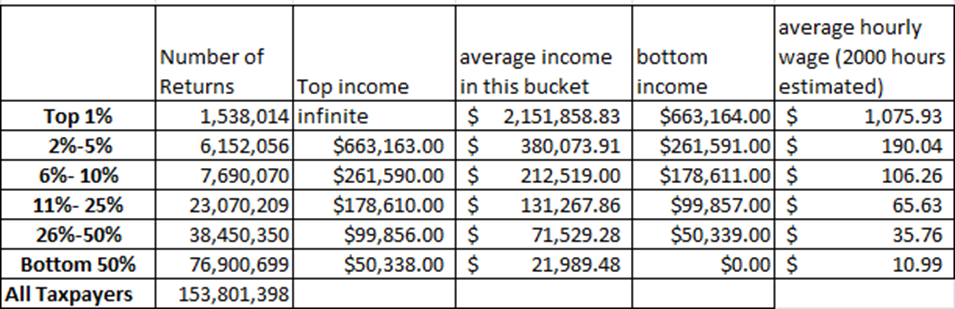
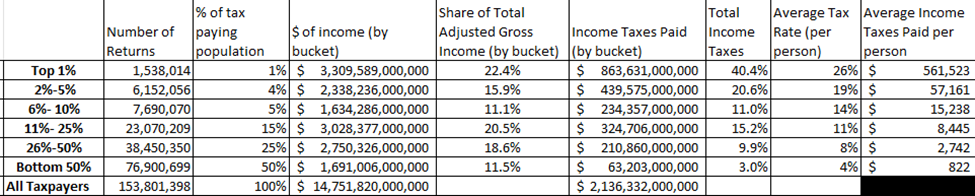
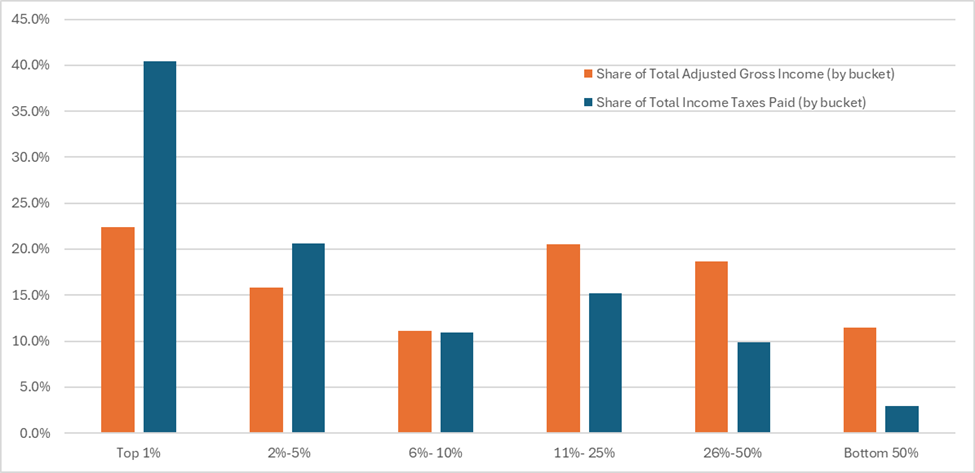
Data gathered from this link – https://taxfoundation.org/data/all/federal/latest-federal-income-tax-data-2025/

When we talk about taxes in America, the debate often gets sloppy. People use “income” and “wealth” almost interchangeably, but they’re very different things.

  • Income is the flow of money earned each year — wages from a job, dividends, or realized capital gains.
  • Wealth is the stock of assets someone already owns — businesses, real estate, stocks, Bitcoin, etc.

Our tax system is built mainly on income, not wealth. And when commentators conflate the two, it clouds the conversation about fairness and policy.


Income Snapshot

In 2022, the U.S. collected $2.1 trillion in federal income taxes on about $14.8 trillion in total income. That’s about 14.4% of taxable income.

Divide that income across all 153 million taxpayers, and the average income comes out to $95,915, or about $47.96 per hour assuming 2,000 hours of work per year. Of course, averages can mislead — the distribution is anything but equal.


The Top 1%

To qualify for the top 1% in 2022, you needed at least $663,164 of income. On average, these 1.5 million taxpayers earned $2.1 million each.

  • Share of income: 22.4%
  • Share of taxes paid: 40.4%
  • Effective tax rate: 26%

The Bottom 50%

The bottom half — about 76 million taxpayers — earned less than $50,339 per year. Their average income was just $21,000, totaling $1.7 trillion across the group.

  • Effective tax rate: ~4%
  • Many pay no federal income tax at all, often due to credits like the Earned Income Tax Credit (EITC) or child tax credits.

Wealth Snapshot

If we shift from income to wealth, the picture looks even starker. As of mid-2025, U.S. billionaires hold over $6.2 trillion in wealth, spread across only about 813–867 individuals.

But here’s the catch: the U.S. government is adding about $2 trillion in deficit spending every year. Even if you taxed billionaires at extremely high rates, it might cover only a year or two of deficits. After that, the wealth pool would shrink — and most billionaires would likely relocate to avoid such aggressive taxation.

That doesn’t mean we shouldn’t debate fairness, redistribution, or even wealth taxes. But it does mean we need to be realistic about the math.


Why This Matters

The key takeaway is that income and wealth are different conversations. Most tax debates focus on income flows, yet the loudest arguments are often about wealth concentration. If we mix those together, we miss the real tradeoffs.

I’m happy to debate how much each group should earn, or whether a wealth tax makes sense (though I personally think it doesn’t). But if we want an honest conversation, we have to separate what we’re actually measuring.

Because when we ask, “Who should pay more?” the first step is being clear: are we talking about annual income, or about the stock of wealth built up over decades?

Data – https://taxfoundation.org/data/all/federal/latest-federal-income-tax-data-2025/

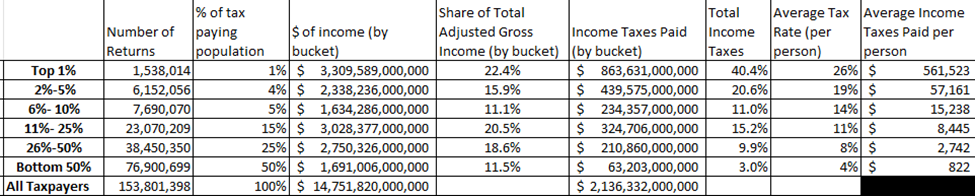
You will notice myd ata is slightly different than from the website. The website continually aggregates so their “top 5%” data includes all the income & people from the top 1% + the 2%-5%.
I have broken it down so you can see how much income is in each bucket. I think my method is much more useful.
It also allows you to see how much income, taxes, average income, is in each bucket.

When the data is aggregated it always is skewed due to the higher amount of income above it.

Wealth Inequality: The Quiet Apocalypse… and What Comes After

I recently watched a powerful video titled Wealth Inequality: The Quiet Apocalypse.” It’s honest, emotional, and brutally accurate in describing what it feels like to live in a system that seems to squeeze you harder every year. I found myself nodding along for much of it—but also wanting to widen the lens a little.

Before offering my response, here are five key points I took from the video:

Five Core Points from “Wealth Inequality: The Quiet Apocalypse”

  1. The system isn’t broken—it’s working as designed. It extracts time and value from most people and consolidates wealth at the top.
  2. Capital outpaces labor. Referencing Piketty: when the rate of return on capital exceeds growth, wealth concentrates.
  3. The American Dream is largely a delusion. Doing everything right doesn’t mean you’ll get ahead.
  4. Wealth inequality creates spiritual and psychological harm. It hollows out people’s sense of identity and worth.
  5. What we need is a cultural shift—not just policy. Minimalism, rest, and meaning are antidotes to hustle culture and economic extraction.

Here’s my reply, point by point.


1. The system isn’t broken—it’s working as designed

Yes, the system is designed to reward capital—not labor. But that doesn’t mean we need to burn the whole thing down. In fact, we should want capital to outperform labor—because that means more productivity with less effort.

The real problem? Capital is too concentrated.

What if we built systems that allowed more people to own capital? That would mean more people benefiting from productivity gains, without needing to grind themselves into dust. In the U.S., this is more accessible than we sometimes realize. Low-cost investing tools, like Fidelity or Vanguard, allow everyday people to start building wealth—even with modest means.

I wrote about how just $2,000/year for 10 years can grow to over $365,000 by retirement:
👉 The Power of Investing Early

The system does work—as designed. We just need to make sure more people have a stake in it.


2. Capital outpaces labor

Piketty’s point is mathematically true: capital grows faster than wages, and that concentrates wealth. But instead of treating that as a death sentence, let’s treat it like a map.

If labor will always lose, then we need to stop relying on labor alone. We need to become capital owners.

That’s the core of Post-Labor Economics: a future where AI and automation do the work, and human beings benefit from ownership rather than employment. That’s only dystopian if ownership remains exclusive.

I broke this down further here:
👉 Post-Labor Economics – David Shapiro Video Summary

The real answer isn’t to slow capital—it’s to distribute capital.


3. The American Dream is a delusion

We agree: doing everything “right” no longer guarantees success. Degrees, hard work, and even smart money habits don’t always lead to stability.

But here’s the truth: that level of frustration is itself a luxury in global terms. If you’re in the U.S., have internet, clean water, and access to banking—you are already in the global top 10%, maybe even the top 1%.

I say this not to invalidate anyone’s struggle—but to widen the perspective. There are billions of people who would love to have the problems you have. That realization isn’t meant to inspire guilt—it’s meant to highlight opportunity.

You don’t have to “win” the American Dream to live a meaningful life. But if you understand your relative position in the world, you can use it to lift others up while building your own path.


4. Wealth inequality creates spiritual and psychological harm

Yes. When everything becomes transactional, identity collapses into productivity and income. And when we don’t measure up, we blame ourselves.

But here’s the twist: even while critiquing this system, you might still be letting it define you.

There are other ways of living. You don’t need to win the game. You can just stop playing—and focus instead on living intentionally, giving what you can, and creating meaning through service or simplicity.

Some books that shaped my thinking:

Even if just 5% of your life is dedicated to helping others, that’s enough. That’s opting out of the culture in a way that matters.


5. We need a cultural shift—not just policy

Yes. A shift away from hustle culture, productivity obsession, and materialism is overdue. Minimalism, rest, and meaning are powerful forms of resistance.

But there’s another layer: you don’t just have to escape the culture—you can help reshape it.

That might mean:

  • Raising your kids with different values
  • Giving consistently, even in small amounts
  • Choosing a simple life so others can simply live

You don’t need to be an influencer or a billionaire to change the culture. You just need to stop waiting for permission—and start living by a better scorecard.

Opting out is good. But opting into something better is even stronger.


Final Thoughts

Wealth Inequality: The Quiet Apocalypse is a powerful wake-up call. But let’s not stop at diagnosis. Let’s ask: what comes next?

You don’t need to be rich to make a difference. You don’t need to have all the answers to start living a better one. And even in a rigged game, you can still choose your own values.

In a collapsing world, the most radical thing you can do is refuse to collapse with it.

And if you’re someone with a platform—as the video’s creator clearly is, with 80,000+ subscribers—then that gives you not just a voice, but a real opportunity. You can lead. You can educate. You can help people see a way forward.

Not everyone has that kind of reach. So if you do, I hope you use it.


If you want to learn more about effective giving, post-labor economics, or investing with purpose, browse around MyWheelLife.com.