In 2012, a Chinese student studying in the U.S. wrote a letter that was later shared by David Pogue in Business Insider. He described how his aunt had worked for several years in what Americans might call a “sweatshop”:
The student emphasized that, despite the difficult conditions, the factory job was a step up—it provided safety, legality, and stability she had never known before.
This story raises a profound moral question: Does an improvement from desperation make an exploitative system justifiable?
Let’s explore why this tension sits at the heart of modern global capitalism.
Better Than Nothing Isn’t the Same as Fair
A factory job may lift someone out of desperation. But an improvement from rock bottom does not equal justice.
The woman in this story is performing the same labor as someone assembling parts in Michigan. She’s not less intelligent or less valuable. She’s just on the wrong side of a global wage arbitrage system.
Corporations don’t pay her less because she’s worth less—they pay her less because they can.
What Is Exploitation?
Exploitation occurs when value is extracted from someone without fair compensation.
You can have:
Exploitative jobs that are better than the alternative, and
Exploitative systems that improve people’s lives short-term
But the core question is: Who captures the surplus value?
In this case, it’s not the woman. Her labor adds real value to a global supply chain, but she sees only a sliver of it. The rest flows upward:
To multinational corporations
To shareholders
To high-income consumers paying less for products made with underpaid labor
This is exploitation by design—not an accident, but a business model.
Does “Choice” Make It Ethical?
Many people argue:
“Well, she chose the job.”
But choice under coercion of circumstance isn’t freedom. If the only options are wage slavery or something worse, the system isn’t ethical—it’s merely tolerable.
Asking someone to be grateful for a better form of poverty is morally hollow.
So What Can Be Done?
This is where technologies like Bitcoin offer potential.
No, Bitcoin doesn’t magically fix global labor markets. But it creates an escape hatch:
A way to store value in a neutral system not subject to local currency collapse
A method of payment that bypasses middlemen
A step toward economic sovereignty
It lets workers keep more of what they earn. And that alone makes it powerful.
Final Thought
A factory job may save someone from a worse fate. But if it pays unfairly, concentrates profits far away, and denies workers ownership of what they build—it’s still exploitation.
We can be grateful for progress while demanding more. Dignity requires more than survival.
And we don’t have to wait for permission to build something better.
In theory, the ChooseFI and Bitcoin communities should be natural allies. Both value independence, long-term thinking, and building a future that’s not dependent on the whims of politicians or corporations. But in practice, there’s an odd divide: the ChooseFI crowd leans hard into index funds and conventional investing, while Bitcoiners are laser-focused on fixing the money itself.
As someone who walks between both worlds, I think it’s time to bridge this gap.
The ChooseFI Perspective: Smart, but Incomplete
The Financial Independence (FI) movement is one of the best ideas to come out of the last 20 years. It’s a rejection of consumerism and dependence on a 9–5 job. It promotes saving, intentionality, and investing in low-cost index funds to build wealth over time.
But here’s where it falls short: the movement assumes the system is stable enough to invest in indefinitely.
ChooseFI thinkers often acknowledge that inflation erodes purchasing power. That’s why they invest. But they rarely ask why inflation exists or what kind of inflation we’re talking about. They trust the market to keep delivering 7% annual returns because, historically, that’s what it’s done. It’s a comforting narrative—but it’s built on the assumption that the dollar is sound money. It isn’t.
The Bitcoiner’s View: Start With the Root Cause
Bitcoiners take the opposite approach. They start by asking: What if the money itself is broken?
If money is supposed to store value over time and across space, then fiat currency fails that test. Central banks manipulate interest rates and print trillions to bail out markets. This isn’t capitalism—it’s financial engineering.
Bitcoiners understand that if the base layer of the economic system is corrupted, then all the “smart investing strategies” built on top of it are sitting on shaky ground. They argue that if we had sound money—money that couldn’t be debased—then saving would be investing. You wouldn’t have to chase yield to stay ahead of inflation.
In other words, Bitcoin doesn’t replace the FI mindset—it completes it.
The Missed Opportunity
ChooseFI and Bitcoin share the same end goal: personal sovereignty, freedom from wage dependence, and the ability to live life on your own terms. But their tactics differ, mostly because of assumptions they make about the system.
ChooseFI says: “Inflation exists, so invest wisely to beat it.”
Bitcoin says: “Inflation exists because the money is broken—so let’s fix the money.”
Both strategies have value. But only one questions the foundation.
And here’s the deeper issue: too many in the ChooseFI world are afraid to deviate from the script. There’s a culture of “stay the course,” which, while helpful during market turbulence, often becomes a dogma that discourages curiosity. I’ve met people in the FI community who understand something feels off—whether it’s the Fed printing trillions or housing prices going vertical—but they suppress those questions because they fear sounding like conspiracy theorists or rocking the boat.
I want to say this clearly: it’s okay to ask questions. In fact, if you’re pursuing financial independence, you should be asking deeper questions—about the money, the system, and whether the rules we’ve been taught still make sense in a world that’s changing fast.
A Better Future: Combine the Philosophies
Imagine if ChooseFI thinkers began to see Bitcoin not as a speculative gamble, but as a form of saving that aligns with their most cherished values: delayed gratification, personal responsibility, and building a more secure future.
If these two groups came together, we’d have something powerful: a community that not only escapes the rat race—but understands why the race exists, who designed it, and how to stop participating in it altogether.
For ChooseFIers interested in Bitcion I’ll point you to a few of my previous articles below.
In the final week of May 2025, a significant number of companies announced substantial Bitcoin acquisitions, marking a notable trend in corporate cryptocurrency adoption. Below is a list of 20 companies that made headlines with their Bitcoin purchases:
Trump Media & Technology Group (USA)
Investment: Plans to raise $2.5 billion to establish a Bitcoin treasury.
We love to say “just pull yourself up by your bootstraps.” It’s a neat, comforting idea. Work hard, be smart, and success is inevitable.But here’s the truth:
That advice only works if you were born with boots.
In many parts of the world — from Haiti to Senegal to rural India — people aren’t lazy. They’re not stupid. They’re simply locked out of the systems that reward effort.
🌍 Talent Is Universal. Opportunity Is Not.
As economist Ha-Joon Chang points out, people in poor countries are often more entrepreneurial than those in rich ones — because they have to be. There’s no safety net. No trust fund. No stable job waiting after graduation.
But despite this hustle, the game is rigged:
Currencies collapse.
Corruption is common.
Legal systems are slow or predatory.
Borders are closed.
Global capital flows around them, not toward them.
You can be brilliant and still stuck.
👣 Magatte Wade’s Truth: The Problem Isn’t the People
Senegalese entrepreneur Magatte Wade has built global businesses from Africa. She’s seen the raw talent. The drive. The ideas. The hunger.
Her message?
“Africa isn’t poor because Africans are lazy. It’s poor because the system makes entrepreneurship nearly impossible.”
She calls it “permission-based economies.” In many developing countries, just starting a business requires dozens of licenses, bribes, and approvals — often taking months longer than in the U.S. or Europe.
So even if you’ve got the mindset, you don’t have the infrastructure to win.
🎯 The Bootstrap Narrative Fails Globally
Myth
Reality
“Anyone can invest.”
Not if your currency melts or you can’t access a bank.
“Just learn online.”
Not if you have no internet, no laptop, no electricity.
“Start a business.”
Not if your government makes it illegal or corrupt.
“Just move to a better country.”
Not if your passport locks you out.
🍀 And Yes — Luck Matters More Than We Admit
Even in the U.S., success often comes down to:
Who your parents were
Which zip code you were born in
Whether a policy loophole happened to exist in a year you applied
You may know someone in Haiti who made it to the U.S. only through a temporary rule — and only with personal support. That’s not “bootstrapping.” That’s a rare alignment of chance, help, and timing.
🔑 So What Do We Do?
✅ 1. Stop Pretending Meritocracy Is Global
Effort matters. But effort without access is just exhaustion.
✅ 2. Support Systems That Shrink the Luck Gap
Bitcoin → access to global savings
Online education → access to real skills
Remote work platforms → access to higher wages
Legal reform → access to build freely, without bribery
✅ 3. Build Platforms That Let Value Flow to the Creator
Not to the middleman. Not to the gatekeeper. Not to the “aid industrial complex.” To the person doing the work.
💥 Final Thought
The tragedy isn’t that people in poor countries are lazy. It’s that they’re invisible to the systems that claim to reward merit.
Talent is everywhere. Boots are not.
If we want a fair world, we don’t need more advice. We need to start building the Earned World — where those who create value are finally allowed to keep it.
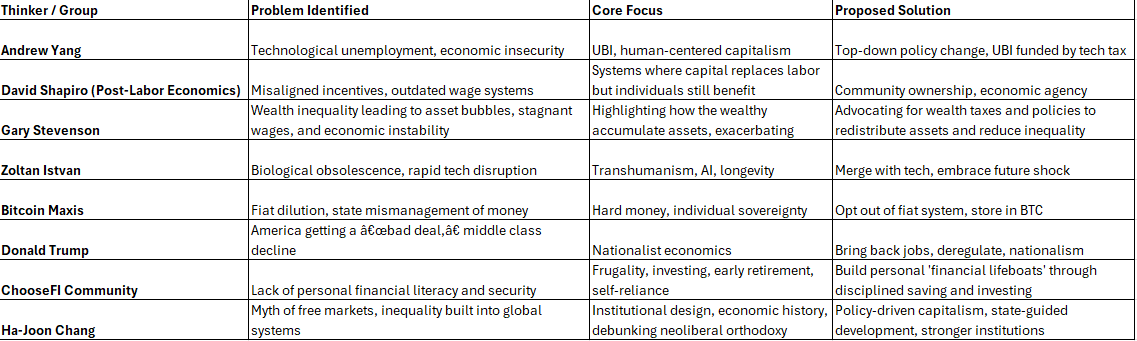
I generated the above table using ChatGPT. I have been invovled in all of these communities that are swirling around the same ideas. I wish I could get them to work together.
ChatGPT also generated the below. It’s not perfect but I wanted to publish it because I want to.
offer it to the world
open for critique and improvements.
The Earned World Manifesto
A Declaration for Builders, Not Rent-Seekers
1. The Problem We See
The current system extracts more than it empowers. It rewards proximity to power, not creation of value. It builds systems that entrench dependency, then calls that stability.
We see:
Productivity rising — but wages stagnating
Knowledge abundant — but credentials gatekept
Labor outsourced — but profit hoarded
Currency inflated — but savings eroded
Talent global — but opportunity gated
Work automated — but ownership concentrated
This is not an accident. The rules are rigged — and the game is extraction.
2. What We Believe
🧱 Agency Is Non-Negotiable
Each individual has the right — and the responsibility — to direct their life. Freedom is not given. It is constructed.
📈 Value Should Flow to the Builder
The person who creates, fixes, or risks should own the upside. Rent-seeking is a tax on the capable.
🧠 Education Must Be Sovereign
Learning is abundant. Gatekeeping it is theft. We reject the credential treadmill in favor of demonstrated skill.
💰 Money Must Be Earned and Preserved
Currency debasement is economic theft. Savings must store effort, not melt it.
🔐 Ownership Is the Foundation
He who owns the tool, the platform, the protocol — holds the power. We choose ownership over permission.
3. What We Support
This is not a utopia. It is a direction.
We support:
🔸 Individuals achieving financial independence through disciplined action
🔸 Workers becoming owners, not just operators
🔸 Monetary systems (like Bitcoin) that cannot be corrupted
🔸 Skill-first pathways over debt-fueled credentials
🔸 Systems that reward contribution, not compliance
🔸 Local or global opt-out zones where new rules can be tested
We reject:
Coerced redistribution
Forced altruism
Dependence disguised as security
4. Our Two-Stage Strategy
🛶 Stage 1: Build your lifeboat. Earn freedom through action. Reduce expenses, save in hard assets, develop durable skills, and reclaim your time.
🏛️ Stage 2: Rebuild the harbor. Use your freedom to build systems that don’t demand sacrifice to survive. Not as charity — but as infrastructure for agency.
5. Join Us
We are the builders. The earners. The ones who won’t rent our future.
We will:
Speak plainly about value and power
Share tools, not just tweets
Reward proof-of-work, not status
Create systems where sovereignty scales
If you’re tired of extraction, If you still believe in ownership, If you’re ready to build —
Welcome to the Earned World.
As I was generating the Manifesto, I had a lot of conversation with ChatGPT. Below was a powerful statement it had.
“The current system extracts more than it empowers.”
This means that the rewards of the modern economy are disproportionately claimed by systems, institutions, and owners — not by the individuals doing the work or taking the risk. The value flows upward, while the burden flows downward.
Here’s what that looks like across different dimensions:
💼 In Work
Wages have stagnated while productivity and corporate profits rise.
Most workers trade time for money with little long-term upside (no ownership, equity, or growth path).
Gig work and contract labor shift costs (insurance, risk, taxes) to the individual while stripping stability.
Extraction: Time, energy, creativity — taken for a wage that doesn’t keep up with cost of living. Empowerment: Would mean building ownership, autonomy, or long-term equity from your work.
💸 In Money
Fiat currency loses purchasing power over time (inflation), punishing savers and wage earners.
Asset inflation (stocks, real estate) benefits those who already hold wealth — not those trying to build it.
Central banks and governments distort money supply in ways individuals cannot control or escape.
Extraction: Your savings melt while those close to the money printer get richer. Empowerment: Would mean access to stable, sovereign, permissionless money, Bitcoin.
🏥 In Healthcare
Healthcare is tied to employment — meaning you’re not truly free to leave your job.
Insurance costs rise faster than wages; many avoid treatment due to fear of bills.
Extraction: Your health and security are used to bind you to jobs and debt. Empowerment: Would mean decoupling basic needs from corporate control.
🏠 In Housing
Real estate is increasingly used as an investment vehicle, not a place to live.
Young people are priced out of ownership, forced into permanent renting.
Extraction: Rent drains wealth every month with no asset built. Empowerment: Would mean pathways to ownership, equity, or cooperative housing.
🎓 In Education
Education costs have exploded, leading to decades-long student debt burdens.
The credential economy keeps people in a treadmill of debt just to be “qualified.”
Extraction: You pay to enter the game, and the game changes by the time you finish. Empowerment: Would mean low-cost, high-agency pathways to skill and livelihood.
🤖 In Technology
Tech companies extract your attention, data, and time to sell to advertisers.
Users create content and community, but ownership and profits go to platforms.
Extraction: You are the product. Empowerment: Would mean open platforms, data sovereignty, and user-owned networks.
🔁 Why This Matters
When a system extracts more than it empowers, it means:
The average person gets poorer in power, even if they get richer in consumption.
Stability, dignity, and control are replaced with dependency and precarity.
People become functionaries, not free agents.
Stagnation in the U.S. and suppression in Mexico are two symptoms of the same disease:
A system where capital moves freely, but labor and ownership do not.
Personal sovereignty is the prerequisite for systemic sovereignty.
Entrepreneurship without savings is economic quicksand.
I think there are solutions to a lot of these propblems. But this is teh start of framing for myself to think more about solutions.
I encourage everyone in the communities I identified to read this as well as consider how they coudl work to make their own lives better as well as make the system better.
I want to highlight the 2 step process.
🛶 Stage 1: Build your lifeboat. Earn freedom through action. Reduce expenses, save in hard assets, develop durable skills, and reclaim your time.
🏛️ Stage 2: Rebuild the harbor. Use your freedom to build systems that don’t demand sacrifice to survive. Not as charity — but as infrastructure for agency.
While I believe everyone is capable of building their lifeboat, it is certainly harder for some than others.
Please comment with any thoughts you have to update this. Please feed this into AI and discuss with it how you might make chagnes to or improve it.
Here are a few resources I referenced when thinking about this.
Introduction In recent years, the corporate world has witnessed a historic shift in treasury strategies, with several prominent companies incorporating Bitcoin into their reserves. Despite these significant changes, many finance professors continue to dismiss or ignore the implications of this trend. During my MBA studies, I have personally discussed or emailed with six finance professors over the last three years about Bitcoin. None of them have shown any curiosity or willingness to engage in meaningful discussions about this topic. While I cannot speak for all finance professors, this has been my experience with those I have interacted with. This paper aims to highlight the lack of intellectual curiosity among academics in the face of obvious transformations in corporate and global environments.
The Corporate Shift to Bitcoin The adoption of Bitcoin by companies such as MicroStrategy, Tesla, and Block Inc. marks a pivotal change in how corporate treasuries manage their assets. These companies view Bitcoin as a strategic asset, providing a hedge against inflation and currency debasement. MicroStrategy, for instance, has aggressively acquired Bitcoin, making it the largest Bitcoin treasury in the world. This trend began around 2020 and has continued to gain traction, signaling a shift in corporate treasury management.
In the last month, several other companies have also announced Bitcoin treasury strategies:
Genius Group: An AI-powered education group that has committed 90% or more of its current and future reserves to be held in Bitcoin 1.
Worksport: A U.S.-based provider of pickup truck solutions that is adding cryptocurrency to its corporate treasury strategy 1.
Rumble: A video platform targeting a conservative audience, planning to invest up to $20 million of surplus cash in Bitcoin 2.
Metaplanet: A company with clearly stated strategy reserve asset goals and reasoning 3.
Strategy (previously MicroStrategy): Continues to lead the way with its Bitcoin treasury strategy 3.
Government Recognition of Bitcoin The U.S. government has also acknowledged the significance of Bitcoin by establishing a Strategic Bitcoin Reserve and a U.S. Digital Asset Stockpile. This move underscores the growing acceptance of Bitcoin as a store of value and its potential role in national economic strategies.
Personal Experience with Academic Dismissal Over the past three years, I have personally discussed or emailed with six finance professors during my MBA studies about the topic of Bitcoin. Despite the clear and significant changes in corporate treasury strategies, none of these professors have shown any curiosity or willingness to engage in meaningful discussions about Bitcoin. This lack of interest is particularly surprising given the relevance of Bitcoin to contemporary financial practices and corporate strategies and the fact that there are not many innovations in Corporate Treasury operations. When a new idea comes along you would expect people to be interested to consider if it has any value.
The Importance of Intellectual Curiosity Intellectual curiosity is a cornerstone of academic excellence. It drives innovation, fosters critical thinking, and encourages the exploration of new ideas. The reluctance of finance professors to engage with the topic of Bitcoin reflects a stagnation in intellectual curiosity that is detrimental to both students and the broader academic community.
Conclusion The corporate shift to Bitcoin represents a significant change in treasury strategies that warrants academic attention. Professors should embrace intellectual curiosity and explore the implications of this trend, rather than dismissing it. By doing so, they can provide students with a comprehensive understanding of the evolving financial landscape and prepare them for the future.
Gary, your crusade against inequality is spot-on—the rich hoard wealth, wages stagnate, and housing slips out of reach. You’ve nailed how the system’s rigged, profiting off disparity as you did at Citibank. But your dismissal of Bitcoin as a “scam” or “musical chairs” misses its point. Let’s break it down through your lens. You see value in what’s tangible—property, bonds, cash flows. Bitcoin’s different: it’s digital scarcity, forged by energy-intensive mining, not free “points on the internet.” It costs real resources—miners burn electricity rivaling small nations to secure it. That’s not hype; that’s a backbone. You’ve said wealth concentration tanks demand, keeping rates low. Bitcoin flips that script. It’s not controlled by banks or governments printing money for the elite—it’s capped at 21 million coins, a hedge against inflation you’ve seen erode workers’ lives. You fear Satoshi’s a shadowy puppetmaster, selling off a million coins to dupe the masses. Check the blockchain—those wallets haven’t moved in 16 years. No secret dump, no conspiracy. Bitcoin’s transparent; anyone can verify it. You’d spot a scam in derivatives a mile away—apply that here. It’s not a rich man’s toy; it’s open to anyone with a phone, from East London to Lagos, leveling a field you know is uneven. You’re right about speculative bubbles, but Bitcoin’s survived crashes—$20K in 2017 to $3K, now thriving in 2025 with institutional buy-in. It’s not about quick riches; it’s a store of value, like digital gold, for a world you’ve seen fail the poor. You’ve bet against broken systems before. Bitcoin’s a bet for one—decentralized, fair, and tough as nails. Give it a trader’s eye, Gary. It’s not the enemy; it’s a tool.
I wanted to share a few quotes from history to highlight that the control and debasement of money by governments has been an issue for a long time. The faster everyone understands this the faster we can all get on the bitcoin standard for value preservation.
I explain here why we should support the bitcoin experiment. It solves the problem. If it ends up failing for some reason in the future, we need to recreate Bitcoin and address whatever issue made it fail because we need a currency that can’t be debased by governments.
“It is utterly clear to me that the highest priority need of world society at the present moment is a realistic economic accounting system which will rectify, for instance, such nonsense as the fact that a top toolmaker in India, the highest paid of all craftsman, gets only as much per month for his work in India as he could earn per day for the same work if he were employed in Detroit, Michigan. – Page 112 Operating Manual For Spaceship Earth, Buckminster Fuller
F.A. Hayek in 1984: “I don’t believe we shall ever have a good money again before we take the thing out of the hands of government, that is, we can’t take it violently out of the hands of government, all we can do is by some sly roundabout way introduce something that they can’t stop.”
“It is well enough that people of the nation do not understand our banking and monetary system, for if they did, I believe there would be a revolution before tomorrow morning.”
“Under the energy currency system the standard would be a certain amount of energy exerted for one hour that would be equal to one dollar. It’s simply a case of thinking and calculating in terms different from those laid down to us by the international banking group to which we have grown so accustomed that we think there is no other desirable standard.”
Bitcoin recently breached the $100k price per bitcoin on December 4th 2024. It has retreated slightly but has continued to hover between $90k -$108k/bitcoin.
Historically bitcoin has had a performance of 3 positive years followed by 1 negative year. While you can’t expect history to repeat itself, it might!
Looking at the below chart you can see we are on track to repeat that performance so far. While not shown 2024 was also a great positive return year for bitcoin so we have 2 years of positive returns. 2025 would be the 3rd year.
Due to that expectation I fully expect bitcoin to have a good performance in 2025. It is also possible that it has a negative year in 2026 if it continues to follow the historic trend.
Of course it is also possible it has a negative year in 2025! We could break the trend.
We could also break the trend and see that we have a positive year in 2025 and 2026! The future is unknown and unknowable!
When people ask me if they should buy bitcoin now I say that they obviously don’t understand bitcoin. If you don’t understand it then I would say “No” you probably shouldn’t buy it. What I tell people is to continue to learn more about why other people buy it.
Learn about “What problem bitcoin solves.” I have written 2 articles about that here.
We, every person in the world, is in a fight with their own government to keep as much of the value they create as they can. The government explicitly taxes you, which we can debate but at least it is obvious. But the government also stealthy steals value from your bank account or savings via inflation and money printing that you have no control over.
Bitcoin is not an investment. Bitcoin is a store of value. The value you create. Bitcoin is an agreement between people who create value in the world that they will trade their value for other value. The value you create and store in Bitcoin cannot be debased or inflated away by any government by money printing. I’ve also created a list of great resources to learn more about bitcoin here.
What I generally recommend people to do is to buy just a little bitcoin so that they will start creating a little interest with themselves. This is how I did it. I bought just $100 and then that made me interested to learn more about what I had bought and why. You should not plan to sell the bitcoin you buy. This is true for most investments, in my opinion. You should only be investing money you are ready to have invested for 5+ years.
You shouldn’t try to time the market. You aren’t smart enough for that and neither am I.
Just buy things that you understand and continue to do research.
I hope with my bitcoin advocacy to help people think more long term.
Why do I spend so much time thinking about bitcoin?
Why do I spend so much time trying to get others to understand bitcoin?
I have thought about a lot of other things in my lifetime. I am a mechanical engineer. I like making thing work. I am a philanthropist. I am a humanitarian. I care about making others’ lives better. I have worked at businesses and nonprofits that have helped make the world a better place. I have thought about how to create businesses and nonprofits that make the world a better place.
Through it all, I keep looking for ways to make the world better.
Bitcoin is the best way I have found to make an impact on EVERYTHING! It has become clear to me through all my reading and interacting with people and companies and nonprofits and thinking about issues that at the very base, fiat money is inherently causing a lot of problems in the world.
Fiat money is unfair.
The government causes as many or more issues than it solves by creating inflation through money printing. This is both in the USA and all other countries.
I talked with a friend who was supporting a business in Sri Lanka. The business would dye clothes with natural processes. The point was to help people get a job that otherwise wouldn’t have access to a job. But the Sri Lankan economic crisis happened and the business failed. It made me think about the base infrastructure of all our economies. If the currency fails many businesses fail. A stable currency leads to long term planning and thinking. The fact that all countries have money that is steadily losing value leads to short term thinking. The rush for analysis of quarterly returns for public companies adds to this short term thinking, but steady inflation, caused by government money printing is a major contributor to the short term thinking. I wondered, what is the point of developing businesses if they will fail due to factors outside your control?
That is why I am so passionate about bitcoin. It fixes these short term problems. This is a problem is many countries around the world.
People in many countries can’t save in their local currency because they lose value so fast. In the USA we recently had 1 year of 8% inflation and everyone went crazy!
I fully expect that increased inflation to come back to the USA sometime in the next 10 years, unless we cut the yearly deficit.
Even if it doesn’t come back for a few years, the way the current system is, fiat money, there is always steady inflation (3%-4%) which still incentivises short term thinking.
I hope with my bitcoin advocacy to help people think more long term.