Earned World Manifesto – Thinkers I Wish to Unite

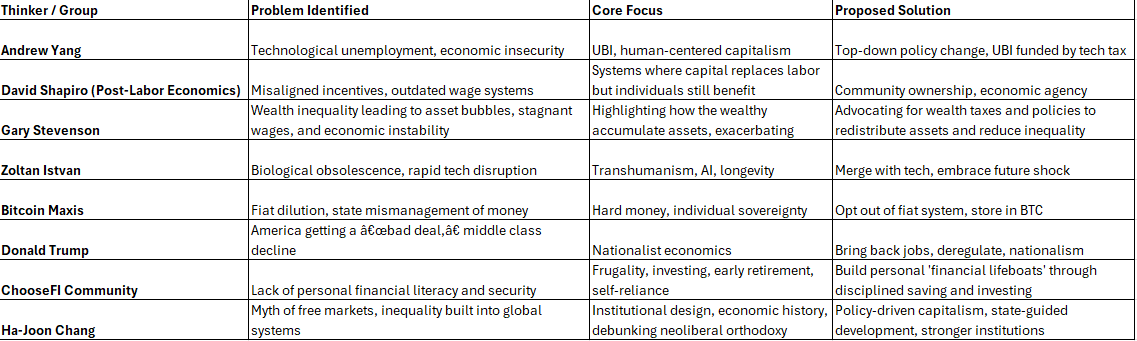
I generated the above table using ChatGPT. I have been invovled in all of these communities that are swirling around the same ideas. I wish I could get them to work together.

ChatGPT also generated the below. It’s not perfect but I wanted to publish it because I want to.

  1. offer it to the world
  2. open for critique and improvements.

The Earned World Manifesto

A Declaration for Builders, Not Rent-Seekers

1. The Problem We See

The current system extracts more than it empowers.
It rewards proximity to power, not creation of value.
It builds systems that entrench dependency, then calls that stability.

We see:

  • Productivity rising — but wages stagnating
  • Knowledge abundant — but credentials gatekept
  • Labor outsourced — but profit hoarded
  • Currency inflated — but savings eroded
  • Talent global — but opportunity gated
  • Work automated — but ownership concentrated

This is not an accident.
The rules are rigged — and the game is extraction.


2. What We Believe

🧱 Agency Is Non-Negotiable

Each individual has the right — and the responsibility — to direct their life.
Freedom is not given. It is constructed.

📈 Value Should Flow to the Builder

The person who creates, fixes, or risks should own the upside.
Rent-seeking is a tax on the capable.

🧠 Education Must Be Sovereign

Learning is abundant. Gatekeeping it is theft.
We reject the credential treadmill in favor of demonstrated skill.

💰 Money Must Be Earned and Preserved

Currency debasement is economic theft.
Savings must store effort, not melt it.

🔐 Ownership Is the Foundation

He who owns the tool, the platform, the protocol — holds the power.
We choose ownership over permission.


3. What We Support

This is not a utopia. It is a direction.

We support:

  • 🔸 Individuals achieving financial independence through disciplined action
  • 🔸 Workers becoming owners, not just operators
  • 🔸 Monetary systems (like Bitcoin) that cannot be corrupted
  • 🔸 Skill-first pathways over debt-fueled credentials
  • 🔸 Systems that reward contribution, not compliance
  • 🔸 Local or global opt-out zones where new rules can be tested

We reject:

  • Coerced redistribution
  • Forced altruism
  • Dependence disguised as security

4. Our Two-Stage Strategy

🛶 Stage 1: Build your lifeboat.
Earn freedom through action.
Reduce expenses, save in hard assets, develop durable skills, and reclaim your time.

🏛️ Stage 2: Rebuild the harbor.
Use your freedom to build systems that don’t demand sacrifice to survive.
Not as charity — but as infrastructure for agency.


5. Join Us

We are the builders. The earners. The ones who won’t rent our future.

We will:

  • Speak plainly about value and power
  • Share tools, not just tweets
  • Reward proof-of-work, not status
  • Create systems where sovereignty scales

If you’re tired of extraction,
If you still believe in ownership,
If you’re ready to build —

Welcome to the Earned World.

As I was generating the Manifesto, I had a lot of conversation with ChatGPT. Below was a powerful statement it had.

“The current system extracts more than it empowers.”

This means that the rewards of the modern economy are disproportionately claimed by systems, institutions, and owners — not by the individuals doing the work or taking the risk. The value flows upward, while the burden flows downward.

Here’s what that looks like across different dimensions:


💼 In Work
  • Wages have stagnated while productivity and corporate profits rise.
  • Most workers trade time for money with little long-term upside (no ownership, equity, or growth path).
  • Gig work and contract labor shift costs (insurance, risk, taxes) to the individual while stripping stability.

Extraction: Time, energy, creativity — taken for a wage that doesn’t keep up with cost of living.
Empowerment: Would mean building ownership, autonomy, or long-term equity from your work.


💸 In Money
  • Fiat currency loses purchasing power over time (inflation), punishing savers and wage earners.
  • Asset inflation (stocks, real estate) benefits those who already hold wealth — not those trying to build it.
  • Central banks and governments distort money supply in ways individuals cannot control or escape.

Extraction: Your savings melt while those close to the money printer get richer.
Empowerment: Would mean access to stable, sovereign, permissionless money, Bitcoin.


🏥 In Healthcare
  • Healthcare is tied to employment — meaning you’re not truly free to leave your job.
  • Insurance costs rise faster than wages; many avoid treatment due to fear of bills.

Extraction: Your health and security are used to bind you to jobs and debt.
Empowerment: Would mean decoupling basic needs from corporate control.


🏠 In Housing
  • Real estate is increasingly used as an investment vehicle, not a place to live.
  • Young people are priced out of ownership, forced into permanent renting.

Extraction: Rent drains wealth every month with no asset built.
Empowerment: Would mean pathways to ownership, equity, or cooperative housing.


🎓 In Education
  • Education costs have exploded, leading to decades-long student debt burdens.
  • The credential economy keeps people in a treadmill of debt just to be “qualified.”

Extraction: You pay to enter the game, and the game changes by the time you finish.
Empowerment: Would mean low-cost, high-agency pathways to skill and livelihood.


🤖 In Technology
  • Tech companies extract your attention, data, and time to sell to advertisers.
  • Users create content and community, but ownership and profits go to platforms.

Extraction: You are the product.
Empowerment: Would mean open platforms, data sovereignty, and user-owned networks.


🔁 Why This Matters

When a system extracts more than it empowers, it means:

  • The average person gets poorer in power, even if they get richer in consumption.
  • Stability, dignity, and control are replaced with dependency and precarity.
  • People become functionaries, not free agents.

Stagnation in the U.S. and suppression in Mexico are two symptoms of the same disease:

A system where capital moves freely, but labor and ownership do not.

Personal sovereignty is the prerequisite for systemic sovereignty.

Entrepreneurship without savings is economic quicksand.

I think there are solutions to a lot of these propblems. But this is teh start of framing for myself to think more about solutions.

I encourage everyone in the communities I identified to read this as well as consider how they coudl work to make their own lives better as well as make the system better.

I want to highlight the 2 step process.

🛶 Stage 1: Build your lifeboat.
Earn freedom through action.
Reduce expenses, save in hard assets, develop durable skills, and reclaim your time.

🏛️ Stage 2: Rebuild the harbor.
Use your freedom to build systems that don’t demand sacrifice to survive.
Not as charity — but as infrastructure for agency.

While I believe everyone is capable of building their lifeboat, it is certainly harder for some than others.

Please comment with any thoughts you have to update this.
Please feed this into AI and discuss with it how you might make chagnes to or improve it.

Here are a few resources I referenced when thinking about this.

Gold, Silver, Debt To GDP, Wealth Preservation

The Idea of Bitcoin Needs to Succeed, Even if Bitcoin Fails

World Wage and Work

23 Things They Don’t Tell You About Capitalism -Ha-Joon Chang

Post Labor Econonomics Videos – David Shapiro

The Intellectual Stagnation in Academia: Ignoring the Corporate Shift to Bitcoin

Introduction In recent years, the corporate world has witnessed a historic shift in treasury strategies, with several prominent companies incorporating Bitcoin into their reserves. Despite these significant changes, many finance professors continue to dismiss or ignore the implications of this trend. During my MBA studies, I have personally discussed or emailed with six finance professors over the last three years about Bitcoin. None of them have shown any curiosity or willingness to engage in meaningful discussions about this topic. While I cannot speak for all finance professors, this has been my experience with those I have interacted with. This paper aims to highlight the lack of intellectual curiosity among academics in the face of obvious transformations in corporate and global environments.

The Corporate Shift to Bitcoin The adoption of Bitcoin by companies such as MicroStrategy, Tesla, and Block Inc. marks a pivotal change in how corporate treasuries manage their assets. These companies view Bitcoin as a strategic asset, providing a hedge against inflation and currency debasement. MicroStrategy, for instance, has aggressively acquired Bitcoin, making it the largest Bitcoin treasury in the world. This trend began around 2020 and has continued to gain traction, signaling a shift in corporate treasury management.

In the last month, several other companies have also announced Bitcoin treasury strategies:

  • Genius Group: An AI-powered education group that has committed 90% or more of its current and future reserves to be held in Bitcoin 1.
  • Worksport: A U.S.-based provider of pickup truck solutions that is adding cryptocurrency to its corporate treasury strategy 1.
  • Rumble: A video platform targeting a conservative audience, planning to invest up to $20 million of surplus cash in Bitcoin 2.
  • Metaplanet: A company with clearly stated strategy reserve asset goals and reasoning 3.
  • Strategy (previously MicroStrategy): Continues to lead the way with its Bitcoin treasury strategy 3.

Government Recognition of Bitcoin The U.S. government has also acknowledged the significance of Bitcoin by establishing a Strategic Bitcoin Reserve and a U.S. Digital Asset Stockpile. This move underscores the growing acceptance of Bitcoin as a store of value and its potential role in national economic strategies.

Personal Experience with Academic Dismissal Over the past three years, I have personally discussed or emailed with six finance professors during my MBA studies about the topic of Bitcoin. Despite the clear and significant changes in corporate treasury strategies, none of these professors have shown any curiosity or willingness to engage in meaningful discussions about Bitcoin. This lack of interest is particularly surprising given the relevance of Bitcoin to contemporary financial practices and corporate strategies and the fact that there are not many innovations in Corporate Treasury operations. When a new idea comes along you would expect people to be interested to consider if it has any value.

The Importance of Intellectual Curiosity Intellectual curiosity is a cornerstone of academic excellence. It drives innovation, fosters critical thinking, and encourages the exploration of new ideas. The reluctance of finance professors to engage with the topic of Bitcoin reflects a stagnation in intellectual curiosity that is detrimental to both students and the broader academic community.

Conclusion The corporate shift to Bitcoin represents a significant change in treasury strategies that warrants academic attention. Professors should embrace intellectual curiosity and explore the implications of this trend, rather than dismissing it. By doing so, they can provide students with a comprehensive understanding of the evolving financial landscape and prepare them for the future.

Essay: Why Gary Stevenson Should Rethink Bitcoin

@garyseconomics

Gary, your crusade against inequality is spot-on—the rich hoard wealth, wages stagnate, and housing slips out of reach. You’ve nailed how the system’s rigged, profiting off disparity as you did at Citibank. But your dismissal of Bitcoin as a “scam” or “musical chairs” misses its point. Let’s break it down through your lens. You see value in what’s tangible—property, bonds, cash flows. Bitcoin’s different: it’s digital scarcity, forged by energy-intensive mining, not free “points on the internet.” It costs real resources—miners burn electricity rivaling small nations to secure it. That’s not hype; that’s a backbone. You’ve said wealth concentration tanks demand, keeping rates low. Bitcoin flips that script. It’s not controlled by banks or governments printing money for the elite—it’s capped at 21 million coins, a hedge against inflation you’ve seen erode workers’ lives. You fear Satoshi’s a shadowy puppetmaster, selling off a million coins to dupe the masses. Check the blockchain—those wallets haven’t moved in 16 years. No secret dump, no conspiracy. Bitcoin’s transparent; anyone can verify it. You’d spot a scam in derivatives a mile away—apply that here. It’s not a rich man’s toy; it’s open to anyone with a phone, from East London to Lagos, leveling a field you know is uneven. You’re right about speculative bubbles, but Bitcoin’s survived crashes—$20K in 2017 to $3K, now thriving in 2025 with institutional buy-in. It’s not about quick riches; it’s a store of value, like digital gold, for a world you’ve seen fail the poor. You’ve bet against broken systems before. Bitcoin’s a bet for one—decentralized, fair, and tough as nails. Give it a trader’s eye, Gary. It’s not the enemy; it’s a tool.

@satmojoe

@Jcastweet

@PeterMcCormack

@HawkMcFlipster

@Oriflamme87

What Problem Does Bitcoin Solve? part 3 Buckminster Fuller, F.A Hayek & Henry Ford’s comments

I’ve written a few things about why bitcoin is the solution to many problems. 

Here for What problem does Bitcoin solve part 1 and here for what problem does bitcoin solve part 2 and here for “Why Bitcoin?

I wanted to share a few quotes from history to highlight that the control and debasement of money by governments has been an issue for a long time. The faster everyone understands this the faster we can all get on the bitcoin standard for value preservation. 

I explain here why we should support the bitcoin experiment. It solves the problem. If it ends up failing for some reason in the future, we need to recreate Bitcoin and address whatever issue made it fail because we need a currency that can’t be debased by governments. 

The Idea of Bitcoin Needs to Succeed, Even if Bitcoin Fails

“It is utterly clear to me that the highest priority need of world society at the present moment is a realistic economic accounting system which will rectify, for instance, such nonsense as the fact that a top toolmaker in India, the highest paid of all craftsman, gets only as much per month for his work in India as he could earn per day for the same work if he were employed in Detroit, Michigan.  – Page 112 Operating Manual For Spaceship Earth, Buckminster Fuller

F.A. Hayek in 1984: “I don’t believe we shall ever have a good money again before we take the thing out of the hands of government, that is, we can’t take it violently out of the hands of government, all we can do is by some sly roundabout way introduce something that they can’t stop.”

“It is well enough that people of the nation do not understand our banking and monetary system, for if they did, I believe there would be a revolution before tomorrow morning.”

― Henry Ford

Ford, who founded Ford Motor Company in 1903, told the publication:

“Under the energy currency system the standard would be a certain amount of energy exerted for one hour that would be equal to one dollar. It’s simply a case of thinking and calculating in terms different from those laid down to us by the international banking group to which we have grown so accustomed that we think there is no other desirable standard.”

Bitcoin is $100k, Should I Buy It Now Or Is It Too Expensive?

Bitcoin recently breached the $100k price per bitcoin on December 4th 2024. It has retreated slightly but has continued to hover between $90k -$108k/bitcoin. 

Historically bitcoin has had a performance of 3 positive years followed by 1 negative year. While you can’t expect history to repeat itself, it might!

Looking at the below chart you can see we are on track to repeat that performance so far. While not shown 2024 was also a great positive return year for bitcoin so we have 2 years of positive returns. 2025 would be the 3rd year. 

Due to that expectation I fully expect bitcoin to have a good performance in 2025. It is also possible that it has a negative year in 2026 if it continues to follow the historic trend. 

 Of course it is also possible it has a negative year in 2025! We could break the trend. 

We could also break the trend and see that we have a positive year in 2025 and 2026! The future is unknown and unknowable!

When people ask me if they should buy bitcoin now I say that they obviously don’t understand bitcoin. If you don’t understand it then I would say “No” you probably shouldn’t buy it. What I tell people is to continue to learn more about why other people buy it. 

Learn about “What problem bitcoin solves.” I have written 2 articles about that here. 

What Problem Does Bitcoin Solve?

We, every person in the world, is in a fight with their own government to keep as much of the value they create as they can.  The government explicitly taxes you, which we can debate but at least it is obvious.  But the government also stealthy steals value from your bank account or savings via inflation and money printing that you have no control over.

What is Money? (What Problem Does Bitcoin Solve -2)

Bitcoin is not an investment. Bitcoin is a store of value. The value you create. Bitcoin is an agreement between people who create value in the world that they will trade their value for other value. The value you create and store in Bitcoin cannot be debased or inflated away by any government by money printing.
I’ve also created a list of great resources to learn more about bitcoin here. 

Books & Videos to Learn About Bitcoin

What I generally recommend people to do is to buy just a little bitcoin so that they will start creating a little interest with themselves. This is how I did it. I bought just $100 and then that made me interested to learn more about what I had bought and why.
You should not plan to sell the bitcoin you buy. This is true for most investments, in my opinion. You should only be investing money you are ready to have invested for 5+ years. 

You shouldn’t try to time the market. You aren’t smart enough for that and neither am I. 

Just buy things that you understand and continue to do research. 

Why Bitcoin?

I hope with my bitcoin advocacy to help people think more long term.

Why do I spend so much time thinking about bitcoin?

Why do I spend so much time trying to get others to understand bitcoin?

I have thought about a lot of other things in my lifetime. I am a mechanical engineer. I like making thing work. I am a philanthropist. I am a humanitarian. I care about making others’ lives better. I have worked at businesses and nonprofits that have helped make the world a better place. I have thought about how to create businesses and nonprofits that make the world a better place. 

Through it all, I keep looking for ways to make the world better. 

Bitcoin is the best way I have found to make an impact on EVERYTHING! It has become clear to me through all my reading and interacting with people and companies and nonprofits and thinking about issues that at the very base, fiat money is inherently causing a lot of problems in the world. 

Fiat money is unfair. 

The government causes as many or more issues than it solves by creating inflation through money printing. This is both in the USA and all other countries. 

I talked with a friend who was supporting a business in Sri Lanka. The business would dye clothes with natural processes. The point was to help people get a job that otherwise wouldn’t have access to a job. But the Sri Lankan economic crisis happened and the business failed. It made me think about the base infrastructure of all our economies. If the currency fails many businesses fail. A stable currency leads to long term planning and thinking. The fact that all countries have money that is steadily losing value leads to short term thinking. The rush for analysis of quarterly returns for public companies adds to this short term thinking, but steady inflation, caused by government money printing is a major contributor to the short term thinking. I wondered, what is the point of developing businesses if they will fail due to factors outside your control?

That is why I am so passionate about bitcoin. It fixes these short term problems. This is a problem is many countries around the world. 

People in many countries can’t save in their local currency because they lose value so fast. In the USA we recently had 1 year of 8% inflation and everyone went crazy! 

I fully expect that increased inflation to come back to the USA sometime in the next 10 years, unless we cut the yearly deficit. 

Even if it doesn’t come back for a few years, the way the current system is, fiat money, there is always steady inflation (3%-4%) which still incentivises short term thinking.

I hope with my bitcoin advocacy to help people think more long term. 

Books & Videos to Learn About Bitcoin

Below is a list of videos, a PDF and some books I have put together to recommend for anyone who wants to learn about bitcoin. The list is most sorted from top to bottom by shortest or easiest to read to longer and more in depth towards the bottom.

Blackrock – IBIT ETF Bitcoin Page – Has a link to a 3 minute video.

Bitcoin First Revisited – PDF from Fidelity

What’s The Problem? – Demystifying why we all need Bitcoin – Joe Bryan

The world feels like it’s heading in the wrong direction—rising costs, declining standards, and growing instability. The root cause? The corruption of our money.

The Bitcoin Paradigm Shift: A Beginner’s Journey to Understanding BTC (2025) – shortest video I can find yet that explains it well!

The bullish case for Bitcoin – Vijay Boyapati ~ 2 hour book read – link below to buy

https://bitcoin-resources.com/books/the-bullish-case-for-bitcoin

Below is a link to the blog post that inspired the book “The bullish case for bitcoin” if you want to read this for free instead.

https://vijayboyapati.medium.com/the-bullish-case-for-bitcoin-6ecc8bdecc1

The Bitcoin Standard – Saifedean Ammous  

The Saylor Series- with Robert Breedlove -You only need to listen to about the first 1 hour of each interview where Michael Saylor is talking. The 2nd half is Robert Breedlove summarizing what Michael said. Not necessary to listen to.

The Saylor Series What is Money – Book – summary of the above podcast. This is shorter than the podcast.

EXCLUSIVE: TESLA’S $1 Billion Bitcoin Bet Pays Off | Cern Basher – A great summary of why Tesla (or any company) should buy more Bitcoin.

Broken Money: Why Our Financial System is Failing Us and How We Can Make it Better- Lyn Alden

Extra – Can bitcoin mining empower energy transition and fuel sustainable development goals in the US?

Metaplanet – Japanese Public Company Buying Bitcoin as a Treasury Reserve Asset

Metaplanet  – Japanese Public Company Buying Bitcoin as a Treasury Reserve Asset

Metaplanet is a publicly traded company in Japan that has set Bitcoin as its primary treasury reserve asset. You can read about it here. You will have to click on their link to their “official disclosure” or you can link directly to the PDF of the official disclosure here. 

You can listen to Dylan LeClair, the Director of Bitcoin Strategy at MetaPlanet, here talk about MetaPlanet and their Bitcoin Strategy. The link takes you to the correct timestamp in the Youtube Video.

 I highly recommend everyone reads this. It lays out in simple, clear language, the benefits to the company of buying bitcoin as their treasury reserve asset. Most of their reasoning applies to individuals also.  I’d like to repost it here directly, but they have requested no reproductions. I have emailed them asking if it’s possible to repost it and will if they allow it. But if not, you can read at the link above. It’s only a 3 page document. 

Metaplanet is the first public company in Japan I am aware of that has started using Bitcoin as it’s treasury reserve asset. But it wasn’t the first worldwide and I’m sure it won’t be the last. 


Here is a previous article I wrote about companies and pension funds starting to buy Bitcoin. 

A short list of those companies is below.

Metaplanet – Metaplanet direct link to PDF

Microstrategy 

Mara – Bitcoin miner

Semler Scientific

Onemed

Block (formally Square, owns Square processing points and Cashapp app)

Private company –

Tahini’s (corporate page) – Restaurant in Canada – Tahini bitcoin article

As well as all these companies continually buying bitcoin, there are 2 US state pension funds that have bought bitcoin they have disclosed so far.

Wisconsin Pension Fund

Michigan Pension Fund

And one, Arizona, that has a resolution for their pension fund to learn about it. Here is the resolution directly.

There are a few other countries that are involved in mining bitcoin. 

Bhutan 

Oman

Ethiopia

Finally, El Salvador is the first country to adopt bitcoin as legal tender. It is also committed to buying 1 bitcoin a day. You can follow directly in their bitcoin address. 

Again, it was the first ,but I doubt it will be the last. 

At this link is a list of all companies holding bitcoin. The above lists are more recent companies and companies that are actively proclaiming that they are accumulating more bitcoin aggressively. 

A second link with entities holding bitcoin. 

0.1 Bitcoin

There are about 8 billion (8,000,000,000) people in the world. 

According to Kiplinger, globally there are about 59 million millionaires. 

59,000,000/8,000,000,000 = 0.007375 =  0.7375% of people in the world are millionaires. So less than 1% of people are millionaires. 

If you divided the 21 million (21,000,000) bitcoin among the 8 billion people

21,000,000/8,000,000,000 = 0.002625

0.002625 x $60,000/btc = $157.50

You only need to buy $157.50 worth of bitcoin to get “your share” today. 

There are 21 million bitcoin that will ever be made. 

There are 59 million millionaires. So it’s not possible for every millionaire to have 1 bitcoin. 

If we divide the 21 million bitcoin by 59 million millionaires we get 

21/59 = 0.35593220 btc per millionaire.

 0.35593220 x $60,000/btc = $21,355.93 if every millionaire wanted to get “their share” of bitcoin and it was only split among millionaires.

If we go down to units of 0.1 bitcoin then 210 million people could own 0.1 bitcoin.

That is still only 

210,000,000 people/ 8,000,000,000 people = 0.02625 = 2.625% of people would have 0.1 bitcoin.

0.1 bitcoin x $60k/bitcoin = $6,000 to buy 0.1 bitcoin today.

If I was someone with no bitcoin today I’d think hard about setting a goal of getting to 0.1 bitcoin. 

The market capitalization of Gold is $16,590,000,000,000 ($16.59 Trillion) as of 8-11-2024 when I write this.  Note that this changes daily as the price of gold fluctuates and as more gold is mined each year. 

If bitcoin was to attaining the same market capitalization  

$16,590,000,000,000/21,000,000 bitcoin = $790,000 per bitcoin

$790,000 x 0.1 bitcoin = $79,000

If bitcoin was to reach a value of $10 million per Bitcoin then 0.1 bitcoin would be worth $1 million. 

Plenty of people have made a prediction in the millions for the future price of bitcoin. You will have to do research for yourself to determine if you think this is reasonable. But I would encourage you to be inquisitive about why people are prediction such a high price for Bitcoin. 

This isn’t all to tell you you have to buy bitcoin. But it’s to encourage you to look into why many people think bitcoin has value. 


There is not much bitcoin and we are still early as far as world wide adoption. You don’t need to buy much (0.1 bitcoin = $6k today) to potentially have $1 million in the future. 


Of course, only buy as much as you are able to lose! Many people are able to have a risky bet of $6k and if it did happen to go to $0 (which is of course a possibility) they’d still be fine. 

But if that is not you then definitely DON’T buy bitcoin. 


But if you are a person who has sufficient assets, you might try thinking about why so many people have such a high conviction in bitcoin. 

Letter to Iowa State Senator Kevin Alons about Bitcoin

I sent the below letter to Iowa State Senator, Kevin Alons, related to Bitcoin. I encourage you to copy and send, or modify and send, to him at kevin.alons@legis.iowa.gov

Senator Alons

I read through your bill IA SF2273 related to gold and silver coinage. I appreciate the sentiment and wish you luck with your bill in the future if you continue to pursue it. 


I wanted to appeal to your hard money side with some data about the emerging hardest money ever created, Bitcoin.


As you know, Gold backed currency has failed in many different countries in history for the same reason. The government always centralizes the gold and prints more paper than can back the bills. Even in Ancient Rome when the money was silver, there was coin clipping and physical debasement where existing coins were recalled and melted down to a lower percentage of gold. 

Another issue with Gold is that we don’t actually know how much there is. More gold is mined everyday and more is mined as the price goes up. 

Bitcoin addresses all the shortcomings of Gold that have caused it to fail in the past. 


Bitcoin has a perfectly limited amount, 21 million.

Bitcoin is quickly and easily transmitted across the world. You need a lot of military hardware to transport any significant amount of gold.
Bitcoin is also easily transacted in very small amounts. The smallest unit of 1 bitcoin is 1 satoshi. There are 100,000,000 satoshis in 1 bitcoin. 

0.00000001 Bitcoin = 1 Satoshi. 

Bitcoin currently has a market capitalization of about $1 trillion.

Once 1 BTC = $1 million, it will have a market capitalization of $21 trillion and 1 satoshi will = 

$0.01

Using the lightning network consumers are easily able to make very small transactions such as at a grocery store or a restaurant. 

If you read this post on my website, https://mywheellife.com/2024/06/23/2024-bitcoin-adoption/, you will see that there are a lot of large institutions like the Wisconsin state pension adding bitcoin to their portfolio.
It is also legal tender in El Salvador and they are buying 1 bitcoin a day also to ad to their treasury.

As you have probably seen there are now ETF’s available that have bought 1 million bitcoin this year in the USA only. 


The available supply of 21 million bitcoin is draining quickly. 

I would encourage you to investigate more about bitcoin.

Perhaps you have heard that President Trump has recently endorsed Bitcoin. He is speaking at the Bitcoin Conference in Tennessee this Sunday, 7-28-2024. You should be able to find it on Youtube later.


I would also point you to this video that just came out “Thank God For Bitcoin”

It is one of the best videos I’ve seen to explain the benefits of Bitcoin.

I’d encourage you to introduce a bill, similar to Arizona, to direct the IPERS pension fund to investigate adding bitcoin to the IPERS portfolio. That would be a first step.

A 2nd step would be to have a state reserve of Bitcoin.


Thank you for your time.