The financial advising industry doesn’t work for most people. Advisors charge 1%-2% a year which can cost clients $10k-$40k a year! That is money that people could be living off of instead of giving to advisors.
Other people might have so little money (usually less than $500k is “little” to financial advisors”) that they won’t work with people.
The Giving Solution is a non-profit that provides free financial advising for anyone. If you have $50 or $50 million, The Giving Solution will connect you with a Fee-Only Financial that they have deemed is a trustworthy advisor and will invest in a way that is best for your personal net worth growth. You pay nothing.
They will meet with you via Zoom or other online options if you are unable to meet with them locally. They will meet with anyone, anywhere in the world!
Connect with them yourself.
Share with others who you think could benefit from financial advising.
I keep thinking of new ways to think about what value Bitcoin provides. Below is the way I thought about it today. It started while talking with a friend at a coffee shop about money. We discussed the gold standard and he asked how it would be possible to go to a gold standard today. The market capitalization of all the gold in the world today is only about $13.7 trillion and the value of all the money in the world is around $450 trillion. Gold currently costs about $2,000/oz. To fully back the $450 trillion of money with gold the gold would have to significantly appreciate. It would increase it’s monetary premium. In fact some central banks have explicitly said they are buying more gold in case this happens!
This website, gold survival guide, did a calculation of what you’d have to reprice gold to, in US dollars, to get only a 26% backing. They determined that you’d need gold to be worth $33,690/oz. This would be a significant monetary premium on gold over what it is worth today.
Gold is the most commonly thought of thing that has a monetary premium. Houses are a good example of something that people don’t often think of that has a monetary premium. Many houses are bought by speculators to store value. For example:
Rich Chinese buyers are willing to use houses, which are not very liquid, to store value outside of China. It is a lot simpler way to get value out of the country. It would look a lot more suspicious if they just shipped hundreds of thousands of dollars out of China and parked it in a bank. But to buy a property is an “acceptable” reason to take money out of the country. People are resourceful and will find ways to store value.
People want assets that will rise with inflation. They can be willing to pay more than the utility value of the asset to acquire it. Unfortunately, it’s never explicitly stated or even talked about that some things have a monetary premium on top of their utility value. Commodities like corn or oil have very little or usually no monetary premium.Their only value is from the things they can be used to do. They don’t store well. To have a monetary premium a good has to have a long life, like gold or houses. Stocks are another thing that has a monetary premium.
One thing that also has a monetary premium that is not often talked about is money! People like to talk about the fact that Bitcoin has no “intrinsic value”. Do you know what is another thing that has no intrinsic value? US dollars. Think about it. What gives a dollar its value? It is it’s network effects. It is accepted as valuable by others. Gold has a utility value as well as a monetary premium. Some people get confused by gold having a utility value and they think that any money has to have a utility value. But that is not true, as evidenced by the US dollar, the primary money in the world, having no intrinsic value! In fact there is really only 1 major difference between US dollars and bitcoin. US dollars can be created at will by the US government, and are everyday. This reduces the purchasing power of every existing dollar, including the ones you own and worked to earn.
Bitcoin has a fixed supply. Once you own a fraction of a bitcoin, you own that much of the total bitcoin network. There is no way for anyone to steal your percentage of the network by creating more bitcoin
I often say, if the government quit printing dollars, we wouldn’t need bitcoin. Every government that has had their own currency in history has always printed and debased that currency until it has lost all value. See the Romans. They literally has physical silver coins. They would periodically recall them, melt them down, dilute the silver percentage and reissue them. Initially they would act like they were the same value of coin, but as people came to realize that new coins had less silver they would require more coins for the same goods. So back to the monetary premium. US dollars have no inherent value. Neither does bitcoin. But US dollars have a created monetary premium from their acceptance as a means of payment. There is no reason that bitcoin, or anything else that a group of individuals choose to use as a store of value and means of payment could become that and gain some of the monetary premium that dollars have. In essence we can transfer the monetary premium from dollars to bitcoin, if we choose to. In El Salvador bitcoin is already accepted as a means of payment. Many individuals and businesses around the world have already individually chosen to accept bitcoin as a means of payment. SInce dollars don’t reliably store value, due to the ability of the government to print more, why wouldn’t people choose to store value in a tool that it is impossible to make more of? That is why I choose to store some of my value in bitcoin. If you are interested in talking about the idea of monetary premium more, or the idea of transferring monetary premium from one good to another, get in touch!
I put on my goals for 2024 to write at least 4 letters to politicians this year. This is my 2nd letter. You can find the 1st here. I believe I would find very few people who would be against these ideas. There have been multiple bills proposed to rectify both of these issues. But none has ever been passed by Congress. Why? Ask your politicians. Vote them out if they don’t fix this.
I write these so you can copy, paste, send to your politicians if you agree with these ideas. We often think writing politicians doesn’t do anything, and it might not. But if they know there is large enough support that people will act on (vote them out) if they don’t do what we want, they will eventually do the right thing.
“Bans on stock trading & term limits for Congress are *wildly* popular, yet never get enacted because they run against the self-interest of Congressmen. Here’s the solution: propose legislation requiring it & just “grandfather” exemptions for those enact it. It’d pass instantly.” – Vivek Ramaswamy, 1-31-2024 X post
I am writing you to encourage you to vote in support and show my support for
Mr. Ossoff (for himself, Mr. Kelly, Mr. Warnock, Mr. Bennet, Ms. Duckworth, Mr. Luján, Mr. Schatz, Ms. Baldwin, and Mrs. Shaheen) introduced the following bill; which was read twice and referred to the Committee on Homeland Security and Governmental Affairs.
Trust in the government, which you are a part of, has been eroding for over 60 years.
One of the reasons is that it appears that many politicians get into government after they are already rich and then proceed to use their positions to get even richer.
There are multiple websites and X accounts to follow Nancy Pelosi’s stock trading.
Nancy Pelosi Stock Tracker ♟- @PelosiTracker_
The 1 reason why I like Ron Desantis is he sold his stocks before he became a member of Congress to remove any show of insider trading. While I don’t agree with all his policies, I appreciate that about him. I wish others would follow him.
The fact that there is a bill in congress that has been proposed multiple times to ban stock trading but has not been passed makes me trust Congress even less.
I ask you why this bill has not been passed?
As mentioned in the original quote from Vivek, there is also a bill proposed to pass term limits for members of Congress.
H.J.Res.20 – Proposing an amendment to the Constitution of the United States to limit the number of consecutive terms that a Member of Congress may serve.
Why do I spend so much time reading about Bitcoin and writing about Bitcoin and telling others about Bitcoin? I do it because I want the world to be a better place. Historically, I have given money to many charities to try to make the world a better place. I think that is still a good thing to do. But I’ve always wondered why the world is so messed up in the first place? Many things don’t seem to work.
At a more naive point in my life I told a friend “I want to work to get rid of money.” Because I had this feeling that somehow money was making the world a worse place. I have obviously grown in my thinking immensely since then. I now see money as the clear tool it is to foster trade and specialization. Money is actually imperative to a functioning society. Trade and specialization increase efficiency and make the world a more abundant place.
Unfortunately, the money we have is not functional itself. There are over 100 fiat currencies in the world, Yen, Yuan, USD, Euro, and a hundred more. So while there is more abundance for some, the abundance is actually concentrated and many are exploited.
Each currency is dysfunctional in the same way. New units are created everyday, reducing the value of each existing Dollar, Euro, Yen, etc. It is no wonder that there are so many issues in the world when an entity, (the Government) is able to print money and manipulate the market to purchase as much as they want for any pet project that a politician has.
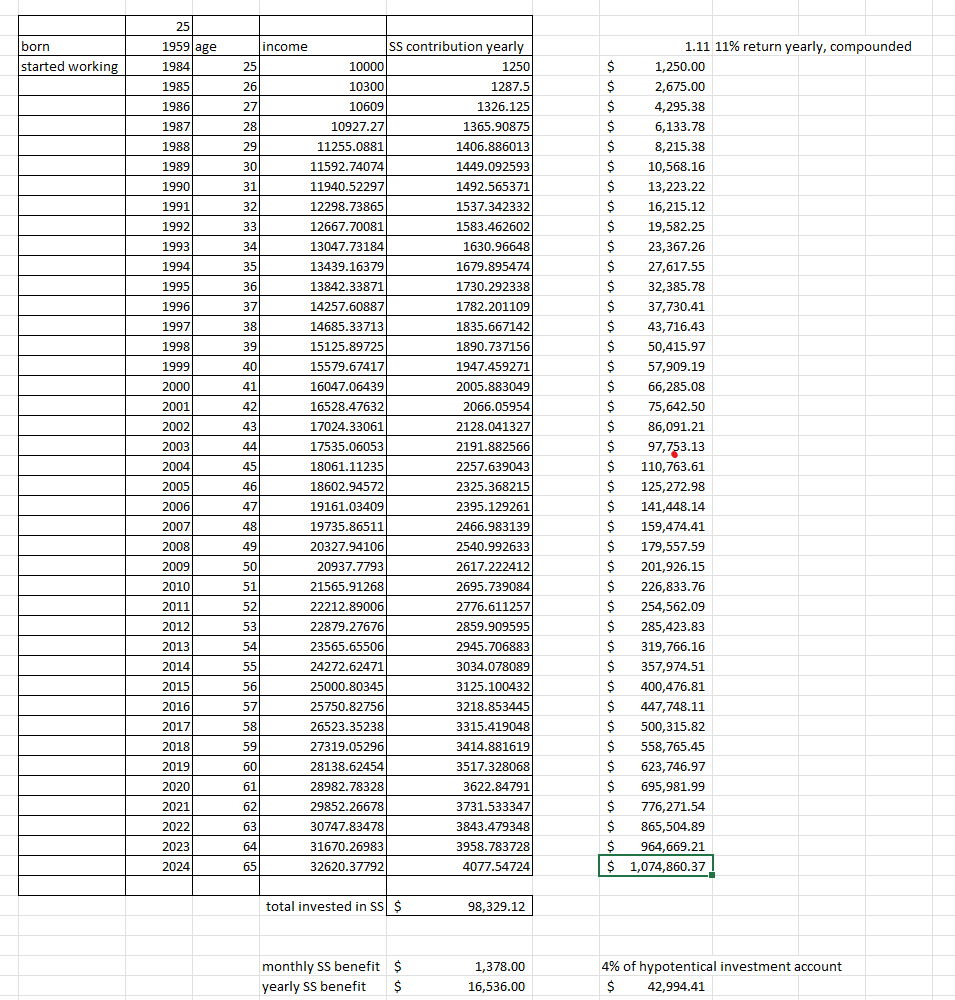
Just 1 example that I am highly against is Social Security. I went through and created a hypothetical person who started working in 1984 at the age of 25 (after being born in 1959).
If that person started making $10k in 1984 that would be equivalent to $30k/year in 2024. I gave this person a 3% raise a year. You can see that in the “income column” below. So this person would have ended working in 2024 with a salary of $32k/year (being 65 years old).
The next column shows the 12.5%/year that this person + their employer is paying into Social Security. After 40 years this person would have paid $98k into Social Security. I went through and put all the earnings data into the Social Security website benefit calculator, found here.
It provided an estimate of $1,378/month or $16,536/year.
I provided an alternative column, where you would instead take that 12.5%/year and invest that in the S&P 500 for 40 years.
As of January 26, 2024, the S&P 500’s price is 4,890.97. If you invested $100 in the S&P 500 at the beginning of 1984, you would have about $6,606.25 at the end of 2023, assuming you reinvested all dividends. This is a return on investment of 6,506.25%, or 11.14% per year. This person would have $1,074,860.37 in their 401k. They could safely withdraw $42,944/year from this (4%) as well as having a portfolio worth $1 million dollars! This is making a relatively low $30k per year equivalent for 40 years!
But most people I know who have made $30k a year for 40 years do not have a million dollar portfolio. Why is that?
It’s because they are unable to invest 12% of their salary a year, because it is required to go to the government and the Social Security Fund. This is robbing millions of workers of $25k/year in their retirement.
And input the dollar amount in the table for each year to find the benefit.
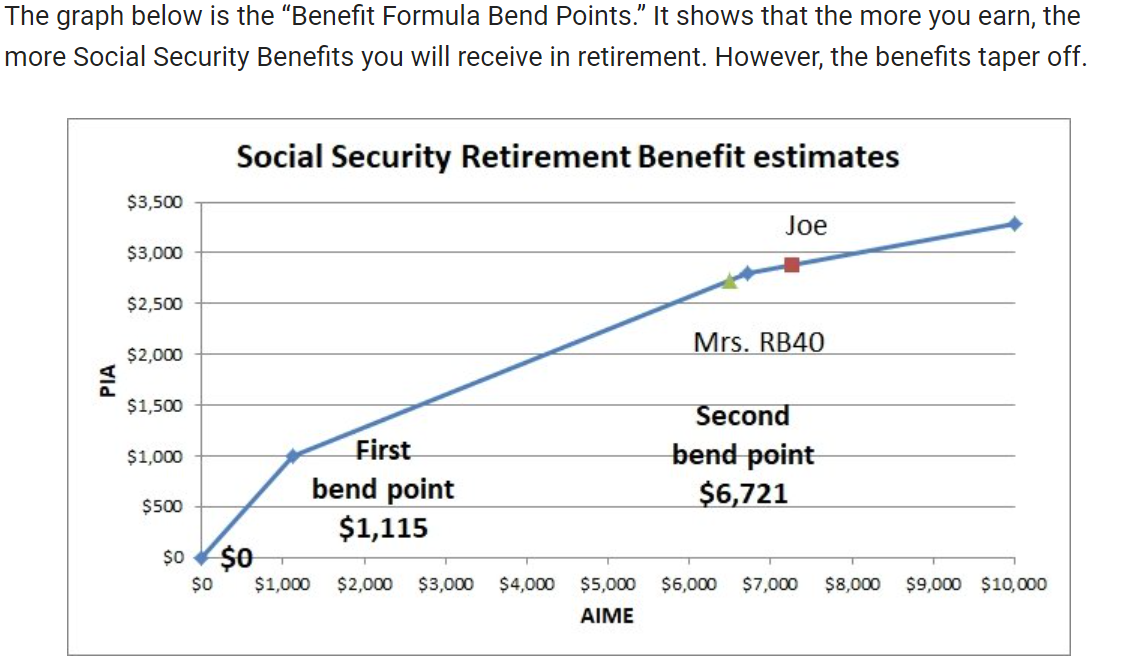
This is bad enough for a $30k/year equivalent worker. The more money you make though, the worse of a deal Social Security is. This is because of the “knee points” in the Social Security return table. The more you pay in, the less you get out. https://retireby40.org/early-retirement-impact-social-security-benefit/
While Social Security being a terrible return on your money is something of a first world problem, there are plenty of other instances of money losing value in other countries that really hurts people in those countries.
You can read from Alex Gladstein to learn about some of those.
“The rate of inflation in the U.S. is paltry compared to many other countries worldwide. The chief strategy officer for the Human Rights Foundation, Alex Gladstein highlighted this issue on Monday in a series of tweets. Gladstein is also a bitcoin (BTC) proponent and has been an evangelist for the leading crypto asset for quite some time.
“Many might think that extreme inflation is a rare occurrence in today’s modern world,” Gladstein said to his 27,000 Twitter followers on Monday. “That’s simply not the case. There are 1.2 billion people currently living in countries experiencing double or triple-digit inflation,” Gladstein insisted.”
F.A. Hayek in 1984: “I don’t believe we shall ever have a good money again before we take the thing out of the hands of government, that is, we can’t take it violently out of the hands of government, all we can do is by some sly roundabout way introduce something that they can’t stop.”
First 15 minutes of the podcast “Why Bitcoin Makes The World Better – The Bitcoin Layer”- I think this is a great 15 minute video to learn about “why Bitcoin” if you aren’t sure what “problem Bitcoin is trying to solve”.
Full episode – Why Bitcoin Makes The World Better – The Bitcoin Layer
Inflation/money printing by the government is a hidden tax, or more nefariously, theft of your savings.
I received the below email from a coworker related to this home for sale.
I was walking the dog tonight and there are several new houses down the street. I looked up what they go for. There is a video of it on the page, it’s a just a house. Nothing huge, with some basement finished. – coworker
I shared the below picture with this coworker. If you are measuring the world in USD then things are getting more expensive. But if you are measuring in Bitcoin, things are getting cheaper, as Jeff Booth explains in the initial Youtube video I shared above.
Below is the rest of my reply to this coworker.
You could always try to put multiple families together in one house, as times will get desperate. That would be the historic solution. And as you said, as people are poorer, they will just have to do it again.
There are plenty of very poor both in the USA and abroad already living this way.
As referenced from the trip I just got back from India from.
Most of the world is ALREADY poor. The USA has benefited from being able to export inflation to the rest of the world for the last 50 years.
We do this by everyone having to buy USD to buy oil. Then every country has a huge pile of US treasuries/dollars. Then we print more. Printing money is effectively stealing value from people who hold dollars. That is why NO ONE ever wants to have cash for longer than they have to.
Don’t you think that’s kind of crazy that no one actually wants US dollars “money”?
We buy bonds, gold, real estate, stocks, anything to store the value because we know that dollars lose value over time. It’s wild!
It’s even more obvious in countries like Argentina or Turkey where they have REALLY awful money. But our money also sucks for preserving value over time.
It all started with 1971 and removing the gold backing of the USD. Well really that started in 1930 with executive order 6102 which the government confiscated people’s gold. Paid them $20.67/oz of gold. Then repriced the dollar to $35/oz! they literally stole $15 worth for every oz of gold they took. It is crazy!
So I’m just saying you are noticing the results, extremely high home prices. Things getting more expensive. I am telling you there is a clear history to how we got here. And there is literally 1 solution to this problem. Well 2 but 1 will never happen.
If the US government quit over spending and printing new dollars that would fix it. But that will NEVER happen. So the alternate solution is to save in a currency that has a maximum limit, 21 million bitcoin.
If we DON’T support the bitcoin network we will continue down this path of everything getting more expensive. I have read so many books about the history of money and governments messing with money. It always happens this way.
The Romans debased their money, see below.
See quote below.
I really encourage you to learn more about bitcoin. It is our only hope.
Super short book, 2 hours on audible, but it’s really great.
The Bullish Case for Bitcoin Paperback – May 8, 2021
by Vijay Boyapati (Author)
F.A. Hayek in 1984: “I don’t believe we shall ever have a good money again before we take the thing out of the hands of government, that is, we can’t take it violently out of the hands of government, all we can do is by some sly roundabout way introduce something that they can’t stop.”
I wrote a letter to Joni Ernst (and Chuck Grassley) about Bitcoin that you can find here. I have posted Joni’s reply and then my reply to her, trying to correct the many incorrect things she noted in her letter (or her email reply person’s letter). I understand why most people dont’ waste their time contacting their politicians. You never get a straight answer. But unfortunately, beyond voting them out, which is nearly impossible to do as most politicians stay in once elected, the only thing we can do is contact them to try to educate them on topics and encourage others to contact them also. That is why I post my emails with politicians, so others can just copy/paste send them, if they want, to show our politicians that it’s a topic people care about, without making others spend time writing a letter.
Thank you for reaching out to me regarding digital asset regulation. It is important for me to hear from folks in Iowa on this rapidly evolving topic.
Whether it is Bitcoin, central bank digital currencies, or digital currency exchanges like FTX, digital assets have been a big topic of conversation in Washington. Cryptocurrencies can create new avenues for financial transactions, investments, and other economic activity given they do not rely on a government’s central bank. While digital assets offer new possibilities, there are legitimate concerns we must also address.
For example, Bitcoin is among the most popular cryptocurrencies, but we do not know who created it or how much of it exists. These uncertainties raise questions as to how legitimate Bitcoin can be as a currency. Further, cryptocurrencies are volatile. We have seen currencies become extremely valuable, and then, in the blink of an eye, lose their value all-together. This volatility raises questions around the extent to which cryptocurrencies may need to be regulated in some form or fashion so as to create more stability for investors.
Additionally, the decentralized nature of digital assets create potential risks related to fraud and illicit activities. We have already seen how bad actors across the world take advantage of the secrecy digital currencies provide in order to commit crimes, fund terrorism, or evade sanctions.
However, there is much benefit to be had from greater use of technology in the financial system. Cryptocurrencies do open doors for people who may not otherwise have access to capital. Though substantially distinct from digital currencies, the Federal Reserve recently unveiled its new FedNow service to help give people and businesses instant access to their money when they transfer it from account to account.
As we continue to flesh out the use of digital currencies and technology in finance, we must strike the right balance between fostering innovation, protecting individuals, and limiting the ability of bad actors to abuse the system.
You may be interested to know, this year’s National Defense Authorization Act included a provision to tighten oversight of financial institutions working with cryptocurrencies and other digital assets. By instituting regulatory clarity while weeding out bad actors, financial institutions can better ensure digital assets are not improperly used. This is just one of many crucial provisions in the annual defense bill that bolsters our national security and sends a clear sign of strength to our adversaries.
Thank you again for reaching out to my office, and please know that I am closely monitoring this situation as it develops. Please feel free to share any additional insights or concerns you may have regarding digital assets as I always enjoy hearing from Iowans.
Sincerely,
Joni K. Ernst
United States Senator
My reply is below.
Senator –
Thank you for your reply. I wanted to point out that you didn’t really address any of the specific topics I noted and you even shared some incorrect factual information. It concerns me when my elected Senator (or their email writer/advisor) is so wrong on a very basic topic.
It is obvious that this is your canned bitcoin/crypto currency response. I want to emphasize to you there is a fundamental difference between bitcoin and “cryptocurrency”
You can read about the differences in this short blog post .
I also asked you to to learn from Alex Gladstein about the human rights benefits that Bitcoin provides. He has already tried to speak to congress on this.You did not mention that at all.
Are you not interested in the plight of those fleeing authoritarian regimes?
You did mention, unprompted that “Bitcoin is among the most popular cryptocurrencies, but we do not know who created it or how much of it exists.”
While it is true the inventor, Satoshi Nakamato, is unknown, we do know that there will only be 21 million bitcoin ever. This is ingrained in the code.
This is unlike the amount of US dollars of which we truly can’t know how many will ever exist. Every year the US government prints trillions more in new dollars.
While Republicans pay lip service to the budget deficit when Democrats hold the presidency, historically, Republican presidents run even larger budget deficits than Democrats! You are right to fight against deficits but I believe you do it only in word for votes. I don’t believe you have any personal conviction to reduce the deficit.
I encourage you to talk to your fellow Senator, Cynthia Lumis. She seems to understand Bitcoin.
I have written the below open letter to my Iowa representatives about Bitcoin. I have also emailed it to them with a link to this post so they are able to get to the links below. I encourage you to go to your own representatives websites and email them this also.
“Warren’s bill, the Digital Asset Anti-Money Laundering Act, aims to solve a problem that no one has. It that would classify nearly all crypto industry participants — from wallet providers to miners to validators — as financial institutions, subjecting them to the onerous compliance regime of the Bank Secrecy Act. Under this bill, a teenager running a bitcoin mining rig in his basement could be subject to the same compliance burdens as JP Morgan Chase and Goldman Sachs.
But wallet providers, miners, and validators are not banks. They do not hold custody of assets. They certainly should not be collecting or storing the sensitive personal financial information of individual users of an asset. They merely provide infrastructure — the open-source software and computing power to help secure the network. Much like Microsoft, which also supplies a lot of software and cybersecurity products to financial institutions, they are not financial institutions.
It would be impossible for the industry to comply with Warren’s requirements, and she knows this. The point of her bill is not to improve national security or stop money laundering, but to kill digital asset innovation.” – The Hill
Please also investigate Elizabeth Warren and her collusion with the banks and SEC. I am concerned she is not regulation in good faith.
I want to encourage, you, my representatives, to learn about Bitcoin and it’s many benefits.
I also want you to learn about the benefits of bitcoin mining and it’s ability to mitigate emissions. Specifically, please learn from Daniel Batten and his work into bitcoin mining reducing methane emissions.
I’ve had an interest in developing countries for years. Often this has been in the form of donations to charity. I have also personally been giving money to a couple men in Haiti for school for years.
I recently visited India to visit some friends and also to attend a Business Summit for JoyCorps.
“The JoyCorps Fellowship is a group of carefully selected, visionary leaders who operate agrarian and small manufacturing businesses in Asia’s under-resourced communities.
We offer Accelerator and Incubator services that provide business expertise, structures, encouragement and community — all vital for growing a thriving business in a challenging environment.”
I was able to meet many entrepreneurs in India and learned about their challenges in starting their businesses.
by Magatte Wade due to following Magatte Wade on LinkedIn. It was very timely and I listened to this while I was in India. A lot of the challenges faced in different developing countries are all the same.
One other organization I became aware of while I was in India is AgGrandize.They have a fund available that you can invest in. Actually making an investment in a foreign small business directly is still not nearly as easy as a donation to charity. I am going to continue learning and looking for options to make this easier.
If anyone knows of a fund that you can invest in in monthly increments, that invests in small foreign businesses, please let me know!
If you are interested in this topic below are a few books I would recommend to learn more about investing in developing countries to help them help themselves.
I have been reading and thinking about money, economics, wages,fair wages, trade imbalances and business stuff for years. This is a list of links and some books that I have found interesting related to the topic. I don’t have a take away conclusion from this reading yet.
“It is utterly clear to me that the highest priority need of world society at the present moment is a realistic economic accounting system which will rectify, for instance, such nonsense as the fact that a top toolmaker in India, the highest paid of all craftsman, gets only as much per month for his work in India as he could earn per day for the same work if he were employed in Detroit, Michigan. – Page 112 Operating Manual For Spaceship Earth, Buckminster Fuller
I am sharing a few articles I’ve read the last years about various impacts of higher wages in different parts of the world. I still don’t have a big conclusion from this.
As jobs are exported slowly the world wide wage should rise, but likely America’s will fall, which is fine.
I do share the concern that some businesses “can’t afford to pay people $15/hr” but if that is the case should they be businesses?
I mentioned that there are a lot of things that challenge starting businesses (wages/paying SS, and medicare/insurance).
I have been a big proponent that nationwide healthcare will allow smaller businesses to be more competitive with larger businesses because they should only have to compete on wages, not healthcare. This same idea came from Andrew Yang. His book “The War on Normal People” is very good, for many ideas, not just UBI.
I like the below articles for worldwide perspectives on income and economics.
The country allows lower pay for teenagers, and the labor deal McDonald’s struck with its employees currently pays 16-year-olds roughly US$8 an hour, not altogether different from what they’d make in the states. In an email, Greg Bamber, a professor at Australia’s Monash University who has studied labor relations in the country’s fast food industry, told me that as a result, McDonald’s relies heavily on young workers in Australia.
Jobs moved to Mexico. Seems to have worked out well for the new employees in Mexico. Seems to have “busted” the people who lost jobs in USA,
Now, of course, to an American audience this seems so minor, so unbelievably reasonable, it’s hard to see how there can be any opposition: Five bucks a day? As a minimum? It’s easy to be outraged that the U.S. government wouldn’t push for a minimum of more. Who can live on five bucks a day?
Haiti’s industry is focused on commodity white T-shirts for brands like Hanes. The commodity white T-shirt is one of the cheapest, easiest things in the world to make. With $500,000 you could buy a bunch of used sewing machines in Alabama or Guangzhou, rent a cement shell in some poor country, and be in business in a few weeks.
In short, Dominican textile workers have real bargaining power because they have real, globally competitive skills. I’m sure manufacturers would love to pay them $3 a day, but they can’t because the Dominicans know how to do stuff that commands a higher wage.
I have no idea what would happen if Haiti did have a $5-a-day minimum wage. But I do think it’s reasonable to assume that some factories would close and far fewer new ones would be built. Far fewer Haitians would be allowed to take that first tentative step on to the ladder of industrial development.
It looks like LOWRY sewing robot has been made into a company.
ABOUT SOFTWEAR AUTOMATION
We are an Atlanta-based advanced machine-vision and robotics startup disrupting the $1.5 trillion apparel industry. Our fully automated Sewbots enable on-demand manufacturing by moving supply chains local and closer to the customer, while creating higher quality products at comparable cost to imports from low-wage countries.
This is the future of everything. Automate as much as possible, for mass production. It is how the past has always gone and it’s the way of the future. More things will be automated. Automated things will be cheaper, or they wouldn’t be automated! Cheaper things means people can actually buy more things! Think of TV’s. In 1990 a 20” tv was relatively expensive and maybe a family had 1. Now it’s cheaper to have 3 55” tv’s.
LA garment worker pay- Many garment workers in the USA are here illegally. The employers should be held responsible for hiring illegal immigrants. They are also taking advantage of these people.
A 2016 U.S. Department of Labor investigation found pay violations in 85% of the L.A. garment shops it looked into. – How do these places stay in business? If they are investigated and found to be violating the US DOL how do they stay in business????
Vernette speaks in Haitian Creole, as he has trouble communicating in Spanish.
He arrived in the Dominican Republic “under the fence,” or irregularly, about a year ago.- It appears that illegal immigration is a problem worldwide, and they are treated poorly everywhere.
It should be difficult (or impossible) to counterfeit.
It should be assayable (easy to verify it is what it says it is).
Bitcoin has all these things already.
It just needs to be “adopted as a treasury reserve asset” to quote Michael Saylor. Meaning people just need to choose to preserve their wealth in bitcoin, over time.
People don’t need to store all their money in bitcoin. A small percentage of people in the world own gold, but it still has value.
Bitcoin doesn’t need to be used in daily transactions to have value. Gold has value but it is not used in daily transactions.
Bitcoin doesn’t need to be “legal tender” to have value. Gold has value but it is not legal tender.
Money should only be used as money. If you give it some other use or value, it’s possible that it’s main use, as money, is twisted such that it’s monetary value gets distorted and it is no longer a good money!
I encourage you to ask questions about “What is Money?” What is the purpose of money? Why do we need money? What things does money need to do to make it useful?