Email To Congressperson Regarding Epstein Files

Sent this to my Congress Representative Ashley Hinson- I hope she does the right thing.

I am writing as a concerned constituent to urge you to support the Epstein Files Transparency Act, led by Rep. Thomas Massie and Rep. Ro Khanna. This bipartisan bill would require the Department of Justice to release all unclassified records related to Jeffrey Epstein and Ghislaine Maxwell, while protecting victims’ identities. Congress has already reached the 218-signature threshold to force a vote, and the American people overwhelmingly want transparency.

Here’s why this matters:

  • Past Promises: High-profile figures in the Trump administration—including Pam Bondi, Kash Patel, and JD Vance—publicly pledged to release these files when President Biden was in office. They even held meetings and photo ops promising transparency. Why have those promises evaporated now?
  • The Hoax Narrative Doesn’t Add Up: If this is all a “Democratic hoax,” as President Trump now claims, why is Ghislaine Maxwell serving a 20-year sentence for sex trafficking minors? Her conviction was based on evidence of a real criminal conspiracy, not political theater.
  • Gaslighting the Public: President Trump is actively discouraging Republicans from supporting transparency, calling the effort a “trap” and a “hoax.” If there’s nothing to hide, why fight so hard to keep these files secret?

Please do not deflect by asking “why didn’t the Democrats release it when they were in power.” That is gaslighting. You NOW have the power to release the files and do the right thing. Be on the right side of history.

This is not about partisanship—it’s about justice and accountability. Survivors deserve answers, and the public deserves to know the truth about who enabled Epstein’s crimes. Shielding powerful individuals from embarrassment is not a valid reason to withhold information.

Please vote YES on the Epstein Files Transparency Act and stand on the side of transparency, justice, and the rule of law.

Thank you for your time and service.

The Earmark Era: How Washington Rewards Spending, Not Stewardship — and Why the Federal Budget Keeps Breaking

Earlier in 2024, I read a local article about Washington’s senior senator proudly announcing how much federal money she had brought home to the state. Her list ran dozens of pages — hundreds of millions in Congressionally Directed Spending, better known as earmarks.

She’s not alone. Nearly every senator submits earmark requests, which you can browse on the Senate Appropriations Committee’s official list. Each item sounds worthy enough: a wastewater upgrade, a community arts incubator, a “therapeutic court.” But taken together, these line items add up fast.

According to the Peter G. Peterson Foundation, Congress approved 8,098 earmark projects costing $14.6 billion in FY 2024—about the same as FY 2023—and still under one percent of total discretionary spending. In context, that’s roughly 0.2 percent of total federal outlays.

It’s easy to shrug and say, “So what? That’s peanuts in a $6.8 trillion budget.”
But the issue isn’t the size. It’s the signal.


The Round-Trip Problem

When money takes the round trip — federal tax → congressional politics → earmark → local grantee — it leaks. Every stop adds overhead, lobbying, and political friction.

If a project’s benefits are local, fund it locally. Save federal dollars for truly national needs—and make any remaining federal grants competitive and audited.

That’s not ideological; it’s basic hygiene. Less leakage, less pork, more accountability.


The GAO’s Quiet Crusade

The Government Accountability Office (GAO) has spent over a decade documenting federal overlap, duplication, and inefficiency. Between 2011 and 2023, its recommendations produced about $667 billion in cumulative savings—roughly $51 billion a year.

That sounds impressive… until you set it beside annual deficits averaging $1.2 trillion over the same period. Even if every GAO fix were implemented perfectly, it would only offset a few cents of every deficit dollar. We celebrate small wins while ignoring the structural math.


The Trillions That Run on Autopilot

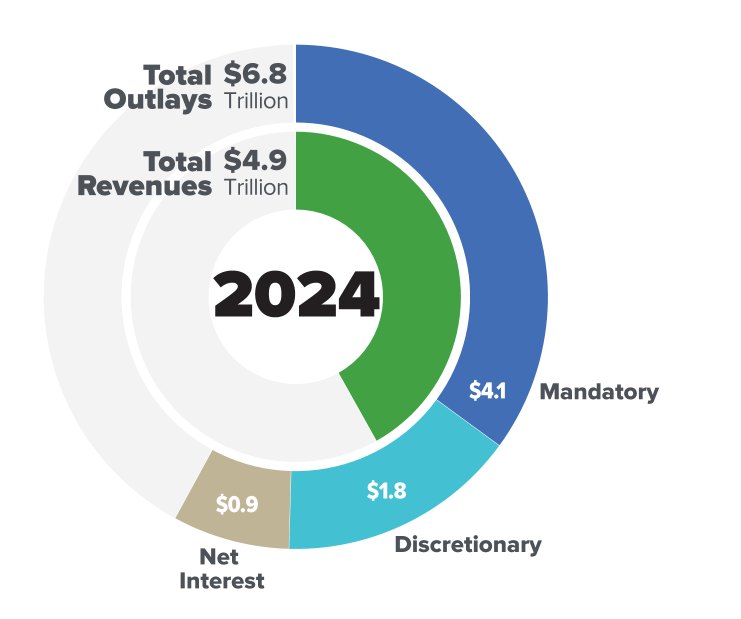
To understand that math, look at the 2024 federal budget as a whole (data from the Congressional Budget Office’s Budget and Economic Outlook: 2024–2034):

  • Total Outlays (FY 2024):$6.8 trillion
  • Total Revenues:$4.9 trillion
  • Mandatory Spending:$4.1 trillion (60%) — Social Security, Medicare, Medicaid, and other entitlements
  • Discretionary Spending:$1.8 trillion (26%) — defense, education, housing, infrastructure, research
  • Net Interest:$0.9 trillion (13%) — the fastest-growing line item in the budget

Source: Congressional Budget Office, “Budget and Economic Outlook: 2024–2034.”

All the fights over earmarks, audits, and waste reports happen inside that discretionary slice, the part Congress actually votes on each year.
The other 70 percent runs on autopilot — driven by demographics, healthcare inflation, and debt.

So yes, we have a trillions problem, not a billions problem.
But pretending the billions don’t matter ensures the trillions never get fixed.


The Cultural Incentive to Spend

Politicians are rewarded for bringing money home. A senator who resists earmarks looks “ineffective.”
That same incentive—spend now, borrow later—is what prevents any real reform on the mandatory side.

If Congress can’t resist handing out $14 billion in earmarks to score headlines, how will it ever take on the hard reforms that actually matter?


The Real Problem

The problem isn’t that earmarks alone bankrupt the country — they don’t.
The problem is that they reveal a mindset: Washington still rewards politicians for spending, not stewardship.

Every senator gets praised for what they bring home, not for what they turn down.
That’s the same mindset that makes real entitlement reform politically impossible and deficit reduction unthinkable.

Earmarks aren’t bankrupting the U.S., but they show why the U.S. can’t stop bankrupting itself.

Until that incentive changes — in Congress, in media, and among voters — the numbers will keep getting bigger, and the excuses will too.


Sources:

2024 Congressional Pig Book Summary
32nd “TheBook Washington Doesn’t WantYou to Read”
CITIZENS AGAINST GOVERNMENT WASTE

The Congressional Pig Book is CAGW’s annual compilation of earmarks in the appropriations bills and the database contains every earmark since it was first published in 1991. All items in the Congressional Pig Book meet at least one of CAGW’s seven criteria that were developed by CAGW and the Congressional Porkbusters Coalition:

  • Requested by only one chamber of Congress;
  • Not specifically authorized;
  • Not competitively awarded;
  • Not requested by the President;
  • Greatly exceeds the President’s budget request or the previous year’s funding;
  • Not the subject of congressional hearings; or,
  • Serves only a local or special interest.

Bitcoin and the Triffin Dilemma: Why Wages Would Adjust Fairly Under a Neutral Money

Most people don’t realize that many of the economic problems facing Americans today trace back to something called the Triffin dilemma. Politicians like Trump rage about trade deficits or promise to bring back jobs, but they rarely understand the underlying monetary system that makes those promises impossible to keep. And because they don’t understand it, millions of middle-aged workers in the U.S. are left angry and disillusioned.

But here’s the good news: the problem is solvable. And Bitcoin, combined with Buckminster Fuller’s vision of a “world accounting system,” offers a way forward.


The Triffin Dilemma in Plain English

Robert Triffin pointed out a paradox in the 1960s: if one country’s currency becomes the world’s reserve currency, that country must constantly supply it to the rest of the world. For the U.S., that means running trade deficits and flooding the globe with dollars.

The catch is that what looks good globally causes pain domestically. To meet the world’s demand for dollars, the U.S. must run deficits, borrow more, and tolerate an overvalued dollar. That makes American exports less competitive, hollows out manufacturing, and weakens wage growth.


The Cost of Supplying the World with Dollars

To keep the global economy running on dollars, the U.S. has to keep sending them out. There are only two main ways that happens: by running trade deficits (importing more than we export) or by borrowing (issuing Treasuries that foreigners buy with their surplus dollars). Both of these mechanisms keep the world awash in dollar liquidity — but they impose heavy costs on American workers.

  • Persistent deficits mean more borrowing. Every trade deficit eventually gets financed with U.S. debt. Foreign governments and investors recycle the dollars they earn back into U.S. Treasuries. The system keeps spinning, but America’s national debt climbs ever higher.
  • Global demand keeps the dollar strong. Because the world needs dollars, our currency stays overvalued compared to others. A strong dollar makes imports cheap (which feels good for consumers at Walmart) but makes American exports expensive (which is brutal for manufacturers trying to compete abroad).
  • Manufacturing gets hollowed out. When American goods are too expensive, factories lose business. Over time, companies either shut down or relocate production overseas. Entire industries migrate abroad, leaving behind shuttered plants and devastated communities.

Take steel as a concrete example. In the late 20th century, global demand for dollars, combined with cheaper steel production in Asia, kept the U.S. dollar strong and U.S. steel prices uncompetitive. By the 1980s and 1990s, iconic steel towns in Pennsylvania and Ohio watched mills close. Workers who once earned solid middle-class wages saw their jobs vanish, and many never found work at the same pay level again.

  • Wages stagnate. With fewer competitive industries at home, American workers lose bargaining power. They’re forced to compete against cheaper labor abroad, and wage growth flatlines. Meanwhile, the cost of living — housing, healthcare, education — keeps climbing. The result is the frustration many middle-aged Americans feel today: they’ve worked hard their whole lives, yet the system seems rigged against them.

In short: to supply the world with dollars, America borrows, tolerates an overvalued currency, and sacrifices its own competitiveness. The global dollar system helps keep international trade flowing, but it extracts its pound of flesh from U.S. workers.


Figure 1: Global demand for dollars keeps the dollar strong, which makes imports cheap but exports uncompetitive — hollowing out U.S. manufacturing and holding down wages.

Why Trump (and Most Politicians) Miss the Point

Trump recognizes that something is broken — but his diagnosis is shallow. He blames foreign countries, bad trade deals, and weak leaders. His answer is tariffs and protectionism.

But the deeper issue is that America can’t stop running deficits without undermining the very system that makes the dollar the global reserve. The Triffin dilemma locks us in. Protectionism only papers over the problem temporarily.


How Wages Would “Automatically Adjust” Under Bitcoin

Now imagine a world where global trade is denominated in Bitcoin, a money no government can print or devalue.

  1. High Productivity Raises Wages Locally
    If Country A is extremely productive, it earns more Bitcoin. Workers there see higher wages in BTC terms.
  2. Prices Rise in the Productive Country
    With higher wages, local goods get more expensive relative to other countries.
  3. Trade Shifts
    Other countries stop buying from Country A and look to Country B or C, where wages are lower and goods are cheaper.
  4. Jobs Move, Wages Rebalance
    Jobs flow out of the high-wage country into lower-wage ones. Wages in the expensive country stabilize or even fall, while wages in cheaper countries rise.

The result: wages “automatically” adjust across borders to reflect real productivity, not the games governments play with currency printing or manipulation.


Figure 2: Under a Bitcoin-based system, wages and trade flows automatically rebalance. High wages make exports more expensive, shifting jobs abroad until global wages reflect true productivity.

Why Fiat Prevents This Natural Balance

In today’s fiat system, governments intervene to block this natural adjustment. They devalue their currencies to keep exports cheap, trapping workers in low wages and preventing global wage convergence.

Meanwhile, American workers face the opposite problem: a strong dollar that prices them out of global competition. The Triffin dilemma ensures the imbalance persists.


“Isn’t It Just Greedy Companies Suppressing Wages?”

A common belief is that big U.S. companies are the real villains — trillion-dollar firms posting record profits while holding wages flat, outsourcing jobs, or using H1B visas to bring in cheaper labor. There’s truth in that frustration, and yes, there is abuse in how the visa system is used.

Consider this example: if an American worker expects $80,000 but a skilled H1B worker is willing to accept $50,000, the company has a clear incentive to hire the cheaper worker. To Americans, this feels like wage suppression. But for the H1B worker, it’s a huge win. That $50,000 U.S. salary might translate into the equivalent of $150,000 back home, especially if they can send $10,000 to family abroad where the cost of living is far lower.

So while it looks like companies are simply greedy, they’re really responding to the incentives of a distorted global money system. With the dollar overvalued and global trade imbalances baked in, U.S. labor is structurally overpriced compared to the rest of the world. Companies are not the root cause — they’re just playing the game according to the rules we’ve set.

In a Bitcoin-based system, the game changes. Wages would adjust across borders automatically, not through currency manipulation or immigration loopholes. Companies would still seek efficiency, but the playing field would be leveled: wages in every country would reflect true productivity, not fiat distortions.

Figure 3: Under fiat money, companies are incentivized to outsource, use H1B labor, and suppress wages. Under Bitcoin, wages converge globally based on real productivity, not manipulated exchange rates.

Fuller’s Dream of a World Accounting System

Buckminster Fuller envisioned a future where humanity had a scientific, global accounting system that measured real wealth and resources instead of manipulating national ledgers.

Bitcoin is a step in that direction. It’s transparent, borderless, and immune to political distortion. A Bitcoin-based world economy would essentially run on Fuller’s “world accounting system,” with wages, trade, and prices reflecting true productivity instead of central bank policy.


The Takeaway

The middle-aged frustration in America isn’t just about lost jobs or bad politicians. It’s about being trapped inside the Triffin dilemma — a system where the U.S. must sacrifice its workers to supply the world with dollars.

Bitcoin offers a way out: a neutral, global money where wages naturally rebalance, trade adjusts fairly, and no single country bears the impossible burden of being the world’s reserve.

It’s not just a monetary upgrade — it’s the foundation for a more honest accounting system for the entire world.

🛑 You Can’t Outgrow a Debt Spiral — But You Can Exit It (or Reprice It)

The U.S. won’t grow its way out of a debt spiral — it’ll inflate, debase, and extract.
The real exit ramp is Bitcoin: a parallel system with hard rules, not political ones.
Opting into BTC isn’t about returns — it’s about exiting a rigged game before the math breaks.

Conventional wisdom keeps hoping that the U.S. can grow its way out of a fiscal doom spiral:

“If GDP just grows fast enough, even the most reckless overspending by Congress won’t matter.”

But that assumes we still live in an age of manageable debt, cooperative politics, and sound incentives.

We don’t.


📉 The U.S. Fiscal Reality

  • $36+ trillion in debt
  • $2 trillion annual deficits
  • $1.1 trillion in yearly interest
  • Interest payments now exceed military spending

We are no longer debating whether the debt matters — we’re just seeing how long it can be delayed before the math breaks. Growth won’t fix this. It hasn’t yet, and it won’t now.

So what’s the plan? Inflate, extract, or collapse?


🇳🇴 But What About Norway?

Norway is often brought up as a model of fiscal sanity — and with good reason:

  • Budget surplus in 2024: 13.2% of GDP
  • Sovereign wealth fund: $1.74 trillion (largest in the world)
  • Debt-to-GDP around 55%, but fully offset by national savings

They even run a structural non-oil deficit, but it’s funded by planned withdrawals from their sovereign fund. In short: they spend with discipline and have assets to back it.

So why can’t every country do that?


🚫 Because It’s Not Globally Sustainable

Norway is rich in oil, small in population, and extremely disciplined in governance. They:

  • Save during booms instead of spending
  • Use their wealth fund to smooth volatility, not plug holes
  • Issue debt strategically, not out of desperation

For the rest of the world, especially the U.S., that model isn’t available.

Most countries are net debtors. They’ve hollowed out their productive base, offshored manufacturing, and replaced savings with speculation.

You can’t run a surplus if:

  • Your economy is dependent on imported energy and goods
  • Your entitlement promises are growing faster than your tax base
  • Your political class has no incentive to say “no”

Surpluses require restraint, surplus-producing sectors, and trust — all of which are in short supply.


🧱 So What’s the Real Path Out?

It’s not hoping for a miraculous growth surge. It’s not copying Norway. It’s not electing better managers of a broken system.

It’s opting out. It’s repricing trust.

🔑 Enter Bitcoin.

  • A monetary system with hard limits, not political ones
  • No printing. No bailouts. No “emergency exceptions”
  • Open, auditable, neutral — like a global sovereign wealth reserve for the people

Bitcoin is:

  • An exit for individuals
  • A hedge against sovereign collapse
  • And, increasingly, a foundation for new financial instruments — including Bitcoin-backed bonds.

🧾 Bitcoin-Backed Bonds: Repricing Sovereign Risk

Here’s a future worth considering:

Nations issue bonds backed by Bitcoin reserves, restoring credibility and reducing borrowing costs.

Instead of trusting central banks or political stability, investors trust digital collateral — liquid, auditable, incorruptible.

  • Governments get lower interest rates
  • Investors get higher real returns
  • The system regains trust — not by promising growth, but by tying itself to something outside its control

This isn’t sci-fi. El Salvador is already moving in this direction. Others will follow — especially as debt costs soar and trust erodes.


🧠 TL;DR

  • You can’t outgrow a debt spiral.
  • You can’t copy Norway unless you’re already Norway.
  • You can’t reform a system whose core logic is delay and inflate.

But you can exit.

Bitcoin offers individuals, institutions, and eventually even nations a path out — not to escape responsibility, but to rebuild trust from the ground up.

This isn’t about being early to an investment. It’s about being on time to a monetary exit.

Elon vs. Trump’s “Big Beautiful Bill”: Why It’s All Noise Without Bitcoin

Elon Musk is on a rampage again—this time, against Donald Trump’s so-called “One, Big, Beautiful Bill.” He’s called it a “disgusting abomination,” a pork-stuffed monstrosity that will explode the national deficit and bury Americans under a mountain of debt. And he’s not wrong.

But here’s the thing: yelling into the void of Washington politics won’t change a system that’s already rigged to print, spend, and inflate its way into oblivion. The real protest isn’t a tweetstorm. It’s opting out.

Elon Tried to Fix It—And Got Burned

Let’s not forget: Elon Musk didn’t start out as a critic. He tried to work within the system. He joined advisory councils, met with presidents, and even offered to help streamline government operations. He believed that innovation and logic could steer the ship of state.

But the bureaucracy didn’t budge. The incentives were too broken, the politics too entrenched. Eventually, Musk walked away—disillusioned and vocal. His recent outburst isn’t just frustration; it’s the sound of someone who tried to fix the machine and realized it’s designed to resist change.

Why Fighting the System Is a Distraction

The U.S. government isn’t going to stop spending. It’s not going to balance the budget. And it’s certainly not going to voluntarily give up the power to print money. So while Elon’s outrage is justified, it’s also futile. The system isn’t broken—it’s working exactly as designed.

The Only Real Exit: Bitcoin

If you’re tired of watching your purchasing power erode while politicians play Monopoly with your future, there’s only one real move: opt out. Buy Bitcoin.

Bitcoin isn’t just a hedge against inflation—it’s a peaceful protest. It’s a decentralized, deflationary alternative to fiat currencies that can’t be manipulated by central banks or corrupted by politics. It’s the lifeboat in a sea of fiscal insanity.

Conclusion: Don’t Rage—Exit

Elon’s fury is understandable. But the real revolution won’t be televised—it’ll be verified on the blockchain. If you want to send a message to Washington, don’t waste your breath. Move your money. Buy Bitcoin.

The Fake Money That Fueled a Real War: How Mefo Bills Led to WWII

This post was created from this video

Hitlers Gamble That Ignited War | Blood Money Inside The Nazi Economy | Part 1 | Documentary Central

In the 1930s, Nazi Germany was broke. The country was reeling from the Great Depression, saddled with war reparations, and shackled by the Treaty of Versailles, which banned it from rearming. Yet within a few years, Germany had built one of the most fearsome war machines in history.

How did they pay for it?

They invented money.

The Mefo Trick

Enter Mefo bills—a financial sleight of hand orchestrated by Hjalmar Schacht, Hitler’s economic wizard and head of the Reichsbank.

The plan was simple and devious:

  • A fake company called MEFO (Metallurgical Research Corporation) was set up.
  • MEFO issued IOUs, or “Mefo bills,” to arms manufacturers instead of actual cash.
  • These IOUs were guaranteed by the German government, and companies could trade them or cash them in later at the Reichsbank.
  • Crucially, the bills were kept off the official budget, hiding the scale of rearmament.

This created a parallel currency used only within the military-industrial complex. No taxes raised. No gold reserves touched. Just promises backed by more promises.

But there was a catch: each Mefo bill had a five-year maturity. That meant the government had, at most, five years before they had to repay the IOUs in Reichsmarks. The first wave of bills, issued in 1934, would come due in 1939—just as Germany was preparing to invade Poland.

A Booming Mirage

It worked—at first.

Factories roared back to life. Steel, chemicals, and synthetic fuel production surged. Unemployment plummeted. To the outside world, it looked like an economic miracle.

But it wasn’t prosperity—it was military Keynesianism on credit.

By 1938, 20% of German GDP was going to the military. Consumer goods remained scarce. Wages were frozen. Trade unions were banned. Prices were controlled. And Mefo bills kept piling up.

Schacht warned that the system couldn’t last. Eventually, the bills would come due—and the Reichsbank would either default or start printing money. Hitler didn’t care. Instead of slowing down, he pushed harder. Schacht was sidelined, and Hermann Göring took over economic planning with a singular goal: prepare for total war.

War Became the Only Exit

The Mefo system couldn’t sustain itself. Germany was running out of foreign reserves and raw materials. The economy was overheating. The only way out was forward—through invasion, plunder, and conquest.

Occupied countries like Austria, Czechoslovakia, and eventually Poland were stripped of gold, steel, coal, and labor. France was forced to fund the German occupation. The Nazi war machine was now self-financing—by theft.

By the time the Mefo bills started coming due in 1939, the regime began repaying them not through taxes or trade, but by printing money and launching war. The economy was now riding on a tidal wave of credit, conquest, and coercion.

Why It Matters

The Mefo bill scheme shows how financial manipulation can fuel political extremism, militarism, and war. When money is divorced from accountability and markets are warped by ideology, the result isn’t just inflation or inefficiency.

The result is destruction.