Email To Congressperson Regarding Epstein Files

Sent this to my Congress Representative Ashley Hinson- I hope she does the right thing.

I am writing as a concerned constituent to urge you to support the Epstein Files Transparency Act, led by Rep. Thomas Massie and Rep. Ro Khanna. This bipartisan bill would require the Department of Justice to release all unclassified records related to Jeffrey Epstein and Ghislaine Maxwell, while protecting victims’ identities. Congress has already reached the 218-signature threshold to force a vote, and the American people overwhelmingly want transparency.

Here’s why this matters:

  • Past Promises: High-profile figures in the Trump administration—including Pam Bondi, Kash Patel, and JD Vance—publicly pledged to release these files when President Biden was in office. They even held meetings and photo ops promising transparency. Why have those promises evaporated now?
  • The Hoax Narrative Doesn’t Add Up: If this is all a “Democratic hoax,” as President Trump now claims, why is Ghislaine Maxwell serving a 20-year sentence for sex trafficking minors? Her conviction was based on evidence of a real criminal conspiracy, not political theater.
  • Gaslighting the Public: President Trump is actively discouraging Republicans from supporting transparency, calling the effort a “trap” and a “hoax.” If there’s nothing to hide, why fight so hard to keep these files secret?

Please do not deflect by asking “why didn’t the Democrats release it when they were in power.” That is gaslighting. You NOW have the power to release the files and do the right thing. Be on the right side of history.

This is not about partisanship—it’s about justice and accountability. Survivors deserve answers, and the public deserves to know the truth about who enabled Epstein’s crimes. Shielding powerful individuals from embarrassment is not a valid reason to withhold information.

Please vote YES on the Epstein Files Transparency Act and stand on the side of transparency, justice, and the rule of law.

Thank you for your time and service.

Tracking the “Political ETFs” — My Ongoing Experiment

Members of Congress have long faced accusations of trading on insider information — buying and selling stocks in companies they help regulate.
It’s a bipartisan problem: Republicans and Democrats alike have profited from privileged access and timing the rest of the public could never match.

That’s not just bad optics — it’s corruption.
It undermines faith in both the markets and the integrity of government.

To highlight how deep this problem goes, I’ve started an experiment tracking three ETFs:

  • NANC — the Unusual Whales Subversive Democratic Trading ETF, built around stocks traded by Democratic lawmakers.
  • GOP — the Unusual Whales Subversive Republican Trading ETF, reflecting trades made by Republican lawmakers.
  • SPY — the SPDR S&P 500 ETF Trust, serving as a neutral market benchmark.

My goal isn’t to glorify these funds — it’s to show in real numbers how political trading compares to the broad market, and to call out why this system needs reform.


Policy Context

This issue connects directly to Senator Josh Hawley’s proposal to ban individual stock trading by members of Congress.
His bill wouldn’t ban investing altogether — lawmakers could still own broad mutual funds or ETFs, just not trade individual stocks that might be affected by their votes.

That distinction matters. It allows long-term wealth building without the appearance or reality of insider trading.
📎 Read Hawley’s bill here


Performance Snapshot (Feb 10 2023 → Oct 27 2025)

SymbolETF NameDescriptionStarting Price*Current PriceTotal Return
NANCUnusual Whales Subversive Democratic Trading ETFTracks stocks favored by Democratic members of Congress$24.69$46.15+86.9%
GOPUnusual Whales Subversive Republican Trading ETFTracks stocks favored by Republican members of Congress$24.96$37.20+49.0%
SPYSPDR S&P 500 ETF TrustBaseline for overall U.S. market$408$685+67.9%

*Starting prices from Google Finance (Feb 10 2023, ETF inception date). Current prices as of Oct 27 2025.


The Takeaway

Both “political ETFs” have gained since launch, but that doesn’t justify congressional trading.
When lawmakers can personally profit from decisions they influence, public trust erodes — no matter how well the market performs.

This experiment is my small way to expose how close politics and profit have become — and to advocate for a system where leadership means stewardship, not stock tips.


The Earmark Era: How Washington Rewards Spending, Not Stewardship — and Why the Federal Budget Keeps Breaking

Earlier in 2024, I read a local article about Washington’s senior senator proudly announcing how much federal money she had brought home to the state. Her list ran dozens of pages — hundreds of millions in Congressionally Directed Spending, better known as earmarks.

She’s not alone. Nearly every senator submits earmark requests, which you can browse on the Senate Appropriations Committee’s official list. Each item sounds worthy enough: a wastewater upgrade, a community arts incubator, a “therapeutic court.” But taken together, these line items add up fast.

According to the Peter G. Peterson Foundation, Congress approved 8,098 earmark projects costing $14.6 billion in FY 2024—about the same as FY 2023—and still under one percent of total discretionary spending. In context, that’s roughly 0.2 percent of total federal outlays.

It’s easy to shrug and say, “So what? That’s peanuts in a $6.8 trillion budget.”
But the issue isn’t the size. It’s the signal.


The Round-Trip Problem

When money takes the round trip — federal tax → congressional politics → earmark → local grantee — it leaks. Every stop adds overhead, lobbying, and political friction.

If a project’s benefits are local, fund it locally. Save federal dollars for truly national needs—and make any remaining federal grants competitive and audited.

That’s not ideological; it’s basic hygiene. Less leakage, less pork, more accountability.


The GAO’s Quiet Crusade

The Government Accountability Office (GAO) has spent over a decade documenting federal overlap, duplication, and inefficiency. Between 2011 and 2023, its recommendations produced about $667 billion in cumulative savings—roughly $51 billion a year.

That sounds impressive… until you set it beside annual deficits averaging $1.2 trillion over the same period. Even if every GAO fix were implemented perfectly, it would only offset a few cents of every deficit dollar. We celebrate small wins while ignoring the structural math.


The Trillions That Run on Autopilot

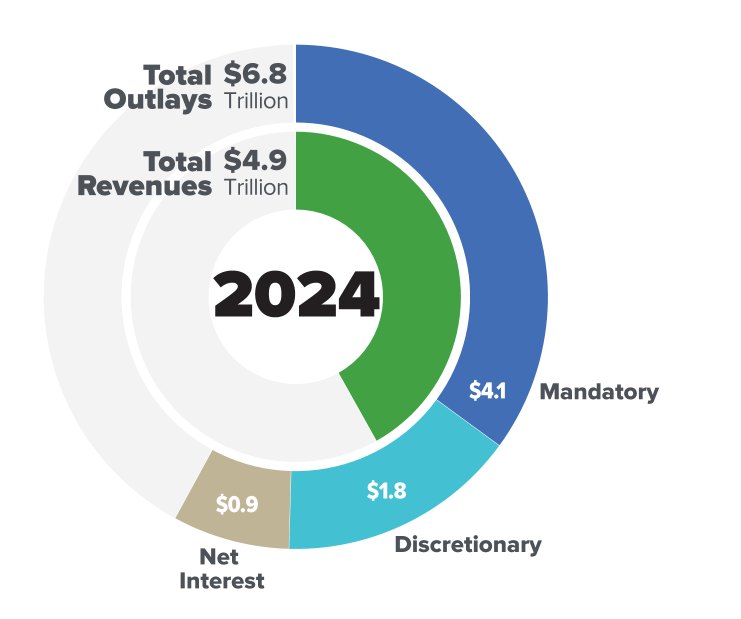
To understand that math, look at the 2024 federal budget as a whole (data from the Congressional Budget Office’s Budget and Economic Outlook: 2024–2034):

  • Total Outlays (FY 2024):$6.8 trillion
  • Total Revenues:$4.9 trillion
  • Mandatory Spending:$4.1 trillion (60%) — Social Security, Medicare, Medicaid, and other entitlements
  • Discretionary Spending:$1.8 trillion (26%) — defense, education, housing, infrastructure, research
  • Net Interest:$0.9 trillion (13%) — the fastest-growing line item in the budget

Source: Congressional Budget Office, “Budget and Economic Outlook: 2024–2034.”

All the fights over earmarks, audits, and waste reports happen inside that discretionary slice, the part Congress actually votes on each year.
The other 70 percent runs on autopilot — driven by demographics, healthcare inflation, and debt.

So yes, we have a trillions problem, not a billions problem.
But pretending the billions don’t matter ensures the trillions never get fixed.


The Cultural Incentive to Spend

Politicians are rewarded for bringing money home. A senator who resists earmarks looks “ineffective.”
That same incentive—spend now, borrow later—is what prevents any real reform on the mandatory side.

If Congress can’t resist handing out $14 billion in earmarks to score headlines, how will it ever take on the hard reforms that actually matter?


The Real Problem

The problem isn’t that earmarks alone bankrupt the country — they don’t.
The problem is that they reveal a mindset: Washington still rewards politicians for spending, not stewardship.

Every senator gets praised for what they bring home, not for what they turn down.
That’s the same mindset that makes real entitlement reform politically impossible and deficit reduction unthinkable.

Earmarks aren’t bankrupting the U.S., but they show why the U.S. can’t stop bankrupting itself.

Until that incentive changes — in Congress, in media, and among voters — the numbers will keep getting bigger, and the excuses will too.


Sources:

2024 Congressional Pig Book Summary
32nd “TheBook Washington Doesn’t WantYou to Read”
CITIZENS AGAINST GOVERNMENT WASTE

The Congressional Pig Book is CAGW’s annual compilation of earmarks in the appropriations bills and the database contains every earmark since it was first published in 1991. All items in the Congressional Pig Book meet at least one of CAGW’s seven criteria that were developed by CAGW and the Congressional Porkbusters Coalition:

  • Requested by only one chamber of Congress;
  • Not specifically authorized;
  • Not competitively awarded;
  • Not requested by the President;
  • Greatly exceeds the President’s budget request or the previous year’s funding;
  • Not the subject of congressional hearings; or,
  • Serves only a local or special interest.

The Politics of Envy: How Bernie Sanders Uses Billionaires to Distract from Washington’s Failures — and Keep People Angry

Blaming billionaires is easy. Fixing bad policy, broken incentives, and decades of fiscal irresponsibility isn’t — so Bernie Sanders keeps the outrage machine running instead.

A lot of people — Bernie Sanders in particular — hate billionaires because they assume billionaires stole their wealth.
But that belief comes from misunderstanding how value is actually created.


💵 Creation vs. Printing

Bernie and the government “create money” by printing it — literally out of thin air — which steals purchasing power from everyone who already has dollars.
That’s not value creation. It’s value redistribution by dilution.

So when that’s your frame of reference, you start to believe that everyone who gets rich must have taken something from someone else. Because that’s how you create “money” in politics — you print it or tax it away.

But wealth in a free market isn’t created by decree. It’s created by building, coordinating, and innovating — by making something others voluntarily trade for.


📈 Value Creation Is Not Theft

Larry Ellison, for example. One day Oracle stock went up, and his net worth jumped by $100 billion. Bernie acts like Larry ran around stealing $100 billion from working people.
But that’s not what happened. That value didn’t exist before — it was created.

Wealth in the market represents new value built through skill, innovation, and coordination, not theft.
If you’re stranded on an island with a billion dollars, it’s worthless. You need resources, tools, and knowledge to turn that “money” into something useful.

The problem is, people who’ve never built or created real value assume no one else can either.
So they see wealth as theft instead of creation. That’s the confusion at the heart of modern politics.


⚠️ Bernie’s Game: Blame, Not Solutions

And that’s where Bernie Sanders comes in.
He isn’t actually helping working people by pointing to billionaires as evil — he’s manipulating them.

By giving people a villain to hate, he distracts from the real causes of economic pain — bad money, wasteful government, and decades of inflation that quietly rob savers and workers.
He rallies frustration around a scapegoat instead of a fix.

If Bernie genuinely wanted to help, he’d talk about restoring fiscal discipline, reducing waste, and making it easier for regular people to build wealth — not demonizing those who already have.
But he doesn’t. Because blaming billionaires is politically easy.
Fixing the system would mean questioning the very machine that gives him power.

So instead of solving problems, he feeds resentment — keeping people angry, divided, and dependent on him to express that anger.


🧮 The Fantasy of the “Billionaire Tax”

In a recent Time article titled “I’m a Millionaire. No One Needs More Than $30 Million”, the author argues that a Billionaire Income Tax could raise $557 billion over ten years and “jump-start a permanent safety net.”

That sounds impressive — until you look at the math.

The U.S. government currently runs a $2 trillion annual deficit.
That’s $20 trillion in overspending every decade.
So this “transformative” billionaire tax covers less than 3 % of the hole. It’s fiscal rounding error.

The problem isn’t a lack of billionaire money — it’s a lack of discipline and accountability.


🏛 The Real Problem Isn’t “Too Much Money” — It’s How It’s Used

The Time article goes on to argue that wealth beyond $30 million stops being about living well and becomes about wielding power — influencing elections, buying media outlets, and suppressing competition.

That part isn’t entirely wrong. Money can corrupt politics.
But the author’s solution — capping wealth — misses the point completely.

If the issue is that money manipulates the system, then the answer is to make the system harder to manipulate, not to confiscate wealth after the fact.

We should make elections harder to buy, not success harder to earn.
Reform campaign finance, close regulatory loopholes, stop insider lobbying — that’s how you stop abuse.

The same goes for the “buy, borrow, die” loophole that allows the ultra-wealthy to avoid realizing gains.
If that’s the concern, close the loopholes directly — don’t destroy the entire structure of value creation to fix a tax code glitch.

And even then, no system will ever be perfect.
Smart, ambitious people will always find new ways to optimize around the rules — that’s part of what makes them successful.
Every time you close one loophole, innovation and adaptation create another.
The goal shouldn’t be to eliminate advantage; it should be to keep the playing field open and the incentives productive.

And far from “locking others out,” large pools of wealth are what fund the next generation of builders.
People don’t lose the chance to innovate because billionaires exist — they lose it when regulation, bureaucracy, and bad policy make it impossible to start or scale.
Just look at Europe: it leads the world in regulation, but none of the world’s biggest or most dynamic companies are European.
They’ve made it harder to fail, but also impossible to truly win.
Capital isn’t a finite pie being hoarded; it’s the byproduct of trust, savings, and productive investment.
Destroy that, and you destroy the fuel for future innovation.

Blaming “too much money” is a lazy shortcut that lets broken institutions off the hook.


💥 What Happens If You Actually Take It

Let’s pretend we go full Bernie and seize every dollar of billionaire wealth in America — all $6 trillion of it.

Here’s what happens:

  1. That covers just three years of deficit spending at current rates. Then what? You’re out of billionaires, and the deficit keeps growing.
  2. Most of that wealth isn’t cash. It’s ownership stakes in companies — Tesla, Oracle, Amazon, Microsoft, etc.
  3. If the government forces liquidation, prices collapse. No one can buy trillions in stock without tanking the market.
    • Even a 50 % drop cuts the haul to $3 trillion — barely 18 months of deficits.
  4. Who buys the assets? The next-richest class. Inequality reshuffles briefly, then reforms.
  5. Meanwhile, innovation stalls. Investment dries up. Everyone gets poorer.

You can’t fund a government by destroying the productive capital that funds everything else.


⚙️ The Real Issue Isn’t Wealth, It’s Value

Wealth isn’t evil — it’s a signal that someone created something valuable enough for millions of people to trade their time or money for it.
That’s fundamentally different from printing dollars and calling it “stimulus.”

If we want a stronger, fairer economy, the solution isn’t confiscation — it’s creation.
Encourage building, innovation, and hard work, and you’ll raise living standards for everyone.
Punish them, and you’ll end up with equality through shared decline.


🧭 Final Thought

Bernie isn’t fighting for the working class. He’s fighting to stay relevant to it.
You don’t fix inequality by burning down the factory.
You fix it by letting more people build factories of their own.


Bitcoin and the Triffin Dilemma: Why Wages Would Adjust Fairly Under a Neutral Money

Most people don’t realize that many of the economic problems facing Americans today trace back to something called the Triffin dilemma. Politicians like Trump rage about trade deficits or promise to bring back jobs, but they rarely understand the underlying monetary system that makes those promises impossible to keep. And because they don’t understand it, millions of middle-aged workers in the U.S. are left angry and disillusioned.

But here’s the good news: the problem is solvable. And Bitcoin, combined with Buckminster Fuller’s vision of a “world accounting system,” offers a way forward.


The Triffin Dilemma in Plain English

Robert Triffin pointed out a paradox in the 1960s: if one country’s currency becomes the world’s reserve currency, that country must constantly supply it to the rest of the world. For the U.S., that means running trade deficits and flooding the globe with dollars.

The catch is that what looks good globally causes pain domestically. To meet the world’s demand for dollars, the U.S. must run deficits, borrow more, and tolerate an overvalued dollar. That makes American exports less competitive, hollows out manufacturing, and weakens wage growth.


The Cost of Supplying the World with Dollars

To keep the global economy running on dollars, the U.S. has to keep sending them out. There are only two main ways that happens: by running trade deficits (importing more than we export) or by borrowing (issuing Treasuries that foreigners buy with their surplus dollars). Both of these mechanisms keep the world awash in dollar liquidity — but they impose heavy costs on American workers.

  • Persistent deficits mean more borrowing. Every trade deficit eventually gets financed with U.S. debt. Foreign governments and investors recycle the dollars they earn back into U.S. Treasuries. The system keeps spinning, but America’s national debt climbs ever higher.
  • Global demand keeps the dollar strong. Because the world needs dollars, our currency stays overvalued compared to others. A strong dollar makes imports cheap (which feels good for consumers at Walmart) but makes American exports expensive (which is brutal for manufacturers trying to compete abroad).
  • Manufacturing gets hollowed out. When American goods are too expensive, factories lose business. Over time, companies either shut down or relocate production overseas. Entire industries migrate abroad, leaving behind shuttered plants and devastated communities.

Take steel as a concrete example. In the late 20th century, global demand for dollars, combined with cheaper steel production in Asia, kept the U.S. dollar strong and U.S. steel prices uncompetitive. By the 1980s and 1990s, iconic steel towns in Pennsylvania and Ohio watched mills close. Workers who once earned solid middle-class wages saw their jobs vanish, and many never found work at the same pay level again.

  • Wages stagnate. With fewer competitive industries at home, American workers lose bargaining power. They’re forced to compete against cheaper labor abroad, and wage growth flatlines. Meanwhile, the cost of living — housing, healthcare, education — keeps climbing. The result is the frustration many middle-aged Americans feel today: they’ve worked hard their whole lives, yet the system seems rigged against them.

In short: to supply the world with dollars, America borrows, tolerates an overvalued currency, and sacrifices its own competitiveness. The global dollar system helps keep international trade flowing, but it extracts its pound of flesh from U.S. workers.


Figure 1: Global demand for dollars keeps the dollar strong, which makes imports cheap but exports uncompetitive — hollowing out U.S. manufacturing and holding down wages.

Why Trump (and Most Politicians) Miss the Point

Trump recognizes that something is broken — but his diagnosis is shallow. He blames foreign countries, bad trade deals, and weak leaders. His answer is tariffs and protectionism.

But the deeper issue is that America can’t stop running deficits without undermining the very system that makes the dollar the global reserve. The Triffin dilemma locks us in. Protectionism only papers over the problem temporarily.


How Wages Would “Automatically Adjust” Under Bitcoin

Now imagine a world where global trade is denominated in Bitcoin, a money no government can print or devalue.

  1. High Productivity Raises Wages Locally
    If Country A is extremely productive, it earns more Bitcoin. Workers there see higher wages in BTC terms.
  2. Prices Rise in the Productive Country
    With higher wages, local goods get more expensive relative to other countries.
  3. Trade Shifts
    Other countries stop buying from Country A and look to Country B or C, where wages are lower and goods are cheaper.
  4. Jobs Move, Wages Rebalance
    Jobs flow out of the high-wage country into lower-wage ones. Wages in the expensive country stabilize or even fall, while wages in cheaper countries rise.

The result: wages “automatically” adjust across borders to reflect real productivity, not the games governments play with currency printing or manipulation.


Figure 2: Under a Bitcoin-based system, wages and trade flows automatically rebalance. High wages make exports more expensive, shifting jobs abroad until global wages reflect true productivity.

Why Fiat Prevents This Natural Balance

In today’s fiat system, governments intervene to block this natural adjustment. They devalue their currencies to keep exports cheap, trapping workers in low wages and preventing global wage convergence.

Meanwhile, American workers face the opposite problem: a strong dollar that prices them out of global competition. The Triffin dilemma ensures the imbalance persists.


“Isn’t It Just Greedy Companies Suppressing Wages?”

A common belief is that big U.S. companies are the real villains — trillion-dollar firms posting record profits while holding wages flat, outsourcing jobs, or using H1B visas to bring in cheaper labor. There’s truth in that frustration, and yes, there is abuse in how the visa system is used.

Consider this example: if an American worker expects $80,000 but a skilled H1B worker is willing to accept $50,000, the company has a clear incentive to hire the cheaper worker. To Americans, this feels like wage suppression. But for the H1B worker, it’s a huge win. That $50,000 U.S. salary might translate into the equivalent of $150,000 back home, especially if they can send $10,000 to family abroad where the cost of living is far lower.

So while it looks like companies are simply greedy, they’re really responding to the incentives of a distorted global money system. With the dollar overvalued and global trade imbalances baked in, U.S. labor is structurally overpriced compared to the rest of the world. Companies are not the root cause — they’re just playing the game according to the rules we’ve set.

In a Bitcoin-based system, the game changes. Wages would adjust across borders automatically, not through currency manipulation or immigration loopholes. Companies would still seek efficiency, but the playing field would be leveled: wages in every country would reflect true productivity, not fiat distortions.

Figure 3: Under fiat money, companies are incentivized to outsource, use H1B labor, and suppress wages. Under Bitcoin, wages converge globally based on real productivity, not manipulated exchange rates.

Fuller’s Dream of a World Accounting System

Buckminster Fuller envisioned a future where humanity had a scientific, global accounting system that measured real wealth and resources instead of manipulating national ledgers.

Bitcoin is a step in that direction. It’s transparent, borderless, and immune to political distortion. A Bitcoin-based world economy would essentially run on Fuller’s “world accounting system,” with wages, trade, and prices reflecting true productivity instead of central bank policy.


The Takeaway

The middle-aged frustration in America isn’t just about lost jobs or bad politicians. It’s about being trapped inside the Triffin dilemma — a system where the U.S. must sacrifice its workers to supply the world with dollars.

Bitcoin offers a way out: a neutral, global money where wages naturally rebalance, trade adjusts fairly, and no single country bears the impossible burden of being the world’s reserve.

It’s not just a monetary upgrade — it’s the foundation for a more honest accounting system for the entire world.

Who Gets the Income? Who Pays the Taxes?

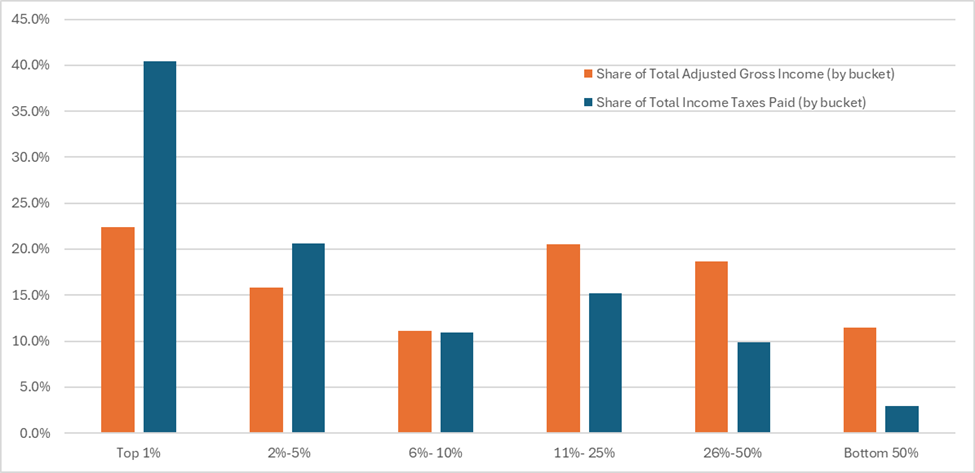
Data gathered from this link – https://taxfoundation.org/data/all/federal/latest-federal-income-tax-data-2025/

When we talk about taxes in America, the debate often gets sloppy. People use “income” and “wealth” almost interchangeably, but they’re very different things.

  • Income is the flow of money earned each year — wages from a job, dividends, or realized capital gains.
  • Wealth is the stock of assets someone already owns — businesses, real estate, stocks, Bitcoin, etc.

Our tax system is built mainly on income, not wealth. And when commentators conflate the two, it clouds the conversation about fairness and policy.


Income Snapshot

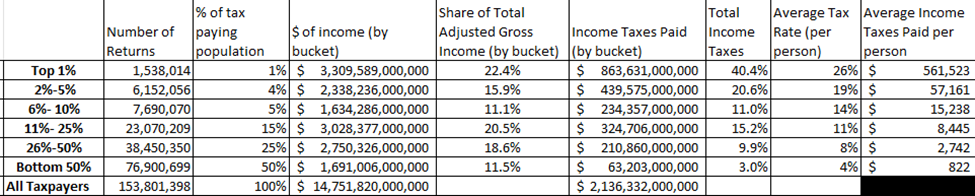
In 2022, the U.S. collected $2.1 trillion in federal income taxes on about $14.8 trillion in total income. That’s about 14.4% of taxable income.

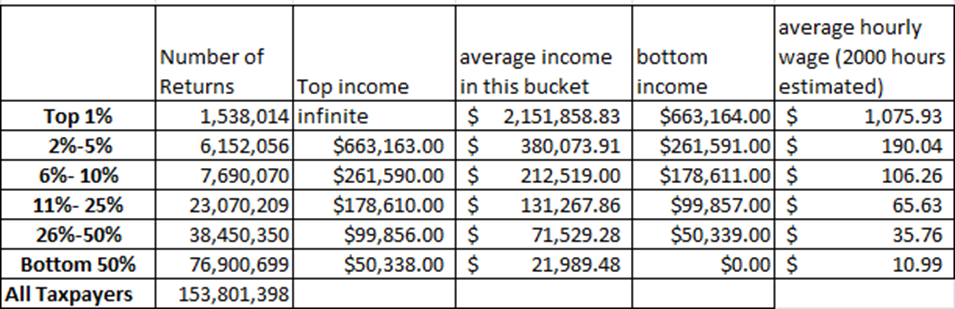
Divide that income across all 153 million taxpayers, and the average income comes out to $95,915, or about $47.96 per hour assuming 2,000 hours of work per year. Of course, averages can mislead — the distribution is anything but equal.


The Top 1%

To qualify for the top 1% in 2022, you needed at least $663,164 of income. On average, these 1.5 million taxpayers earned $2.1 million each.

  • Share of income: 22.4%
  • Share of taxes paid: 40.4%
  • Effective tax rate: 26%

The Bottom 50%

The bottom half — about 76 million taxpayers — earned less than $50,339 per year. Their average income was just $21,000, totaling $1.7 trillion across the group.

  • Effective tax rate: ~4%
  • Many pay no federal income tax at all, often due to credits like the Earned Income Tax Credit (EITC) or child tax credits.

Wealth Snapshot

If we shift from income to wealth, the picture looks even starker. As of mid-2025, U.S. billionaires hold over $6.2 trillion in wealth, spread across only about 813–867 individuals.

But here’s the catch: the U.S. government is adding about $2 trillion in deficit spending every year. Even if you taxed billionaires at extremely high rates, it might cover only a year or two of deficits. After that, the wealth pool would shrink — and most billionaires would likely relocate to avoid such aggressive taxation.

That doesn’t mean we shouldn’t debate fairness, redistribution, or even wealth taxes. But it does mean we need to be realistic about the math.


Why This Matters

The key takeaway is that income and wealth are different conversations. Most tax debates focus on income flows, yet the loudest arguments are often about wealth concentration. If we mix those together, we miss the real tradeoffs.

I’m happy to debate how much each group should earn, or whether a wealth tax makes sense (though I personally think it doesn’t). But if we want an honest conversation, we have to separate what we’re actually measuring.

Because when we ask, “Who should pay more?” the first step is being clear: are we talking about annual income, or about the stock of wealth built up over decades?

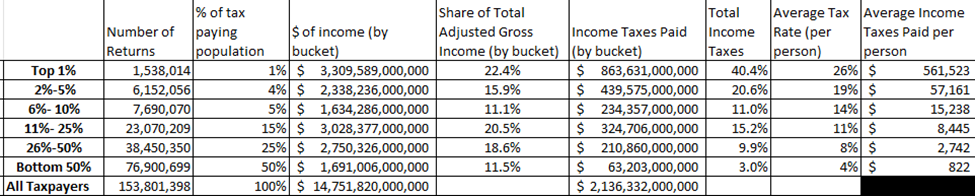
Data – https://taxfoundation.org/data/all/federal/latest-federal-income-tax-data-2025/

You will notice myd ata is slightly different than from the website. The website continually aggregates so their “top 5%” data includes all the income & people from the top 1% + the 2%-5%.
I have broken it down so you can see how much income is in each bucket. I think my method is much more useful.
It also allows you to see how much income, taxes, average income, is in each bucket.

When the data is aggregated it always is skewed due to the higher amount of income above it.

Wealth Inequality: The Quiet Apocalypse… and What Comes After

I recently watched a powerful video titled Wealth Inequality: The Quiet Apocalypse.” It’s honest, emotional, and brutally accurate in describing what it feels like to live in a system that seems to squeeze you harder every year. I found myself nodding along for much of it—but also wanting to widen the lens a little.

Before offering my response, here are five key points I took from the video:

Five Core Points from “Wealth Inequality: The Quiet Apocalypse”

  1. The system isn’t broken—it’s working as designed. It extracts time and value from most people and consolidates wealth at the top.
  2. Capital outpaces labor. Referencing Piketty: when the rate of return on capital exceeds growth, wealth concentrates.
  3. The American Dream is largely a delusion. Doing everything right doesn’t mean you’ll get ahead.
  4. Wealth inequality creates spiritual and psychological harm. It hollows out people’s sense of identity and worth.
  5. What we need is a cultural shift—not just policy. Minimalism, rest, and meaning are antidotes to hustle culture and economic extraction.

Here’s my reply, point by point.


1. The system isn’t broken—it’s working as designed

Yes, the system is designed to reward capital—not labor. But that doesn’t mean we need to burn the whole thing down. In fact, we should want capital to outperform labor—because that means more productivity with less effort.

The real problem? Capital is too concentrated.

What if we built systems that allowed more people to own capital? That would mean more people benefiting from productivity gains, without needing to grind themselves into dust. In the U.S., this is more accessible than we sometimes realize. Low-cost investing tools, like Fidelity or Vanguard, allow everyday people to start building wealth—even with modest means.

I wrote about how just $2,000/year for 10 years can grow to over $365,000 by retirement:
👉 The Power of Investing Early

The system does work—as designed. We just need to make sure more people have a stake in it.


2. Capital outpaces labor

Piketty’s point is mathematically true: capital grows faster than wages, and that concentrates wealth. But instead of treating that as a death sentence, let’s treat it like a map.

If labor will always lose, then we need to stop relying on labor alone. We need to become capital owners.

That’s the core of Post-Labor Economics: a future where AI and automation do the work, and human beings benefit from ownership rather than employment. That’s only dystopian if ownership remains exclusive.

I broke this down further here:
👉 Post-Labor Economics – David Shapiro Video Summary

The real answer isn’t to slow capital—it’s to distribute capital.


3. The American Dream is a delusion

We agree: doing everything “right” no longer guarantees success. Degrees, hard work, and even smart money habits don’t always lead to stability.

But here’s the truth: that level of frustration is itself a luxury in global terms. If you’re in the U.S., have internet, clean water, and access to banking—you are already in the global top 10%, maybe even the top 1%.

I say this not to invalidate anyone’s struggle—but to widen the perspective. There are billions of people who would love to have the problems you have. That realization isn’t meant to inspire guilt—it’s meant to highlight opportunity.

You don’t have to “win” the American Dream to live a meaningful life. But if you understand your relative position in the world, you can use it to lift others up while building your own path.


4. Wealth inequality creates spiritual and psychological harm

Yes. When everything becomes transactional, identity collapses into productivity and income. And when we don’t measure up, we blame ourselves.

But here’s the twist: even while critiquing this system, you might still be letting it define you.

There are other ways of living. You don’t need to win the game. You can just stop playing—and focus instead on living intentionally, giving what you can, and creating meaning through service or simplicity.

Some books that shaped my thinking:

Even if just 5% of your life is dedicated to helping others, that’s enough. That’s opting out of the culture in a way that matters.


5. We need a cultural shift—not just policy

Yes. A shift away from hustle culture, productivity obsession, and materialism is overdue. Minimalism, rest, and meaning are powerful forms of resistance.

But there’s another layer: you don’t just have to escape the culture—you can help reshape it.

That might mean:

  • Raising your kids with different values
  • Giving consistently, even in small amounts
  • Choosing a simple life so others can simply live

You don’t need to be an influencer or a billionaire to change the culture. You just need to stop waiting for permission—and start living by a better scorecard.

Opting out is good. But opting into something better is even stronger.


Final Thoughts

Wealth Inequality: The Quiet Apocalypse is a powerful wake-up call. But let’s not stop at diagnosis. Let’s ask: what comes next?

You don’t need to be rich to make a difference. You don’t need to have all the answers to start living a better one. And even in a rigged game, you can still choose your own values.

In a collapsing world, the most radical thing you can do is refuse to collapse with it.

And if you’re someone with a platform—as the video’s creator clearly is, with 80,000+ subscribers—then that gives you not just a voice, but a real opportunity. You can lead. You can educate. You can help people see a way forward.

Not everyone has that kind of reach. So if you do, I hope you use it.


If you want to learn more about effective giving, post-labor economics, or investing with purpose, browse around MyWheelLife.com.

America’s Crumbling House: Left, Right, and the Missing Foundation

America feels broken. Everyone knows it—whether you’re arguing with your uncle over turkey at Thanksgiving or doomscrolling through social media. But what’s fascinating (and disturbing) is that people across the political spectrum are noticing the same fractures: collapsing birth rates, unaffordable housing, dead-end jobs, institutional rot, and youth malaise.

I recently listened to three different voices, each from a different ideological “neighborhood”:

  • A far-right cultural critic, furious about the destruction of the family unit and what he sees as elite-led population control.
  • A center-left economist, frustrated by how every group benefits from a rigged economy while pretending someone else is to blame.
  • A far-left progressive, warning that America has become a pariah nation, economically and morally isolated, lurching toward authoritarianism.

They couldn’t be more different in tone or political tribe. One quotes Blink-182 and rails against birth control. Another explains tiger parenting with nuance and lived experience. The last one drops historical comparisons to Nazi Germany while pointing at collapsing tourism and empty shelves. And yet, they’re all describing the same crumbling house.

💥 The House Is Falling Apart

The symptoms they describe are unmistakable:

  • Broken families and a collapsing birth rate
  • Wages stagnating while cost of living skyrockets
  • Distrust in institutions from schools to elections
  • Youth alienation in relationships, work, and meaning
  • Global disillusionment with American leadership
  • Cultural fragmentation and a sense of existential decline

Some blame immigration. Others blame billionaires, churches, or elite schools. But whatever the cause, all three perspectives agree: America is not correcting itself. The systems that once promised prosperity and stability no longer deliver.

🧱 We’re Trying to Fix the Walls

You can think of the U.S. like a house. We see cracks in the drywall—so we patch them. But then another crack shows up. We reinforce a beam. Then a window shatters. We debate whether the left side or the right side is more broken.

What none of us are doing—at least not seriously enough—is inspecting the foundation.

That foundation is our money system.

🪙 The Money Is the Root of It

Our economic system runs on a fiat currency that:

  • Encourages endless debt and consumption
  • Funnels wealth upward through asset inflation
  • Devalues labor by design
  • Rewards speculation over contribution
  • Incentivizes short-term thinking in both business and government

All of these things show up in the critiques from the left, right, and center. But they often miss the fact that these aren’t isolated symptoms. They stem from a rotted monetary foundation that no longer serves the people who live in the house.

🧱 Bitcoin: Fix the Foundation First

Bitcoin is not a magic solution to all social and economic ills. But it is a foundation repair tool. It offers:

  • Hard money that can’t be printed into oblivion
  • Decentralization that resists capture by any single party, institution, or ideology
  • Incentives for long-term thinking—saving, building, and responsibility
  • A chance for global cooperation without relying on coercive power

Fixing money doesn’t solve everything. But without fixing the foundation, trying to repair the walls is a waste of time.

🔁 Common Pain, Fragmented Response

The tragedy of our current moment is that everyone feels the pain, but we’re tearing each other apart over the symptoms instead of joining forces to solve the root cause.

  • The far-right influencer sees collapsing families and thinks: “Return to tradition.”
  • The centrist economist sees rigged systems and thinks: “Reform the meritocracy.”
  • The far-left voice sees global collapse and thinks: “Dismantle the empire.”

All have valid critiques. All are trying to fix walls in a house with a rotting foundation.

Bitcoin isn’t left or right. It’s not even center. It’s underneath all of it. A chance to rebuild the ground we all stand on—before the entire structure falls.

Analysis of – Geo-Strategy #3: How Empire is Destroying America

You Were So Close: Where the Anti-Empire Analysis Misses Bitcoin’s Role as the Fix

A year old video titled Geo-Strategy #3: How Empire is Destroying America delivers a sharp, compelling critique of the United States’ transformation from a productive manufacturing economy into a hollowed-out empire addicted to easy money, foreign capital, and speculative finance. The lecturer nails several things before they happened:

  • Trump won
  • The U.S. dropped bombs on Iran (June 21, 2025).
  • Empire—not capitalism alone—is the real structural disease.

So far, so good.

But here’s where it falls short: when it comes to solutions, the analysis stops at nostalgia. It groups Bitcoin in with the broader financialized, speculative mindset of the current era—instead of recognizing it as the clearest path out of the collapsing fiat-imperial system.


What the Video Gets Right

1. The Shift to Financialization Was a Disaster
The U.S. economy went from 40% of profits coming from manufacturing to only 10%. Meanwhile, financial services ballooned to 40% of profits but employ only 5% of the workforce. It’s not a real economy anymore—it’s rent-seeking on a grand scale.

2. Empire Crowds Out Domestic Prosperity
As the video rightly says: the U.S. has 800+ overseas bases, trillions in defense spending, and a growing dependency on foreign goods. Meanwhile, infrastructure decays, wages stagnate, and people struggle to own homes.

3. Easy Money Has Warped the Psyche
He astutely observes that young people have a speculative mindset. They want to gamble their way to freedom because working hard for 40 years no longer gets you a house or family. The fiat system broke the ladder.

4. Empires Collapse from Hubris
Rome did it. So did Britain. The U.S. has reached a point where it can’t imagine losing, but is too bloated and fragile to truly win.


What the Video Misses Entirely

Bitcoin isn’t a symptom of decline. It’s the cure.

Here’s where the logic fails: Bitcoin gets lumped in with real estate speculation, meme stocks, and Wall Street grifting. That’s a category error.

Bitcoin is:

  • Not tied to Wall Street.
  • Not controlled by central banks.
  • Not created through debt.

It is, in fact, everything the empire cannot print, inflate, or manipulate.

If fiat money is what powers the empire’s global dominance and fiscal addiction, then Bitcoin is the tool that cuts the cord. It’s what lets young people store value, opt out of inflation, and build sovereign systems outside elite capture.


The Real Problem: Fiat, Not Just Empire

Let’s go one layer deeper:

  • Empire needs fiat to fund wars, bailouts, and pensions.
  • Fiat needs empire to enforce its global dominance (petrodollar system, SWIFT sanctions, military threats).

It’s a closed loop. And Bitcoin breaks it.

Bitcoin is the only monetary system with no central issuer, no forced trust, no inflationary mandate, and no border. It’s not speculative escapism. It’s the foundation for a post-imperial world.


Final Thought

The lecturer in Geo-Strategy #3 is brave and accurate in his breakdown of how empire is destroying America. But like many critics, he sees the collapse clearly yet misses the exit sign flashing in orange behind him:

Bitcoin isn’t the distraction. It’s the lifeboat.

💵 How Fiat Money Hollowed Out America’s Job Market and How to Fix it


Intro – Why can’t Americans find good jobs anymore?

Because the U.S. dollar’s role as the world’s reserve currency lets us import everything without producing anything.

Fiat money didn’t just change our economy—it hollowed it out.

This article explains how we got here—and why only a return to hard money, like Bitcoin, can bring us back.

There’s a sentence I keep coming back to:

Without fiat, we’d have to export goods to earn gold or foreign currency before we could import.

Quick note: “Fiat” money just means paper money that isn’t backed by anything tangible like gold or silver. Its value comes entirely from government decree (“fiat” is Latin for “let it be done”)—and trust.

That’s it. That’s the whole game.

Donald Trump spent years hammering America’s trade deficit, accusing China of taking advantage of us and blaming past politicians for “bad deals.” But the truth is deeper—and more systemic.

The trade deficit isn’t just a negotiating failure. It’s a structural requirement of the global dollar system.

Since the 1970s, the U.S. has run chronic trade deficits not because we’re dumb—but because we have to. That’s how the world gets its dollars. It’s the price of running the global reserve currency.

Fiat money—and specifically, the U.S. dollar’s role as global reserve—didn’t just change how we buy and sell. It rewired the entire global economy. It made it profitable to consume without producing, and to outsource labor while importing goods with nothing more than printed IOUs.

Let’s break that down.


📜 A Brief History of the Cheat Code

After World War II, the U.S. dollar became the centerpiece of the global financial system through the Bretton Woods Agreement. Other countries pegged their currencies to the dollar, and the dollar was pegged to gold at $35/oz. Global trust was strong—because dollars were redeemable for something real.

But by the late 1960s, the system was already cracking.

The U.S. was printing more dollars than it had gold to back, funding both the Vietnam War and LBJ’s Great Society programs. Foreign nations started to notice. The promise of gold convertibility was still on paper, but the gold simply wasn’t there to cover all the dollars in circulation.

Then came the bluff-calling moment: France sent a warship to New York Harbor in 1971 to collect its gold. The U.S. honored the request—but it was a wake-up call. If one country could demand gold, others would follow—and the U.S. didn’t have enough gold left to fulfill those redemptions.

Rather than continue the outflow—and risk total collapse of the system—President Nixon closed the gold window, ending the dollar’s convertibility to gold and defaulting on the original Bretton Woods promise. He called it “temporary,” but we’re still living with the consequences.

The U.S. had just rugged the global economy—but there was no better option available. All other currencies were fiat too.

And so, by default—not by merit—the dollar remained the foundation of global trade.


🛢️ The Petrodollar Patch

To maintain global demand for the dollar, the U.S. struck a 1974 deal with Saudi Arabia:

  • The Saudis would price oil only in dollars,
  • And the U.S. would provide military protection.

This created the petrodollar system, locking in global demand for dollars—because energy runs the world. Every country that wanted oil had to first acquire dollars.

That meant: even without gold, the dollar was still backed—by oil, debt, and military force.

This gave the U.S. a unique superpower:

  • Print money (or sell Treasuries),
  • Ship it overseas,
  • And receive real goods, labor, and resources in return.

No other nation could do this. And no other empire in history ever got away with it for so long.


🏭 The Fallout: Jobs Go Offshore, But Dollars Still Flow

Because the world kept accepting dollars, American companies could:

  • Shut down U.S. factories,
  • Hire cheaper labor abroad,
  • Import those same goods back to the U.S.,
  • And sell them to consumers who were buying with borrowed or printed money.

The fiat system didn’t make foreign workers cheaper, but it made it possible to use them without consequences.

We stopped needing to earn our imports by making things. We could just finance everything with paper and debt. Capital loved it. Wall Street loved it. Politicians loved it.

But working people? Not so much.

From Janesville to Youngstown, from Flint to the Bronx, the outcome was the same: a slow, grinding hollowing-out of America’s industrial base and middle class.


🏦 Makers and Takers: How Finance Replaced Work

In Makers and Takers, journalist Rana Foroohar lays out how U.S. corporations gradually stopped investing in workers, R&D, and physical capital—and instead prioritized stock buybacks, dividends, and debt-fueled growth.

But here’s the uncomfortable truth:

Many of those companies had to play that game—or risk being eaten alive.

In a fiat system with low interest rates, abundant capital, and massive global competition:

  • Shareholder pressure rewards short-term profit over long-term investment.
  • Stock buybacks boost prices faster than hiring or training workers.
  • Outsourcing and financial engineering became necessary survival tools—not just greed.

This wasn’t just a few bad CEOs. It was a system-wide shift in incentives.
The rise of finance wasn’t a deviation—it was an adaptation.


🤖 You Can’t Skill Your Way Out of This

Today, people are told to just “learn to code” or “work harder.” But what they’re really up against is a global fiat machine that rewards capital over labor, and extraction over production.

That’s why:

  • Degrees don’t guarantee jobs,
  • Effort doesn’t guarantee stability,
  • And “just working harder” feels like treading water.

It’s not that Americans don’t want to work. It’s that the system no longer rewards domestic labor—because it doesn’t need to.


🧱 What Comes Next?

The world is starting to wake up. Countries are buying gold. Some are experimenting with Bitcoin. Others are trying to de-dollarize trade altogether. Trust in the U.S. dollar isn’t infinite—and neither is the empire it props up.

The dollar still works—not because it’s sound, but because there hasn’t been a better option. Yet.

But every empire that runs on paper eventually runs out of trust. And when that happens, the real cost of all those “free” imports comes due.


₿ A Hard Money Future: Why Bitcoin Matters

The only real way to end this game is to remove the cheat code: fiat money itself.

A return to hard money—like Bitcoin—could force the system to reorient around real productivity, long-term investment, and sustainable value creation.

Without the ability to endlessly paper over deficits, businesses would once again have to:

  • Build resilient supply chains
  • Invest in their workers
  • Serve customers over shareholders
  • Plan for decades, not quarters

Bitcoin doesn’t just offer escape—it offers discipline. It turns off the short-term game and invites long-term thinking back into the economy.


💬 Closing Thought

Fiat gave us the illusion that we could consume without producing.
But in the long run, reality has a way of settling the bill.
Maybe it’s time we stopped running the tab—and started building again.