
Wealth Inequality: The Quiet Apocalypse… and What Comes After

I recently watched a powerful video titled Wealth Inequality: The Quiet Apocalypse.” It’s honest, emotional, and brutally accurate in describing what it feels like to live in a system that seems to squeeze you harder every year. I found myself nodding along for much of it—but also wanting to widen the lens a little.

Before offering my response, here are five key points I took from the video:

Five Core Points from “Wealth Inequality: The Quiet Apocalypse”

  1. The system isn’t broken—it’s working as designed. It extracts time and value from most people and consolidates wealth at the top.
  2. Capital outpaces labor. Referencing Piketty: when the rate of return on capital exceeds growth, wealth concentrates.
  3. The American Dream is largely a delusion. Doing everything right doesn’t mean you’ll get ahead.
  4. Wealth inequality creates spiritual and psychological harm. It hollows out people’s sense of identity and worth.
  5. What we need is a cultural shift—not just policy. Minimalism, rest, and meaning are antidotes to hustle culture and economic extraction.

Here’s my reply, point by point.


1. The system isn’t broken—it’s working as designed

Yes, the system is designed to reward capital—not labor. But that doesn’t mean we need to burn the whole thing down. In fact, we should want capital to outperform labor—because that means more productivity with less effort.

The real problem? Capital is too concentrated.

What if we built systems that allowed more people to own capital? That would mean more people benefiting from productivity gains, without needing to grind themselves into dust. In the U.S., this is more accessible than we sometimes realize. Low-cost investing tools, like Fidelity or Vanguard, allow everyday people to start building wealth—even with modest means.

I wrote about how just $2,000/year for 10 years can grow to over $365,000 by retirement:
👉 The Power of Investing Early

The system does work—as designed. We just need to make sure more people have a stake in it.


2. Capital outpaces labor

Piketty’s point is mathematically true: capital grows faster than wages, and that concentrates wealth. But instead of treating that as a death sentence, let’s treat it like a map.

If labor will always lose, then we need to stop relying on labor alone. We need to become capital owners.

That’s the core of Post-Labor Economics: a future where AI and automation do the work, and human beings benefit from ownership rather than employment. That’s only dystopian if ownership remains exclusive.

I broke this down further here:
👉 Post-Labor Economics – David Shapiro Video Summary

The real answer isn’t to slow capital—it’s to distribute capital.


3. The American Dream is a delusion

We agree: doing everything “right” no longer guarantees success. Degrees, hard work, and even smart money habits don’t always lead to stability.

But here’s the truth: that level of frustration is itself a luxury in global terms. If you’re in the U.S., have internet, clean water, and access to banking—you are already in the global top 10%, maybe even the top 1%.

I say this not to invalidate anyone’s struggle—but to widen the perspective. There are billions of people who would love to have the problems you have. That realization isn’t meant to inspire guilt—it’s meant to highlight opportunity.

You don’t have to “win” the American Dream to live a meaningful life. But if you understand your relative position in the world, you can use it to lift others up while building your own path.


4. Wealth inequality creates spiritual and psychological harm

Yes. When everything becomes transactional, identity collapses into productivity and income. And when we don’t measure up, we blame ourselves.

But here’s the twist: even while critiquing this system, you might still be letting it define you.

There are other ways of living. You don’t need to win the game. You can just stop playing—and focus instead on living intentionally, giving what you can, and creating meaning through service or simplicity.

Some books that shaped my thinking:

Even if just 5% of your life is dedicated to helping others, that’s enough. That’s opting out of the culture in a way that matters.


5. We need a cultural shift—not just policy

Yes. A shift away from hustle culture, productivity obsession, and materialism is overdue. Minimalism, rest, and meaning are powerful forms of resistance.

But there’s another layer: you don’t just have to escape the culture—you can help reshape it.

That might mean:

  • Raising your kids with different values
  • Giving consistently, even in small amounts
  • Choosing a simple life so others can simply live

You don’t need to be an influencer or a billionaire to change the culture. You just need to stop waiting for permission—and start living by a better scorecard.

Opting out is good. But opting into something better is even stronger.


Final Thoughts

Wealth Inequality: The Quiet Apocalypse is a powerful wake-up call. But let’s not stop at diagnosis. Let’s ask: what comes next?

You don’t need to be rich to make a difference. You don’t need to have all the answers to start living a better one. And even in a rigged game, you can still choose your own values.

In a collapsing world, the most radical thing you can do is refuse to collapse with it.

And if you’re someone with a platform—as the video’s creator clearly is, with 80,000+ subscribers—then that gives you not just a voice, but a real opportunity. You can lead. You can educate. You can help people see a way forward.

Not everyone has that kind of reach. So if you do, I hope you use it.


If you want to learn more about effective giving, post-labor economics, or investing with purpose, browse around MyWheelLife.com.
America’s Crumbling House: Left, Right, and the Missing Foundation

America feels broken. Everyone knows it—whether you’re arguing with your uncle over turkey at Thanksgiving or doomscrolling through social media. But what’s fascinating (and disturbing) is that people across the political spectrum are noticing the same fractures: collapsing birth rates, unaffordable housing, dead-end jobs, institutional rot, and youth malaise.

I recently listened to three different voices, each from a different ideological “neighborhood”:

  • A far-right cultural critic, furious about the destruction of the family unit and what he sees as elite-led population control.
  • A center-left economist, frustrated by how every group benefits from a rigged economy while pretending someone else is to blame.
  • A far-left progressive, warning that America has become a pariah nation, economically and morally isolated, lurching toward authoritarianism.

They couldn’t be more different in tone or political tribe. One quotes Blink-182 and rails against birth control. Another explains tiger parenting with nuance and lived experience. The last one drops historical comparisons to Nazi Germany while pointing at collapsing tourism and empty shelves. And yet, they’re all describing the same crumbling house.

💥 The House Is Falling Apart

The symptoms they describe are unmistakable:

  • Broken families and a collapsing birth rate
  • Wages stagnating while cost of living skyrockets
  • Distrust in institutions from schools to elections
  • Youth alienation in relationships, work, and meaning
  • Global disillusionment with American leadership
  • Cultural fragmentation and a sense of existential decline

Some blame immigration. Others blame billionaires, churches, or elite schools. But whatever the cause, all three perspectives agree: America is not correcting itself. The systems that once promised prosperity and stability no longer deliver.

🧱 We’re Trying to Fix the Walls

You can think of the U.S. like a house. We see cracks in the drywall—so we patch them. But then another crack shows up. We reinforce a beam. Then a window shatters. We debate whether the left side or the right side is more broken.

What none of us are doing—at least not seriously enough—is inspecting the foundation.

That foundation is our money system.

🪙 The Money Is the Root of It

Our economic system runs on a fiat currency that:

  • Encourages endless debt and consumption
  • Funnels wealth upward through asset inflation
  • Devalues labor by design
  • Rewards speculation over contribution
  • Incentivizes short-term thinking in both business and government

All of these things show up in the critiques from the left, right, and center. But they often miss the fact that these aren’t isolated symptoms. They stem from a rotted monetary foundation that no longer serves the people who live in the house.

🧱 Bitcoin: Fix the Foundation First

Bitcoin is not a magic solution to all social and economic ills. But it is a foundation repair tool. It offers:

  • Hard money that can’t be printed into oblivion
  • Decentralization that resists capture by any single party, institution, or ideology
  • Incentives for long-term thinking—saving, building, and responsibility
  • A chance for global cooperation without relying on coercive power

Fixing money doesn’t solve everything. But without fixing the foundation, trying to repair the walls is a waste of time.

🔁 Common Pain, Fragmented Response

The tragedy of our current moment is that everyone feels the pain, but we’re tearing each other apart over the symptoms instead of joining forces to solve the root cause.

  • The far-right influencer sees collapsing families and thinks: “Return to tradition.”
  • The centrist economist sees rigged systems and thinks: “Reform the meritocracy.”
  • The far-left voice sees global collapse and thinks: “Dismantle the empire.”

All have valid critiques. All are trying to fix walls in a house with a rotting foundation.

Bitcoin isn’t left or right. It’s not even center. It’s underneath all of it. A chance to rebuild the ground we all stand on—before the entire structure falls.

Is Factory Work Exploitative If It Saves You From Something Worse?

In 2012, a Chinese student studying in the U.S. wrote a letter that was later shared by David Pogue in Business Insider. He described how his aunt had worked for several years in what Americans might call a “sweatshop”:

“It was hard work. Long hours, small wage, poor working conditions. Do you know what my aunt did before she worked in one of these factories? She was a prostitute.”

The student emphasized that, despite the difficult conditions, the factory job was a step up—it provided safety, legality, and stability she had never known before.

This story raises a profound moral question: Does an improvement from desperation make an exploitative system justifiable?

Let’s explore why this tension sits at the heart of modern global capitalism.


Better Than Nothing Isn’t the Same as Fair

A factory job may lift someone out of desperation. But an improvement from rock bottom does not equal justice.

The woman in this story is performing the same labor as someone assembling parts in Michigan. She’s not less intelligent or less valuable. She’s just on the wrong side of a global wage arbitrage system.

Corporations don’t pay her less because she’s worth less—they pay her less because they can.


What Is Exploitation?

Exploitation occurs when value is extracted from someone without fair compensation.

You can have:

  • Exploitative jobs that are better than the alternative, and
  • Exploitative systems that improve people’s lives short-term

But the core question is: Who captures the surplus value?

In this case, it’s not the woman. Her labor adds real value to a global supply chain, but she sees only a sliver of it. The rest flows upward:

  • To multinational corporations
  • To shareholders
  • To high-income consumers paying less for products made with underpaid labor

This is exploitation by design—not an accident, but a business model.


Does “Choice” Make It Ethical?

Many people argue:

“Well, she chose the job.”

But choice under coercion of circumstance isn’t freedom. If the only options are wage slavery or something worse, the system isn’t ethical—it’s merely tolerable.

Asking someone to be grateful for a better form of poverty is morally hollow.


So What Can Be Done?

This is where technologies like Bitcoin offer potential.

No, Bitcoin doesn’t magically fix global labor markets. But it creates an escape hatch:

  • A way to store value in a neutral system not subject to local currency collapse
  • A method of payment that bypasses middlemen
  • A step toward economic sovereignty

It lets workers keep more of what they earn. And that alone makes it powerful.


Final Thought

A factory job may save someone from a worse fate. But if it pays unfairly, concentrates profits far away, and denies workers ownership of what they build—it’s still exploitation.

We can be grateful for progress while demanding more. Dignity requires more than survival.

And we don’t have to wait for permission to build something better.

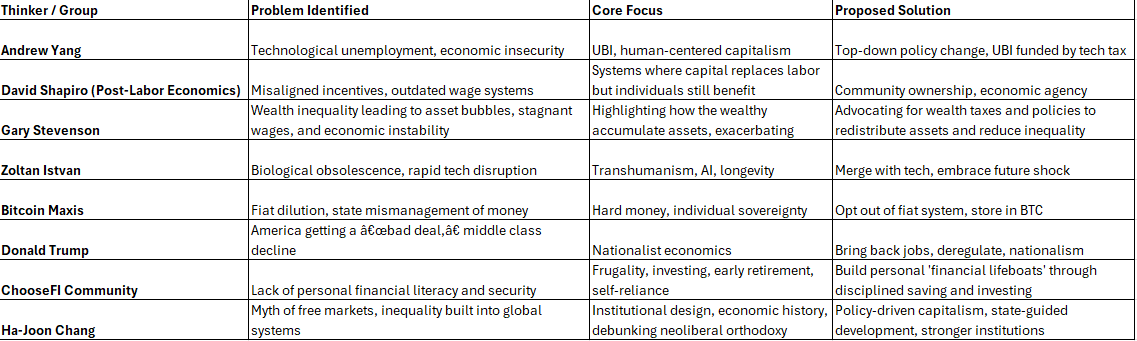
Earned World Manifesto – Thinkers I Wish to Unite

I generated the above table using ChatGPT. I have been invovled in all of these communities that are swirling around the same ideas. I wish I could get them to work together.

ChatGPT also generated the below. It’s not perfect but I wanted to publish it because I want to.

  1. offer it to the world
  2. open for critique and improvements.

The Earned World Manifesto

A Declaration for Builders, Not Rent-Seekers

1. The Problem We See

The current system extracts more than it empowers.
It rewards proximity to power, not creation of value.
It builds systems that entrench dependency, then calls that stability.

We see:

  • Productivity rising — but wages stagnating
  • Knowledge abundant — but credentials gatekept
  • Labor outsourced — but profit hoarded
  • Currency inflated — but savings eroded
  • Talent global — but opportunity gated
  • Work automated — but ownership concentrated

This is not an accident.
The rules are rigged — and the game is extraction.


2. What We Believe

🧱 Agency Is Non-Negotiable

Each individual has the right — and the responsibility — to direct their life.
Freedom is not given. It is constructed.

📈 Value Should Flow to the Builder

The person who creates, fixes, or risks should own the upside.
Rent-seeking is a tax on the capable.

🧠 Education Must Be Sovereign

Learning is abundant. Gatekeeping it is theft.
We reject the credential treadmill in favor of demonstrated skill.

💰 Money Must Be Earned and Preserved

Currency debasement is economic theft.
Savings must store effort, not melt it.

🔐 Ownership Is the Foundation

He who owns the tool, the platform, the protocol — holds the power.
We choose ownership over permission.


3. What We Support

This is not a utopia. It is a direction.

We support:

  • 🔸 Individuals achieving financial independence through disciplined action
  • 🔸 Workers becoming owners, not just operators
  • 🔸 Monetary systems (like Bitcoin) that cannot be corrupted
  • 🔸 Skill-first pathways over debt-fueled credentials
  • 🔸 Systems that reward contribution, not compliance
  • 🔸 Local or global opt-out zones where new rules can be tested

We reject:

  • Coerced redistribution
  • Forced altruism
  • Dependence disguised as security

4. Our Two-Stage Strategy

🛶 Stage 1: Build your lifeboat.
Earn freedom through action.
Reduce expenses, save in hard assets, develop durable skills, and reclaim your time.

🏛️ Stage 2: Rebuild the harbor.
Use your freedom to build systems that don’t demand sacrifice to survive.
Not as charity — but as infrastructure for agency.


5. Join Us

We are the builders. The earners. The ones who won’t rent our future.

We will:

  • Speak plainly about value and power
  • Share tools, not just tweets
  • Reward proof-of-work, not status
  • Create systems where sovereignty scales

If you’re tired of extraction,
If you still believe in ownership,
If you’re ready to build —

Welcome to the Earned World.

As I was generating the Manifesto, I had a lot of conversation with ChatGPT. Below was a powerful statement it had.

“The current system extracts more than it empowers.”

This means that the rewards of the modern economy are disproportionately claimed by systems, institutions, and owners — not by the individuals doing the work or taking the risk. The value flows upward, while the burden flows downward.

Here’s what that looks like across different dimensions:


💼 In Work
  • Wages have stagnated while productivity and corporate profits rise.
  • Most workers trade time for money with little long-term upside (no ownership, equity, or growth path).
  • Gig work and contract labor shift costs (insurance, risk, taxes) to the individual while stripping stability.

Extraction: Time, energy, creativity — taken for a wage that doesn’t keep up with cost of living.
Empowerment: Would mean building ownership, autonomy, or long-term equity from your work.


💸 In Money
  • Fiat currency loses purchasing power over time (inflation), punishing savers and wage earners.
  • Asset inflation (stocks, real estate) benefits those who already hold wealth — not those trying to build it.
  • Central banks and governments distort money supply in ways individuals cannot control or escape.

Extraction: Your savings melt while those close to the money printer get richer.
Empowerment: Would mean access to stable, sovereign, permissionless money, Bitcoin.


🏥 In Healthcare
  • Healthcare is tied to employment — meaning you’re not truly free to leave your job.
  • Insurance costs rise faster than wages; many avoid treatment due to fear of bills.

Extraction: Your health and security are used to bind you to jobs and debt.
Empowerment: Would mean decoupling basic needs from corporate control.


🏠 In Housing
  • Real estate is increasingly used as an investment vehicle, not a place to live.
  • Young people are priced out of ownership, forced into permanent renting.

Extraction: Rent drains wealth every month with no asset built.
Empowerment: Would mean pathways to ownership, equity, or cooperative housing.


🎓 In Education
  • Education costs have exploded, leading to decades-long student debt burdens.
  • The credential economy keeps people in a treadmill of debt just to be “qualified.”

Extraction: You pay to enter the game, and the game changes by the time you finish.
Empowerment: Would mean low-cost, high-agency pathways to skill and livelihood.


🤖 In Technology
  • Tech companies extract your attention, data, and time to sell to advertisers.
  • Users create content and community, but ownership and profits go to platforms.

Extraction: You are the product.
Empowerment: Would mean open platforms, data sovereignty, and user-owned networks.


🔁 Why This Matters

When a system extracts more than it empowers, it means:

  • The average person gets poorer in power, even if they get richer in consumption.
  • Stability, dignity, and control are replaced with dependency and precarity.
  • People become functionaries, not free agents.

Stagnation in the U.S. and suppression in Mexico are two symptoms of the same disease:

A system where capital moves freely, but labor and ownership do not.

Personal sovereignty is the prerequisite for systemic sovereignty.

Entrepreneurship without savings is economic quicksand.

I think there are solutions to a lot of these propblems. But this is teh start of framing for myself to think more about solutions.

I encourage everyone in the communities I identified to read this as well as consider how they coudl work to make their own lives better as well as make the system better.

I want to highlight the 2 step process.

🛶 Stage 1: Build your lifeboat.
Earn freedom through action.
Reduce expenses, save in hard assets, develop durable skills, and reclaim your time.

🏛️ Stage 2: Rebuild the harbor.
Use your freedom to build systems that don’t demand sacrifice to survive.
Not as charity — but as infrastructure for agency.

While I believe everyone is capable of building their lifeboat, it is certainly harder for some than others.

Please comment with any thoughts you have to update this.
Please feed this into AI and discuss with it how you might make chagnes to or improve it.

Here are a few resources I referenced when thinking about this.

Gold, Silver, Debt To GDP, Wealth Preservation

The Idea of Bitcoin Needs to Succeed, Even if Bitcoin Fails

World Wage and Work

23 Things They Don’t Tell You About Capitalism -Ha-Joon Chang

Post Labor Econonomics Videos – David Shapiro