Email To Congressperson Regarding Epstein Files

Sent this to my Congress Representative Ashley Hinson- I hope she does the right thing.

I am writing as a concerned constituent to urge you to support the Epstein Files Transparency Act, led by Rep. Thomas Massie and Rep. Ro Khanna. This bipartisan bill would require the Department of Justice to release all unclassified records related to Jeffrey Epstein and Ghislaine Maxwell, while protecting victims’ identities. Congress has already reached the 218-signature threshold to force a vote, and the American people overwhelmingly want transparency.

Here’s why this matters:

  • Past Promises: High-profile figures in the Trump administration—including Pam Bondi, Kash Patel, and JD Vance—publicly pledged to release these files when President Biden was in office. They even held meetings and photo ops promising transparency. Why have those promises evaporated now?
  • The Hoax Narrative Doesn’t Add Up: If this is all a “Democratic hoax,” as President Trump now claims, why is Ghislaine Maxwell serving a 20-year sentence for sex trafficking minors? Her conviction was based on evidence of a real criminal conspiracy, not political theater.
  • Gaslighting the Public: President Trump is actively discouraging Republicans from supporting transparency, calling the effort a “trap” and a “hoax.” If there’s nothing to hide, why fight so hard to keep these files secret?

Please do not deflect by asking “why didn’t the Democrats release it when they were in power.” That is gaslighting. You NOW have the power to release the files and do the right thing. Be on the right side of history.

This is not about partisanship—it’s about justice and accountability. Survivors deserve answers, and the public deserves to know the truth about who enabled Epstein’s crimes. Shielding powerful individuals from embarrassment is not a valid reason to withhold information.

Please vote YES on the Epstein Files Transparency Act and stand on the side of transparency, justice, and the rule of law.

Thank you for your time and service.

Tracking the “Political ETFs” — My Ongoing Experiment

Members of Congress have long faced accusations of trading on insider information — buying and selling stocks in companies they help regulate.
It’s a bipartisan problem: Republicans and Democrats alike have profited from privileged access and timing the rest of the public could never match.

That’s not just bad optics — it’s corruption.
It undermines faith in both the markets and the integrity of government.

To highlight how deep this problem goes, I’ve started an experiment tracking three ETFs:

  • NANC — the Unusual Whales Subversive Democratic Trading ETF, built around stocks traded by Democratic lawmakers.
  • GOP — the Unusual Whales Subversive Republican Trading ETF, reflecting trades made by Republican lawmakers.
  • SPY — the SPDR S&P 500 ETF Trust, serving as a neutral market benchmark.

My goal isn’t to glorify these funds — it’s to show in real numbers how political trading compares to the broad market, and to call out why this system needs reform.


Policy Context

This issue connects directly to Senator Josh Hawley’s proposal to ban individual stock trading by members of Congress.
His bill wouldn’t ban investing altogether — lawmakers could still own broad mutual funds or ETFs, just not trade individual stocks that might be affected by their votes.

That distinction matters. It allows long-term wealth building without the appearance or reality of insider trading.
📎 Read Hawley’s bill here


Performance Snapshot (Feb 10 2023 → Oct 27 2025)

SymbolETF NameDescriptionStarting Price*Current PriceTotal Return
NANCUnusual Whales Subversive Democratic Trading ETFTracks stocks favored by Democratic members of Congress$24.69$46.15+86.9%
GOPUnusual Whales Subversive Republican Trading ETFTracks stocks favored by Republican members of Congress$24.96$37.20+49.0%
SPYSPDR S&P 500 ETF TrustBaseline for overall U.S. market$408$685+67.9%

*Starting prices from Google Finance (Feb 10 2023, ETF inception date). Current prices as of Oct 27 2025.


The Takeaway

Both “political ETFs” have gained since launch, but that doesn’t justify congressional trading.
When lawmakers can personally profit from decisions they influence, public trust erodes — no matter how well the market performs.

This experiment is my small way to expose how close politics and profit have become — and to advocate for a system where leadership means stewardship, not stock tips.


The Earmark Era: How Washington Rewards Spending, Not Stewardship — and Why the Federal Budget Keeps Breaking

Earlier in 2024, I read a local article about Washington’s senior senator proudly announcing how much federal money she had brought home to the state. Her list ran dozens of pages — hundreds of millions in Congressionally Directed Spending, better known as earmarks.

She’s not alone. Nearly every senator submits earmark requests, which you can browse on the Senate Appropriations Committee’s official list. Each item sounds worthy enough: a wastewater upgrade, a community arts incubator, a “therapeutic court.” But taken together, these line items add up fast.

According to the Peter G. Peterson Foundation, Congress approved 8,098 earmark projects costing $14.6 billion in FY 2024—about the same as FY 2023—and still under one percent of total discretionary spending. In context, that’s roughly 0.2 percent of total federal outlays.

It’s easy to shrug and say, “So what? That’s peanuts in a $6.8 trillion budget.”
But the issue isn’t the size. It’s the signal.


The Round-Trip Problem

When money takes the round trip — federal tax → congressional politics → earmark → local grantee — it leaks. Every stop adds overhead, lobbying, and political friction.

If a project’s benefits are local, fund it locally. Save federal dollars for truly national needs—and make any remaining federal grants competitive and audited.

That’s not ideological; it’s basic hygiene. Less leakage, less pork, more accountability.


The GAO’s Quiet Crusade

The Government Accountability Office (GAO) has spent over a decade documenting federal overlap, duplication, and inefficiency. Between 2011 and 2023, its recommendations produced about $667 billion in cumulative savings—roughly $51 billion a year.

That sounds impressive… until you set it beside annual deficits averaging $1.2 trillion over the same period. Even if every GAO fix were implemented perfectly, it would only offset a few cents of every deficit dollar. We celebrate small wins while ignoring the structural math.


The Trillions That Run on Autopilot

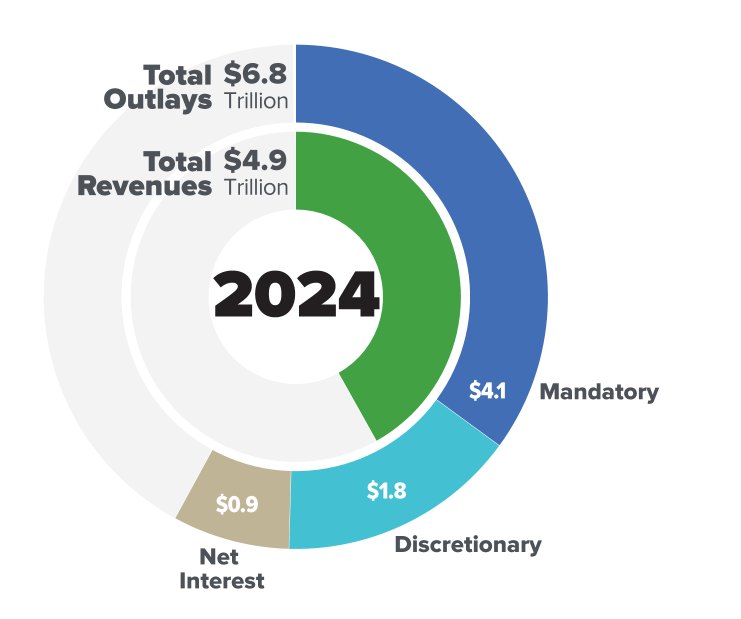
To understand that math, look at the 2024 federal budget as a whole (data from the Congressional Budget Office’s Budget and Economic Outlook: 2024–2034):

  • Total Outlays (FY 2024):$6.8 trillion
  • Total Revenues:$4.9 trillion
  • Mandatory Spending:$4.1 trillion (60%) — Social Security, Medicare, Medicaid, and other entitlements
  • Discretionary Spending:$1.8 trillion (26%) — defense, education, housing, infrastructure, research
  • Net Interest:$0.9 trillion (13%) — the fastest-growing line item in the budget

Source: Congressional Budget Office, “Budget and Economic Outlook: 2024–2034.”

All the fights over earmarks, audits, and waste reports happen inside that discretionary slice, the part Congress actually votes on each year.
The other 70 percent runs on autopilot — driven by demographics, healthcare inflation, and debt.

So yes, we have a trillions problem, not a billions problem.
But pretending the billions don’t matter ensures the trillions never get fixed.


The Cultural Incentive to Spend

Politicians are rewarded for bringing money home. A senator who resists earmarks looks “ineffective.”
That same incentive—spend now, borrow later—is what prevents any real reform on the mandatory side.

If Congress can’t resist handing out $14 billion in earmarks to score headlines, how will it ever take on the hard reforms that actually matter?


The Real Problem

The problem isn’t that earmarks alone bankrupt the country — they don’t.
The problem is that they reveal a mindset: Washington still rewards politicians for spending, not stewardship.

Every senator gets praised for what they bring home, not for what they turn down.
That’s the same mindset that makes real entitlement reform politically impossible and deficit reduction unthinkable.

Earmarks aren’t bankrupting the U.S., but they show why the U.S. can’t stop bankrupting itself.

Until that incentive changes — in Congress, in media, and among voters — the numbers will keep getting bigger, and the excuses will too.


Sources:

2024 Congressional Pig Book Summary
32nd “TheBook Washington Doesn’t WantYou to Read”
CITIZENS AGAINST GOVERNMENT WASTE

The Congressional Pig Book is CAGW’s annual compilation of earmarks in the appropriations bills and the database contains every earmark since it was first published in 1991. All items in the Congressional Pig Book meet at least one of CAGW’s seven criteria that were developed by CAGW and the Congressional Porkbusters Coalition:

  • Requested by only one chamber of Congress;
  • Not specifically authorized;
  • Not competitively awarded;
  • Not requested by the President;
  • Greatly exceeds the President’s budget request or the previous year’s funding;
  • Not the subject of congressional hearings; or,
  • Serves only a local or special interest.

The Politics of Envy: How Bernie Sanders Uses Billionaires to Distract from Washington’s Failures — and Keep People Angry

Blaming billionaires is easy. Fixing bad policy, broken incentives, and decades of fiscal irresponsibility isn’t — so Bernie Sanders keeps the outrage machine running instead.

A lot of people — Bernie Sanders in particular — hate billionaires because they assume billionaires stole their wealth.
But that belief comes from misunderstanding how value is actually created.


💵 Creation vs. Printing

Bernie and the government “create money” by printing it — literally out of thin air — which steals purchasing power from everyone who already has dollars.
That’s not value creation. It’s value redistribution by dilution.

So when that’s your frame of reference, you start to believe that everyone who gets rich must have taken something from someone else. Because that’s how you create “money” in politics — you print it or tax it away.

But wealth in a free market isn’t created by decree. It’s created by building, coordinating, and innovating — by making something others voluntarily trade for.


📈 Value Creation Is Not Theft

Larry Ellison, for example. One day Oracle stock went up, and his net worth jumped by $100 billion. Bernie acts like Larry ran around stealing $100 billion from working people.
But that’s not what happened. That value didn’t exist before — it was created.

Wealth in the market represents new value built through skill, innovation, and coordination, not theft.
If you’re stranded on an island with a billion dollars, it’s worthless. You need resources, tools, and knowledge to turn that “money” into something useful.

The problem is, people who’ve never built or created real value assume no one else can either.
So they see wealth as theft instead of creation. That’s the confusion at the heart of modern politics.


⚠️ Bernie’s Game: Blame, Not Solutions

And that’s where Bernie Sanders comes in.
He isn’t actually helping working people by pointing to billionaires as evil — he’s manipulating them.

By giving people a villain to hate, he distracts from the real causes of economic pain — bad money, wasteful government, and decades of inflation that quietly rob savers and workers.
He rallies frustration around a scapegoat instead of a fix.

If Bernie genuinely wanted to help, he’d talk about restoring fiscal discipline, reducing waste, and making it easier for regular people to build wealth — not demonizing those who already have.
But he doesn’t. Because blaming billionaires is politically easy.
Fixing the system would mean questioning the very machine that gives him power.

So instead of solving problems, he feeds resentment — keeping people angry, divided, and dependent on him to express that anger.


🧮 The Fantasy of the “Billionaire Tax”

In a recent Time article titled “I’m a Millionaire. No One Needs More Than $30 Million”, the author argues that a Billionaire Income Tax could raise $557 billion over ten years and “jump-start a permanent safety net.”

That sounds impressive — until you look at the math.

The U.S. government currently runs a $2 trillion annual deficit.
That’s $20 trillion in overspending every decade.
So this “transformative” billionaire tax covers less than 3 % of the hole. It’s fiscal rounding error.

The problem isn’t a lack of billionaire money — it’s a lack of discipline and accountability.


🏛 The Real Problem Isn’t “Too Much Money” — It’s How It’s Used

The Time article goes on to argue that wealth beyond $30 million stops being about living well and becomes about wielding power — influencing elections, buying media outlets, and suppressing competition.

That part isn’t entirely wrong. Money can corrupt politics.
But the author’s solution — capping wealth — misses the point completely.

If the issue is that money manipulates the system, then the answer is to make the system harder to manipulate, not to confiscate wealth after the fact.

We should make elections harder to buy, not success harder to earn.
Reform campaign finance, close regulatory loopholes, stop insider lobbying — that’s how you stop abuse.

The same goes for the “buy, borrow, die” loophole that allows the ultra-wealthy to avoid realizing gains.
If that’s the concern, close the loopholes directly — don’t destroy the entire structure of value creation to fix a tax code glitch.

And even then, no system will ever be perfect.
Smart, ambitious people will always find new ways to optimize around the rules — that’s part of what makes them successful.
Every time you close one loophole, innovation and adaptation create another.
The goal shouldn’t be to eliminate advantage; it should be to keep the playing field open and the incentives productive.

And far from “locking others out,” large pools of wealth are what fund the next generation of builders.
People don’t lose the chance to innovate because billionaires exist — they lose it when regulation, bureaucracy, and bad policy make it impossible to start or scale.
Just look at Europe: it leads the world in regulation, but none of the world’s biggest or most dynamic companies are European.
They’ve made it harder to fail, but also impossible to truly win.
Capital isn’t a finite pie being hoarded; it’s the byproduct of trust, savings, and productive investment.
Destroy that, and you destroy the fuel for future innovation.

Blaming “too much money” is a lazy shortcut that lets broken institutions off the hook.


💥 What Happens If You Actually Take It

Let’s pretend we go full Bernie and seize every dollar of billionaire wealth in America — all $6 trillion of it.

Here’s what happens:

  1. That covers just three years of deficit spending at current rates. Then what? You’re out of billionaires, and the deficit keeps growing.
  2. Most of that wealth isn’t cash. It’s ownership stakes in companies — Tesla, Oracle, Amazon, Microsoft, etc.
  3. If the government forces liquidation, prices collapse. No one can buy trillions in stock without tanking the market.
    • Even a 50 % drop cuts the haul to $3 trillion — barely 18 months of deficits.
  4. Who buys the assets? The next-richest class. Inequality reshuffles briefly, then reforms.
  5. Meanwhile, innovation stalls. Investment dries up. Everyone gets poorer.

You can’t fund a government by destroying the productive capital that funds everything else.


⚙️ The Real Issue Isn’t Wealth, It’s Value

Wealth isn’t evil — it’s a signal that someone created something valuable enough for millions of people to trade their time or money for it.
That’s fundamentally different from printing dollars and calling it “stimulus.”

If we want a stronger, fairer economy, the solution isn’t confiscation — it’s creation.
Encourage building, innovation, and hard work, and you’ll raise living standards for everyone.
Punish them, and you’ll end up with equality through shared decline.


🧭 Final Thought

Bernie isn’t fighting for the working class. He’s fighting to stay relevant to it.
You don’t fix inequality by burning down the factory.
You fix it by letting more people build factories of their own.


From Rome to Norway: What History Teaches Us About Post-Labor Wealth Models

As we edge closer to a post-labor economy fueled by AI and automation, the conversation around how to distribute wealth fairly is more urgent than ever. Advocates of dividend-driven futures, like David Shapiro and others, propose income portfolios built from public wealth funds, UBI, cooperatives, and residual wages. But are there any historical models to guide us? Have civilizations ever successfully structured systems where wealth flowed to the public without direct labor?

It turns out, yes. And the lessons are mixed.


The Roman Bread Dole: Subsidy Without Structure

Ancient Rome’s grain dole (“annona”) offered a form of basic sustenance to citizens, distributing heavily subsidized or free grain. At its peak, hundreds of thousands of Romans received this support. It was politically stabilizing, popular, and arguably necessary as economic power consolidated into the elite.

But the system was fragile. It depended on imperial conquests, slave labor, and an expansive logistics network that became unsustainable as Rome declined. It also did little to build durable economic agency. The dole kept people fed, but not empowered.

Lesson: Subsidy without economic diversification or civic agency becomes brittle.


Native Tribes and Casino Revenues: Promise and Pitfalls

In the U.S., many Native American tribes operate casinos, with profits funding health care, education, and direct dividends to tribal members. These tribal wealth funds resemble the localized wealth mechanisms proposed in post-labor economics.

However, outcomes vary widely. In some communities, casino revenues have elevated living standards and strengthened governance. In others, benefits have concentrated in tribal leadership, exacerbating inequality and dependency.

Lesson: Without transparency, inclusive governance, and diversified investment, even well-intentioned redistribution can fall short.


The Alaska Permanent Fund: A Modern Dividend Model

Established in 1976, Alaska’s Permanent Fund takes oil revenues and invests them globally. Each year, residents receive a dividend, usually between $1,000-$2,000. It’s simple, durable, and popular.

Yet, it faces political risk. When Alaska hit budget shortfalls, politicians dipped into the fund. There are debates about whether it discourages work or disincentivizes participation in broader civic life.

Lesson: Popular dividend programs are sustainable, but vulnerable to political raids and lack of reinvestment discipline.


Norway’s Oil Fund: The Gold Standard of Public Wealth

Norway’s Government Pension Fund Global, often dubbed the Norwegian Oil Fund, is the largest sovereign wealth fund in the world. Fueled by oil profits, it now exceeds $1.5 trillion and invests in over 9,000 companies across more than 70 countries.

Unlike Alaska, Norway does not send direct cash to citizens. Instead, the fund returns go into the national budget, funding universal services such as education, health care, and pensions. Crucially, the fund adheres to strict ethical guidelines, has world-class transparency, and maintains a 3% spending rule to preserve capital.

Lesson: Long-term sustainability requires diversification, professional governance, limited spending, and a focus on services that boost collective agency.


Designing for the Post-Labor Era: What Must Be Done

The future calls for a blend of these lessons. Post-labor economic resilience depends on:

  • Diversification: Don’t over-rely on a single industry or location (Rome, casinos).
  • Transparency & Governance: Avoid elite capture (tribal pitfalls).
  • Capital Preservation: Limit annual drawdowns to preserve intergenerational equity (Norway).
  • Layered Income Models: Combine UBI, local trusts, cooperatives, and personal assets for resilience.

The past offers both warning signs and inspiration. If we take the best from each model—Rome’s stabilizing intent, tribal localization, Alaska’s dividends, and Norway’s professionalism—we might just build a post-labor economy worth living in.

Elon vs. Trump’s “Big Beautiful Bill”: Why It’s All Noise Without Bitcoin

Elon Musk is on a rampage again—this time, against Donald Trump’s so-called “One, Big, Beautiful Bill.” He’s called it a “disgusting abomination,” a pork-stuffed monstrosity that will explode the national deficit and bury Americans under a mountain of debt. And he’s not wrong.

But here’s the thing: yelling into the void of Washington politics won’t change a system that’s already rigged to print, spend, and inflate its way into oblivion. The real protest isn’t a tweetstorm. It’s opting out.

Elon Tried to Fix It—And Got Burned

Let’s not forget: Elon Musk didn’t start out as a critic. He tried to work within the system. He joined advisory councils, met with presidents, and even offered to help streamline government operations. He believed that innovation and logic could steer the ship of state.

But the bureaucracy didn’t budge. The incentives were too broken, the politics too entrenched. Eventually, Musk walked away—disillusioned and vocal. His recent outburst isn’t just frustration; it’s the sound of someone who tried to fix the machine and realized it’s designed to resist change.

Why Fighting the System Is a Distraction

The U.S. government isn’t going to stop spending. It’s not going to balance the budget. And it’s certainly not going to voluntarily give up the power to print money. So while Elon’s outrage is justified, it’s also futile. The system isn’t broken—it’s working exactly as designed.

The Only Real Exit: Bitcoin

If you’re tired of watching your purchasing power erode while politicians play Monopoly with your future, there’s only one real move: opt out. Buy Bitcoin.

Bitcoin isn’t just a hedge against inflation—it’s a peaceful protest. It’s a decentralized, deflationary alternative to fiat currencies that can’t be manipulated by central banks or corrupted by politics. It’s the lifeboat in a sea of fiscal insanity.

Conclusion: Don’t Rage—Exit

Elon’s fury is understandable. But the real revolution won’t be televised—it’ll be verified on the blockchain. If you want to send a message to Washington, don’t waste your breath. Move your money. Buy Bitcoin.

Is Factory Work Exploitative If It Saves You From Something Worse?

In 2012, a Chinese student studying in the U.S. wrote a letter that was later shared by David Pogue in Business Insider. He described how his aunt had worked for several years in what Americans might call a “sweatshop”:

“It was hard work. Long hours, small wage, poor working conditions. Do you know what my aunt did before she worked in one of these factories? She was a prostitute.”

The student emphasized that, despite the difficult conditions, the factory job was a step up—it provided safety, legality, and stability she had never known before.

This story raises a profound moral question: Does an improvement from desperation make an exploitative system justifiable?

Let’s explore why this tension sits at the heart of modern global capitalism.


Better Than Nothing Isn’t the Same as Fair

A factory job may lift someone out of desperation. But an improvement from rock bottom does not equal justice.

The woman in this story is performing the same labor as someone assembling parts in Michigan. She’s not less intelligent or less valuable. She’s just on the wrong side of a global wage arbitrage system.

Corporations don’t pay her less because she’s worth less—they pay her less because they can.


What Is Exploitation?

Exploitation occurs when value is extracted from someone without fair compensation.

You can have:

  • Exploitative jobs that are better than the alternative, and
  • Exploitative systems that improve people’s lives short-term

But the core question is: Who captures the surplus value?

In this case, it’s not the woman. Her labor adds real value to a global supply chain, but she sees only a sliver of it. The rest flows upward:

  • To multinational corporations
  • To shareholders
  • To high-income consumers paying less for products made with underpaid labor

This is exploitation by design—not an accident, but a business model.


Does “Choice” Make It Ethical?

Many people argue:

“Well, she chose the job.”

But choice under coercion of circumstance isn’t freedom. If the only options are wage slavery or something worse, the system isn’t ethical—it’s merely tolerable.

Asking someone to be grateful for a better form of poverty is morally hollow.


So What Can Be Done?

This is where technologies like Bitcoin offer potential.

No, Bitcoin doesn’t magically fix global labor markets. But it creates an escape hatch:

  • A way to store value in a neutral system not subject to local currency collapse
  • A method of payment that bypasses middlemen
  • A step toward economic sovereignty

It lets workers keep more of what they earn. And that alone makes it powerful.


Final Thought

A factory job may save someone from a worse fate. But if it pays unfairly, concentrates profits far away, and denies workers ownership of what they build—it’s still exploitation.

We can be grateful for progress while demanding more. Dignity requires more than survival.

And we don’t have to wait for permission to build something better.

Elon Musk’s Vision Still Matters for Tesla

On a recent episode of the Sanity Podcast, hosts Dave Briggs and Allison Camarada sat down with Ross Gerber, an early Tesla investor who once held nearly 500,000 shares. Gerber’s take? Elon Musk’s political stances, his Twitter antics, and his role in slashing government spending via DOGE have turned Tesla into a “pariah brand,” tanking its stock and alienating owners. He’s sold off much of his stake and wants Musk out as CEO, pointing to a board he claims is overpaid in stock options and lacks independence. As a Tesla shareholder who’s voted twice to back Musk’s compensation, I’ve got a different view—one that sees Gerber’s complaints as shortsighted and the hate for Tesla as misplaced. Here’s why Musk’s vision still matters, and why Tesla wouldn’t be Tesla without him.

Stock Options Align Incentives, Not Greed

Gerber griped about Tesla’s board getting rich off stock options instead of flat pay—$600 million for chair Robyn Denholm, he says, versus the $400k norm at companies like Disney. But isn’t that the same deal Musk has? Back in 2018, when Tesla was a $50 billion company, shareholders like me voted for his pay package: for every $50 billion in value he added, up to $650 billion, he’d get a payout. The media called it absurd, saying Tesla would never hit that mark. Guess what? It did, and then some—12xing my investment. We voted again in 2024 to reaffirm it, with 75% approval. So why’s Gerber mad when the same stock-based incentives that rewarded Musk also rewarded him 20-fold? The board and Musk win when shareholders win—when Tesla provides value to the world. That’s not a flaw; it’s the point. The only ones whining are Gerber and an activist lawyer pushing a BS lawsuit with a guy who owns nine shares. Most of us aren’t mad—we’re counting our gains.

Tesla’s Success Isn’t Luck—It’s Elon

Gerber wants Musk gone, but look at the alternatives. Ford’s stock has been stuck at $9 since 1989. GM went bankrupt in 2008, wiping out shareholders like me (I lost $100—not much, but still). Meanwhile, Tesla’s the only new U.S. car company to thrive in a century. Why? Musk’s vision. He’s not just churning out cars—he’s pushing grid-scale Megapack batteries, humanoid robots, and electric semis. New EV players like Fisker and Canoo crashed and burned; Tesla didn’t. People think CEOs micromanage daily ops, but that’s not the gig. A CEO makes a few big calls a year to set the course. Compare Musk to GM’s Mary Barra—stock flat since their bankruptcy—or Ford’s latest CEO, whoever that is. Musk sees where tech and the world are headed; they don’t. Without him, Tesla might coast for 10-15 years on Model Ys and 3s, but the visionary spark would die.

Apple’s Lesson: Visionaries Matter

Take Apple. People see it as a juggernaut now, but in 1998, it was nearly bankrupt. They’d kicked Steve Jobs out in 1985, and for over a decade, the company floundered—until they brought him back in 1997. Jobs turned it around with the iPod, iPhone, and more, making Apple a titan. Since his death, though? They’ve coasted—new iPhones, sure, but nothing revolutionary. Tesla could follow that path if Musk were axed: profitable for a while, but stagnant, no longer dreaming big. Gerber might not care, but I do—because that’s where the real value lies.

The Hate’s Misplaced—And It Hurts the Wrong People

Yes, Musk’s dive into politics stings for Tesla owners. I get it—nobody likes being hassled for driving one. But the pain isn’t from Elon; it’s from people attacking us for his views. I don’t see folks boycotting Amazon over Jeff Bezos, or GM over Barra. Why Tesla? Gerber notes Musk owns just 13% of the company—87% is us: shareholders, pension funds, workers. Protests at Tesla stores, keying cars—that doesn’t hit Elon; it hits regular people. Tesla owners now have to worry their cars will be vandalized every time they go oujust because they drive a Tesla. It’s unfair, and it’s missing the point: Tesla’s still fighting climate change, even if Musk’s tweets rile up the culture wars.

Musk’s Not Perfect, But He’s Proven His Worth

Is Musk distracting? Sure, sometimes. Twitter was a wild move, and his Trump endorsement after the assassination attempt raised eyebrows. But Gerber’s wrong that it’s all downhill. Musk’s quirks—political or otherwise—come with the genius. He took Tesla from a cash-strapped EV geek dream to a global force. When Biden snubbed Tesla for GM and Ford in that EV summit, Musk fought for the credit he’d earned—because he built the industry they’re now riding. And DOGE? If it’s slashing waste, I’m not crying over it—especially when Gerber admits the SEC’s understaffed anyway. Musk’s not “taking his eye off the ball”; he’s juggling more balls than most CEOs could dream of.

The Bottom Line

Gerber’s selling because he’s cashed out his 20x gains and doesn’t like Musk’s vibe anymore. Fine (we, other Tesla Shareholders, don’t like him! Go start your own company Ross!)—he’s free to buy Ford or GM instead. But for me, and plenty of other shareholders, Musk’s the reason Tesla’s not just another failed startup—or a coasting has-been like Apple post-Jobs. The stock’s down 40% from its peak, sure, but it’s still worth more than Ford, GM, and Stellantis combined. BYD’s cheaper cars don’t touch Tesla’s software edge, and robo-taxis? Good luck finding a better bet. Tesla’s not dying—it’s evolving, and Musk’s the one steering it. If you don’t like it, nobody’s forcing you to buy the stock—or the car. Me? I’m still in, because vision beats complacency every time.

Tesla – Next Opportunities 2025 and 2026

I am a big believer in the future of Tesla as a business and the positive impacts they will have on the world.I wanted to put together a quick reference for the catalysts I see coming in the next 2 years that I can quickly share with people. 

These are ordered from first to happen to furthest away. 

Tesla Model Y Juniper Update

New Cheaper Tesla car/vehicles for sale – H1 2025

China megapack factory 

Semi production next year

FSD release in China imminent

Robotaxi service – start in Texas and California next year

Optimus bot

Tesla Model Y Juniper Update – This is a styling and hardware update for the best selling car in the world in 2023, the Tesla Model Y SUV. It wasn’t quite the best selling in 2024, likely due to people waiting for the 2025 update. This update should lead to best selling status of this car again and help total production of 2.3 million vehicles in 2024. 

New Cheaper Tesla car/vehicles for sale – H1 2025 – Elon has mentioned veiled comments related to cheaper vehicles in H1 2025. These will be able to be built on the same lines as Model 3 and Y. This should help total production of 2.3 million vehicles in 2024. 

Tesla model Q?

China megapack factory – The Megapack is a “grid scale” battery storage solution for energy. These are sold often in sits of 200-500 at at time. They cost around $1 million per megapack. The current factory is in the USA, for the USA and rest of world. The China Megapack factory should be in production in H1 2025 and fully ramped by end 2025. These are extremely profitable products. 

Megapack factory 60% complete – sept 2024

Semi production next year – Tesla has been testing the Tesla Semi for a while with Pepsi and other companies. The Tesla semi will be much cheaper to operate and more reliable (fewer parts) than a diesel semi. I fully expect electric semi’s to almost completely replace all semi’s in 10 years. The average semi is 7 years old. That means every 7 years most of the semi fleet is fully replaced. Of course there are some older vehicles that remain. Since electric semi’s will be cheaper to operate and trucking is a business large businesses will drive adoption of this more efficient technology, or they will go out of of business and be replaced by companies that do.
Tesla semi has driven 250,000 miles 

Tesla Semi partner PepsiCo says electric truck helps with driver retention

Tesla semi factory videos 

FSD release in China imminent – Up until now, FSD (Full Self Driving) A $8,000 option, or $100/month subscription, has only been available in the USA. Tesla is likely to get approval to start using and selling in EU and China in 2025. This will open up for millions of drivers to pay for that software. 

Robotaxi – start in Texas and California 2025 – Tesla has had good progress on its FSD (Full Self Driving) software in the last year. They are planning to start offering a Robotaxi service, using Tesla 3’s and Y’s in California and Texas in 2025. 

Tesla Eyes 2025 Robotaxi Launch in California and Texas

Tesla robotaxis are coming in 2025 with an unexpected addition

Optimus bot – Tesla has been working on the Optimus, humanoid Robot, for a few years now. The latest versions are very compelling, being able to walk down a steep slippery slope and catch a thrown ball. These will be offered to do simple work in factories. They don’t need to do 100% of the work people can do. There is a curve of simple tasks they can start on and slowly develop skills and do more and more. Even if they cost $50k a year, they will be cheaper than a fully burdened factory worker who after factoring in health care, sick time, etc costs a company more than $50k a year, even if they are only paid $30k /year. Tesla could likely lease these for “only” $25k/year and even replace half a person. 

Tesla’s Optimus can now walk autonomously on rough terrain

Tesla Optimus Robot Catching a Ball