
$200K vs $1.2M: A SATA + STRC Thought Experiment on Reaching F.I.R.E.

For years, the standard framework for retirement income has been the 4% rule.

The idea is simple: if you want $48,500 per year of spending, you would typically need roughly:

$48,500 × 25 = $1,212,500

In other words, about $1.2 million invested in a diversified portfolio to sustainably withdraw that income.

But recently I came across an interesting thought experiment involving two relatively new preferred securities.

Before diving into the math, it’s important to note that these securities ultimately sit within financial structures connected to Bitcoin, so they carry some exposure to the long-term success of Bitcoin itself. More on that later.


Two High-Yield Preferred Securities

Two securities caught my attention:

  • Strategy Series C Preferred (STRC) – currently yielding about 11.5%
  • Strive Asset Management Preferred (SATA) – currently yielding about 12.75%

Both are preferred securities issued by companies building financial products around Bitcoin treasury strategies.

An interesting feature is their dividend timing.

  • STRC has an ex-dividend date around the 15th of the month
  • SATA has an ex-dividend date around the 28th of the month

The actual cash payment arrives roughly 15 days later, but what matters for dividend eligibility is simply holding the shares on the ex-dividend date.

After that date passes, an investor can sell the shares and still receive the dividend.


The Rotation Idea

Because the ex-dividend dates occur at different times of the month, a strategy some investors discuss is rotating between the two securities:

  1. Hold STRC through its ex-dividend date (~15th)
  2. After the ex-date passes, sell and move into SATA
  3. Hold SATA through its ex-dividend date (~28th)
  4. Then rotate back to STRC and repeat

In theory, this rotation attempts to capture both dividend streams each month.


The Yield Math

Using approximate yields:

SATA: 12.75%
STRC: 11.5%

Combined:

12.75% + 11.5% = 24.25%

If an investor pays roughly 24% tax on the income:

24.25% × 0.76 ≈ 18.4% after tax

That’d give this investor $18,400 per a year income on $100k or $36,400 per a year on $200k.


The Early Retirement Thought Experiment

Suppose an early retired investor allocated $200,000 to this strategy.

At a 24.25% gross yield, the income would be:

$200,000 × 0.2425 = $48,500 per year

Under the traditional 4% rule, producing that same income would require:

$48,500 × 25 = $1,212,500

So the comparison looks like this:

StrategyCapital Required
Traditional 4% rule~$1.2 million
Preferred rotation idea~$200,000

That’s roughly a 6× difference in required capital.


Even More Interesting for Early Retirees

For some early retirees who structure their income carefully, qualified dividend income can fall within the 0% federal tax bracket.

In that scenario, the full 24.25% yield could theoretically flow through without federal income tax.

Using the same $200,000 example:

InvestmentYieldAnnual Income
$200,00024.25%$48,500

That level of income could cover a meaningful portion of living expenses for many households.


The Bitcoin Connection

It’s important to understand what ultimately sits underneath these securities.

Both STRC and SATA are part of financial structures built around companies holding significant amounts of Bitcoin on their balance sheets.

At the base of these preferred securities is therefore some degree of Bitcoin risk.

If Bitcoin were to fail as an asset class entirely, the underlying business models supporting these preferreds would likely fail as well.

However, if Bitcoin continues to grow and remain valuable over time, these structures should continue to function as designed.

It is also possible that as demand for these types of securities increases, the dividend yields could gradually decline. Markets tend to compress yields when large numbers of investors compete for the same income-producing assets.

So the yields discussed above should be viewed as the current state of the market, not necessarily a permanent condition.

Finally there is company risk. Strive (ASST) issues SATA and Strategy (MSTR) issues STRC. Either company could fail for some generic business reason and that woudl also be a risk, just like any business.


Final Thoughts

For decades, the 4% rule has been a useful guideline for thinking about retirement income.

But financial markets are constantly evolving, and new structures occasionally appear that change the math in interesting ways.

This rotation idea may or may not prove durable over the long run. But it highlights how emerging financial instruments—especially those tied to Bitcoin treasury strategies—are beginning to create entirely new types of income assets.

And sometimes, when you run the numbers, it’s worth pausing and asking:

Could the future of income investing look different than the past?

As of 3-16-2026 I started an account to do this specifically. I will share the results in a few months or at the end of the year to see how it’s gone and if anything has changed since I started this experiment.

All prices in the below table are per share. multiple the # shares x any price to get the total amount. I started with 10x $97.22 = $972.20 and a purchase of 10 shares of SATA.

Stock# sharesDate PurchasedDate SoldPurchase Price Sell Priceprice appreciationDividend DateDividend
SATA103-16-264-1-26$97.2297.89+$0.67

This article is for informational purposes only and should not be considered investment advice.
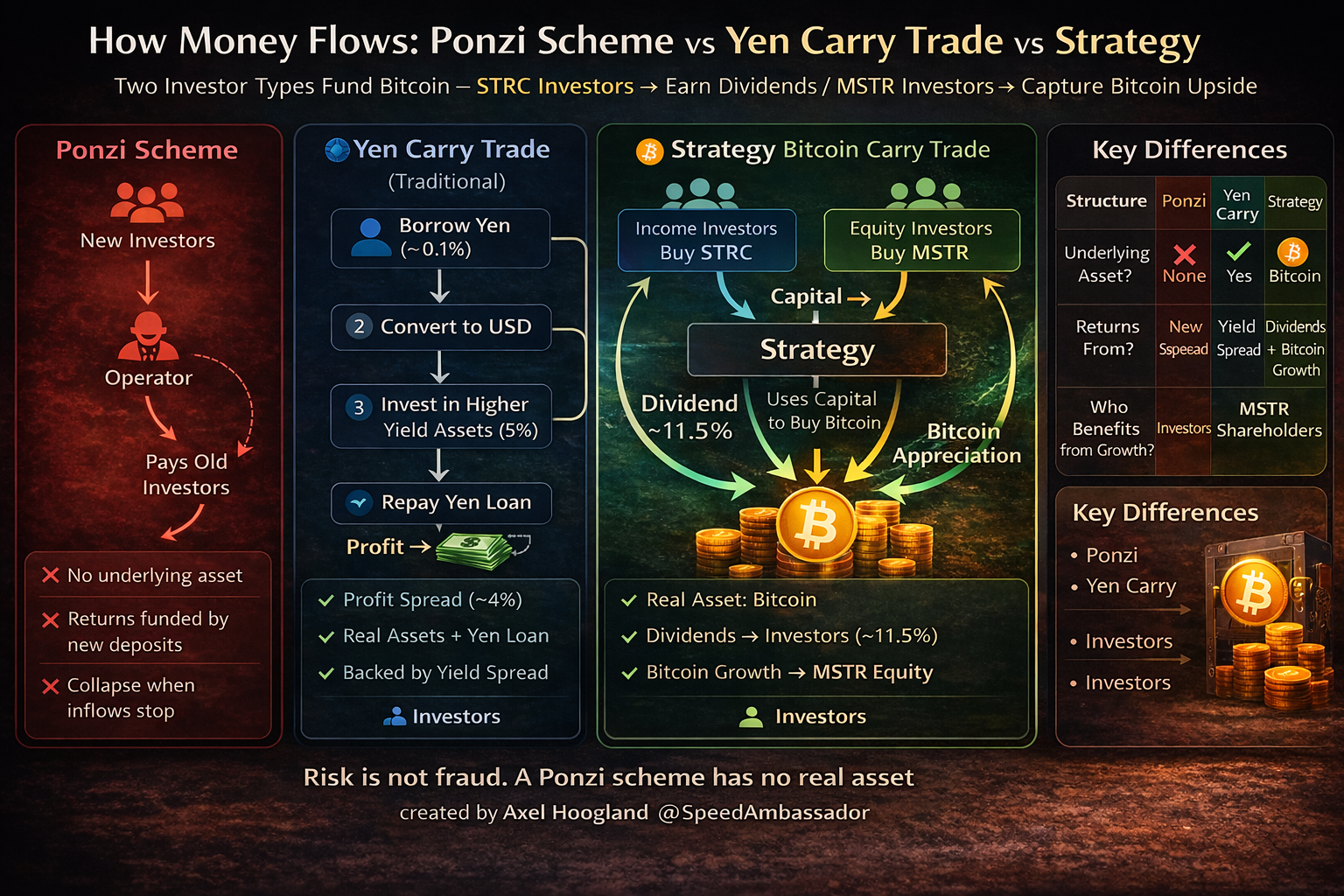
Calling MSTR a Ponzi Scheme Shows a Fundamental Misunderstanding of Finance

Understanding Ponzi schemes, Bitcoin carry trades, and how new financial instruments are evolving

Recently there has been a wave of posts online claiming that MicroStrategy and securities like STRC are “Ponzi schemes.”

That claim misunderstands both what a Ponzi scheme actually is and how these instruments work.

Before labeling something a Ponzi scheme, it helps to start with a clear definition.


What Is a Ponzi Scheme?

A Ponzi scheme is a fraudulent investment structure where:

  1. Investors are promised returns
  2. Those returns are not generated by real economic activity
  3. Early investors are paid using money from new investors
  4. The scheme collapses once new inflows stop

The defining characteristics are:

  • No real underlying asset
  • No productive activity generating returns
  • Fabricated account statements or hidden losses
  • Mathematical collapse once new money stops coming in

The most famous example is Bernie Madoff, who fabricated account balances while paying existing investors with money from new clients.

If there is no real asset and no real economic activity, you may be looking at a Ponzi scheme.


An Interesting Contrast: Social Security

Ironically, one of the closest structures many Americans participate in that resembles a Ponzi-style payment system is **Social Security Administration’s Social Security program.

Social Security works by:

  • taxing current workers
  • using those taxes to pay current retirees

There is no large invested pool backing the system. Instead, it relies on a continuous stream of new contributors to fund previous participants.

Government projections show the trust funds are expected to become depleted within the next decade, after which benefits would have to be reduced or taxes increased to maintain payouts.

This is not fraud — it is a demographic funding system created by law — but it illustrates an important point:

Money flowing from new participants to previous participants does not automatically make something a Ponzi scheme.

A Ponzi scheme specifically requires deception and fake returns.

Now let’s look at MicroStrategy.


What MicroStrategy Actually Does

MicroStrategy is a publicly traded company that:

  • issues equity and debt securities
  • uses the proceeds to purchase Bitcoin
  • holds that Bitcoin on its balance sheet

The underlying asset is Bitcoin, which is publicly verifiable on the blockchain.

Investors buying MicroStrategy securities know exactly what they are purchasing.

Nothing is hidden.
Nothing is fabricated.
The underlying asset exists and can be independently verified.

You may disagree with the strategy.

But it clearly does not meet the definition of a Ponzi scheme.


What STRC Actually Is

STRC is a preferred stock issued by MicroStrategy that pays a monthly dividend currently around 11.5% annually.

The capital raised from selling STRC is used to purchase additional Bitcoin.

Conceptually, the structure resembles a carry trade.


A Bitcoin Carry Trade

For decades global investors used the Yen carry trade.

The strategy worked like this:

  1. Borrow Japanese yen at extremely low interest rates
  2. Convert yen into higher-yielding assets (often U.S. dollars)
  3. Capture the yield difference

STRC works in a somewhat similar way — but with Bitcoin.

Instead of:

Yen → USD

The structure is effectively:

USD → Bitcoin

Investors provide capital and earn roughly 11.5% yield, while MicroStrategy accumulates Bitcoin.


What the Market Has Actually Shown

STRC began trading in July 2025.

Around August 2025, Bitcoin traded near $120,000.

Since then Bitcoin has experienced significant price volatility.

Yet STRC has generally continued trading near its $100 reference price.

That doesn’t prove the structure will work forever.

But it does show something important:

So far, the instrument has functioned roughly as designed.

Financial markets tend to expose broken structures quickly.


The Lindy Effect

There is a concept known as the Lindy effect.

The Lindy effect suggests:

The longer something survives, the longer it is likely to continue surviving.

We see this with technologies, institutions, and financial instruments.

Gold has survived thousands of years.
Stock markets have survived more than a century.
Bitcoin itself has now survived multiple boom-bust cycles.

Each month that STRC:

  • maintains its price near $100
  • pays its dividend
  • continues operating normally

…the probability that the structure works increases slightly.


What Are the Real Risks?

None of this means STRC or MicroStrategy are risk-free.

But the risks are often misunderstood.

The real risks are tail risks — low-probability but high-impact events.

For example:

1. Catastrophic failure of Bitcoin

If Bitcoin were somehow fundamentally broken — a critical cryptographic flaw, catastrophic protocol failure, or a coordinated global ban that destroyed liquidity — the entire thesis behind MicroStrategy’s balance sheet would be undermined.

2. Corporate catastrophe unrelated to Bitcoin

Another possibility would be some major event affecting the company itself:

  • fraud inside the company
  • regulatory disaster
  • management misconduct
  • or some unforeseen corporate collapse

These risks exist for every public company.

3. Extreme financial system disruption

In a severe financial crisis, credit markets can temporarily freeze. Any company that relies on capital markets — including MicroStrategy — could be affected.


Risk Is Not Fraud

The irony in many of these debates is that the word “Ponzi” often gets used as a general insult for anything people don’t understand.

Real Ponzi schemes involve deception, fake assets, and fabricated returns.

MicroStrategy and STRC involve transparent securities backed by a publicly verifiable asset.

Whether someone believes in Bitcoin or not, the structure is visible to everyone.

In fact, one of the broader trends of the past decade has been the opposite of a Ponzi scheme: systems where the underlying asset is more transparent than ever before.

Bitcoin’s supply is public.
Bitcoin’s transactions are public.
Bitcoin’s monetary policy is fixed.

Financial instruments like STRC are simply new ways that traditional capital markets are interacting with that asset.

You may think the strategy is aggressive.
You may think the trade will fail.

But the difference between risk and fraud still matters.

And confusing the two only makes it harder to understand what is actually happening in financial markets today.

Microstrategy $750 Million to Buy MORE Bitcoin!

Microstrategy is a large software analytics company. It is also the company which holds the most Bitcoin. Microstrategy currently holds 152,800 bitcoins.

This is 0.73% of all Bitcoin that will ever be created! There will be only 21 million Bitcoin ever.

It’s also estimated that perhaps 4 million bitcoin have been “lost” with old computers that people have lost so that means 152,800/17 million = 0.9% of all Bitcoin that will ever be available! Only 19 million bitcoin have been issued. The final 2 million will be issued over the next 120 years, so that means there are only about 21-2-4 = 15 million bitcoin available for purchase today. So Microstrategy owns over 1% of all Bitcoin available today!

And they are buying more!

MicroStrategy is planning to raise up to $750 million via a stock sale and says it may use the proceeds to buy more Bitcoin- Cointelegraph

The reason Microstrategy is buying more bitcoin is because they see it as the supreme ownership asset. In a world where more fiat currency (USD, Euros, Yen) are created everyday something that is ultimately scarce is valuable!

You can watch the Chairman of Microstrategy, Michael Saylor, discuss bitcoin here, for 1 hour, or if you are really interested he discusses history, energy and bitcoin here for many hours. I watched the hours and hours podcast as it’s fascinating!
This development, Microstrategy, buying more and more bitcoin, is a signal in the noise of everyday life where people are talking about if you should buy bitcoin, or gold, or stocks. There are things that are signals and things that are noise. This is a signal. KPMG putting out a paper about bitcoin being ESG friendly is also a signal

You should watch for signals and act accordingly!

Remember! Don’t FOMO buy thousands and thousands of dollars of Bitcoin unless you are ready to temporarily lose 50% or more.

Don’t invest any more into Bitcoin than you are willing to lose. While I think it will be fine, it’s always possible something wild could happen and it could go to $0 (I doubt this but keeping all possibilities open). 

Bitcoin For Everybody – Saylor Academy

I stumbled upon the Saylor Academy Professional Development course, “PRDV151: Bitcoin for Everybody”. Saylor Academy is associated with Michael Saylor, CEO of Microstrategy, which was the first public company to put Bitcoin on its balance sheet. “Saylor Academy is a nonprofit initiative working since 2008 to offer free and open online courses to all who want to learn. We offer nearly 100 full-length courses at the college and professional levels, each of which is available right now — at your pace, on your schedule, and free of cost.” Saylor Academy has free courses on a lot of things, English as a 2nd Language, Math, Politics, etc. 

While there is some overlap between Michael Saylor and his non-profit and bitcoin, in general it is just a learning website which also happens to have a Bitcoin course. Despite having read many articles about bitcoin for the past 4 years, I decided to take this course. WOW! I learned a lot. The course is free and signing up for Saylor academy is free. I am going to link a few of the articles that I found most interesting from the  courses below as well as some of the most impactful quotes that I got from each article for people who don’t want to read all the articles. Many of the articles are also available from their original sources in spoken format so that would make them easier to listen to while driving instead of taking an hour to read them.
A lot of the information is more about the history of money, how US dollars came to be the World Reserve Currency and other interesting history. Later information gets into the history of bitcoin as well as why it makes good money. I highly recommend taking this course for anyone who is skeptical about Bitcoin. 

Unit 1: Bitcoin Economics

The Bullish Case for Bitcoin -Vijay Boyapati

PoW is Efficient – Dan Held

Everything requires energy (first law of thermodynamics). Claiming that one usage of energy is more or less wasteful than another is completely subjective since all users have paid market rate to utilize that electricity.

Unit 2: Bitcoin Investment

Bitcoin is Not Backed by Nothing -Parker Lewis

“What backs the dollar (or euro or yen, etc.) in the first place? When attempting to answer this question, the retort is most often that the dollar is backed by the government, the military (guys with guns), or taxes. However, the dollar is backed by none of these. Not the government, not the military and not taxes. Governments tax what is valuable; a good is not valuable because it is taxed. Similarly, militaries secure what is valuable, not the other way around. And a government cannot dictate the value of its currency; it can only dictate the supply of its currency.

Venezuela, Argentina, and Turkey all have governments, militaries and the authority to tax, yet the currencies of each have deteriorated significantly over the past five years. While it’s not sufficient to prove the counterfactual, each is an example that contradicts the idea that a currency derives its value as a function of government.”

Bitcoin Cannot be Banned – Parker Lewis

In fact, it posits that bitcoin works so well that it will threaten the incumbent government-run monopolies on money in which case governments will regulate it out of existence to eliminate the threat. Think about the claim that governments will ban bitcoin as conditional logic. Is bitcoin functional as money? If not, governments have nothing to ban. If yes, then governments will attempt to ban bitcoin.

Unit 3: Bitcoin History and Philosophy

Honestly, I didn’t find Unit 3 very interesting. It was full of a lot of history and details that are rather dry reading to me at the moment. While it probably provides useful history, it’s just not very exciting and isn’t completely necessary to understand Bitcoin. 

Unit 4: Bitcoin Technology

THE GREAT PLAGUE OF SHITCOINERY – THIBAUD MARÉCHAL

Under the fiat monetary system, the cost of currency issuance is close to zero, which is very profitable for the national issuers, as there is no longer any limit on the quantity of money that can be created, further shrinking the value of the existing currency in circulation, and annihilating the purchasing power of the currency holders — people like you and me.

Unit 5: Bitcoin in Practice

Unit 5 is relatively short compared to the other units. It is a lot more practical. Here is how Saylor Academy describes unit 5. 

“Now that you have some base awareness of Bitcoin, we will cover basic instruction on putting Bitcoin into practice in this unit. This includes acquiring Bitcoin, using a Bitcoin wallet and the Lightning Network, privacy and security practices, and avoiding common pitfalls, scams, and mistakes.”

This is probably a very useful unit for people who don’t have a lot of familiarity with how Bitcoin works.
