What is Money? (What Problem Does Bitcoin Solve -2)

‘This Is Immoral’: David Schweikert Issues Dire Economic Warning To House Colleagues

This representative discusses the issue with US debt. 

Below are a few related articles I’ve written related to this topic. 

What Problem Does Bitcoin Solve?

The Fed has no power to stop government spending, which is the root cause of inflation!

Bitcoin is not an investment. Bitcoin is a store of value. The value you create. Bitcoin is an agreement between people who create value in the world that they will trade their value for other value. The value you create and store in Bitcoin cannot be debased or inflated away by any government by money printing.

What is money?

The Google AI answer is below. 

 “Money is a widely accepted medium of exchange that can be used to pay for goods and services, repay loans, and store value. It’s also a unit of account that can be easily translated into prices. Money can take many forms, including:

Cowrie shells, Copper ingots, Rum, Gold coins, Paper banknotes, Digital bank records, Barley, Peppercorns, and Silver.”

A different way to think about it is money is a store of value provided to you in exchange for something of actual value (good or service) you have created, that you can cash in at a future date. You work all week, but you don’t need to spend all that value you created at the end of the week. So you try to store the value you have created in US Dollars. 

There is an obvious problem with the main money we use in the world today, the US Dollar. It loses value every day. 

Not every form of store of value has this problem. If you borrow a cup of sugar from someone and they repay you with a cup of sugar later, they don’t usually give you 95% of the sugar you gave them. They usually pay you back the exact same amount of value you gave them.

If you work for someone for an hour as a favor they don’t come work for your for 55 minutes. They pay you back the full hour. 

So why if we are paid $100 for our work and we hold it in the bank are we willing to have that money lose value while it sits in the bank? It is still the same $100 later, but the value the $100 can purchase has decreased over time. 


This is reflected in higher prices for good, inflation. 


What causes inflation?

According to Milton Friedman, “inflation is always and everywhere a monetary phenomenon”. This means that inflation is a rise in the general price level, and can only be produced by a more rapid increase in the quantity of money than in output.”

Meaning, the government causes inflation by printing money. Contrary to what politicians want you to believe (that greedy business people cause inflation), politicians themselves are the cause of the inflation! People need to understand how the system works. Businesses raise or lower prices with demand. If demand lowers, they will lower prices or they won’t be able to sell products. They also have to raise prices faster than inflation so they can stay ahead of inflation and stay profitable. Businesses are not the cause of inflation, the government printing more money, that is being spent on the same amount of goods, is what causes inflation. This has happened many times in history, from the Roman Empire to Revolutionary France. Inflation is always produced by governments printing money to try to buy goods. 

Bitcoin puts handcuffs on the government. It is impossible to print more bitcoin. There will only ever be 21 million bitcoin. Bitcoin is the only chance we have at reigning in government spending and stopping inflation. 


Bitcoin is not an investment. Bitcoin is a store of value. The value you create. Bitcoin is an agreement between people who create value in the world that they will trade their value for other value. The value you create and store in Bitcoin cannot be debased or inflated away by any government by money printing.

Until you understand the exact problem, you won’t see bitcoin in the right way. You will see it’s value, denominated in dollars. As it goes up you will be happy you have more dollars. But more dollars is not the goal. More bitcoin is the goal. 
The Giving Solution

The financial advising industry doesn’t work for most people. Advisors charge 1%-2% a year which can cost clients $10k-$40k a year! That is money that people could be living off of instead of giving to advisors. 

Other people might have so little money (usually less than $500k is “little” to financial advisors”) that they won’t work with people. 

The Giving Solution is a non-profit that provides free financial advising for anyone. If you have $50 or $50 million, The Giving Solution will connect you with a Fee-Only Financial that they have deemed is a trustworthy advisor and will invest in a way that is best for your personal net worth growth.  You pay nothing.

If you would like to get free financial advising, you can connect with me and I can refer you to The Giving Solution or you can connect with The Giving Solution, via their website.

They will meet with you via Zoom or other online options if you are unable to meet with them locally. They will meet with anyone, anywhere in the world!

Connect with them yourself.

Share with others who you think could benefit from financial advising.

Let’s succeed together!

Monetary Premium

I keep thinking of new ways to think about what value Bitcoin provides. Below is the way I thought about it today. It started while talking with a friend at a coffee shop about money. We discussed the gold standard and he asked how it would be possible to go to a gold standard today. The market capitalization of all the gold in the world today is only about $13.7 trillion and the value of all the money in the world is around $450 trillion. Gold currently costs about $2,000/oz. To fully back the $450 trillion of money with gold the gold would have to significantly appreciate. It would increase it’s monetary premium. In fact some central banks have explicitly said they are buying more gold in case this happens!

In a recent interview the Dutch central bank (DNB) shares it has equalized its gold reserves, relative to GDP, to other countries in the eurozone and outside of Europe. This has been a political decision. If there is a financial crisis the gold price will skyrocket,

This website, gold survival guide, did a calculation of what you’d have to reprice gold to, in US dollars, to get only a 26% backing. They determined that you’d need gold to be worth $33,690/oz. This would be a significant monetary premium on gold over what it is worth today. 

To reach a 26% gold backing, the price of gold would need to increase 17.31 times. ($8.76 trillion or $8,760 billion divided by $506 billion = 17.31).

That is a gold price of $33,690 per troy ounce.

Conclusion: To match the 1934 and 1980 “reset” prices and back US debt by the same percentage of 26%, gold would need to be priced at just under US$33,700 per troy ounce!

Many things that are semi-scarce have a monetary premium. A monetary premium is the premium that the market gives a good that has the ability to perform the functions of a money. Money’s primary function is to serve as a medium of exchange. However, before society will use something as a medium of exchange, the good must first be able to function as a store of value. Therefore, one of the functions of a money is to store value.

Gold is the most commonly thought of thing that has a monetary premium. Houses are a good example of something that people don’t often think of that has a monetary premium. Many houses are bought by speculators to store value. For example:

Chinese homebuyers accounted for nearly one-third of Vancouver’s real estate market during 2015, spending approximately $9.6 billion of the $29 billion of total real estate sales, according to a new study by the National Bank of Canada.

Rich Chinese buyers are willing to use houses, which are not very liquid, to store value outside of China. It is a lot simpler way to get value out of the country. It would look a lot more suspicious if they just shipped hundreds of thousands of dollars out of China and parked it in a bank. But to buy a property is an “acceptable” reason to take money out of the country. People are resourceful and will find ways to store value. 

People want assets that will rise with inflation. They can be willing to pay more than the utility value of the asset to acquire it. Unfortunately, it’s never explicitly stated or even talked about that some things have a monetary premium on top of their utility value. Commodities like corn or oil have very little or usually no monetary premium.Their only value is from the things they can be used to do. They don’t store well. To have a monetary premium a good has to have a long life, like gold or houses. Stocks are another thing that has a monetary premium.


One thing that also has a monetary premium that is not often talked about is money! People like to talk about the fact that Bitcoin has no “intrinsic value”. Do you know what is another thing that has no intrinsic value? US dollars. Think about it. What gives a dollar its value? It is it’s network effects. It is accepted as valuable by others. Gold has a utility value as well as a monetary premium. Some people get confused by gold having a utility value and they think that any money has to have a utility value. But that is not true, as evidenced by the US dollar, the primary money in the world, having no intrinsic value! In fact there is really only 1 major difference between US dollars and bitcoin. US dollars can be created at will by the US government, and are everyday. This reduces the purchasing power of every existing dollar, including the ones you own and worked to earn. 

Bitcoin has a fixed supply. Once you own a fraction of a bitcoin, you own that much of the total bitcoin network. There is no  way for anyone to steal your percentage of the network by creating more bitcoin

I often say, if the government quit printing dollars, we wouldn’t need bitcoin. Every government that has had their own currency in history has always printed and debased that currency until it has lost all value. See the Romans. They literally has physical silver coins. They would periodically recall them, melt them down, dilute the silver percentage and reissue them. Initially they would act like they were the same value of coin, but as people came to realize that new coins had less silver they would require more coins for the same goods. 
So back to the monetary premium. US dollars have no inherent value. Neither does bitcoin. But US dollars have a created monetary premium from their acceptance as a means of payment. There is no reason that bitcoin, or anything else that a group of individuals choose to use as a store of value and means of payment could become that and gain some of the monetary premium that dollars have. In essence we can transfer the monetary premium from dollars to bitcoin, if we choose to. In El Salvador bitcoin is already accepted as a means of payment. Many individuals and businesses around the world have already individually chosen to accept bitcoin as a means of payment.
SInce dollars don’t reliably store value, due to the ability of the government to print more, why wouldn’t people choose to store value in a tool that it is impossible to make more of? That is why I choose to store some of my value in bitcoin. If you are interested in talking about the idea of monetary premium more, or the idea of transferring monetary premium from one good to another, get in touch!

Letter to Politicians – Ban Stock Trading and Create Term Limits for Congress

I put on my goals for 2024 to write at least 4 letters to politicians this year. This is my 2nd letter. You can find the 1st here.  I believe I would find very few people who would be against these ideas. There have been multiple bills proposed to rectify both of these issues. But none has ever been passed by Congress. Why? Ask your politicians. Vote them out if they don’t fix this.

I write these so you can copy, paste, send to your politicians if you agree with these ideas. We often think writing politicians doesn’t do anything, and it might not. But if they know there is large enough support that people will act on (vote them out) if they don’t do what we want, they will eventually do the right thing.  

“Bans on stock trading & term limits for Congress are *wildly* popular, yet never get enacted because they run against the self-interest of Congressmen. Here’s the solution: propose legislation requiring it  & just “grandfather” exemptions for those enact it. It’d pass instantly.” – Vivek Ramaswamy, 1-31-2024 X post

I am writing you to encourage you to vote in support and show my support for 

S.2773 – Ban Congressional Stock Trading Act. 

Mr. Ossoff (for himself, Mr. Kelly, Mr. Warnock, Mr. Bennet, Ms. Duckworth, Mr. Luján, Mr. Schatz, Ms. Baldwin, and Mrs. Shaheen) introduced the following bill; which was read twice and referred to the Committee on Homeland Security and Governmental Affairs.

Trust in the government, which you are a part of, has been eroding for over 60 years.

One of the reasons is that it appears that many politicians get into government after they are already rich and then proceed to use their positions to get even richer. 

There are multiple websites and X accounts to follow Nancy Pelosi’s stock trading.

 Nancy Pelosi Stock Tracker ♟- @PelosiTracker_

The 1 reason why I like Ron Desantis is he sold his stocks before he became a member of Congress to remove any show of insider trading. While I don’t agree with all his policies, I appreciate that about him. I wish others would follow him. 

https://rollcall.com/2023/08/14/desantis-says-he-sold-all-stocks-house-disclosures-show-otherwise/

The fact that there is a bill in congress that has been proposed multiple times to ban stock trading but has not been passed makes me trust Congress even less. 

I ask you why this bill has not been passed?

As mentioned in the original quote from Vivek, there is also a bill proposed to pass term limits for members of Congress. 

H.J.Res.20 – Proposing an amendment to the Constitution of the United States to limit the number of consecutive terms that a Member of Congress may serve.

I also ask you, why has this not been passed?

Why Bitcoin? And Why Social Security Is Awful.

Why do I spend so much time reading about Bitcoin and writing about Bitcoin and telling others about Bitcoin? I do it because I want the world to be a better place. Historically, I have given money to many charities to try to make the world a better place. I think that is still a good thing to do. But I’ve always wondered why the world is so messed up in the first place? Many things don’t seem to work. 

At a more naive point in my life I told a friend “I want to work to get rid of money.” Because I had this feeling that somehow money was making the world a worse place. I have obviously grown in my thinking immensely since then.
I now see money as the clear tool it is to foster trade and specialization. Money is actually imperative to a functioning society.
Trade and specialization increase efficiency and make the world a more abundant place.

Unfortunately, the money we have is not functional itself. There are over 100 fiat currencies in the world, Yen, Yuan, USD, Euro, and a hundred more.
So while there is more abundance for some, the abundance is actually concentrated and many are exploited.

Each currency is dysfunctional in the same way. New units are created everyday, reducing the value of each existing Dollar, Euro, Yen, etc.
It is no wonder that there are so many issues in the world when an entity, (the Government) is able to print money and manipulate the market to purchase as much as they want for any pet project that a politician has.

Just 1 example that I am highly against is Social Security.
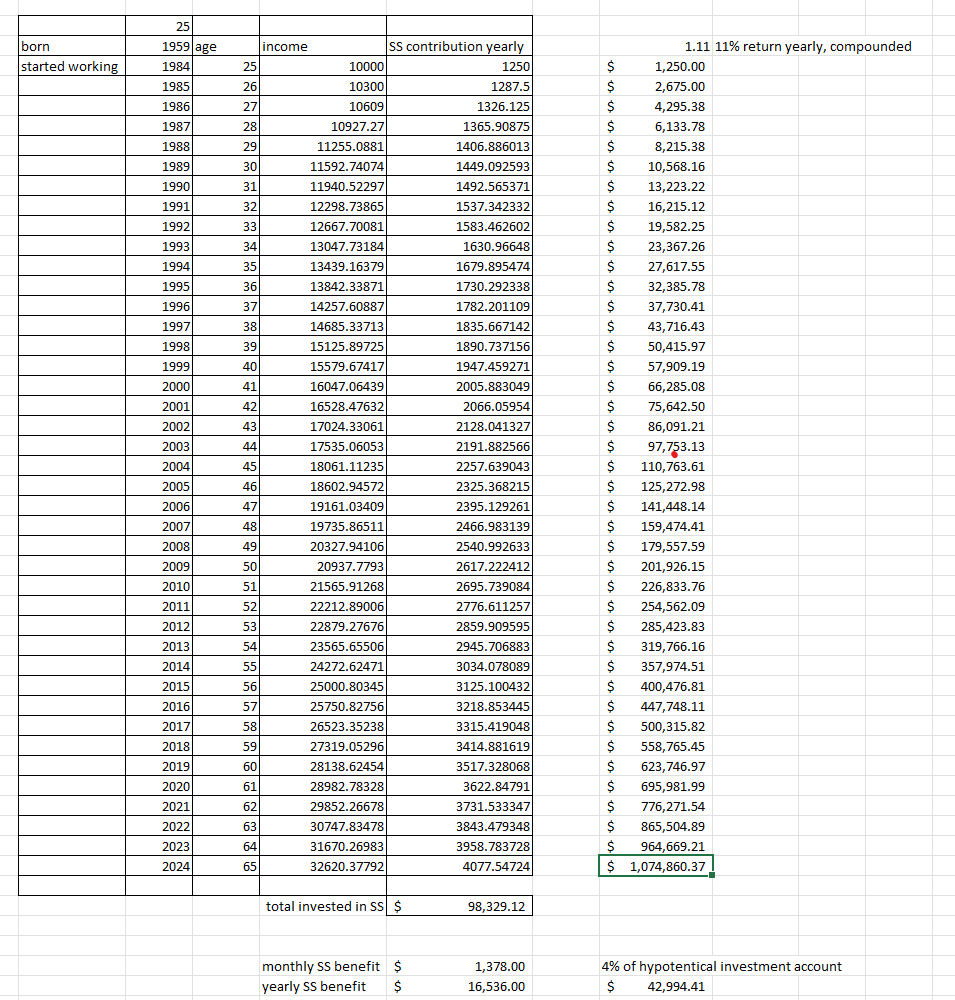
I went through and created a hypothetical person who started working in 1984 at the age of 25 (after being born in 1959). 

If that person started making $10k in 1984 that would be equivalent to $30k/year in 2024.
I gave this person a 3% raise a year. You can see that in the “income column” below. So this person would have ended working in 2024 with a salary of $32k/year (being 65 years old).

The next column shows the 12.5%/year that this person + their employer is paying into Social Security. After 40 years this person would have paid $98k into Social Security.
I went through and put all the earnings data into the Social Security website benefit calculator, found here. 

https://www.ssa.gov/benefits/retirement/planner/AnypiaApplet.html

It provided an estimate of $1,378/month or $16,536/year. 

I provided an alternative column, where you would instead take that 12.5%/year and invest that in the S&P 500 for 40 years.

As of January 26, 2024, the S&P 500’s price is 4,890.97. If you invested $100 in the S&P 500 at the beginning of 1984, you would have about $6,606.25 at the end of 2023, assuming you reinvested all dividends. This is a return on investment of 6,506.25%, or 11.14% per year.
This person would have $1,074,860.37  in their 401k. They could safely withdraw $42,944/year from this (4%) as well as having a portfolio worth $1 million dollars! This is making a relatively low $30k per year equivalent for 40 years!

But most people I know who have made $30k a year for 40 years do not have a million dollar portfolio. Why is that?

It’s because they are unable to invest 12% of their salary a year, because it is required to go to the government and the Social Security Fund. This is robbing millions of workers of $25k/year in their retirement. 

You could go through this same exercise. Simply go to https://www.ssa.gov/benefits/retirement/planner/AnypiaApplet.html

And input the dollar amount in the table for each year to find the benefit. 

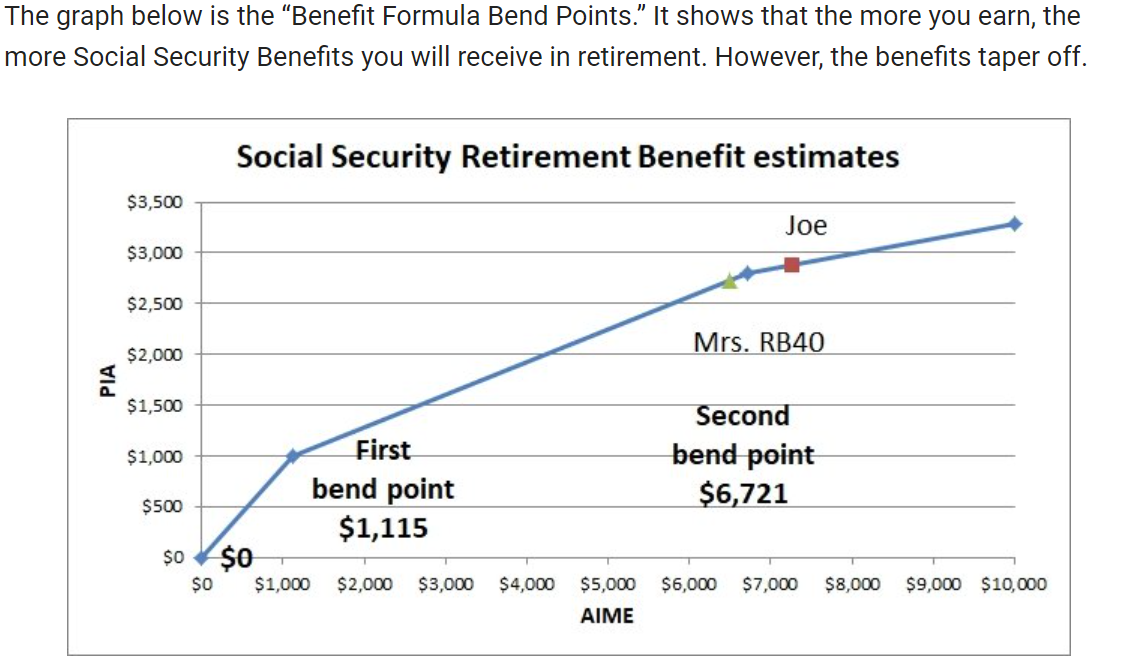
This is bad enough for a $30k/year equivalent worker. The more money you make though, the worse of a deal Social Security is. This is because of the “knee points” in the Social Security return table. The more you pay in, the less you get out. https://retireby40.org/early-retirement-impact-social-security-benefit/

While Social Security being a terrible return on your money is something of a first world problem, there are plenty of other instances of money losing value in other countries that really hurts people in those countries. 

You can read from Alex Gladstein to learn about some of those. 

“The rate of inflation in the U.S. is paltry compared to many other countries worldwide. The chief strategy officer for the Human Rights Foundation, Alex Gladstein highlighted this issue on Monday in a series of tweets. Gladstein is also a bitcoin (BTC) proponent and has been an evangelist for the leading crypto asset for quite some time.

“Many might think that extreme inflation is a rare occurrence in today’s modern world,” Gladstein said to his 27,000 Twitter followers on Monday. “That’s simply not the case. There are 1.2 billion people currently living in countries experiencing double or triple-digit inflation,” Gladstein insisted.”

https://news.bitcoin.com/1-2-billion-people-live-under-double-digit-inflation-many-have-found-escape-in-bitcoin-says-hrfs-alex-gladstein/

Why Bitcoin Makes The World Better – The Bitcoin Layer and “How My Co-worker Identified the Issues Without Identifying The Causes”

F.A. Hayek in 1984: “I don’t believe we shall ever have a good money again before we take the thing out of the hands of government, that is, we can’t take it violently out of the hands of government, all we can do is by some sly roundabout way introduce something that they can’t stop.”

First 15 minutes of the podcast “Why Bitcoin Makes The World Better – The Bitcoin Layer”- I think this is a great 15 minute video to learn about “why Bitcoin” if you aren’t sure what “problem Bitcoin is trying to solve”.

Full episode – Why Bitcoin Makes The World Better – The Bitcoin Layer

Inflation/money printing by the government is a hidden tax, or more nefariously, theft of your savings.

I received the below email from a coworker related to this home for sale.

https://www.homesofiowa.com/idx/listing/IA-WCFMLS/20233854/4426-Granite-Ridge-Road-Cedar-Falls-IA-50613

I was walking the dog tonight and there are several new houses down the street. I looked up what they go for. There is a video of it on the page, it’s a just a house.  Nothing huge, with some basement finished. – coworker

I shared the below picture with this coworker. If you are measuring the world in USD then things are getting more expensive. But if you are measuring in Bitcoin, things are getting cheaper, as Jeff Booth explains in the initial Youtube video I shared above. 

Below is the rest of my reply to this coworker. 

You could always try to put multiple families together in one house, as times will get desperate. That would be the historic solution. And as you said, as people are poorer, they will just have to do it again.

There are plenty of very poor both in the USA and abroad already living this way.

As referenced from the trip I just got back from India from.

Most of the world is ALREADY poor. The USA has benefited from being able to export inflation to the rest of the world for the last 50 years.

We do this by everyone having to buy USD to buy oil. Then every country has a huge pile of US treasuries/dollars. Then we print more.
Printing money is effectively stealing value from people who hold dollars.
That is why NO ONE ever wants to have cash for longer than they have to.

Don’t you think that’s kind of crazy that no one actually wants US dollars “money”?

We buy bonds, gold, real estate, stocks, anything to store the value because we know that dollars lose value over time. It’s wild!

It’s even more obvious in countries like Argentina or Turkey where they have REALLY awful money. But our money also sucks for preserving value over time.

It all started with 1971 and removing the gold backing of the USD. Well really that started in 1930 with executive order 6102 which the government confiscated people’s gold. Paid them $20.67/oz of gold. Then repriced the dollar to $35/oz! they literally stole $15 worth for every oz of gold they took. It is crazy!

$15 was real money back then!

So I’m just saying you are noticing the results, extremely high home prices. Things getting more expensive. I am telling you there is a clear history to how we got here. And there is literally 1 solution to this problem. Well 2 but 1 will never happen.

If the US government quit over spending and printing new dollars that would fix it. But that will NEVER happen.
So the alternate solution is to save in a currency that has a maximum limit, 21 million bitcoin.

If we DON’T support the bitcoin network we will continue down this path of everything getting more expensive.
I have read so many books about the history of money and governments messing with money. It always happens this way.

The Romans debased their money, see below.


See quote below.

I really encourage you to learn more about bitcoin. It is our only hope.

Super short book, 2 hours on audible, but it’s really great.

The Bullish Case for Bitcoin Paperback – May 8, 2021

by Vijay Boyapati (Author)

F.A. Hayek in 1984: “I don’t believe we shall ever have a good money again before we take the thing out of the hands of government, that is, we can’t take it violently out of the hands of government, all we can do is by some sly roundabout way introduce something that they can’t stop.”

Bitcoin Letter To Politician (Joni Ernst) #2

I wrote a letter to Joni Ernst (and Chuck Grassley) about Bitcoin that you can find here. I have posted Joni’s reply and then my reply to her, trying to correct the many incorrect things she noted in her letter (or her email reply person’s letter). I understand why most people dont’ waste their time contacting their politicians. You never get a straight answer. But unfortunately, beyond voting them out, which is nearly impossible to do as most politicians stay in once elected, the only thing we can do is contact them to try to educate them on topics and encourage others to contact them also. That is why I post my emails with politicians, so others can just copy/paste send them, if they want, to show our politicians that it’s a topic people care about, without making others spend time writing a letter.

Below is Joni Ernst’s reply. 

Dear Mr. Hoogland,

Thank you for reaching out to me regarding digital asset regulation. It is important for me to hear from folks in Iowa on this rapidly evolving topic.

Whether it is Bitcoin, central bank digital currencies, or digital currency exchanges like FTX, digital assets have been a big topic of conversation in Washington. Cryptocurrencies can create new avenues for financial transactions, investments, and other economic activity given they do not rely on a government’s central bank. While digital assets offer new possibilities, there are legitimate concerns we must also address. 

For example, Bitcoin is among the most popular cryptocurrencies, but we do not know who created it or how much of it exists. These uncertainties raise questions as to how legitimate Bitcoin can be as a currency. Further, cryptocurrencies are volatile. We have seen currencies become extremely valuable, and then, in the blink of an eye, lose their value all-together. This volatility raises questions around the extent to which cryptocurrencies may need to be regulated in some form or fashion so as to create more stability for investors.

Additionally, the decentralized nature of digital assets create potential risks related to fraud and illicit activities. We have already seen how bad actors across the world take advantage of the secrecy digital currencies provide in order to commit crimes, fund terrorism, or evade sanctions. 

However, there is much benefit to be had from greater use of technology in the financial system. Cryptocurrencies do open doors for people who may not otherwise have access to capital. Though substantially distinct from digital currencies, the Federal Reserve recently unveiled its new FedNow service to help give people and businesses instant access to their money when they transfer it from account to account. 

As we continue to flesh out the use of digital currencies and technology in finance, we must strike the right balance between fostering innovation, protecting individuals, and limiting the ability of bad actors to abuse the system. 

You may be interested to know, this year’s National Defense Authorization Act included a provision to tighten oversight of financial institutions working with cryptocurrencies and other digital assets. By instituting regulatory clarity while weeding out bad actors, financial institutions can better ensure digital assets are not improperly used. This is just one of many crucial provisions in the annual defense bill that bolsters our national security and sends a clear sign of strength to our adversaries.

Thank you again for reaching out to my office, and please know that I am closely monitoring this situation as it develops. Please feel free to share any additional insights or concerns you may have regarding digital assets as I always enjoy hearing from Iowans. 

Sincerely,

Joni K. Ernst

United States Senator

My reply is below.

Senator – 

Thank you for your reply. I wanted to point out that you didn’t really address any of the specific topics I noted and you even shared some incorrect factual information. It concerns me when my elected Senator (or their email writer/advisor) is so wrong on a very basic topic. 

It is obvious that this is your canned bitcoin/crypto currency response.
I want to emphasize to you there is a fundamental difference between bitcoin and “cryptocurrency”

You can read about the differences in this short blog post .

I asked you to oppose Senator Elizabeth Warren’s “Digital Asset Anti-Money Laundering Act” in particular. You did not mention that bill at all. 

I also encouraged you to learn from Daniel Batten and his work into bitcoin mining reducing methane emissions. You did not mention that at all. 

Flared Methane as a Sustainable Power Source for Cryptocurrency Mining


I also asked you to to learn from Alex Gladstein about the human rights benefits that Bitcoin provides. He has already tried to speak to congress on this.You did not mention that at all. 

https://www.cnbc.com/2022/06/07/human-rights-advocates-say-bitcoin-critical-in-authoritarian-countries.html


Are you not interested in the plight of those fleeing authoritarian regimes?


You did mention, unprompted that “Bitcoin is among the most popular cryptocurrencies, but we do not know who created it or how much of it exists.

While it is true the inventor, Satoshi Nakamato, is unknown, we do know that there will only be 21 million bitcoin ever. This is ingrained in the code.

This is unlike the amount of US dollars of which we truly can’t know how many will ever exist. Every year the US government prints trillions more in new dollars.

While Republicans pay lip service to the budget deficit when Democrats hold the presidency, historically, Republican presidents run even larger budget deficits than Democrats! You are right to fight against deficits but I believe you do it only in word for votes. I don’t believe you have any personal conviction to reduce the deficit.

I encourage you to talk to your fellow Senator, Cynthia Lumis. She seems to understand Bitcoin. 

Investing In Developing Countries

I’ve had an interest in developing countries for years. Often this has been in the form of donations to charity. I have also personally been giving money to a couple men in Haiti for school for years.

Direct Payment of Education in Haiti

The Last Hunger Season – A Book Review

I recently visited India to visit some friends and also to attend a Business Summit for JoyCorps

“The JoyCorps Fellowship is a group of carefully selected, visionary leaders who operate agrarian and small manufacturing businesses in Asia’s under-resourced communities.

We offer Accelerator and Incubator services that provide business expertise, structures, encouragement and community — all vital for growing a thriving business in a challenging environment.”


I was able to meet many entrepreneurs in India and learned about their challenges in starting their businesses.

I was also able to get an advanced copy of the book The Heart of A Cheetah: How We Have Been Lied to about African Poverty, and What That Means for Human Flourishing 

by Magatte Wade due to following Magatte Wade on LinkedIn. It was very timely and I listened to this while I was in India. A lot of the challenges faced in different developing countries are all the same. 

One other organization I became aware of while I was in India is AgGrandize.They have a fund available that you can invest in. Actually making an investment in a foreign small business directly is still not nearly as easy as a donation to charity. I am going to continue learning and looking for options to make this easier. 

If anyone knows of a fund that you can invest in in monthly increments, that invests in small foreign businesses, please let me know!

If you are interested in this topic below are a few books I would recommend to learn more about investing in developing countries to help them help themselves. 

Toxic Charity: How Churches and Charities Hurt Those They Help, And How to Reverse It – 

by Robert D. Lupton 

The Last Hunger Season – A Book Review

The Heart of A Cheetah: How We Have Been Lied to about African Poverty, and What That Means for Human Flourishing 

by Magatte Wade

Poor Economics: A Radical Rethinking of the Way to Fight Global Poverty by Abhijit V. Banerjee, Esther Duflo 

Bitcoin Doesn’t Need Anything, Bitcoin Is Already A Store Of Value

Bitcoin is a store of value, over time.

Bitcoin doesn’t need to have a perfectly stable price over time.

Bitcoin doesn’t need to be used in daily transactions. 

Bitcoin doesn’t need to be able to be transacted in 1 second.
Bitcoin doesn’t need to cost $0.01 to send $1 billion across the world. 

Bitcoin doesn’t need to be the only money in the world, it can exist alongside government currencies, just like gold does today. 

Bitcoin doesn’t need intrinsic value

Bitcoin doesn’t need a government to give it value.

Bitcoin doesn’t need to run NFT and smart contracts on it’s base chain.

Bitcoin doesn’t need to change the maximum number of 21 million bitcoin.

Bitcoin doesn’t need BIPS (Bitcoin Improvement Protocols)!

Bitcoin needs the properties of a sound money.

It should be scarce. 

It should be divisible.

It should be transmissible.

It should be immutable. 

It should be difficult  (or impossible) to counterfeit.

It should be assayable (easy to verify it is what it says it is).


Bitcoin has all these things already. 

It just needs to be “adopted as a treasury reserve asset” to quote Michael Saylor. Meaning people just need to choose to preserve their wealth in bitcoin, over time.

People don’t need to store all their money in bitcoin. A small percentage of people in the world own gold, but it still has value.

Bitcoin doesn’t need to be used in daily transactions to have value. Gold has value but it is not used in daily transactions.

Bitcoin doesn’t need to be “legal tender” to have value. Gold has value but it is not legal tender. 

Money should only be used as money. If you give it some other use or value, it’s possible that it’s main use, as money, is twisted such that it’s monetary value gets distorted and it is no longer a good money!

I encourage you to ask questions about “What is Money?” What is the purpose of money? Why do we need money? What things does money need to do to make it useful?

Bitcoin Market Cap, How Much Could 1 Bitcoin Be Worth?

Much of this post was taken from this tweet from  MD₿TC@MDBitcoin. I felt this information was very helpful so I wanted to share and expand on it.


Original tweet below

The Inevitable Path of #BTC 

I. Global wealth = between $400-$900T

II. Let’s say 10% of Bitcoins are lost.

III. Let’s do a conservative estimate that #BTC captures  ONLY 1% of global wealth, the value of one #Bitcoin would be? 

then imagine 5%?, 10%? 20%? 50%?  

There is no other path, accumulate as if your life depended on it. 🟠

Complete Calculations:

Available Bitcoins:

Total Bitcoin Supply: 21,000,000

Lost Bitcoins: 10% of 21,000,000 = 2,100,000

Available Bitcoins: 21,000,000 – 2,100,000 = 18,900,000

1% of Global Wealth:

Lower Bound:

1% of $400T = $4T

Value of one Bitcoin = $4T / 18,900,000 ≈ $211,640.21

Upper Bound:

1% of $900T = $9T

Value of one Bitcoin = $9T / 18,900,000 ≈ $476,190.48

5% of Global Wealth:

Lower Bound:

5% of $400T = $20T

Value of one Bitcoin = $20T / 18,900,000 ≈ $1,058,201.06

Upper Bound:

5% of $900T = $45T

Value of one Bitcoin = $45T / 18,900,000 ≈ $2,380,952.38

10% of Global Wealth:

Lower Bound:

10% of $400T = $40T

Value of one Bitcoin = $40T / 18,900,000 ≈ $2,116,402.12

Upper Bound:

10% of $900T = $90T

Value of one Bitcoin = $90T / 18,900,000 ≈ $4,761,904.76

20% of Global Wealth:

Lower Bound:

20% of $400T = $80T

Value of one Bitcoin = $80T / 18,900,000 ≈ $4,232,804.23

Upper Bound:

20% of $900T = $180T

Value of one Bitcoin = $180T / 18,900,000 ≈ $9,523,809.52

50% of Global Wealth:

Lower Bound:

50% of $400T = $200T

Value of one Bitcoin = $200T / 18,900,000 ≈ $10,582,010.58

Upper Bound:

50% of $900T = $450T

Value of one Bitcoin = $450T / 18,900,000 ≈ $23,809,523.81

Buy the quantity that you can and put it in cold storage, wait a decade and watch the inevitable path.

-End original tweet. 


There is a lot to unpack there. 

Let’s start with the basics. 

There is between $400T and $900T of wealth in the world. 

For reference at bitcoin’s current price of $26,000 and total coin maximum number of bitcoin ever of 21 million coins, bitcoin’s current market capitalization is $546 billion. This is between 0.067% and 0.13% of all the value in the world. That’s pretty small currently!

Gold has a current market capitalization of $12 trillion. 

That comes to between 1.3% -3% of all the value in the world. 

As noted above, if bitcoin was to capture 1% of the world value  it would be worth between $211k and $476k per coin. This doesn’t even get it to the same market capitalization as gold!

Lower Bound:

1% of $400T = $4T

Value of one Bitcoin = $4T / 18,900,000 ≈ $211,640.21

Upper Bound:

1% of $900T = $9T

Value of one Bitcoin = $9T / 18,900,000 ≈ $476,190.48

Since bitcoin has many features that make it more useful than gold it has a good chance of at least gaining the adoption of 1% of the store of world value. Bitcoin doesn’t have to be used for every daily transaction for it to be useful or valuable. Gold has value and it is not very useful at all for daily transactions. 

Bitcoin has multiple benefits over gold, it can be sent around the world nearly instantly, it can be broken down into very small units (1 satoshi = 0.00000001 bitcoin  which at $26k/bitcoin = $0.01 is equal to 37 satoshis) and various other benefits that bitcoin has). 

These are just a few of the reasons that I think Bitcoin will likely continue to stay around as a store of value and continue to gain adoption and grow in price and value.