Tracking the “Political ETFs” — My Ongoing Experiment

Members of Congress have long faced accusations of trading on insider information — buying and selling stocks in companies they help regulate.
It’s a bipartisan problem: Republicans and Democrats alike have profited from privileged access and timing the rest of the public could never match.

That’s not just bad optics — it’s corruption.
It undermines faith in both the markets and the integrity of government.

To highlight how deep this problem goes, I’ve started an experiment tracking three ETFs:

  • NANC — the Unusual Whales Subversive Democratic Trading ETF, built around stocks traded by Democratic lawmakers.
  • GOP — the Unusual Whales Subversive Republican Trading ETF, reflecting trades made by Republican lawmakers.
  • SPY — the SPDR S&P 500 ETF Trust, serving as a neutral market benchmark.

My goal isn’t to glorify these funds — it’s to show in real numbers how political trading compares to the broad market, and to call out why this system needs reform.


Policy Context

This issue connects directly to Senator Josh Hawley’s proposal to ban individual stock trading by members of Congress.
His bill wouldn’t ban investing altogether — lawmakers could still own broad mutual funds or ETFs, just not trade individual stocks that might be affected by their votes.

That distinction matters. It allows long-term wealth building without the appearance or reality of insider trading.
📎 Read Hawley’s bill here


Performance Snapshot (Feb 10 2023 → Oct 27 2025)

SymbolETF NameDescriptionStarting Price*Current PriceTotal Return
NANCUnusual Whales Subversive Democratic Trading ETFTracks stocks favored by Democratic members of Congress$24.69$46.15+86.9%
GOPUnusual Whales Subversive Republican Trading ETFTracks stocks favored by Republican members of Congress$24.96$37.20+49.0%
SPYSPDR S&P 500 ETF TrustBaseline for overall U.S. market$408$685+67.9%

*Starting prices from Google Finance (Feb 10 2023, ETF inception date). Current prices as of Oct 27 2025.


The Takeaway

Both “political ETFs” have gained since launch, but that doesn’t justify congressional trading.
When lawmakers can personally profit from decisions they influence, public trust erodes — no matter how well the market performs.

This experiment is my small way to expose how close politics and profit have become — and to advocate for a system where leadership means stewardship, not stock tips.


The Politics of Envy: How Bernie Sanders Uses Billionaires to Distract from Washington’s Failures — and Keep People Angry

Blaming billionaires is easy. Fixing bad policy, broken incentives, and decades of fiscal irresponsibility isn’t — so Bernie Sanders keeps the outrage machine running instead.

A lot of people — Bernie Sanders in particular — hate billionaires because they assume billionaires stole their wealth.
But that belief comes from misunderstanding how value is actually created.


💵 Creation vs. Printing

Bernie and the government “create money” by printing it — literally out of thin air — which steals purchasing power from everyone who already has dollars.
That’s not value creation. It’s value redistribution by dilution.

So when that’s your frame of reference, you start to believe that everyone who gets rich must have taken something from someone else. Because that’s how you create “money” in politics — you print it or tax it away.

But wealth in a free market isn’t created by decree. It’s created by building, coordinating, and innovating — by making something others voluntarily trade for.


📈 Value Creation Is Not Theft

Larry Ellison, for example. One day Oracle stock went up, and his net worth jumped by $100 billion. Bernie acts like Larry ran around stealing $100 billion from working people.
But that’s not what happened. That value didn’t exist before — it was created.

Wealth in the market represents new value built through skill, innovation, and coordination, not theft.
If you’re stranded on an island with a billion dollars, it’s worthless. You need resources, tools, and knowledge to turn that “money” into something useful.

The problem is, people who’ve never built or created real value assume no one else can either.
So they see wealth as theft instead of creation. That’s the confusion at the heart of modern politics.


⚠️ Bernie’s Game: Blame, Not Solutions

And that’s where Bernie Sanders comes in.
He isn’t actually helping working people by pointing to billionaires as evil — he’s manipulating them.

By giving people a villain to hate, he distracts from the real causes of economic pain — bad money, wasteful government, and decades of inflation that quietly rob savers and workers.
He rallies frustration around a scapegoat instead of a fix.

If Bernie genuinely wanted to help, he’d talk about restoring fiscal discipline, reducing waste, and making it easier for regular people to build wealth — not demonizing those who already have.
But he doesn’t. Because blaming billionaires is politically easy.
Fixing the system would mean questioning the very machine that gives him power.

So instead of solving problems, he feeds resentment — keeping people angry, divided, and dependent on him to express that anger.


🧮 The Fantasy of the “Billionaire Tax”

In a recent Time article titled “I’m a Millionaire. No One Needs More Than $30 Million”, the author argues that a Billionaire Income Tax could raise $557 billion over ten years and “jump-start a permanent safety net.”

That sounds impressive — until you look at the math.

The U.S. government currently runs a $2 trillion annual deficit.
That’s $20 trillion in overspending every decade.
So this “transformative” billionaire tax covers less than 3 % of the hole. It’s fiscal rounding error.

The problem isn’t a lack of billionaire money — it’s a lack of discipline and accountability.


🏛 The Real Problem Isn’t “Too Much Money” — It’s How It’s Used

The Time article goes on to argue that wealth beyond $30 million stops being about living well and becomes about wielding power — influencing elections, buying media outlets, and suppressing competition.

That part isn’t entirely wrong. Money can corrupt politics.
But the author’s solution — capping wealth — misses the point completely.

If the issue is that money manipulates the system, then the answer is to make the system harder to manipulate, not to confiscate wealth after the fact.

We should make elections harder to buy, not success harder to earn.
Reform campaign finance, close regulatory loopholes, stop insider lobbying — that’s how you stop abuse.

The same goes for the “buy, borrow, die” loophole that allows the ultra-wealthy to avoid realizing gains.
If that’s the concern, close the loopholes directly — don’t destroy the entire structure of value creation to fix a tax code glitch.

And even then, no system will ever be perfect.
Smart, ambitious people will always find new ways to optimize around the rules — that’s part of what makes them successful.
Every time you close one loophole, innovation and adaptation create another.
The goal shouldn’t be to eliminate advantage; it should be to keep the playing field open and the incentives productive.

And far from “locking others out,” large pools of wealth are what fund the next generation of builders.
People don’t lose the chance to innovate because billionaires exist — they lose it when regulation, bureaucracy, and bad policy make it impossible to start or scale.
Just look at Europe: it leads the world in regulation, but none of the world’s biggest or most dynamic companies are European.
They’ve made it harder to fail, but also impossible to truly win.
Capital isn’t a finite pie being hoarded; it’s the byproduct of trust, savings, and productive investment.
Destroy that, and you destroy the fuel for future innovation.

Blaming “too much money” is a lazy shortcut that lets broken institutions off the hook.


💥 What Happens If You Actually Take It

Let’s pretend we go full Bernie and seize every dollar of billionaire wealth in America — all $6 trillion of it.

Here’s what happens:

  1. That covers just three years of deficit spending at current rates. Then what? You’re out of billionaires, and the deficit keeps growing.
  2. Most of that wealth isn’t cash. It’s ownership stakes in companies — Tesla, Oracle, Amazon, Microsoft, etc.
  3. If the government forces liquidation, prices collapse. No one can buy trillions in stock without tanking the market.
    • Even a 50 % drop cuts the haul to $3 trillion — barely 18 months of deficits.
  4. Who buys the assets? The next-richest class. Inequality reshuffles briefly, then reforms.
  5. Meanwhile, innovation stalls. Investment dries up. Everyone gets poorer.

You can’t fund a government by destroying the productive capital that funds everything else.


⚙️ The Real Issue Isn’t Wealth, It’s Value

Wealth isn’t evil — it’s a signal that someone created something valuable enough for millions of people to trade their time or money for it.
That’s fundamentally different from printing dollars and calling it “stimulus.”

If we want a stronger, fairer economy, the solution isn’t confiscation — it’s creation.
Encourage building, innovation, and hard work, and you’ll raise living standards for everyone.
Punish them, and you’ll end up with equality through shared decline.


🧭 Final Thought

Bernie isn’t fighting for the working class. He’s fighting to stay relevant to it.
You don’t fix inequality by burning down the factory.
You fix it by letting more people build factories of their own.


What to Buy in 2025? My Thoughts on Global Investing

Quick Take:
International markets are finally outperforming the U.S. in 2025, with VXUS up 25% versus the S&P 500’s 13%. But much of that gain is tied to a weakening dollar and global money printing — not just fundamentals. I also see potential in small-cap value stocks and India as a long-term growth story. – Not financial advice!

I was replying with a long comment to a YouTube video about investing, and it turned into something worth sharing here. I’ve cleaned it up a bit to make it flow like a proper post — but the ideas are the same: how I’m thinking about markets right now and where opportunities might lie.

When people ask me what to buy, I always start with one key principle:
focus on total return, not dividends.

Dividends are nice, but they’re just one piece of the puzzle. What really matters is total return — the combination of price growth plus dividends. That’s what grows your wealth over time.


International Markets Are Finally Waking Up

In November 2024 a friend told me what a dog his internationl stocks were and said he was going to sell them adn buy all S&P 500 I mentioned to him the idea of reversion to the mean While I was rewarded quickly, after years of underperformance, international markets have been on an absolute tear in 2025.

  • VXUS — the total international ETF (about 25% emerging markets) — is up roughly 25% year to date.
  • VWO, which tracks only emerging markets, is up around 21%.
  • Meanwhile, the S&P 500 (VOO) is up just 13% this year.

It’s been a long time since we’ve seen this kind of outperformance from non-U.S. stocks. But before we get too excited, it’s worth asking why.


Factors Driving International Resurgence

Several factors have driven the recent resurgence in international markets.
Concerns about the U.S. trade war and tariffs have pushed investor attention abroad, while a weaker U.S. dollar has amplified gains for dollar-based investors holding foreign assets.

The U.S. Dollar Index has declined roughly 9% this year, giving a lift to unhedged international equities.

That currency impact is easy to see when comparing VXUS to hedged strategies.
For example:

  • Xtrackers MSCI EAFE Hedged Equity ETF (DBEF) and
  • iShares Currency Hedged MSCI EAFE ETF (HEFA)

are both up about 11.4% this year — solid returns, but well below the 25% gains seen in unhedged funds like VXUS.

In other words, a large portion of the international rally is being driven by the decline in the U.S. dollar, not just by improving fundamentals abroad.

👉 You can read more about this dynamic in a recent ETF.com article here:
“VXUS Tops $100B as ETF Investors Embrace International Stocks”


Inflation, Money Printing, and “Bigger” Returns

I suspect that in the future, the stock market’s returns might look higher than historical averages — not necessarily because companies are more productive, but because money printing and inflation are inflating nominal returns.

Historically, the S&P 500 returned about 11% per year, with maybe 3% of that driven by inflation and monetary expansion.
If we enter a world where inflation runs closer to 7%, then even if the real return stays about the same (around 8%), the headline number could look like 15% annual returns.

Obviously, that’s not guaranteed — just a thought experiment. But it’s a good reminder that higher nominal returns don’t always mean higher real returns.

Be Greedy When Others Are Fearful

Warren Buffett’s old rule still applies:

“Be fearful when others are greedy, and greedy when others are fearful.”

So what are investors fearful of right now?
Small-cap stocks.

  • VIOV (small-cap value ETF) is up only 2% this year.
  • VB (small-cap blend) is up around 6.5% year to date, and about 52% over the past 5 years.
  • The S&P 500, by comparison, is up 90% over that same period.

Historically, small caps have outperformed large caps over the long term — and markets tend to revert to the mean. That doesn’t mean small caps will outperform next year, but it might be time to start paying attention to them again.


A Closer Look at India

One specific market I’ve been watching is India, through the INDA ETF. I’ve personally allocated about 1% of my portfolio there. While it is actually -1% for the year that adds to it’s intregue! As I noted you want to consider buying the losers as they will likely revert to their mean higher returns.

I’ve traveled to India and work with suppliers there who produce castings and tubing. The country reminds me a lot of where China was a couple of decades ago — rapid growth, huge labor pool, and rising industrial capacity.

Here’s a quick comparison:

  • Average income in India: about $2,000 per year
  • Average income in China: about $15,000 per year

India also has another advantage — it’s a democracy, politically more aligned with the U.S., and open to global capital and trade. That combination of low base income (meaning huge growth potential) and political stability makes India a fascinating market to watch over the next decade.


Wrapping It Up

So, what should you buy?
That depends on your goals — but here are the themes I’m watching:

  • International markets, especially emerging economies
  • Small-cap value stocks that have been left behind
  • And long-term growth plays like India

Just remember — higher returns on paper may reflect inflation, not real productivity. Always think in terms of real value creation, not just nominal gains.

And, of course, this isn’t financial advice — just my perspective on how I’m thinking about global investing in 2025.

What do you think? Are you adding international exposure or doubling down on U.S. stocks?
Share your thoughts below — I love reading different perspectives on where people see opportunity.


Bitcoin, Deflation, and the Myth of “Useless Money” – (People Won’t Spend Bitcoin Because it’s TOO Valuable????)

A common fear I hear about Bitcoin goes something like this: “If it becomes so valuable in the future, people will never spend it. They’ll just hoard it forever — and that means it can’t work as money.”

But let’s pause. That argument assumes that money needs to lose value in order to be useful — that people will only spend if their savings are constantly melting. Does that really make sense?

People Already Save

In reality, people save no matter what. Even with inflationary dollars, households and businesses don’t spend every cent. They put money aside — but because the dollar steadily loses value, they are forced to search for other stores of value:

  • Stocks
  • Bonds
  • Real estate
  • Gold
  • Collectibles

This isn’t a feature. It’s a problem. The constant need to escape a leaky dollar creates bubbles, misallocates capital, and makes financial life complicated for everyone.

Take housing, for example. When money loses value, homes become more than shelter — they turn into financial assets. People don’t just buy houses to live in them; they buy them as inflation hedges. That means families looking for a roof over their heads end up competing with investors and savers desperate to preserve wealth. Prices get bid up far beyond the utility value of the home, making affordability worse and turning what should be a basic necessity into a speculative storehouse for capital.

Deflationary Money Doesn’t Paralyze Spending

Critics imagine that if money gains value over time, nobody will use it. But people already spend under deflationary conditions — technology proves this. Everyone knows next year’s phone or TV will be cheaper and better, yet they still buy today. Why? Because they value the use and enjoyment now, not just later.

The same applies to Bitcoin. Once mature, it will likely appreciate at roughly the rate of productivity growth (similar to a low-yield bond). People will hold it to store value — and still spend it when a purchase is worth more than waiting.

Flipping the Narrative

Inflationary money forces people into risky, complex alternatives just to save. Hard money that holds or grows its value removes those distortions. Contrary to the fear, deflationary money won’t break the economy — it may actually fix many of the problems caused by inflationary systems.

And here’s the real irony: many critics already suspect Bitcoin could become extremely valuable — that’s why they worry no one will spend it. But at the same time, they refuse to buy any today. They recognize the upside, but fear keeps them paralyzed on the sidelines.

Conclusion

In a Bitcoin world, homes could go back to being homes, not savings accounts. People could save without speculation, spend without fear of losing purchasing power, and invest in businesses for growth rather than sheltering from inflation. That’s not “useless money.” That’s money finally doing its job.

How I’m Using Covered Calls on Tesla as a “Safe” Portion of My Portfolio


Disclaimer – If you aren’t comfortable with all potential outcomes, including your Tesla shares dropping 50% in value, you shouldn’t consider this idea. 

You also should not consider this if you are unfamiliar with trading options. 

I am only sharing this to share information and educate. 

I’ve been a Tesla shareholder for years, and I don’t plan to sell my core position anytime soon. But I’ve also been learning about covered calls as a way to generate income at a higher rate than today’s money market funds which currently are paying ~3.5% and going down as rates decrease!. Right now, I see the potential for about a 14% annual yield using this strategy — and I want to take advantage of that while keeping my long-term conviction in Tesla intact.


What’s a Covered Call?

A covered call is one of the simplest options strategies. It works like this:

  • You own at least 100 shares of a stock. Most options are written where 1 option = a contract for 100 shares.
  • You sell a call option to someone else, giving them the right (but not the obligation) to buy your shares at a set price (the strike price) by a certain date. For example – “You have the option to buy 100 shares of Tesla from me at $600 on or before 3-20-2026”
  • You are paid a premium when you sell the option.

Two big things can happen:

  • If the stock stays below the strike price, the option expires worthless. You keep both the shares and the premium.
  • If the stock rises above the strike, you may have to sell your shares at that strike price. You still keep the premium, but you miss out on gains beyond that level.

Think of it like renting out your shares — you earn income while you hold them, but you’re capping your upside in exchange.


Why Tesla?

Tesla is currently trading around $440. My existing 400 shares make up about 12–13% of my overall portfolio (roughly $176k out of $1.4M). That’s a meaningful bet, but not my entire net worth. I personally have never looked at options before when I had less money. But I am considering it now with a very small part of my portfolio. 

I’ve been holding Tesla for years and plan to continue. I believe in its long-term growth story, Elon Musk’s ability to deliver, and even the possibility of the company eventually reaching an $8 trillion valuation — nearly 6x its current $1.38 trillion market cap. That would potentially happen if Tesla hits all the growth targets in Elon’s proposed new pay package, that is voted on in November 2025. I have already voted yes and hope everyone else does also!

That conviction is what allows me to buy an extra 100 shares — not to hold forever, but to use specifically for covered calls.


The Trade

  • Underlying: Tesla at ~$440
  • Shares purchased for strategy: 100 ($44,000)
  • Option sold: $600 strike, expiring March 2026
  • Premium collected: ~$30/share = $3,000

The Three Outcomes

Here’s how the trade plays out depending on Tesla’s price by March 20th, 2026:

ScenarioTesla PriceOutcomeReturn
1. Tesla < $440Falls below my purchase priceShares drop in value, but I still keep the $3,000 premium. I’ll hold and sell another call in 6 months.Paper loss on stock, but income cushions downside
2. Tesla $440–$600Rises but stays under $600I keep both the shares and the $3,000 premium.~7% in 6 months (~14% annualized) + stock appreciation
3. Tesla > $600Blows past $600Shares are called away at $600. I keep the $3,000 premium plus $16,000 in gains ($160/share).~$19,000 profit on $44,000 (~43% in 6 months)

How This Fits My Long-Term Tesla Plan

Part of my long-term Tesla strategy for my original 400 shares has always been to gradually divest once it grows too large a percentage of my portfolio — say once it approaches 30–50%.

This covered call approach fits that plan perfectly: it generates income now and gives me a way to get paid while reducing exposure if Tesla keeps climbing.

  • At $600/share, my portfolio would grow to about $1.5M, and Tesla would represent ~$300k of that (~20%). If 100 shares are called away, I’d reduce Tesla to 400 shares ($240k), which still leaves me with significant exposure.
  • At $800/share, my portfolio could be around $1.6M. Selling another 100 shares would leave me with 300 shares worth $240k — still ~15% of my portfolio, almost the same weighting Tesla holds today (~12.6%). This is assuming the rest of my portfolio doesn’t also rise. It likely would so really Tesla would end up an even smaller percentage of my portfolio.

So even as I trim, Tesla stays a core but not outsized piece of my investments.


The Long-Term Upside

At $800/share, Tesla would be about a $2.5 trillion company. Even if I’m down to 300 shares at that point, that’s still $240k invested.

And if Tesla grows to an $8 trillion valuation as some expect — a 3.2x increase from $2.5T — my 300 shares could climb to about $768k.

That means even after trimming, I’d still capture massive upside if Tesla’s long-term growth story plays out.


Why This Works for Me

  1. It’s a small slice of my overall portfolio. At ~$44,000, the covered call sleeve is just 3% of my total assets. That makes it a safe experiment that doesn’t threaten my financial foundation.
  2. My core Tesla is protected. My long-term 400 shares are untouchable. The 100 new shares are my “income Tesla” — designed to work harder without risking my conviction stake.
  3. All three outcomes are acceptable. If Tesla dips, I’ll just sell another call. If it grinds sideways, I pocket income. If it rips higher, I still earn a great return, even if I give up some upside.
  4. It aligns with my long-term plan. Selling calls is a structured way to generate income and gradually reduce Tesla’s weight in my portfolio as it grows.
  5. Conviction makes it possible. I’m comfortable capping the upside on 100 shares because I still own 400 more shares that will fully benefit if Tesla continues to grow. This way, I get income from a small slice of my position, while my larger core holding remains positioned for the long-term upside.

Testing My Future Retirement Plan

This trade is also a trial run for my early retirement plan. If I eventually trim my Tesla position to around $240k (say 300 shares at $800), I could use the same covered call strategy to generate income.

At ~14% annualized, that $240k could potentially produce about $33k per year in income — without me ever touching the rest of my portfolio.

That’s a powerful idea: one high-conviction stock position, managed carefully with covered calls, could provide a meaningful cash flow stream in retirement while my index fund base continues to compound.


My Investing Context

Most of my portfolio is in index funds. That’s my base strategy — low-cost, diversified, and reliable.

But Tesla (and Bitcoin) are my two exceptions. I’ve listened to years of Tesla content, followed the company’s progress, and watched Elon Musk repeatedly deliver on ambitious goals. I believe in the growth story.


Final Thoughts

Covered calls aren’t “free money.” They limit your upside, and they only work if you’re comfortable with all possible outcomes. For me, splitting my Tesla into two buckets — 400 shares conviction hold, 100 shares income strategy — strikes the right balance.

Tesla remains my long-term hold. The extra 100 shares are simply there to spin off cash flow, provide income, and help me get paid while gradually divesting. That way, Tesla stays a meaningful but balanced piece of my portfolio — while still giving me the chance to benefit if Elon Musk delivers on the $8 trillion vision.

And looking ahead, this strategy doubles as a test run for retirement income — showing how one well-managed conviction position can help fund financial independence.

If you aren’t comfortable with all potential outcomes, including your Tesla shares dropping 50% in value, you shouldn’t consider this idea. 

You also should not consider this if you are unfamiliar with trading options. 

I am only sharing this to share information and educate. 

From 3% to 10%: STRC and STRD Show How Bitcoin-Backed Preferreds Beat High-Yield Accounts

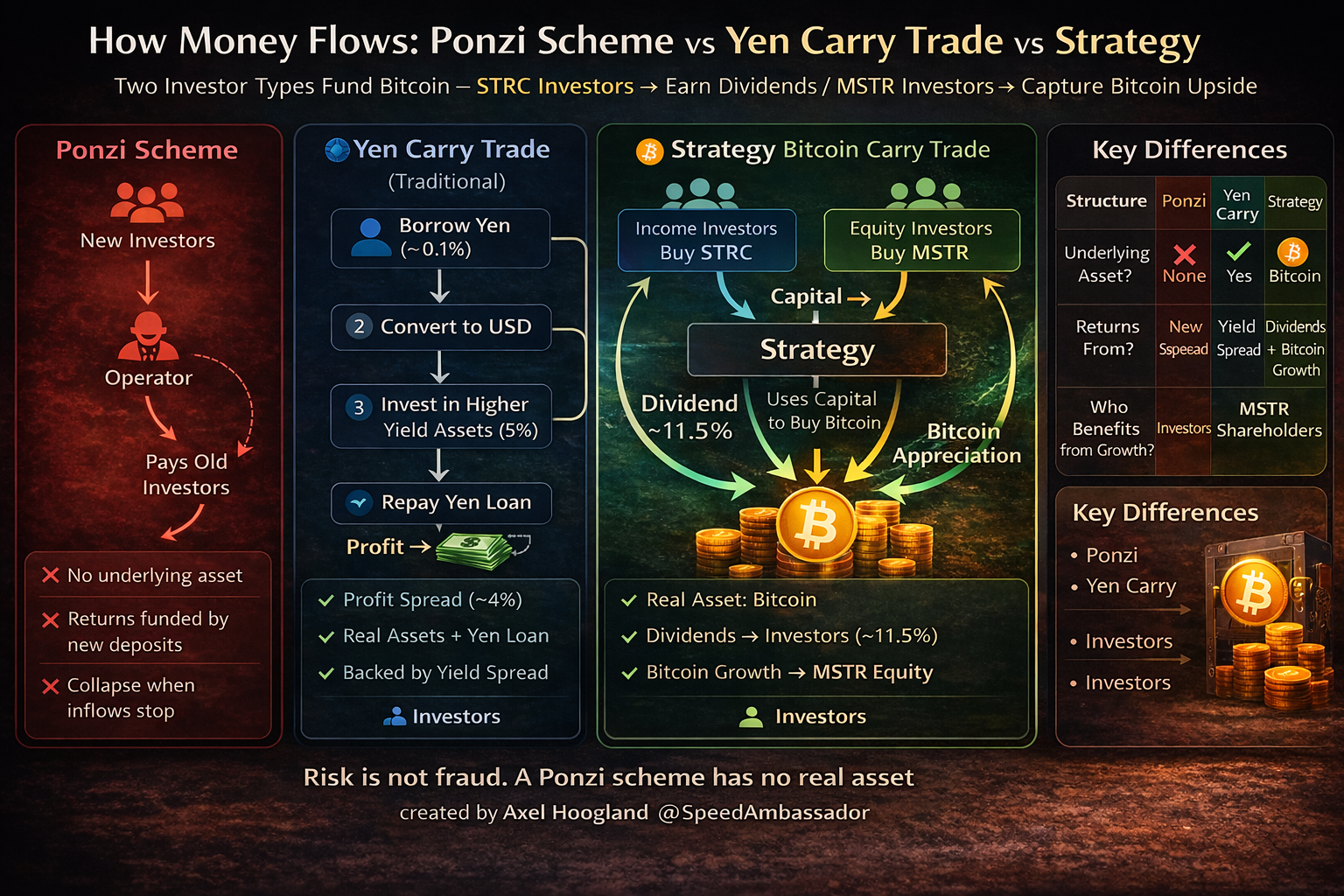
Money market funds have quietly become a $7.7 trillion behemoth. They’re the go-to “safe yield” for investors and savers alike. But with the Federal Reserve now in an easing cycle, those yields — currently around 3.5%–4% — are headed lower.

That’s where Strategy’s Bitcoin-backed perpetual preferreds come in. While most people know Strategy (MSTR) as the largest corporate holder of Bitcoin, fewer realize that it has built a full yield curve of preferred instruments, each engineered for different investors.


Where These Instruments Sit in the Capital Stack

Most senior → Debt (convertible notes)STRF (Strife)STRC (Stretch)STRK (Strike)STRD (Stride)Common (MSTR) → most junior / volatile.


The Rationale: Building a Bitcoin Yield Curve

  • STRF (Strife): Senior, cumulative, fixed dividend, long-duration. Currently yielding about 9%.
  • STRC (Stretch): Senior to STRD and STRK. Variable monthly dividend, engineered to trade around $99–$101, currently yielding about 10.25%.
  • STRK (Strike): Convertible hybrid with both dividend and equity-conversion features. Not my focus here, but it’s an important part of the structure.
  • STRD (Stride): Junior high-yield, fixed 10% dividend, currently yielding about 12.7% due to market pricing in more perceived risk. Functionally similar to STRF, except dividends are non-cumulative (can technically be skipped). That said, I believe skipping would be highly unlikely, as it would damage trust and Strategy’s ability to raise future capital. Dividends are paid quarterly.

Visualizing the Yields

Here’s how these instruments compare against traditional money markets:

  • Money Market (green): conservative baseline at ~3.5–4%.
  • STRF (orange): senior, stable preferred with ~9%.
  • STRC (orange): short, steady instrument at ~10.25%, engineered to trade near $100.
  • STRD (orange): dynamic junior instrument at ~12.7%.

Why I Prefer STRC and STRD

I’m drawn most to STRC and STRD.

  • STRC is designed to be the least volatile of the group, with a monthly payout and mechanisms (ATM issuance, variable rate, call option) that help stabilize its price.
  • STRD is the high-yield gear, juiced by its junior position in the stack. While the market demands extra yield for perceived risk, I personally think that risk is overstated given Strategy’s Bitcoin reserves and incentives to maintain dividend trust.

Together, they cover two ends of the spectrum: steady monthly yield vs. higher-octane quarterly yield.


A Practical Emergency Fund Example

Suppose you have a $10,000 emergency fund.

  • All in Money Market: $10,000 × 4% ≈ $400/year.
  • Blend with STRC: Keep $7,500 in money markets (=$300/year) and put $2,500 into STRC (=$256/year).
    • Total = $556/year — a 39% boost without overcommitting.

I wouldn’t put my entire emergency fund into a new instrument like STRC — safety and liquidity should come first. But even a modest allocation can noticeably lift your yield while still keeping most reserves conservative.


Closing Thought

Strategy is essentially pioneering a new financial system built on Bitcoin collateral. If they can consistently pay these dividends — even through Bitcoin downturns — it would be revolutionary. It would prove that Bitcoin isn’t just “digital gold,” but the foundation for a new class of yield-bearing, creditworthy instruments.

Here are 2 videos of when STRC and STRD were initially offered. They offer a lot of information about how these work. 

Strategy’s Stride STRD Perpetual Preferred Stock IPO Backed by Bitcoin | Michael Saylor and Phong Le

Strategy’s Stretch STRC Perpetual Preferred Stock IPO Backed by Bitcoin | Michael Saylor & Phong Le

Bitcoin, Deflation, and the Myth of “Useless Money” – Why would people spend bitcoin if it keeps gaining value?

Bitcoin, Deflation, and the Myth of “Useless Money”

A common fear I hear about Bitcoin goes something like this: “If it becomes so valuable in the future, people will never spend it. They’ll just hoard it forever — and that means it can’t work as money.”

But let’s pause. That argument assumes that money needs to lose value in order to be useful — that people will only spend if their savings are constantly melting. Does that really make sense?

People Already Save

In reality, people save no matter what. Even with inflationary dollars, households and businesses don’t spend every cent. They put money aside — but because the dollar steadily loses value, they are forced to search for other stores of value:

  • Stocks
  • Bonds
  • Real estate
  • Gold
  • Collectibles

This isn’t a feature. It’s a problem. The constant need to escape a leaky dollar creates bubbles, misallocates capital, and makes financial life complicated for everyone.

Take housing, for example. When money loses value, homes become more than shelter — they turn into financial assets. People don’t just buy houses to live in them; they buy them as inflation hedges. That means families looking for a roof over their heads end up competing with investors and savers desperate to preserve wealth. Prices get bid up far beyond the utility value of the home, making affordability worse and turning what should be a basic necessity into a speculative storehouse for capital.

Deflationary Money Doesn’t Paralyze Spending

Critics imagine that if money gains value over time, nobody will use it. But people already spend under deflationary conditions — technology proves this. Everyone knows next year’s phone or TV will be cheaper and better, yet they still buy today. Why? Because they value the use and enjoyment now, not just later.

The same applies to Bitcoin. Once mature, it will likely appreciate at roughly the rate of productivity growth (similar to a low-yield bond). People will hold it to store value — and still spend it when a purchase is worth more than waiting.

Flipping the Narrative

Inflationary money forces people into risky, complex alternatives just to save. Hard money that holds or grows its value removes those distortions. Contrary to the fear, deflationary money won’t break the economy — it may actually fix many of the problems caused by inflationary systems.

And here’s the real irony: many critics already suspect Bitcoin could become extremely valuable — that’s why they worry no one will spend it. But at the same time, they refuse to buy any today. They recognize the upside, but fear keeps them paralyzed on the sidelines.

Conclusion

In a Bitcoin world, homes could go back to being homes, not savings accounts. People could save without speculation, spend without fear of losing purchasing power, and invest in businesses for growth rather than sheltering from inflation. That’s not “useless money.” That’s money finally doing its job.

For further reading on this read The Price of Tomorrow: Why Deflation is the Key to an Abundant Future – Jeff Booth


Analysis of – Geo-Strategy #3: How Empire is Destroying America

You Were So Close: Where the Anti-Empire Analysis Misses Bitcoin’s Role as the Fix

A year old video titled Geo-Strategy #3: How Empire is Destroying America delivers a sharp, compelling critique of the United States’ transformation from a productive manufacturing economy into a hollowed-out empire addicted to easy money, foreign capital, and speculative finance. The lecturer nails several things before they happened:

  • Trump won
  • The U.S. dropped bombs on Iran (June 21, 2025).
  • Empire—not capitalism alone—is the real structural disease.

So far, so good.

But here’s where it falls short: when it comes to solutions, the analysis stops at nostalgia. It groups Bitcoin in with the broader financialized, speculative mindset of the current era—instead of recognizing it as the clearest path out of the collapsing fiat-imperial system.


What the Video Gets Right

1. The Shift to Financialization Was a Disaster
The U.S. economy went from 40% of profits coming from manufacturing to only 10%. Meanwhile, financial services ballooned to 40% of profits but employ only 5% of the workforce. It’s not a real economy anymore—it’s rent-seeking on a grand scale.

2. Empire Crowds Out Domestic Prosperity
As the video rightly says: the U.S. has 800+ overseas bases, trillions in defense spending, and a growing dependency on foreign goods. Meanwhile, infrastructure decays, wages stagnate, and people struggle to own homes.

3. Easy Money Has Warped the Psyche
He astutely observes that young people have a speculative mindset. They want to gamble their way to freedom because working hard for 40 years no longer gets you a house or family. The fiat system broke the ladder.

4. Empires Collapse from Hubris
Rome did it. So did Britain. The U.S. has reached a point where it can’t imagine losing, but is too bloated and fragile to truly win.


What the Video Misses Entirely

Bitcoin isn’t a symptom of decline. It’s the cure.

Here’s where the logic fails: Bitcoin gets lumped in with real estate speculation, meme stocks, and Wall Street grifting. That’s a category error.

Bitcoin is:

  • Not tied to Wall Street.
  • Not controlled by central banks.
  • Not created through debt.

It is, in fact, everything the empire cannot print, inflate, or manipulate.

If fiat money is what powers the empire’s global dominance and fiscal addiction, then Bitcoin is the tool that cuts the cord. It’s what lets young people store value, opt out of inflation, and build sovereign systems outside elite capture.


The Real Problem: Fiat, Not Just Empire

Let’s go one layer deeper:

  • Empire needs fiat to fund wars, bailouts, and pensions.
  • Fiat needs empire to enforce its global dominance (petrodollar system, SWIFT sanctions, military threats).

It’s a closed loop. And Bitcoin breaks it.

Bitcoin is the only monetary system with no central issuer, no forced trust, no inflationary mandate, and no border. It’s not speculative escapism. It’s the foundation for a post-imperial world.


Final Thought

The lecturer in Geo-Strategy #3 is brave and accurate in his breakdown of how empire is destroying America. But like many critics, he sees the collapse clearly yet misses the exit sign flashing in orange behind him:

Bitcoin isn’t the distraction. It’s the lifeboat.

💵 How Fiat Money Hollowed Out America’s Job Market and How to Fix it


Intro – Why can’t Americans find good jobs anymore?

Because the U.S. dollar’s role as the world’s reserve currency lets us import everything without producing anything.

Fiat money didn’t just change our economy—it hollowed it out.

This article explains how we got here—and why only a return to hard money, like Bitcoin, can bring us back.

There’s a sentence I keep coming back to:

Without fiat, we’d have to export goods to earn gold or foreign currency before we could import.

Quick note: “Fiat” money just means paper money that isn’t backed by anything tangible like gold or silver. Its value comes entirely from government decree (“fiat” is Latin for “let it be done”)—and trust.

That’s it. That’s the whole game.

Donald Trump spent years hammering America’s trade deficit, accusing China of taking advantage of us and blaming past politicians for “bad deals.” But the truth is deeper—and more systemic.

The trade deficit isn’t just a negotiating failure. It’s a structural requirement of the global dollar system.

Since the 1970s, the U.S. has run chronic trade deficits not because we’re dumb—but because we have to. That’s how the world gets its dollars. It’s the price of running the global reserve currency.

Fiat money—and specifically, the U.S. dollar’s role as global reserve—didn’t just change how we buy and sell. It rewired the entire global economy. It made it profitable to consume without producing, and to outsource labor while importing goods with nothing more than printed IOUs.

Let’s break that down.


📜 A Brief History of the Cheat Code

After World War II, the U.S. dollar became the centerpiece of the global financial system through the Bretton Woods Agreement. Other countries pegged their currencies to the dollar, and the dollar was pegged to gold at $35/oz. Global trust was strong—because dollars were redeemable for something real.

But by the late 1960s, the system was already cracking.

The U.S. was printing more dollars than it had gold to back, funding both the Vietnam War and LBJ’s Great Society programs. Foreign nations started to notice. The promise of gold convertibility was still on paper, but the gold simply wasn’t there to cover all the dollars in circulation.

Then came the bluff-calling moment: France sent a warship to New York Harbor in 1971 to collect its gold. The U.S. honored the request—but it was a wake-up call. If one country could demand gold, others would follow—and the U.S. didn’t have enough gold left to fulfill those redemptions.

Rather than continue the outflow—and risk total collapse of the system—President Nixon closed the gold window, ending the dollar’s convertibility to gold and defaulting on the original Bretton Woods promise. He called it “temporary,” but we’re still living with the consequences.

The U.S. had just rugged the global economy—but there was no better option available. All other currencies were fiat too.

And so, by default—not by merit—the dollar remained the foundation of global trade.


🛢️ The Petrodollar Patch

To maintain global demand for the dollar, the U.S. struck a 1974 deal with Saudi Arabia:

  • The Saudis would price oil only in dollars,
  • And the U.S. would provide military protection.

This created the petrodollar system, locking in global demand for dollars—because energy runs the world. Every country that wanted oil had to first acquire dollars.

That meant: even without gold, the dollar was still backed—by oil, debt, and military force.

This gave the U.S. a unique superpower:

  • Print money (or sell Treasuries),
  • Ship it overseas,
  • And receive real goods, labor, and resources in return.

No other nation could do this. And no other empire in history ever got away with it for so long.


🏭 The Fallout: Jobs Go Offshore, But Dollars Still Flow

Because the world kept accepting dollars, American companies could:

  • Shut down U.S. factories,
  • Hire cheaper labor abroad,
  • Import those same goods back to the U.S.,
  • And sell them to consumers who were buying with borrowed or printed money.

The fiat system didn’t make foreign workers cheaper, but it made it possible to use them without consequences.

We stopped needing to earn our imports by making things. We could just finance everything with paper and debt. Capital loved it. Wall Street loved it. Politicians loved it.

But working people? Not so much.

From Janesville to Youngstown, from Flint to the Bronx, the outcome was the same: a slow, grinding hollowing-out of America’s industrial base and middle class.


🏦 Makers and Takers: How Finance Replaced Work

In Makers and Takers, journalist Rana Foroohar lays out how U.S. corporations gradually stopped investing in workers, R&D, and physical capital—and instead prioritized stock buybacks, dividends, and debt-fueled growth.

But here’s the uncomfortable truth:

Many of those companies had to play that game—or risk being eaten alive.

In a fiat system with low interest rates, abundant capital, and massive global competition:

  • Shareholder pressure rewards short-term profit over long-term investment.
  • Stock buybacks boost prices faster than hiring or training workers.
  • Outsourcing and financial engineering became necessary survival tools—not just greed.

This wasn’t just a few bad CEOs. It was a system-wide shift in incentives.
The rise of finance wasn’t a deviation—it was an adaptation.


🤖 You Can’t Skill Your Way Out of This

Today, people are told to just “learn to code” or “work harder.” But what they’re really up against is a global fiat machine that rewards capital over labor, and extraction over production.

That’s why:

  • Degrees don’t guarantee jobs,
  • Effort doesn’t guarantee stability,
  • And “just working harder” feels like treading water.

It’s not that Americans don’t want to work. It’s that the system no longer rewards domestic labor—because it doesn’t need to.


🧱 What Comes Next?

The world is starting to wake up. Countries are buying gold. Some are experimenting with Bitcoin. Others are trying to de-dollarize trade altogether. Trust in the U.S. dollar isn’t infinite—and neither is the empire it props up.

The dollar still works—not because it’s sound, but because there hasn’t been a better option. Yet.

But every empire that runs on paper eventually runs out of trust. And when that happens, the real cost of all those “free” imports comes due.


₿ A Hard Money Future: Why Bitcoin Matters

The only real way to end this game is to remove the cheat code: fiat money itself.

A return to hard money—like Bitcoin—could force the system to reorient around real productivity, long-term investment, and sustainable value creation.

Without the ability to endlessly paper over deficits, businesses would once again have to:

  • Build resilient supply chains
  • Invest in their workers
  • Serve customers over shareholders
  • Plan for decades, not quarters

Bitcoin doesn’t just offer escape—it offers discipline. It turns off the short-term game and invites long-term thinking back into the economy.


💬 Closing Thought

Fiat gave us the illusion that we could consume without producing.
But in the long run, reality has a way of settling the bill.
Maybe it’s time we stopped running the tab—and started building again.

Why I Support Bitcoin: A Personal Journey Through the Global Failure of Fiat

For most of my life, I’ve worked with businesses and nonprofits trying to make the world better. I’m a mechanical engineer by trade. I like building things that work. But the more I’ve worked across systems, the more I’ve realized something deeply broken sits at the root of almost every failure: fiat money.

A Friend, a Business, and a Broken Economy

A few years ago, a friend of mine was helping advise a small, sustainable clothing business in Sri Lanka. They used natural dyes and traditional techniques to create jobs for locals—especially for people who often couldn’t access the formal economy. It was working. Until it wasn’t.

The Sri Lankan currency collapsed during a financial crisis. Inflation soared. Imports became unaffordable. And the business, despite doing everything right, failed—not because of bad management or a poor product, but because the foundation it was built on—its currency—was rotten.

This is what fiat does. It breaks systems from the bottom up. And it leaves regular people holding the bag.

How Fiat Hollowed Out America

We often think of developing countries suffering from bad money, but the same decay has hit the United States. The post-WWII American economy was built on sound money and a manufacturing base that rewarded long-term planning and production.

That changed in 1971, when Nixon took the U.S. off the gold standard. With no monetary anchor, we entered the era of fiat—the era of cheap credit, endless deficits, and quarterly capitalism. Easy money made it easier to offshore jobs , because capital flowed wherever short-term profits looked best. Domestic manufacturing collapsed (such as in Janesville, Wisconsin). Towns hollowed out. Entire regions like the Midwest were gutted for the sake of Wall Street’s earnings calls.

Short-termism infected everything:

  • Companies spent more on stock buybacks than R&D or wages
  • Governments ran up debt with no repayment plan
  • Individuals chased consumption over savings, just to stay ahead of inflation

Economic Hitmen and Empires of Debt

In Confessions of an Economic Hitman, John Perkins explains how U.S. institutions loaned billions to developing nations for infrastructure that looked good on paper but benefited U.S. contractors more than locals. When those countries couldn’t repay, they were forced into austerity, resource sell-offs, and geopolitical obedience. Debt became a weapon.

Today, China is doing the same through its Belt and Road Initiative. In Sri Lanka, China took control of the Hambantota Port on a 99-year lease when the country couldn’t pay its debts. In Greece, China’s COSCO controls the Port of Piraeus. In Australia, they secured a 99-year lease on the Port of Darwin, now under review due to national security concerns.

This isn’t charity. It’s colonialism with spreadsheets.

Fiat Money Rewards the Few, Punishes the Many

Every time a central bank prints new money, it steals from savers and wage earners. Those who hold fiat see their purchasing power decay. This is especially cruel during periods of inflation, like the 8% spike in the U.S. in recent years.

Bitcoin fixes this.

  • It has a fixed supply: 21 million coins, ever.
  • It can’t be printed or manipulated by any government.
  • It rewards saving, planning, and long-term thinking.

It flips the fiat incentives:

  • Instead of spending now, you’re rewarded for holding.
  • Instead of inflation eating your wealth, deflation preserves it.
  • Instead of trusting a corrupt institution, you trust code and math.

Why I Share Bitcoin With Others

I’ve read the books. I’ve seen the failures. I’ve lived through broken systems and watched people I care about suffer—not from laziness or ignorance, but because the monetary foundation was cracked.

Bitcoin is the best alternative I’ve found to a rigged, decaying system. It’s not just about investment. It’s about dignity. Agency. Fairness. It’s about building something that can last.

This is why I support Bitcoin. And this is why I speak up.