Email To Congressperson Regarding Epstein Files

Sent this to my Congress Representative Ashley Hinson- I hope she does the right thing.

I am writing as a concerned constituent to urge you to support the Epstein Files Transparency Act, led by Rep. Thomas Massie and Rep. Ro Khanna. This bipartisan bill would require the Department of Justice to release all unclassified records related to Jeffrey Epstein and Ghislaine Maxwell, while protecting victims’ identities. Congress has already reached the 218-signature threshold to force a vote, and the American people overwhelmingly want transparency.

Here’s why this matters:

  • Past Promises: High-profile figures in the Trump administration—including Pam Bondi, Kash Patel, and JD Vance—publicly pledged to release these files when President Biden was in office. They even held meetings and photo ops promising transparency. Why have those promises evaporated now?
  • The Hoax Narrative Doesn’t Add Up: If this is all a “Democratic hoax,” as President Trump now claims, why is Ghislaine Maxwell serving a 20-year sentence for sex trafficking minors? Her conviction was based on evidence of a real criminal conspiracy, not political theater.
  • Gaslighting the Public: President Trump is actively discouraging Republicans from supporting transparency, calling the effort a “trap” and a “hoax.” If there’s nothing to hide, why fight so hard to keep these files secret?

Please do not deflect by asking “why didn’t the Democrats release it when they were in power.” That is gaslighting. You NOW have the power to release the files and do the right thing. Be on the right side of history.

This is not about partisanship—it’s about justice and accountability. Survivors deserve answers, and the public deserves to know the truth about who enabled Epstein’s crimes. Shielding powerful individuals from embarrassment is not a valid reason to withhold information.

Please vote YES on the Epstein Files Transparency Act and stand on the side of transparency, justice, and the rule of law.

Thank you for your time and service.

Wealth Inequality: The Quiet Apocalypse… and What Comes After

I recently watched a powerful video titled Wealth Inequality: The Quiet Apocalypse.” It’s honest, emotional, and brutally accurate in describing what it feels like to live in a system that seems to squeeze you harder every year. I found myself nodding along for much of it—but also wanting to widen the lens a little.

Before offering my response, here are five key points I took from the video:

Five Core Points from “Wealth Inequality: The Quiet Apocalypse”

  1. The system isn’t broken—it’s working as designed. It extracts time and value from most people and consolidates wealth at the top.
  2. Capital outpaces labor. Referencing Piketty: when the rate of return on capital exceeds growth, wealth concentrates.
  3. The American Dream is largely a delusion. Doing everything right doesn’t mean you’ll get ahead.
  4. Wealth inequality creates spiritual and psychological harm. It hollows out people’s sense of identity and worth.
  5. What we need is a cultural shift—not just policy. Minimalism, rest, and meaning are antidotes to hustle culture and economic extraction.

Here’s my reply, point by point.


1. The system isn’t broken—it’s working as designed

Yes, the system is designed to reward capital—not labor. But that doesn’t mean we need to burn the whole thing down. In fact, we should want capital to outperform labor—because that means more productivity with less effort.

The real problem? Capital is too concentrated.

What if we built systems that allowed more people to own capital? That would mean more people benefiting from productivity gains, without needing to grind themselves into dust. In the U.S., this is more accessible than we sometimes realize. Low-cost investing tools, like Fidelity or Vanguard, allow everyday people to start building wealth—even with modest means.

I wrote about how just $2,000/year for 10 years can grow to over $365,000 by retirement:
👉 The Power of Investing Early

The system does work—as designed. We just need to make sure more people have a stake in it.


2. Capital outpaces labor

Piketty’s point is mathematically true: capital grows faster than wages, and that concentrates wealth. But instead of treating that as a death sentence, let’s treat it like a map.

If labor will always lose, then we need to stop relying on labor alone. We need to become capital owners.

That’s the core of Post-Labor Economics: a future where AI and automation do the work, and human beings benefit from ownership rather than employment. That’s only dystopian if ownership remains exclusive.

I broke this down further here:
👉 Post-Labor Economics – David Shapiro Video Summary

The real answer isn’t to slow capital—it’s to distribute capital.


3. The American Dream is a delusion

We agree: doing everything “right” no longer guarantees success. Degrees, hard work, and even smart money habits don’t always lead to stability.

But here’s the truth: that level of frustration is itself a luxury in global terms. If you’re in the U.S., have internet, clean water, and access to banking—you are already in the global top 10%, maybe even the top 1%.

I say this not to invalidate anyone’s struggle—but to widen the perspective. There are billions of people who would love to have the problems you have. That realization isn’t meant to inspire guilt—it’s meant to highlight opportunity.

You don’t have to “win” the American Dream to live a meaningful life. But if you understand your relative position in the world, you can use it to lift others up while building your own path.


4. Wealth inequality creates spiritual and psychological harm

Yes. When everything becomes transactional, identity collapses into productivity and income. And when we don’t measure up, we blame ourselves.

But here’s the twist: even while critiquing this system, you might still be letting it define you.

There are other ways of living. You don’t need to win the game. You can just stop playing—and focus instead on living intentionally, giving what you can, and creating meaning through service or simplicity.

Some books that shaped my thinking:

Even if just 5% of your life is dedicated to helping others, that’s enough. That’s opting out of the culture in a way that matters.


5. We need a cultural shift—not just policy

Yes. A shift away from hustle culture, productivity obsession, and materialism is overdue. Minimalism, rest, and meaning are powerful forms of resistance.

But there’s another layer: you don’t just have to escape the culture—you can help reshape it.

That might mean:

  • Raising your kids with different values
  • Giving consistently, even in small amounts
  • Choosing a simple life so others can simply live

You don’t need to be an influencer or a billionaire to change the culture. You just need to stop waiting for permission—and start living by a better scorecard.

Opting out is good. But opting into something better is even stronger.


Final Thoughts

Wealth Inequality: The Quiet Apocalypse is a powerful wake-up call. But let’s not stop at diagnosis. Let’s ask: what comes next?

You don’t need to be rich to make a difference. You don’t need to have all the answers to start living a better one. And even in a rigged game, you can still choose your own values.

In a collapsing world, the most radical thing you can do is refuse to collapse with it.

And if you’re someone with a platform—as the video’s creator clearly is, with 80,000+ subscribers—then that gives you not just a voice, but a real opportunity. You can lead. You can educate. You can help people see a way forward.

Not everyone has that kind of reach. So if you do, I hope you use it.


If you want to learn more about effective giving, post-labor economics, or investing with purpose, browse around MyWheelLife.com.

🧊 From Fridges to Bots: What the Adoption Curve of Refrigerators Tells Us About the Future of Household Robots

“Any sufficiently advanced technology is indistinguishable from a luxury—until it’s not.”

In the early 1920s, if you wanted a refrigerator, you were part of the elite. The first electric fridges—bulky, loud, and experimental—cost the equivalent of $7,000 to $15,000 in today’s dollars. They were marvels of innovation but inaccessible to all but the wealthiest households.

Fast forward to today: 99.8% of U.S. households own a refrigerator. They’re so commonplace that we hardly think about them—until they break.

Now imagine we’re at the beginning of the same curve, not for food storage, but for household robots.


📈 Historical Tech Adoption: The Refrigerator Curve

Take a moment to explore this interactive chart from Our World in Data. It tracks the adoption of various home technologies—from refrigerators to microwaves to dishwashers—across the 20th century.

Here’s what the refrigerator’s rise looked like:

  • 1920s–30s: Early adopters only; ~10% of households
  • 1940s: Over 50% adoption, thanks to Freon technology and mass production
  • 1950s: Ownership skyrockets past 80% after WWII
  • By 1960: Nearly universal in U.S. homes

In roughly 30–40 years, refrigerators went from a rich man’s curiosity to a household necessity. Price dropped. Reliability improved. Social expectations shifted.


🤖 Robot Labor Is on the Same Curve

Elon Musk has claimed that every household will eventually have a humanoid robot—a general-purpose machine that can walk, see, understand commands, and perform physical labor. His company Tesla is building “Optimus,” a robot intended to work in factories first, then homes.

This might sound futuristic. But so did refrigerators once.

Currently:

  • A robot costs $20,000–$100,000
  • Only companies or the ultra-wealthy can afford one
  • Reliability is limited, and functionality is narrow

But if history is a guide, we might see a similar trajectory:

YearPhaseApproximate Robot Cost
2025Early adopters only$20k–$100k
2035Middle-class adoption begins$5k–$15k
2045Widespread, household norm<$3k

Just as refrigerators eliminated the need for daily ice deliveries and manual food preservation, robots could eventually eliminate repetitive home labor—cleaning, organizing, even assisting the elderly.


🌍 The Inequality Question

Of course, global access will vary. In the U.S., even $1,000 robot labor might feel cheap. But in parts of India or sub-Saharan Africa, it could be out of reach for decades without intervention—just as electricity and refrigerators took far longer to reach the developing world.

This raises critical questions for post-labor economics:

  • Will robots become tools of empowerment—or deepen the divide?
  • Who will own the robots—individuals, corporations, or governments?
  • Should we envision public “robot libraries” like we once had rural electrification programs?

🔁 The Past is Prologue

When we think about technological change, it’s tempting to view each new device as unprecedented. But the story of household refrigerators shows a clear pattern: steep initial cost, followed by mass adoption and ubiquity.

Robots may follow the same arc. And if they do, the fridge might just be their closest ancestor—not in function, but in social and economic impact.


Explore the data here:
📊 Our World in Data – Technology Adoption Chart

America’s Crumbling House: Left, Right, and the Missing Foundation

America feels broken. Everyone knows it—whether you’re arguing with your uncle over turkey at Thanksgiving or doomscrolling through social media. But what’s fascinating (and disturbing) is that people across the political spectrum are noticing the same fractures: collapsing birth rates, unaffordable housing, dead-end jobs, institutional rot, and youth malaise.

I recently listened to three different voices, each from a different ideological “neighborhood”:

  • A far-right cultural critic, furious about the destruction of the family unit and what he sees as elite-led population control.
  • A center-left economist, frustrated by how every group benefits from a rigged economy while pretending someone else is to blame.
  • A far-left progressive, warning that America has become a pariah nation, economically and morally isolated, lurching toward authoritarianism.

They couldn’t be more different in tone or political tribe. One quotes Blink-182 and rails against birth control. Another explains tiger parenting with nuance and lived experience. The last one drops historical comparisons to Nazi Germany while pointing at collapsing tourism and empty shelves. And yet, they’re all describing the same crumbling house.

💥 The House Is Falling Apart

The symptoms they describe are unmistakable:

  • Broken families and a collapsing birth rate
  • Wages stagnating while cost of living skyrockets
  • Distrust in institutions from schools to elections
  • Youth alienation in relationships, work, and meaning
  • Global disillusionment with American leadership
  • Cultural fragmentation and a sense of existential decline

Some blame immigration. Others blame billionaires, churches, or elite schools. But whatever the cause, all three perspectives agree: America is not correcting itself. The systems that once promised prosperity and stability no longer deliver.

🧱 We’re Trying to Fix the Walls

You can think of the U.S. like a house. We see cracks in the drywall—so we patch them. But then another crack shows up. We reinforce a beam. Then a window shatters. We debate whether the left side or the right side is more broken.

What none of us are doing—at least not seriously enough—is inspecting the foundation.

That foundation is our money system.

🪙 The Money Is the Root of It

Our economic system runs on a fiat currency that:

  • Encourages endless debt and consumption
  • Funnels wealth upward through asset inflation
  • Devalues labor by design
  • Rewards speculation over contribution
  • Incentivizes short-term thinking in both business and government

All of these things show up in the critiques from the left, right, and center. But they often miss the fact that these aren’t isolated symptoms. They stem from a rotted monetary foundation that no longer serves the people who live in the house.

🧱 Bitcoin: Fix the Foundation First

Bitcoin is not a magic solution to all social and economic ills. But it is a foundation repair tool. It offers:

  • Hard money that can’t be printed into oblivion
  • Decentralization that resists capture by any single party, institution, or ideology
  • Incentives for long-term thinking—saving, building, and responsibility
  • A chance for global cooperation without relying on coercive power

Fixing money doesn’t solve everything. But without fixing the foundation, trying to repair the walls is a waste of time.

🔁 Common Pain, Fragmented Response

The tragedy of our current moment is that everyone feels the pain, but we’re tearing each other apart over the symptoms instead of joining forces to solve the root cause.

  • The far-right influencer sees collapsing families and thinks: “Return to tradition.”
  • The centrist economist sees rigged systems and thinks: “Reform the meritocracy.”
  • The far-left voice sees global collapse and thinks: “Dismantle the empire.”

All have valid critiques. All are trying to fix walls in a house with a rotting foundation.

Bitcoin isn’t left or right. It’s not even center. It’s underneath all of it. A chance to rebuild the ground we all stand on—before the entire structure falls.

Analysis of – Geo-Strategy #3: How Empire is Destroying America

You Were So Close: Where the Anti-Empire Analysis Misses Bitcoin’s Role as the Fix

A year old video titled Geo-Strategy #3: How Empire is Destroying America delivers a sharp, compelling critique of the United States’ transformation from a productive manufacturing economy into a hollowed-out empire addicted to easy money, foreign capital, and speculative finance. The lecturer nails several things before they happened:

  • Trump won
  • The U.S. dropped bombs on Iran (June 21, 2025).
  • Empire—not capitalism alone—is the real structural disease.

So far, so good.

But here’s where it falls short: when it comes to solutions, the analysis stops at nostalgia. It groups Bitcoin in with the broader financialized, speculative mindset of the current era—instead of recognizing it as the clearest path out of the collapsing fiat-imperial system.


What the Video Gets Right

1. The Shift to Financialization Was a Disaster
The U.S. economy went from 40% of profits coming from manufacturing to only 10%. Meanwhile, financial services ballooned to 40% of profits but employ only 5% of the workforce. It’s not a real economy anymore—it’s rent-seeking on a grand scale.

2. Empire Crowds Out Domestic Prosperity
As the video rightly says: the U.S. has 800+ overseas bases, trillions in defense spending, and a growing dependency on foreign goods. Meanwhile, infrastructure decays, wages stagnate, and people struggle to own homes.

3. Easy Money Has Warped the Psyche
He astutely observes that young people have a speculative mindset. They want to gamble their way to freedom because working hard for 40 years no longer gets you a house or family. The fiat system broke the ladder.

4. Empires Collapse from Hubris
Rome did it. So did Britain. The U.S. has reached a point where it can’t imagine losing, but is too bloated and fragile to truly win.


What the Video Misses Entirely

Bitcoin isn’t a symptom of decline. It’s the cure.

Here’s where the logic fails: Bitcoin gets lumped in with real estate speculation, meme stocks, and Wall Street grifting. That’s a category error.

Bitcoin is:

  • Not tied to Wall Street.
  • Not controlled by central banks.
  • Not created through debt.

It is, in fact, everything the empire cannot print, inflate, or manipulate.

If fiat money is what powers the empire’s global dominance and fiscal addiction, then Bitcoin is the tool that cuts the cord. It’s what lets young people store value, opt out of inflation, and build sovereign systems outside elite capture.


The Real Problem: Fiat, Not Just Empire

Let’s go one layer deeper:

  • Empire needs fiat to fund wars, bailouts, and pensions.
  • Fiat needs empire to enforce its global dominance (petrodollar system, SWIFT sanctions, military threats).

It’s a closed loop. And Bitcoin breaks it.

Bitcoin is the only monetary system with no central issuer, no forced trust, no inflationary mandate, and no border. It’s not speculative escapism. It’s the foundation for a post-imperial world.


Final Thought

The lecturer in Geo-Strategy #3 is brave and accurate in his breakdown of how empire is destroying America. But like many critics, he sees the collapse clearly yet misses the exit sign flashing in orange behind him:

Bitcoin isn’t the distraction. It’s the lifeboat.

The Fake Money That Fueled a Real War: How Mefo Bills Led to WWII

This post was created from this video

Hitlers Gamble That Ignited War | Blood Money Inside The Nazi Economy | Part 1 | Documentary Central

In the 1930s, Nazi Germany was broke. The country was reeling from the Great Depression, saddled with war reparations, and shackled by the Treaty of Versailles, which banned it from rearming. Yet within a few years, Germany had built one of the most fearsome war machines in history.

How did they pay for it?

They invented money.

The Mefo Trick

Enter Mefo bills—a financial sleight of hand orchestrated by Hjalmar Schacht, Hitler’s economic wizard and head of the Reichsbank.

The plan was simple and devious:

  • A fake company called MEFO (Metallurgical Research Corporation) was set up.
  • MEFO issued IOUs, or “Mefo bills,” to arms manufacturers instead of actual cash.
  • These IOUs were guaranteed by the German government, and companies could trade them or cash them in later at the Reichsbank.
  • Crucially, the bills were kept off the official budget, hiding the scale of rearmament.

This created a parallel currency used only within the military-industrial complex. No taxes raised. No gold reserves touched. Just promises backed by more promises.

But there was a catch: each Mefo bill had a five-year maturity. That meant the government had, at most, five years before they had to repay the IOUs in Reichsmarks. The first wave of bills, issued in 1934, would come due in 1939—just as Germany was preparing to invade Poland.

A Booming Mirage

It worked—at first.

Factories roared back to life. Steel, chemicals, and synthetic fuel production surged. Unemployment plummeted. To the outside world, it looked like an economic miracle.

But it wasn’t prosperity—it was military Keynesianism on credit.

By 1938, 20% of German GDP was going to the military. Consumer goods remained scarce. Wages were frozen. Trade unions were banned. Prices were controlled. And Mefo bills kept piling up.

Schacht warned that the system couldn’t last. Eventually, the bills would come due—and the Reichsbank would either default or start printing money. Hitler didn’t care. Instead of slowing down, he pushed harder. Schacht was sidelined, and Hermann Göring took over economic planning with a singular goal: prepare for total war.

War Became the Only Exit

The Mefo system couldn’t sustain itself. Germany was running out of foreign reserves and raw materials. The economy was overheating. The only way out was forward—through invasion, plunder, and conquest.

Occupied countries like Austria, Czechoslovakia, and eventually Poland were stripped of gold, steel, coal, and labor. France was forced to fund the German occupation. The Nazi war machine was now self-financing—by theft.

By the time the Mefo bills started coming due in 1939, the regime began repaying them not through taxes or trade, but by printing money and launching war. The economy was now riding on a tidal wave of credit, conquest, and coercion.

Why It Matters

The Mefo bill scheme shows how financial manipulation can fuel political extremism, militarism, and war. When money is divorced from accountability and markets are warped by ideology, the result isn’t just inflation or inefficiency.

The result is destruction.

Is Factory Work Exploitative If It Saves You From Something Worse?

In 2012, a Chinese student studying in the U.S. wrote a letter that was later shared by David Pogue in Business Insider. He described how his aunt had worked for several years in what Americans might call a “sweatshop”:

“It was hard work. Long hours, small wage, poor working conditions. Do you know what my aunt did before she worked in one of these factories? She was a prostitute.”

The student emphasized that, despite the difficult conditions, the factory job was a step up—it provided safety, legality, and stability she had never known before.

This story raises a profound moral question: Does an improvement from desperation make an exploitative system justifiable?

Let’s explore why this tension sits at the heart of modern global capitalism.


Better Than Nothing Isn’t the Same as Fair

A factory job may lift someone out of desperation. But an improvement from rock bottom does not equal justice.

The woman in this story is performing the same labor as someone assembling parts in Michigan. She’s not less intelligent or less valuable. She’s just on the wrong side of a global wage arbitrage system.

Corporations don’t pay her less because she’s worth less—they pay her less because they can.


What Is Exploitation?

Exploitation occurs when value is extracted from someone without fair compensation.

You can have:

  • Exploitative jobs that are better than the alternative, and
  • Exploitative systems that improve people’s lives short-term

But the core question is: Who captures the surplus value?

In this case, it’s not the woman. Her labor adds real value to a global supply chain, but she sees only a sliver of it. The rest flows upward:

  • To multinational corporations
  • To shareholders
  • To high-income consumers paying less for products made with underpaid labor

This is exploitation by design—not an accident, but a business model.


Does “Choice” Make It Ethical?

Many people argue:

“Well, she chose the job.”

But choice under coercion of circumstance isn’t freedom. If the only options are wage slavery or something worse, the system isn’t ethical—it’s merely tolerable.

Asking someone to be grateful for a better form of poverty is morally hollow.


So What Can Be Done?

This is where technologies like Bitcoin offer potential.

No, Bitcoin doesn’t magically fix global labor markets. But it creates an escape hatch:

  • A way to store value in a neutral system not subject to local currency collapse
  • A method of payment that bypasses middlemen
  • A step toward economic sovereignty

It lets workers keep more of what they earn. And that alone makes it powerful.


Final Thought

A factory job may save someone from a worse fate. But if it pays unfairly, concentrates profits far away, and denies workers ownership of what they build—it’s still exploitation.

We can be grateful for progress while demanding more. Dignity requires more than survival.

And we don’t have to wait for permission to build something better.

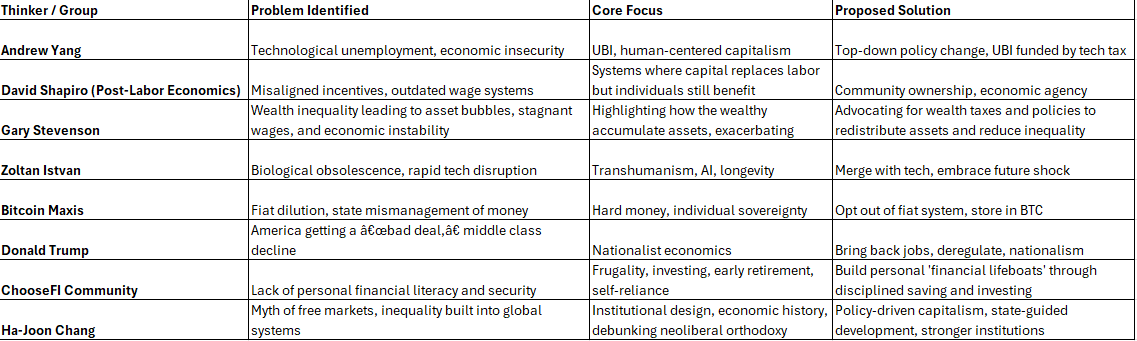
Earned World Manifesto – Thinkers I Wish to Unite

I generated the above table using ChatGPT. I have been invovled in all of these communities that are swirling around the same ideas. I wish I could get them to work together.

ChatGPT also generated the below. It’s not perfect but I wanted to publish it because I want to.

  1. offer it to the world
  2. open for critique and improvements.

The Earned World Manifesto

A Declaration for Builders, Not Rent-Seekers

1. The Problem We See

The current system extracts more than it empowers.
It rewards proximity to power, not creation of value.
It builds systems that entrench dependency, then calls that stability.

We see:

  • Productivity rising — but wages stagnating
  • Knowledge abundant — but credentials gatekept
  • Labor outsourced — but profit hoarded
  • Currency inflated — but savings eroded
  • Talent global — but opportunity gated
  • Work automated — but ownership concentrated

This is not an accident.
The rules are rigged — and the game is extraction.


2. What We Believe

🧱 Agency Is Non-Negotiable

Each individual has the right — and the responsibility — to direct their life.
Freedom is not given. It is constructed.

📈 Value Should Flow to the Builder

The person who creates, fixes, or risks should own the upside.
Rent-seeking is a tax on the capable.

🧠 Education Must Be Sovereign

Learning is abundant. Gatekeeping it is theft.
We reject the credential treadmill in favor of demonstrated skill.

💰 Money Must Be Earned and Preserved

Currency debasement is economic theft.
Savings must store effort, not melt it.

🔐 Ownership Is the Foundation

He who owns the tool, the platform, the protocol — holds the power.
We choose ownership over permission.


3. What We Support

This is not a utopia. It is a direction.

We support:

  • 🔸 Individuals achieving financial independence through disciplined action
  • 🔸 Workers becoming owners, not just operators
  • 🔸 Monetary systems (like Bitcoin) that cannot be corrupted
  • 🔸 Skill-first pathways over debt-fueled credentials
  • 🔸 Systems that reward contribution, not compliance
  • 🔸 Local or global opt-out zones where new rules can be tested

We reject:

  • Coerced redistribution
  • Forced altruism
  • Dependence disguised as security

4. Our Two-Stage Strategy

🛶 Stage 1: Build your lifeboat.
Earn freedom through action.
Reduce expenses, save in hard assets, develop durable skills, and reclaim your time.

🏛️ Stage 2: Rebuild the harbor.
Use your freedom to build systems that don’t demand sacrifice to survive.
Not as charity — but as infrastructure for agency.


5. Join Us

We are the builders. The earners. The ones who won’t rent our future.

We will:

  • Speak plainly about value and power
  • Share tools, not just tweets
  • Reward proof-of-work, not status
  • Create systems where sovereignty scales

If you’re tired of extraction,
If you still believe in ownership,
If you’re ready to build —

Welcome to the Earned World.

As I was generating the Manifesto, I had a lot of conversation with ChatGPT. Below was a powerful statement it had.

“The current system extracts more than it empowers.”

This means that the rewards of the modern economy are disproportionately claimed by systems, institutions, and owners — not by the individuals doing the work or taking the risk. The value flows upward, while the burden flows downward.

Here’s what that looks like across different dimensions:


💼 In Work
  • Wages have stagnated while productivity and corporate profits rise.
  • Most workers trade time for money with little long-term upside (no ownership, equity, or growth path).
  • Gig work and contract labor shift costs (insurance, risk, taxes) to the individual while stripping stability.

Extraction: Time, energy, creativity — taken for a wage that doesn’t keep up with cost of living.
Empowerment: Would mean building ownership, autonomy, or long-term equity from your work.


💸 In Money
  • Fiat currency loses purchasing power over time (inflation), punishing savers and wage earners.
  • Asset inflation (stocks, real estate) benefits those who already hold wealth — not those trying to build it.
  • Central banks and governments distort money supply in ways individuals cannot control or escape.

Extraction: Your savings melt while those close to the money printer get richer.
Empowerment: Would mean access to stable, sovereign, permissionless money, Bitcoin.


🏥 In Healthcare
  • Healthcare is tied to employment — meaning you’re not truly free to leave your job.
  • Insurance costs rise faster than wages; many avoid treatment due to fear of bills.

Extraction: Your health and security are used to bind you to jobs and debt.
Empowerment: Would mean decoupling basic needs from corporate control.


🏠 In Housing
  • Real estate is increasingly used as an investment vehicle, not a place to live.
  • Young people are priced out of ownership, forced into permanent renting.

Extraction: Rent drains wealth every month with no asset built.
Empowerment: Would mean pathways to ownership, equity, or cooperative housing.


🎓 In Education
  • Education costs have exploded, leading to decades-long student debt burdens.
  • The credential economy keeps people in a treadmill of debt just to be “qualified.”

Extraction: You pay to enter the game, and the game changes by the time you finish.
Empowerment: Would mean low-cost, high-agency pathways to skill and livelihood.


🤖 In Technology
  • Tech companies extract your attention, data, and time to sell to advertisers.
  • Users create content and community, but ownership and profits go to platforms.

Extraction: You are the product.
Empowerment: Would mean open platforms, data sovereignty, and user-owned networks.


🔁 Why This Matters

When a system extracts more than it empowers, it means:

  • The average person gets poorer in power, even if they get richer in consumption.
  • Stability, dignity, and control are replaced with dependency and precarity.
  • People become functionaries, not free agents.

Stagnation in the U.S. and suppression in Mexico are two symptoms of the same disease:

A system where capital moves freely, but labor and ownership do not.

Personal sovereignty is the prerequisite for systemic sovereignty.

Entrepreneurship without savings is economic quicksand.

I think there are solutions to a lot of these propblems. But this is teh start of framing for myself to think more about solutions.

I encourage everyone in the communities I identified to read this as well as consider how they coudl work to make their own lives better as well as make the system better.

I want to highlight the 2 step process.

🛶 Stage 1: Build your lifeboat.
Earn freedom through action.
Reduce expenses, save in hard assets, develop durable skills, and reclaim your time.

🏛️ Stage 2: Rebuild the harbor.
Use your freedom to build systems that don’t demand sacrifice to survive.
Not as charity — but as infrastructure for agency.

While I believe everyone is capable of building their lifeboat, it is certainly harder for some than others.

Please comment with any thoughts you have to update this.
Please feed this into AI and discuss with it how you might make chagnes to or improve it.

Here are a few resources I referenced when thinking about this.

Gold, Silver, Debt To GDP, Wealth Preservation

The Idea of Bitcoin Needs to Succeed, Even if Bitcoin Fails

World Wage and Work

23 Things They Don’t Tell You About Capitalism -Ha-Joon Chang

Post Labor Econonomics Videos – David Shapiro