
What to Buy in 2025? My Thoughts on Global Investing

Quick Take:
International markets are finally outperforming the U.S. in 2025, with VXUS up 25% versus the S&P 500’s 13%. But much of that gain is tied to a weakening dollar and global money printing — not just fundamentals. I also see potential in small-cap value stocks and India as a long-term growth story. – Not financial advice!

I was replying with a long comment to a YouTube video about investing, and it turned into something worth sharing here. I’ve cleaned it up a bit to make it flow like a proper post — but the ideas are the same: how I’m thinking about markets right now and where opportunities might lie.

When people ask me what to buy, I always start with one key principle:
focus on total return, not dividends.

Dividends are nice, but they’re just one piece of the puzzle. What really matters is total return — the combination of price growth plus dividends. That’s what grows your wealth over time.


International Markets Are Finally Waking Up

In November 2024 a friend told me what a dog his internationl stocks were and said he was going to sell them adn buy all S&P 500 I mentioned to him the idea of reversion to the mean While I was rewarded quickly, after years of underperformance, international markets have been on an absolute tear in 2025.

  • VXUS — the total international ETF (about 25% emerging markets) — is up roughly 25% year to date.
  • VWO, which tracks only emerging markets, is up around 21%.
  • Meanwhile, the S&P 500 (VOO) is up just 13% this year.

It’s been a long time since we’ve seen this kind of outperformance from non-U.S. stocks. But before we get too excited, it’s worth asking why.


Factors Driving International Resurgence

Several factors have driven the recent resurgence in international markets.
Concerns about the U.S. trade war and tariffs have pushed investor attention abroad, while a weaker U.S. dollar has amplified gains for dollar-based investors holding foreign assets.

The U.S. Dollar Index has declined roughly 9% this year, giving a lift to unhedged international equities.

That currency impact is easy to see when comparing VXUS to hedged strategies.
For example:

  • Xtrackers MSCI EAFE Hedged Equity ETF (DBEF) and
  • iShares Currency Hedged MSCI EAFE ETF (HEFA)

are both up about 11.4% this year — solid returns, but well below the 25% gains seen in unhedged funds like VXUS.

In other words, a large portion of the international rally is being driven by the decline in the U.S. dollar, not just by improving fundamentals abroad.

👉 You can read more about this dynamic in a recent ETF.com article here:
“VXUS Tops $100B as ETF Investors Embrace International Stocks”


Inflation, Money Printing, and “Bigger” Returns

I suspect that in the future, the stock market’s returns might look higher than historical averages — not necessarily because companies are more productive, but because money printing and inflation are inflating nominal returns.

Historically, the S&P 500 returned about 11% per year, with maybe 3% of that driven by inflation and monetary expansion.
If we enter a world where inflation runs closer to 7%, then even if the real return stays about the same (around 8%), the headline number could look like 15% annual returns.

Obviously, that’s not guaranteed — just a thought experiment. But it’s a good reminder that higher nominal returns don’t always mean higher real returns.

Be Greedy When Others Are Fearful

Warren Buffett’s old rule still applies:

“Be fearful when others are greedy, and greedy when others are fearful.”

So what are investors fearful of right now?
Small-cap stocks.

  • VIOV (small-cap value ETF) is up only 2% this year.
  • VB (small-cap blend) is up around 6.5% year to date, and about 52% over the past 5 years.
  • The S&P 500, by comparison, is up 90% over that same period.

Historically, small caps have outperformed large caps over the long term — and markets tend to revert to the mean. That doesn’t mean small caps will outperform next year, but it might be time to start paying attention to them again.


A Closer Look at India

One specific market I’ve been watching is India, through the INDA ETF. I’ve personally allocated about 1% of my portfolio there. While it is actually -1% for the year that adds to it’s intregue! As I noted you want to consider buying the losers as they will likely revert to their mean higher returns.

I’ve traveled to India and work with suppliers there who produce castings and tubing. The country reminds me a lot of where China was a couple of decades ago — rapid growth, huge labor pool, and rising industrial capacity.

Here’s a quick comparison:

  • Average income in India: about $2,000 per year
  • Average income in China: about $15,000 per year

India also has another advantage — it’s a democracy, politically more aligned with the U.S., and open to global capital and trade. That combination of low base income (meaning huge growth potential) and political stability makes India a fascinating market to watch over the next decade.


Wrapping It Up

So, what should you buy?
That depends on your goals — but here are the themes I’m watching:

  • International markets, especially emerging economies
  • Small-cap value stocks that have been left behind
  • And long-term growth plays like India

Just remember — higher returns on paper may reflect inflation, not real productivity. Always think in terms of real value creation, not just nominal gains.

And, of course, this isn’t financial advice — just my perspective on how I’m thinking about global investing in 2025.

What do you think? Are you adding international exposure or doubling down on U.S. stocks?
Share your thoughts below — I love reading different perspectives on where people see opportunity.
Why I Support Bitcoin: A Personal Journey Through the Global Failure of Fiat

For most of my life, I’ve worked with businesses and nonprofits trying to make the world better. I’m a mechanical engineer by trade. I like building things that work. But the more I’ve worked across systems, the more I’ve realized something deeply broken sits at the root of almost every failure: fiat money.

A Friend, a Business, and a Broken Economy

A few years ago, a friend of mine was helping advise a small, sustainable clothing business in Sri Lanka. They used natural dyes and traditional techniques to create jobs for locals—especially for people who often couldn’t access the formal economy. It was working. Until it wasn’t.

The Sri Lankan currency collapsed during a financial crisis. Inflation soared. Imports became unaffordable. And the business, despite doing everything right, failed—not because of bad management or a poor product, but because the foundation it was built on—its currency—was rotten.

This is what fiat does. It breaks systems from the bottom up. And it leaves regular people holding the bag.

How Fiat Hollowed Out America

We often think of developing countries suffering from bad money, but the same decay has hit the United States. The post-WWII American economy was built on sound money and a manufacturing base that rewarded long-term planning and production.

That changed in 1971, when Nixon took the U.S. off the gold standard. With no monetary anchor, we entered the era of fiat—the era of cheap credit, endless deficits, and quarterly capitalism. Easy money made it easier to offshore jobs , because capital flowed wherever short-term profits looked best. Domestic manufacturing collapsed (such as in Janesville, Wisconsin). Towns hollowed out. Entire regions like the Midwest were gutted for the sake of Wall Street’s earnings calls.

Short-termism infected everything:

  • Companies spent more on stock buybacks than R&D or wages
  • Governments ran up debt with no repayment plan
  • Individuals chased consumption over savings, just to stay ahead of inflation

Economic Hitmen and Empires of Debt

In Confessions of an Economic Hitman, John Perkins explains how U.S. institutions loaned billions to developing nations for infrastructure that looked good on paper but benefited U.S. contractors more than locals. When those countries couldn’t repay, they were forced into austerity, resource sell-offs, and geopolitical obedience. Debt became a weapon.

Today, China is doing the same through its Belt and Road Initiative. In Sri Lanka, China took control of the Hambantota Port on a 99-year lease when the country couldn’t pay its debts. In Greece, China’s COSCO controls the Port of Piraeus. In Australia, they secured a 99-year lease on the Port of Darwin, now under review due to national security concerns.

This isn’t charity. It’s colonialism with spreadsheets.

Fiat Money Rewards the Few, Punishes the Many

Every time a central bank prints new money, it steals from savers and wage earners. Those who hold fiat see their purchasing power decay. This is especially cruel during periods of inflation, like the 8% spike in the U.S. in recent years.

Bitcoin fixes this.

  • It has a fixed supply: 21 million coins, ever.
  • It can’t be printed or manipulated by any government.
  • It rewards saving, planning, and long-term thinking.

It flips the fiat incentives:

  • Instead of spending now, you’re rewarded for holding.
  • Instead of inflation eating your wealth, deflation preserves it.
  • Instead of trusting a corrupt institution, you trust code and math.

Why I Share Bitcoin With Others

I’ve read the books. I’ve seen the failures. I’ve lived through broken systems and watched people I care about suffer—not from laziness or ignorance, but because the monetary foundation was cracked.

Bitcoin is the best alternative I’ve found to a rigged, decaying system. It’s not just about investment. It’s about dignity. Agency. Fairness. It’s about building something that can last.

This is why I support Bitcoin. And this is why I speak up.

What is Counterfeit money?

Former Chairman of the Federal Reserve Alan Greenspan explains how the United States can pay down the debt. By printing money. Transcript:

David Gregory, moderator of “Meet The Press” on NBC: “Are U.S. treasury bonds still safe to invest in?”

Alan Greenspan, Former Chairman of the Federal Reserve: “Very much so. This is not an issue of credit rating, the United States can pay any debt it has because we can always print money to do that. So, there is zero probability of default.”

If I were to print new money it would be counterfeiting, which is illegal in the USA, and every other country in the world. When the US government creates new money it is not counterfeiting. The action and result is exactly the same, there are more dollars in circulation, except in magnitude. If I were to print new money it’d be maybe $1 million? When the government creates new money it is $1 trillion! Every year! What’s the difference? Every new dollar decreases the purchasing power of every dollar that currently exists. Why do we put up with this?

What Problem Does a Central Bank Digital Currency (CBDC) Solve?

If you read my previous post you will learn what problem bitcoin is trying to solve. But there is another thing that governments love to talk about when anyone mentions bitcoin or cryptocurrencies. To be clear on the difference between bitcoin and cryptocurrencies read this. The thing Governments love to bring up is a Central Bank Digital Currency or a CBDC for short.  

What is a CBDC and what benefit does it have? The most important thing to know about a CBDC is it is 100% Government controlled, just like money today. It has no limit on how much of it there can be.  Because of this they can create more new CBDC everyday and reduce the value of the ones you own.  This is inflation and that is the problem that bitcoin solves by having a limit that is 21 million bitcoin ever. The fact that  CBDC does not have a limit, means it is not a substitute for bitcoin and you should not be fooled by anyone on tv, or anywhere, saying a CBDC can replace bitcoin and now we don’t need bitcoin.

One thing a CBDC may do is either make settlements at the store faster or international settlements faster. Today international settlements usually go through a company like Western Union.  It is very expensive to send money out of the country. Visa and Mastercard process most payments via their credit system and charge between 1.5%-4%  to the businesses using their network. A CBDC could remove the need for Visa and Mastercard and for Western Union. Basically it could remove any intermediaries as a CBDC would be infinitely and immediately traceable. While to me all our money seems digital and traceable anyway, a CBDC would make it even more easily so. There may be a push from a government to use it as a form of punishment or denial of purchase for certain things which would be another option that opens up even more with the abilities of a CBDC. For example the government could say that buying meat is bad or buying more than 1000g/ month of meat is illegal and could limit your CBDC credit card to purchases of meat, or anything they wanted. 

The main point I wanted to help people understand with that post is that a CBDC certainly does not do anything that would replace bitcoin or reduce inflation and could even potentially be used to control purchases by individuals.

Consider buying a little Bitcoin!

Rome, FED, Debasement

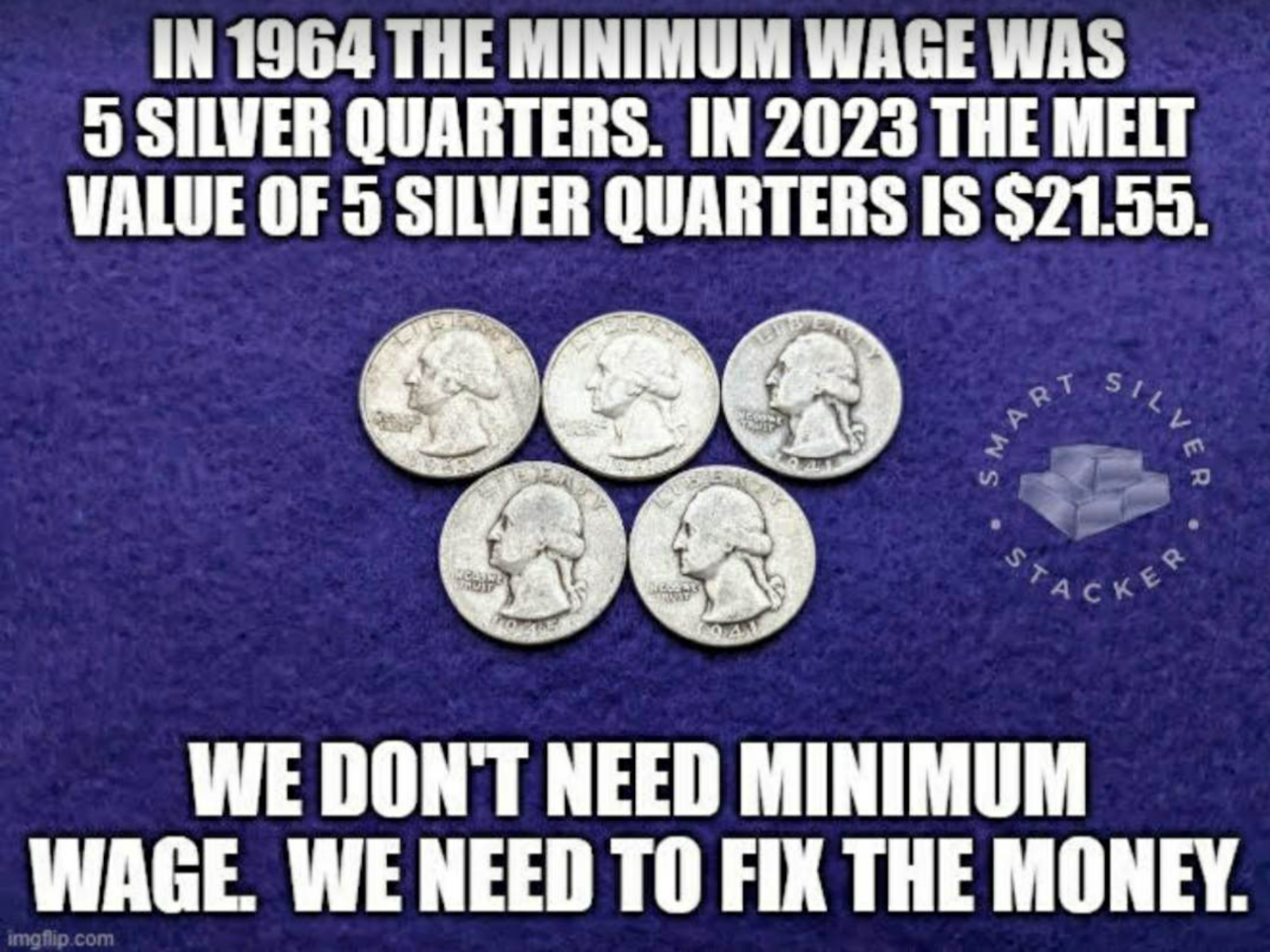
I recently stumbled upon this picture. 

Through 1964 American quarters and dimes were made of 90% silver. Starting in 1965 the inner core is pure copper and the outer covering is copper mixed with nickel. I was discussing this with some friends so I decided to look up some history I recalled about Rome’s debasement of their currency. The first link I found was the below comment and this link to a FEDERAL RESERVE BANK OF ST. LOUIS work book for kids grade 8-12.  

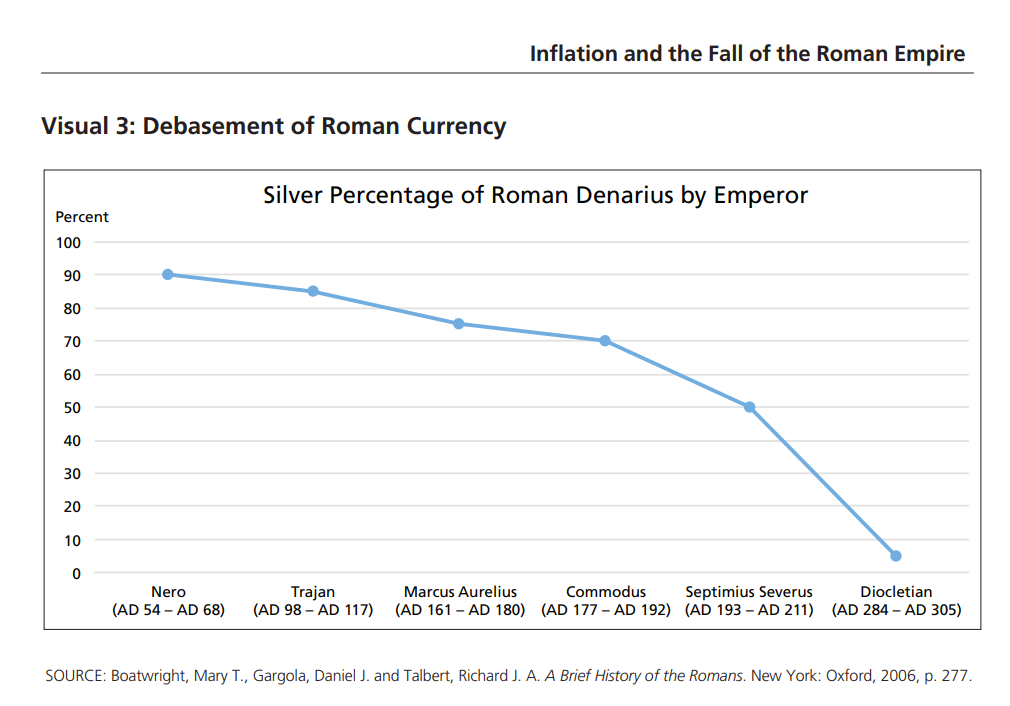
“Commodus (AD 177–AD 192) debased the Roman denarius to about 70 percent silver. Septimius Severus (AD 193–AD 211) debased the Roman denarius to about 50 percent silver. With the added currency, the government could pay for more soldiers and pay existing soldiers more.”

What is incredible is that the Romans “slowly” debased their currency by recalling the money, melting it down and reissuing with a lower percentage of silver. The US government did it quickly by going from 90% to 0% in 1 year! Subsequent dollars were created by adding numbers in the Fed ledger with nothing backing the new money!

Fort Knox holds about 4,580 metric tons of gold which is worth about $250 billion dollars. The US government budget was $6.27 trillion in 2022.

The Government budget deficit in 2022 was $1.38 trillion in 2022.

“A Cantillon effect is a change in relative prices resulting from a change in money supply.” –SWFI

Be Close to the President and Congress

Cantillon also had a theory in which the beneficiaries of the state creating the currency is based on the institutional setup of that state. This essentially means, “he who was close to the king and the wealthy”, likely benefited from the distributional choices of currency through the system. –SWFI

Realizing that the government is constantly creating new money and decreasing the purchasing power of the money you hold in your bank account, what is the average person to do?

See my other posts for a potential answer.

Maintain Purchasing Power

Bitcoin Intrinsic Value