The $2K Stimulus, the 50-Year Mortgage, and the Fiat Trap

Why Americans Deserve Better — and Why Bitcoin May Be the Only Way Out

President Trump recently proposed a $2,000 payment to every American, excluding “high-income individuals.” The idea sounds generous, but it’s also a symptom of a much deeper disease: a government that spends money it doesn’t have—causing inflation in the process and actually hurting the very people who receive the payment.


The Math Behind the Madness

In 2024 alone, the U.S. government ran a $1.8 trillion deficit.
Let’s put that in perspective:

  • There are 128 million households in the United States.
  • There are 340 million individuals.

If we divided that $1.8 trillion evenly, that’s $14,000 per household or $5,294 per person.

So when politicians talk about sending you a one-time $2,000 check, remember — they’re already spending about 2.5 times that amount per person every single year.
If the government simply stopped wasting and borrowing, you’d already be thousands of dollars richer annually — without a single new program or “stimulus.”

That’s money our government already spent—above and beyond the taxes you and I pay. It wasn’t earned. It was created out of thin air by the Treasury and the Federal Reserve. Every time that happens, the dollars in your wallet become worth a little less. That’s why groceries, cars, and homes cost more every year, no matter how hard you work.


The Mirage of the 50-Year Mortgage

Now the U.S. housing authorities are exploring 50-year mortgages, following the path of Japan and even some European countries.
Japan went so far as to experiment with 100-year mortgages, often passed from parents to children. Did that make homes more affordable? No—it made them more expensive.

When you stretch the loan term, monthly payments drop slightly, but total debt rises massively. Sellers raise prices to match what buyers can “afford” on paper. The result: higher prices, higher leverage, and lifelong debt servitude.

The 50-year mortgage is not a solution. It’s an illusion. It’s another way to avoid facing the real issue: our monetary system rewards debt and punishes saving.


Where Does the Money Go?

When we spend $1.8 trillion more than we take in, where does it all go?

  • To foreign wars and endless “operations” that rarely make Americans safer.
  • To subsidies and bailouts for politically favored industries.
  • To bloated bureaucracies that exist to perpetuate themselves.
  • To interest payments on the national debt—now one of the largest single line items in the federal budget.

Meanwhile, our manufacturing jobs were shipped overseas, first to Mexico and China, now to Vietnam and India. Communities that once built real wealth are hollowed out. Young people drown in debt while imported goods fill our stores. The average American is left with higher prices, lower stability, and fewer ways to build lasting capital.

Why does this keep happening? It’s not just bad policy — it’s baked into the structure of the global financial system.
Because the U.S. dollar is the world’s reserve currency, foreign countries must hold dollars to trade internationally. That means America must constantly send dollars abroad — through trade deficits and offshored production — to supply the world with liquidity.

This is known as the Triffin Dilemma: to maintain the dollar’s global dominance, the U.S. has to export jobs, import goods, and print money. It’s a system that benefits global finance, not the American worker.


A Balanced Budget Is Not Just Accounting — It’s Freedom

If the U.S. government lived within its means, you’d instantly gain purchasing power. Prices would stabilize, wages would go further, and the value of your savings would stop eroding.
You wouldn’t need a $2,000 stimulus check—because your dollar would already be strong.

The truth is simple: either we live within our means voluntarily, or reality will force us to.

Now, to be fair, we probably can’t slash spending overnight without causing serious shock to the economy. But we don’t have to.
What if we simply froze federal spending at 2025 levels and let tax revenue grow naturally with the economy? Within a few short years, the budget would balance itself—no chaos, no default, just discipline.

That’s not austerity. That’s responsibility.
And it’s the only peaceful way to restore faith in the dollar while keeping it as the world’s reserve currency.
The other option—the one emerging whether Washington likes it or not—is Bitcoin.


Bitcoin and the End of Fiat Illusion

“I don’t believe we shall ever have a good money again before we take the thing out of the hands of government, that is, we can’t take it violently out of the hands of government, all we can do is by some sly roundabout way introduce something that they can’t stop.”
— F.A. Hayek

Some believe there’s only one peaceful way out of this cycle: a return to sound money—money that cannot be printed at will.

That’s what Bitcoin represents.
It’s not a speculative token or a tech fad—it’s a monetary rebellion against endless inflation, debt-based growth, and political manipulation of money. In a Bitcoin world, politicians can’t quietly steal your savings through inflation. They must tax you honestly or spend less.

That’s accountability.
That’s discipline.
That’s freedom.

Even some in government see this potential. Senator Cynthia Lummis has proposed that the United States create a strategic Bitcoin reserve, allowing America to hold a real, non-inflationary asset on its balance sheet.
That move alone could begin rebuilding trust in the U.S. financial system—and might be the only peaceful way out of this mess.


My Message to Congress

If you truly want to help Americans:

  • Stop using debt as a crutch for broken policy.
  • Reject gimmicks like 50-year mortgages that only inflate prices.
  • Commit to a balanced budget and an honest monetary system.
  • Bring back real production, not financial engineering.
  • End foreign interventions that waste our treasure and divide the world.
  • Support sound money legislation like Senator Lummis’ Bitcoin reserve proposal.

Let the American worker, saver, and builder rise again—on a foundation of real value, not printed promises.


My Message to Every American

Don’t wait for Washington to fix this.
I urge you to learn about the problems with fiat money—how inflation quietly steals your time, labor, and savings—and to understand why Bitcoin solves these problems at their root.

The path forward is clear: either reform the dollar through fiscal discipline, or transition to a world built on honest, decentralized money.
The choice is ours—but the clock is ticking.


Send This Letter to Your Representatives

If this message resonates with you, copy the following text and send it to your senators and congressperson. You can find their contact info at https://www.congress.gov/members.


Subject: Support Fiscal Responsibility and Sound Money

Dear Senator/Representative,

I’m writing to express my concern about the growing national debt, inflation, and the policies that continue to devalue the U.S. dollar. In 2024, the federal deficit was $1.8 trillion—equal to roughly $14,000 per household. Instead of one-time stimulus checks, we need a long-term commitment to balanced budgets and sound money.

Please support policies that:

  • Freeze federal spending at 2025 levels until tax revenue naturally balances the budget.
  • End inflationary monetary expansion that hurts working Americans.
  • Reject 50-year mortgages and other short-term “fixes” that only inflate asset prices.
  • Support legislation like Senator Cynthia Lummis’s proposal for a Bitcoin strategic reserve, ensuring the United States has a sound, non-inflationary store of value.

Fiscal responsibility and sound money aren’t partisan issues—they’re American values.

Sincerely,
[Your Name]
[Your City, State]

Spain’s Silver, Japan’s Bonds, America’s Deficits: Why Easy Money Kills Real Work And Hollows Out The Middle Class


(inspired by this episode of Bitcoin for Millennials)

Big idea: Spain found a mountain of silver in Bolivia, spent like crazy, stopped building real industries—and the bill came due. The same thing is happening today, just with money printers instead of mines.


1) The mountain

In 1545, Spanish explorers struck the richest silver deposit in history: Cerro Rico, “the rich mountain,” in what’s now Bolivia.
A city called Potosí exploded out of the rock. At its height, it was larger than London or Paris.
For two centuries, roughly two-thirds of the world’s silver came from that one mountain. Spain looked unstoppable.


2) Easy money, hard problems

So much silver poured into Europe that prices began rising year after year.
For nearly a thousand years, prices in Europe had been flat. Then suddenly, everything—from bread to rent—started costing more.
Historians call it the Price Revolution.

Spain thought it was getting richer. In reality, its silver was just buying less and less.


3) The addiction loop

Spain borrowed against future silver shipments, funded endless wars, and built palaces to show off its power.
Sound familiar? Borrowing against your future is exactly what modern governments do when they run deficits every single year—financing today’s comfort with tomorrow’s labor and taxes.
And those “endless wars”? Spain fought them across Europe. The U.S. fights them across the globe. Different century, same playbook.


4) “Free” silver, “free” money

The silver was basically free to Spain—mined with forced labor that cost almost nothing.
That “free” flow of money metal fueled reckless spending and inflation.

Today, printing money is even freer. No mines, no ships, no workers—just a digital entry at the central bank.
But the result is the same: more money chasing the same goods, rising prices, and wealth concentrating in financial assets instead of productive work.


5) The wage spiral

When silver poured into Spain, mining and trade paid far more than farming or manufacturing.
Workers chased the high wages, and everyone else demanded raises to keep up.
That wage inflation pushed up local costs across the board.

It soon became cheaper to buy foreign goods than to make them at home.
English and Dutch craftsmen could undersell Spanish products even after shipping them across the sea.
Local factories and farms couldn’t compete. Spain’s economy drifted from production to consumption—spending instead of building.

You can see the same thing happening today.
Money printing and easy credit inflate salaries in finance, tech, and government while driving up housing, energy, and labor costs everywhere else.
Manufacturing can’t keep up, so we import the difference.
The result? A strong currency, cheap goods, and a shrinking middle class.


6) The next chapter — Japan

What if the next Spain isn’t America yet—but Japan?
As this interview with macro analyst Roberto Rios explains, Japan is further down the same path:
zero interest rates, quantitative easing, and government debt so large that the central bank must choose between saving its currency or saving its bond market.

For decades, Japan has printed money to prop up its financial system, even buying stocks outright to keep prices from falling.
That free liquidity created an illusion of stability—until inflation returned and the yen began collapsing.
Now Japan faces the impossible choice every over-leveraged empire eventually faces:
protect the currency and crash the system, or print the money and destroy the currency.

It’s the same dilemma America is approaching, just delayed by our global reserve-currency privilege.
The “free silver” of the 1500s became “free paper” in the 1900s and “free digital dollars” in the 2000s. The pattern never changed—only the technology did.


7) The simple lesson

Resources aren’t wealth. Printing money isn’t wealth. Making things is wealth.
When prosperity feels “free,” it’s usually borrowed from the future.


8) Today’s echo

Easy credit. Quantitative easing. Deficit spending.
Each promises painless prosperity—more liquidity, more growth, no trade-offs.
But it’s the same story Spain wrote 500 years ago: short-term abundance, long-term decay.

Spain’s “free” silver built an empire that rotted from within.
Japan’s “free” money is imploding quietly.
And America’s “free” dollar is next in line—just with better branding and digital ink instead of metal.


9) Bitcoin and the Dollar Endgame

What if Japan’s collapsing bond market isn’t just a regional crisis but a preview of America’s financial future?

In the Bitcoin for Millennials episode, host Bram talks with macro analyst Roberto Rios (“Peruvian Bool”), who has been tracking this “dollar endgame” for years.
While most people fixate on Bitcoin’s short-term price swings, Rios zooms out to the structural problem: every central bank is trapped between saving its currency or saving its bond market. Japan is simply the first to hit the wall.

He calls this dynamic financial gravity—the idea that once debt and money creation expand far enough, gravity pulls everything toward a neutral asset that can’t be printed.

Rios’s core argument:

  • The global monetary system has reached a point where debt can never shrink; it can only be monetized.
  • Central banks will print until confidence breaks.
  • When trust in both sides of the fiat balance sheet—bonds and currencies—collapses, capital will flee into something outside the system entirely.

That’s where Bitcoin enters the picture.

While central banks and institutions still view gold as the “neutral” reserve, Rios argues Bitcoin is the superior version of gold:

  • Fixed supply, instantly verifiable, infinitely divisible.
  • Borderless and digital—no vaults, shipping, or intermediaries.
  • Immune to political capture or forced demand (“fiat” in the literal let-there-be sense).

As he puts it, the Japanese bond crisis could actually trigger the biggest Bitcoin bull run ever.
Once Japan’s carry trade unwinds and the yen weakens further, global liquidity shocks will push central banks to print again—reviving the same inflation loop that began with Spain’s silver.
Each cycle of monetary rescue drives more people to seek an exit from the system itself.

From silver to paper to code:
Spain’s “free” silver created Europe’s first inflation.
Japan’s “free” money is collapsing under its own weight.
Bitcoin is the gravity well everything eventually falls into.


Tracking the “Political ETFs” — My Ongoing Experiment

Members of Congress have long faced accusations of trading on insider information — buying and selling stocks in companies they help regulate.
It’s a bipartisan problem: Republicans and Democrats alike have profited from privileged access and timing the rest of the public could never match.

That’s not just bad optics — it’s corruption.
It undermines faith in both the markets and the integrity of government.

To highlight how deep this problem goes, I’ve started an experiment tracking three ETFs:

  • NANC — the Unusual Whales Subversive Democratic Trading ETF, built around stocks traded by Democratic lawmakers.
  • GOP — the Unusual Whales Subversive Republican Trading ETF, reflecting trades made by Republican lawmakers.
  • SPY — the SPDR S&P 500 ETF Trust, serving as a neutral market benchmark.

My goal isn’t to glorify these funds — it’s to show in real numbers how political trading compares to the broad market, and to call out why this system needs reform.


Policy Context

This issue connects directly to Senator Josh Hawley’s proposal to ban individual stock trading by members of Congress.
His bill wouldn’t ban investing altogether — lawmakers could still own broad mutual funds or ETFs, just not trade individual stocks that might be affected by their votes.

That distinction matters. It allows long-term wealth building without the appearance or reality of insider trading.
📎 Read Hawley’s bill here


Performance Snapshot (Feb 10 2023 → Oct 27 2025)

SymbolETF NameDescriptionStarting Price*Current PriceTotal Return
NANCUnusual Whales Subversive Democratic Trading ETFTracks stocks favored by Democratic members of Congress$24.69$46.15+86.9%
GOPUnusual Whales Subversive Republican Trading ETFTracks stocks favored by Republican members of Congress$24.96$37.20+49.0%
SPYSPDR S&P 500 ETF TrustBaseline for overall U.S. market$408$685+67.9%

*Starting prices from Google Finance (Feb 10 2023, ETF inception date). Current prices as of Oct 27 2025.


The Takeaway

Both “political ETFs” have gained since launch, but that doesn’t justify congressional trading.
When lawmakers can personally profit from decisions they influence, public trust erodes — no matter how well the market performs.

This experiment is my small way to expose how close politics and profit have become — and to advocate for a system where leadership means stewardship, not stock tips.


The Earmark Era: How Washington Rewards Spending, Not Stewardship — and Why the Federal Budget Keeps Breaking

Earlier in 2024, I read a local article about Washington’s senior senator proudly announcing how much federal money she had brought home to the state. Her list ran dozens of pages — hundreds of millions in Congressionally Directed Spending, better known as earmarks.

She’s not alone. Nearly every senator submits earmark requests, which you can browse on the Senate Appropriations Committee’s official list. Each item sounds worthy enough: a wastewater upgrade, a community arts incubator, a “therapeutic court.” But taken together, these line items add up fast.

According to the Peter G. Peterson Foundation, Congress approved 8,098 earmark projects costing $14.6 billion in FY 2024—about the same as FY 2023—and still under one percent of total discretionary spending. In context, that’s roughly 0.2 percent of total federal outlays.

It’s easy to shrug and say, “So what? That’s peanuts in a $6.8 trillion budget.”
But the issue isn’t the size. It’s the signal.


The Round-Trip Problem

When money takes the round trip — federal tax → congressional politics → earmark → local grantee — it leaks. Every stop adds overhead, lobbying, and political friction.

If a project’s benefits are local, fund it locally. Save federal dollars for truly national needs—and make any remaining federal grants competitive and audited.

That’s not ideological; it’s basic hygiene. Less leakage, less pork, more accountability.


The GAO’s Quiet Crusade

The Government Accountability Office (GAO) has spent over a decade documenting federal overlap, duplication, and inefficiency. Between 2011 and 2023, its recommendations produced about $667 billion in cumulative savings—roughly $51 billion a year.

That sounds impressive… until you set it beside annual deficits averaging $1.2 trillion over the same period. Even if every GAO fix were implemented perfectly, it would only offset a few cents of every deficit dollar. We celebrate small wins while ignoring the structural math.


The Trillions That Run on Autopilot

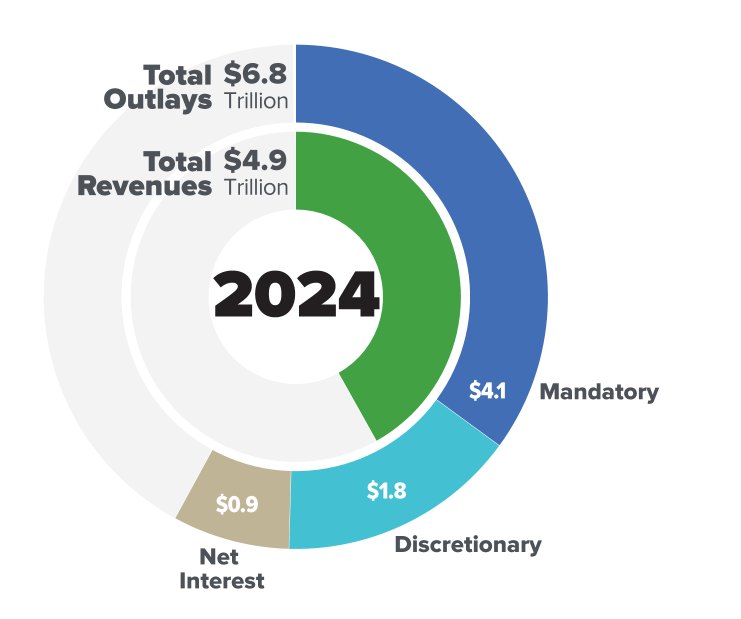
To understand that math, look at the 2024 federal budget as a whole (data from the Congressional Budget Office’s Budget and Economic Outlook: 2024–2034):

  • Total Outlays (FY 2024):$6.8 trillion
  • Total Revenues:$4.9 trillion
  • Mandatory Spending:$4.1 trillion (60%) — Social Security, Medicare, Medicaid, and other entitlements
  • Discretionary Spending:$1.8 trillion (26%) — defense, education, housing, infrastructure, research
  • Net Interest:$0.9 trillion (13%) — the fastest-growing line item in the budget

Source: Congressional Budget Office, “Budget and Economic Outlook: 2024–2034.”

All the fights over earmarks, audits, and waste reports happen inside that discretionary slice, the part Congress actually votes on each year.
The other 70 percent runs on autopilot — driven by demographics, healthcare inflation, and debt.

So yes, we have a trillions problem, not a billions problem.
But pretending the billions don’t matter ensures the trillions never get fixed.


The Cultural Incentive to Spend

Politicians are rewarded for bringing money home. A senator who resists earmarks looks “ineffective.”
That same incentive—spend now, borrow later—is what prevents any real reform on the mandatory side.

If Congress can’t resist handing out $14 billion in earmarks to score headlines, how will it ever take on the hard reforms that actually matter?


The Real Problem

The problem isn’t that earmarks alone bankrupt the country — they don’t.
The problem is that they reveal a mindset: Washington still rewards politicians for spending, not stewardship.

Every senator gets praised for what they bring home, not for what they turn down.
That’s the same mindset that makes real entitlement reform politically impossible and deficit reduction unthinkable.

Earmarks aren’t bankrupting the U.S., but they show why the U.S. can’t stop bankrupting itself.

Until that incentive changes — in Congress, in media, and among voters — the numbers will keep getting bigger, and the excuses will too.


Sources:

2024 Congressional Pig Book Summary
32nd “TheBook Washington Doesn’t WantYou to Read”
CITIZENS AGAINST GOVERNMENT WASTE

The Congressional Pig Book is CAGW’s annual compilation of earmarks in the appropriations bills and the database contains every earmark since it was first published in 1991. All items in the Congressional Pig Book meet at least one of CAGW’s seven criteria that were developed by CAGW and the Congressional Porkbusters Coalition:

  • Requested by only one chamber of Congress;
  • Not specifically authorized;
  • Not competitively awarded;
  • Not requested by the President;
  • Greatly exceeds the President’s budget request or the previous year’s funding;
  • Not the subject of congressional hearings; or,
  • Serves only a local or special interest.

The Politics of Envy: How Bernie Sanders Uses Billionaires to Distract from Washington’s Failures — and Keep People Angry

Blaming billionaires is easy. Fixing bad policy, broken incentives, and decades of fiscal irresponsibility isn’t — so Bernie Sanders keeps the outrage machine running instead.

A lot of people — Bernie Sanders in particular — hate billionaires because they assume billionaires stole their wealth.
But that belief comes from misunderstanding how value is actually created.


💵 Creation vs. Printing

Bernie and the government “create money” by printing it — literally out of thin air — which steals purchasing power from everyone who already has dollars.
That’s not value creation. It’s value redistribution by dilution.

So when that’s your frame of reference, you start to believe that everyone who gets rich must have taken something from someone else. Because that’s how you create “money” in politics — you print it or tax it away.

But wealth in a free market isn’t created by decree. It’s created by building, coordinating, and innovating — by making something others voluntarily trade for.


📈 Value Creation Is Not Theft

Larry Ellison, for example. One day Oracle stock went up, and his net worth jumped by $100 billion. Bernie acts like Larry ran around stealing $100 billion from working people.
But that’s not what happened. That value didn’t exist before — it was created.

Wealth in the market represents new value built through skill, innovation, and coordination, not theft.
If you’re stranded on an island with a billion dollars, it’s worthless. You need resources, tools, and knowledge to turn that “money” into something useful.

The problem is, people who’ve never built or created real value assume no one else can either.
So they see wealth as theft instead of creation. That’s the confusion at the heart of modern politics.


⚠️ Bernie’s Game: Blame, Not Solutions

And that’s where Bernie Sanders comes in.
He isn’t actually helping working people by pointing to billionaires as evil — he’s manipulating them.

By giving people a villain to hate, he distracts from the real causes of economic pain — bad money, wasteful government, and decades of inflation that quietly rob savers and workers.
He rallies frustration around a scapegoat instead of a fix.

If Bernie genuinely wanted to help, he’d talk about restoring fiscal discipline, reducing waste, and making it easier for regular people to build wealth — not demonizing those who already have.
But he doesn’t. Because blaming billionaires is politically easy.
Fixing the system would mean questioning the very machine that gives him power.

So instead of solving problems, he feeds resentment — keeping people angry, divided, and dependent on him to express that anger.


🧮 The Fantasy of the “Billionaire Tax”

In a recent Time article titled “I’m a Millionaire. No One Needs More Than $30 Million”, the author argues that a Billionaire Income Tax could raise $557 billion over ten years and “jump-start a permanent safety net.”

That sounds impressive — until you look at the math.

The U.S. government currently runs a $2 trillion annual deficit.
That’s $20 trillion in overspending every decade.
So this “transformative” billionaire tax covers less than 3 % of the hole. It’s fiscal rounding error.

The problem isn’t a lack of billionaire money — it’s a lack of discipline and accountability.


🏛 The Real Problem Isn’t “Too Much Money” — It’s How It’s Used

The Time article goes on to argue that wealth beyond $30 million stops being about living well and becomes about wielding power — influencing elections, buying media outlets, and suppressing competition.

That part isn’t entirely wrong. Money can corrupt politics.
But the author’s solution — capping wealth — misses the point completely.

If the issue is that money manipulates the system, then the answer is to make the system harder to manipulate, not to confiscate wealth after the fact.

We should make elections harder to buy, not success harder to earn.
Reform campaign finance, close regulatory loopholes, stop insider lobbying — that’s how you stop abuse.

The same goes for the “buy, borrow, die” loophole that allows the ultra-wealthy to avoid realizing gains.
If that’s the concern, close the loopholes directly — don’t destroy the entire structure of value creation to fix a tax code glitch.

And even then, no system will ever be perfect.
Smart, ambitious people will always find new ways to optimize around the rules — that’s part of what makes them successful.
Every time you close one loophole, innovation and adaptation create another.
The goal shouldn’t be to eliminate advantage; it should be to keep the playing field open and the incentives productive.

And far from “locking others out,” large pools of wealth are what fund the next generation of builders.
People don’t lose the chance to innovate because billionaires exist — they lose it when regulation, bureaucracy, and bad policy make it impossible to start or scale.
Just look at Europe: it leads the world in regulation, but none of the world’s biggest or most dynamic companies are European.
They’ve made it harder to fail, but also impossible to truly win.
Capital isn’t a finite pie being hoarded; it’s the byproduct of trust, savings, and productive investment.
Destroy that, and you destroy the fuel for future innovation.

Blaming “too much money” is a lazy shortcut that lets broken institutions off the hook.


💥 What Happens If You Actually Take It

Let’s pretend we go full Bernie and seize every dollar of billionaire wealth in America — all $6 trillion of it.

Here’s what happens:

  1. That covers just three years of deficit spending at current rates. Then what? You’re out of billionaires, and the deficit keeps growing.
  2. Most of that wealth isn’t cash. It’s ownership stakes in companies — Tesla, Oracle, Amazon, Microsoft, etc.
  3. If the government forces liquidation, prices collapse. No one can buy trillions in stock without tanking the market.
    • Even a 50 % drop cuts the haul to $3 trillion — barely 18 months of deficits.
  4. Who buys the assets? The next-richest class. Inequality reshuffles briefly, then reforms.
  5. Meanwhile, innovation stalls. Investment dries up. Everyone gets poorer.

You can’t fund a government by destroying the productive capital that funds everything else.


⚙️ The Real Issue Isn’t Wealth, It’s Value

Wealth isn’t evil — it’s a signal that someone created something valuable enough for millions of people to trade their time or money for it.
That’s fundamentally different from printing dollars and calling it “stimulus.”

If we want a stronger, fairer economy, the solution isn’t confiscation — it’s creation.
Encourage building, innovation, and hard work, and you’ll raise living standards for everyone.
Punish them, and you’ll end up with equality through shared decline.


🧭 Final Thought

Bernie isn’t fighting for the working class. He’s fighting to stay relevant to it.
You don’t fix inequality by burning down the factory.
You fix it by letting more people build factories of their own.


Bitcoin, Deflation, and the Myth of “Useless Money” – Why would people spend bitcoin if it keeps gaining value?

Bitcoin, Deflation, and the Myth of “Useless Money”

A common fear I hear about Bitcoin goes something like this: “If it becomes so valuable in the future, people will never spend it. They’ll just hoard it forever — and that means it can’t work as money.”

But let’s pause. That argument assumes that money needs to lose value in order to be useful — that people will only spend if their savings are constantly melting. Does that really make sense?

People Already Save

In reality, people save no matter what. Even with inflationary dollars, households and businesses don’t spend every cent. They put money aside — but because the dollar steadily loses value, they are forced to search for other stores of value:

  • Stocks
  • Bonds
  • Real estate
  • Gold
  • Collectibles

This isn’t a feature. It’s a problem. The constant need to escape a leaky dollar creates bubbles, misallocates capital, and makes financial life complicated for everyone.

Take housing, for example. When money loses value, homes become more than shelter — they turn into financial assets. People don’t just buy houses to live in them; they buy them as inflation hedges. That means families looking for a roof over their heads end up competing with investors and savers desperate to preserve wealth. Prices get bid up far beyond the utility value of the home, making affordability worse and turning what should be a basic necessity into a speculative storehouse for capital.

Deflationary Money Doesn’t Paralyze Spending

Critics imagine that if money gains value over time, nobody will use it. But people already spend under deflationary conditions — technology proves this. Everyone knows next year’s phone or TV will be cheaper and better, yet they still buy today. Why? Because they value the use and enjoyment now, not just later.

The same applies to Bitcoin. Once mature, it will likely appreciate at roughly the rate of productivity growth (similar to a low-yield bond). People will hold it to store value — and still spend it when a purchase is worth more than waiting.

Flipping the Narrative

Inflationary money forces people into risky, complex alternatives just to save. Hard money that holds or grows its value removes those distortions. Contrary to the fear, deflationary money won’t break the economy — it may actually fix many of the problems caused by inflationary systems.

And here’s the real irony: many critics already suspect Bitcoin could become extremely valuable — that’s why they worry no one will spend it. But at the same time, they refuse to buy any today. They recognize the upside, but fear keeps them paralyzed on the sidelines.

Conclusion

In a Bitcoin world, homes could go back to being homes, not savings accounts. People could save without speculation, spend without fear of losing purchasing power, and invest in businesses for growth rather than sheltering from inflation. That’s not “useless money.” That’s money finally doing its job.

For further reading on this read The Price of Tomorrow: Why Deflation is the Key to an Abundant Future – Jeff Booth


Bitcoin and the Triffin Dilemma: Why Wages Would Adjust Fairly Under a Neutral Money

Most people don’t realize that many of the economic problems facing Americans today trace back to something called the Triffin dilemma. Politicians like Trump rage about trade deficits or promise to bring back jobs, but they rarely understand the underlying monetary system that makes those promises impossible to keep. And because they don’t understand it, millions of middle-aged workers in the U.S. are left angry and disillusioned.

But here’s the good news: the problem is solvable. And Bitcoin, combined with Buckminster Fuller’s vision of a “world accounting system,” offers a way forward.


The Triffin Dilemma in Plain English

Robert Triffin pointed out a paradox in the 1960s: if one country’s currency becomes the world’s reserve currency, that country must constantly supply it to the rest of the world. For the U.S., that means running trade deficits and flooding the globe with dollars.

The catch is that what looks good globally causes pain domestically. To meet the world’s demand for dollars, the U.S. must run deficits, borrow more, and tolerate an overvalued dollar. That makes American exports less competitive, hollows out manufacturing, and weakens wage growth.


The Cost of Supplying the World with Dollars

To keep the global economy running on dollars, the U.S. has to keep sending them out. There are only two main ways that happens: by running trade deficits (importing more than we export) or by borrowing (issuing Treasuries that foreigners buy with their surplus dollars). Both of these mechanisms keep the world awash in dollar liquidity — but they impose heavy costs on American workers.

  • Persistent deficits mean more borrowing. Every trade deficit eventually gets financed with U.S. debt. Foreign governments and investors recycle the dollars they earn back into U.S. Treasuries. The system keeps spinning, but America’s national debt climbs ever higher.
  • Global demand keeps the dollar strong. Because the world needs dollars, our currency stays overvalued compared to others. A strong dollar makes imports cheap (which feels good for consumers at Walmart) but makes American exports expensive (which is brutal for manufacturers trying to compete abroad).
  • Manufacturing gets hollowed out. When American goods are too expensive, factories lose business. Over time, companies either shut down or relocate production overseas. Entire industries migrate abroad, leaving behind shuttered plants and devastated communities.

Take steel as a concrete example. In the late 20th century, global demand for dollars, combined with cheaper steel production in Asia, kept the U.S. dollar strong and U.S. steel prices uncompetitive. By the 1980s and 1990s, iconic steel towns in Pennsylvania and Ohio watched mills close. Workers who once earned solid middle-class wages saw their jobs vanish, and many never found work at the same pay level again.

  • Wages stagnate. With fewer competitive industries at home, American workers lose bargaining power. They’re forced to compete against cheaper labor abroad, and wage growth flatlines. Meanwhile, the cost of living — housing, healthcare, education — keeps climbing. The result is the frustration many middle-aged Americans feel today: they’ve worked hard their whole lives, yet the system seems rigged against them.

In short: to supply the world with dollars, America borrows, tolerates an overvalued currency, and sacrifices its own competitiveness. The global dollar system helps keep international trade flowing, but it extracts its pound of flesh from U.S. workers.


Figure 1: Global demand for dollars keeps the dollar strong, which makes imports cheap but exports uncompetitive — hollowing out U.S. manufacturing and holding down wages.

Why Trump (and Most Politicians) Miss the Point

Trump recognizes that something is broken — but his diagnosis is shallow. He blames foreign countries, bad trade deals, and weak leaders. His answer is tariffs and protectionism.

But the deeper issue is that America can’t stop running deficits without undermining the very system that makes the dollar the global reserve. The Triffin dilemma locks us in. Protectionism only papers over the problem temporarily.


How Wages Would “Automatically Adjust” Under Bitcoin

Now imagine a world where global trade is denominated in Bitcoin, a money no government can print or devalue.

  1. High Productivity Raises Wages Locally
    If Country A is extremely productive, it earns more Bitcoin. Workers there see higher wages in BTC terms.
  2. Prices Rise in the Productive Country
    With higher wages, local goods get more expensive relative to other countries.
  3. Trade Shifts
    Other countries stop buying from Country A and look to Country B or C, where wages are lower and goods are cheaper.
  4. Jobs Move, Wages Rebalance
    Jobs flow out of the high-wage country into lower-wage ones. Wages in the expensive country stabilize or even fall, while wages in cheaper countries rise.

The result: wages “automatically” adjust across borders to reflect real productivity, not the games governments play with currency printing or manipulation.


Figure 2: Under a Bitcoin-based system, wages and trade flows automatically rebalance. High wages make exports more expensive, shifting jobs abroad until global wages reflect true productivity.

Why Fiat Prevents This Natural Balance

In today’s fiat system, governments intervene to block this natural adjustment. They devalue their currencies to keep exports cheap, trapping workers in low wages and preventing global wage convergence.

Meanwhile, American workers face the opposite problem: a strong dollar that prices them out of global competition. The Triffin dilemma ensures the imbalance persists.


“Isn’t It Just Greedy Companies Suppressing Wages?”

A common belief is that big U.S. companies are the real villains — trillion-dollar firms posting record profits while holding wages flat, outsourcing jobs, or using H1B visas to bring in cheaper labor. There’s truth in that frustration, and yes, there is abuse in how the visa system is used.

Consider this example: if an American worker expects $80,000 but a skilled H1B worker is willing to accept $50,000, the company has a clear incentive to hire the cheaper worker. To Americans, this feels like wage suppression. But for the H1B worker, it’s a huge win. That $50,000 U.S. salary might translate into the equivalent of $150,000 back home, especially if they can send $10,000 to family abroad where the cost of living is far lower.

So while it looks like companies are simply greedy, they’re really responding to the incentives of a distorted global money system. With the dollar overvalued and global trade imbalances baked in, U.S. labor is structurally overpriced compared to the rest of the world. Companies are not the root cause — they’re just playing the game according to the rules we’ve set.

In a Bitcoin-based system, the game changes. Wages would adjust across borders automatically, not through currency manipulation or immigration loopholes. Companies would still seek efficiency, but the playing field would be leveled: wages in every country would reflect true productivity, not fiat distortions.

Figure 3: Under fiat money, companies are incentivized to outsource, use H1B labor, and suppress wages. Under Bitcoin, wages converge globally based on real productivity, not manipulated exchange rates.

Fuller’s Dream of a World Accounting System

Buckminster Fuller envisioned a future where humanity had a scientific, global accounting system that measured real wealth and resources instead of manipulating national ledgers.

Bitcoin is a step in that direction. It’s transparent, borderless, and immune to political distortion. A Bitcoin-based world economy would essentially run on Fuller’s “world accounting system,” with wages, trade, and prices reflecting true productivity instead of central bank policy.


The Takeaway

The middle-aged frustration in America isn’t just about lost jobs or bad politicians. It’s about being trapped inside the Triffin dilemma — a system where the U.S. must sacrifice its workers to supply the world with dollars.

Bitcoin offers a way out: a neutral, global money where wages naturally rebalance, trade adjusts fairly, and no single country bears the impossible burden of being the world’s reserve.

It’s not just a monetary upgrade — it’s the foundation for a more honest accounting system for the entire world.

Who Gets the Income? Who Pays the Taxes?

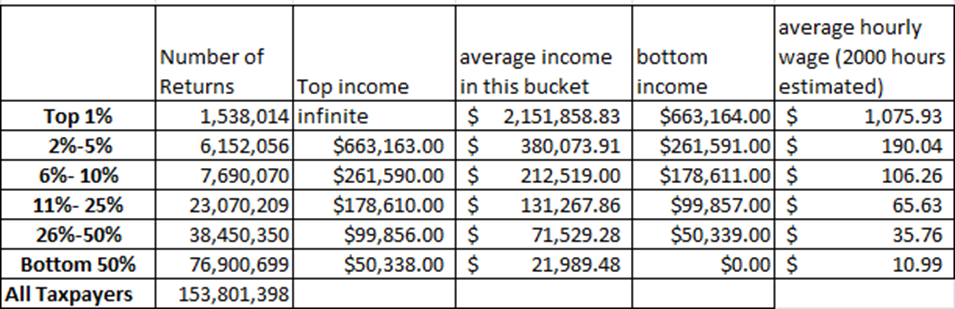
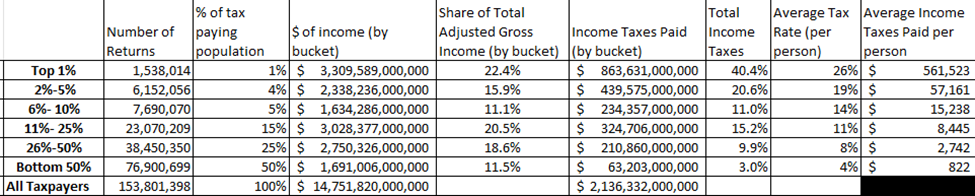
Data gathered from this link – https://taxfoundation.org/data/all/federal/latest-federal-income-tax-data-2025/

When we talk about taxes in America, the debate often gets sloppy. People use “income” and “wealth” almost interchangeably, but they’re very different things.

  • Income is the flow of money earned each year — wages from a job, dividends, or realized capital gains.
  • Wealth is the stock of assets someone already owns — businesses, real estate, stocks, Bitcoin, etc.

Our tax system is built mainly on income, not wealth. And when commentators conflate the two, it clouds the conversation about fairness and policy.


Income Snapshot

In 2022, the U.S. collected $2.1 trillion in federal income taxes on about $14.8 trillion in total income. That’s about 14.4% of taxable income.

Divide that income across all 153 million taxpayers, and the average income comes out to $95,915, or about $47.96 per hour assuming 2,000 hours of work per year. Of course, averages can mislead — the distribution is anything but equal.


The Top 1%

To qualify for the top 1% in 2022, you needed at least $663,164 of income. On average, these 1.5 million taxpayers earned $2.1 million each.

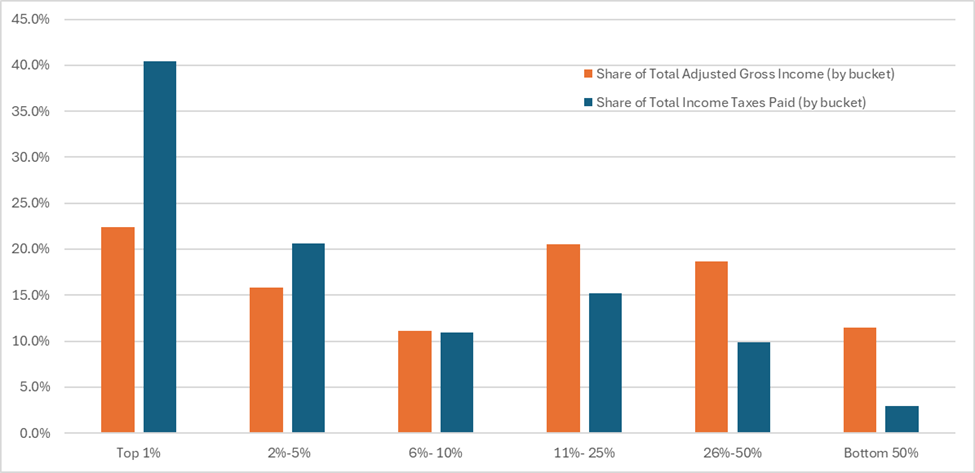
  • Share of income: 22.4%
  • Share of taxes paid: 40.4%
  • Effective tax rate: 26%

The Bottom 50%

The bottom half — about 76 million taxpayers — earned less than $50,339 per year. Their average income was just $21,000, totaling $1.7 trillion across the group.

  • Effective tax rate: ~4%
  • Many pay no federal income tax at all, often due to credits like the Earned Income Tax Credit (EITC) or child tax credits.

Wealth Snapshot

If we shift from income to wealth, the picture looks even starker. As of mid-2025, U.S. billionaires hold over $6.2 trillion in wealth, spread across only about 813–867 individuals.

But here’s the catch: the U.S. government is adding about $2 trillion in deficit spending every year. Even if you taxed billionaires at extremely high rates, it might cover only a year or two of deficits. After that, the wealth pool would shrink — and most billionaires would likely relocate to avoid such aggressive taxation.

That doesn’t mean we shouldn’t debate fairness, redistribution, or even wealth taxes. But it does mean we need to be realistic about the math.


Why This Matters

The key takeaway is that income and wealth are different conversations. Most tax debates focus on income flows, yet the loudest arguments are often about wealth concentration. If we mix those together, we miss the real tradeoffs.

I’m happy to debate how much each group should earn, or whether a wealth tax makes sense (though I personally think it doesn’t). But if we want an honest conversation, we have to separate what we’re actually measuring.

Because when we ask, “Who should pay more?” the first step is being clear: are we talking about annual income, or about the stock of wealth built up over decades?

Data – https://taxfoundation.org/data/all/federal/latest-federal-income-tax-data-2025/

You will notice myd ata is slightly different than from the website. The website continually aggregates so their “top 5%” data includes all the income & people from the top 1% + the 2%-5%.
I have broken it down so you can see how much income is in each bucket. I think my method is much more useful.
It also allows you to see how much income, taxes, average income, is in each bucket.

When the data is aggregated it always is skewed due to the higher amount of income above it.

💵 How Fiat Money Hollowed Out America’s Job Market and How to Fix it


Intro – Why can’t Americans find good jobs anymore?

Because the U.S. dollar’s role as the world’s reserve currency lets us import everything without producing anything.

Fiat money didn’t just change our economy—it hollowed it out.

This article explains how we got here—and why only a return to hard money, like Bitcoin, can bring us back.

There’s a sentence I keep coming back to:

Without fiat, we’d have to export goods to earn gold or foreign currency before we could import.

Quick note: “Fiat” money just means paper money that isn’t backed by anything tangible like gold or silver. Its value comes entirely from government decree (“fiat” is Latin for “let it be done”)—and trust.

That’s it. That’s the whole game.

Donald Trump spent years hammering America’s trade deficit, accusing China of taking advantage of us and blaming past politicians for “bad deals.” But the truth is deeper—and more systemic.

The trade deficit isn’t just a negotiating failure. It’s a structural requirement of the global dollar system.

Since the 1970s, the U.S. has run chronic trade deficits not because we’re dumb—but because we have to. That’s how the world gets its dollars. It’s the price of running the global reserve currency.

Fiat money—and specifically, the U.S. dollar’s role as global reserve—didn’t just change how we buy and sell. It rewired the entire global economy. It made it profitable to consume without producing, and to outsource labor while importing goods with nothing more than printed IOUs.

Let’s break that down.


📜 A Brief History of the Cheat Code

After World War II, the U.S. dollar became the centerpiece of the global financial system through the Bretton Woods Agreement. Other countries pegged their currencies to the dollar, and the dollar was pegged to gold at $35/oz. Global trust was strong—because dollars were redeemable for something real.

But by the late 1960s, the system was already cracking.

The U.S. was printing more dollars than it had gold to back, funding both the Vietnam War and LBJ’s Great Society programs. Foreign nations started to notice. The promise of gold convertibility was still on paper, but the gold simply wasn’t there to cover all the dollars in circulation.

Then came the bluff-calling moment: France sent a warship to New York Harbor in 1971 to collect its gold. The U.S. honored the request—but it was a wake-up call. If one country could demand gold, others would follow—and the U.S. didn’t have enough gold left to fulfill those redemptions.

Rather than continue the outflow—and risk total collapse of the system—President Nixon closed the gold window, ending the dollar’s convertibility to gold and defaulting on the original Bretton Woods promise. He called it “temporary,” but we’re still living with the consequences.

The U.S. had just rugged the global economy—but there was no better option available. All other currencies were fiat too.

And so, by default—not by merit—the dollar remained the foundation of global trade.


🛢️ The Petrodollar Patch

To maintain global demand for the dollar, the U.S. struck a 1974 deal with Saudi Arabia:

  • The Saudis would price oil only in dollars,
  • And the U.S. would provide military protection.

This created the petrodollar system, locking in global demand for dollars—because energy runs the world. Every country that wanted oil had to first acquire dollars.

That meant: even without gold, the dollar was still backed—by oil, debt, and military force.

This gave the U.S. a unique superpower:

  • Print money (or sell Treasuries),
  • Ship it overseas,
  • And receive real goods, labor, and resources in return.

No other nation could do this. And no other empire in history ever got away with it for so long.


🏭 The Fallout: Jobs Go Offshore, But Dollars Still Flow

Because the world kept accepting dollars, American companies could:

  • Shut down U.S. factories,
  • Hire cheaper labor abroad,
  • Import those same goods back to the U.S.,
  • And sell them to consumers who were buying with borrowed or printed money.

The fiat system didn’t make foreign workers cheaper, but it made it possible to use them without consequences.

We stopped needing to earn our imports by making things. We could just finance everything with paper and debt. Capital loved it. Wall Street loved it. Politicians loved it.

But working people? Not so much.

From Janesville to Youngstown, from Flint to the Bronx, the outcome was the same: a slow, grinding hollowing-out of America’s industrial base and middle class.


🏦 Makers and Takers: How Finance Replaced Work

In Makers and Takers, journalist Rana Foroohar lays out how U.S. corporations gradually stopped investing in workers, R&D, and physical capital—and instead prioritized stock buybacks, dividends, and debt-fueled growth.

But here’s the uncomfortable truth:

Many of those companies had to play that game—or risk being eaten alive.

In a fiat system with low interest rates, abundant capital, and massive global competition:

  • Shareholder pressure rewards short-term profit over long-term investment.
  • Stock buybacks boost prices faster than hiring or training workers.
  • Outsourcing and financial engineering became necessary survival tools—not just greed.

This wasn’t just a few bad CEOs. It was a system-wide shift in incentives.
The rise of finance wasn’t a deviation—it was an adaptation.


🤖 You Can’t Skill Your Way Out of This

Today, people are told to just “learn to code” or “work harder.” But what they’re really up against is a global fiat machine that rewards capital over labor, and extraction over production.

That’s why:

  • Degrees don’t guarantee jobs,
  • Effort doesn’t guarantee stability,
  • And “just working harder” feels like treading water.

It’s not that Americans don’t want to work. It’s that the system no longer rewards domestic labor—because it doesn’t need to.


🧱 What Comes Next?

The world is starting to wake up. Countries are buying gold. Some are experimenting with Bitcoin. Others are trying to de-dollarize trade altogether. Trust in the U.S. dollar isn’t infinite—and neither is the empire it props up.

The dollar still works—not because it’s sound, but because there hasn’t been a better option. Yet.

But every empire that runs on paper eventually runs out of trust. And when that happens, the real cost of all those “free” imports comes due.


₿ A Hard Money Future: Why Bitcoin Matters

The only real way to end this game is to remove the cheat code: fiat money itself.

A return to hard money—like Bitcoin—could force the system to reorient around real productivity, long-term investment, and sustainable value creation.

Without the ability to endlessly paper over deficits, businesses would once again have to:

  • Build resilient supply chains
  • Invest in their workers
  • Serve customers over shareholders
  • Plan for decades, not quarters

Bitcoin doesn’t just offer escape—it offers discipline. It turns off the short-term game and invites long-term thinking back into the economy.


💬 Closing Thought

Fiat gave us the illusion that we could consume without producing.
But in the long run, reality has a way of settling the bill.
Maybe it’s time we stopped running the tab—and started building again.

Why I Support Bitcoin: A Personal Journey Through the Global Failure of Fiat

For most of my life, I’ve worked with businesses and nonprofits trying to make the world better. I’m a mechanical engineer by trade. I like building things that work. But the more I’ve worked across systems, the more I’ve realized something deeply broken sits at the root of almost every failure: fiat money.

A Friend, a Business, and a Broken Economy

A few years ago, a friend of mine was helping advise a small, sustainable clothing business in Sri Lanka. They used natural dyes and traditional techniques to create jobs for locals—especially for people who often couldn’t access the formal economy. It was working. Until it wasn’t.

The Sri Lankan currency collapsed during a financial crisis. Inflation soared. Imports became unaffordable. And the business, despite doing everything right, failed—not because of bad management or a poor product, but because the foundation it was built on—its currency—was rotten.

This is what fiat does. It breaks systems from the bottom up. And it leaves regular people holding the bag.

How Fiat Hollowed Out America

We often think of developing countries suffering from bad money, but the same decay has hit the United States. The post-WWII American economy was built on sound money and a manufacturing base that rewarded long-term planning and production.

That changed in 1971, when Nixon took the U.S. off the gold standard. With no monetary anchor, we entered the era of fiat—the era of cheap credit, endless deficits, and quarterly capitalism. Easy money made it easier to offshore jobs , because capital flowed wherever short-term profits looked best. Domestic manufacturing collapsed (such as in Janesville, Wisconsin). Towns hollowed out. Entire regions like the Midwest were gutted for the sake of Wall Street’s earnings calls.

Short-termism infected everything:

  • Companies spent more on stock buybacks than R&D or wages
  • Governments ran up debt with no repayment plan
  • Individuals chased consumption over savings, just to stay ahead of inflation

Economic Hitmen and Empires of Debt

In Confessions of an Economic Hitman, John Perkins explains how U.S. institutions loaned billions to developing nations for infrastructure that looked good on paper but benefited U.S. contractors more than locals. When those countries couldn’t repay, they were forced into austerity, resource sell-offs, and geopolitical obedience. Debt became a weapon.

Today, China is doing the same through its Belt and Road Initiative. In Sri Lanka, China took control of the Hambantota Port on a 99-year lease when the country couldn’t pay its debts. In Greece, China’s COSCO controls the Port of Piraeus. In Australia, they secured a 99-year lease on the Port of Darwin, now under review due to national security concerns.

This isn’t charity. It’s colonialism with spreadsheets.

Fiat Money Rewards the Few, Punishes the Many

Every time a central bank prints new money, it steals from savers and wage earners. Those who hold fiat see their purchasing power decay. This is especially cruel during periods of inflation, like the 8% spike in the U.S. in recent years.

Bitcoin fixes this.

  • It has a fixed supply: 21 million coins, ever.
  • It can’t be printed or manipulated by any government.
  • It rewards saving, planning, and long-term thinking.

It flips the fiat incentives:

  • Instead of spending now, you’re rewarded for holding.
  • Instead of inflation eating your wealth, deflation preserves it.
  • Instead of trusting a corrupt institution, you trust code and math.

Why I Share Bitcoin With Others

I’ve read the books. I’ve seen the failures. I’ve lived through broken systems and watched people I care about suffer—not from laziness or ignorance, but because the monetary foundation was cracked.

Bitcoin is the best alternative I’ve found to a rigged, decaying system. It’s not just about investment. It’s about dignity. Agency. Fairness. It’s about building something that can last.

This is why I support Bitcoin. And this is why I speak up.