Microstrategy $750 Million to Buy MORE Bitcoin!

Microstrategy is a large software analytics company. It is also the company which holds the most Bitcoin. Microstrategy currently holds 152,800 bitcoins.

This is 0.73% of all Bitcoin that will ever be created! There will be only 21 million Bitcoin ever.

It’s also estimated that perhaps 4 million bitcoin have been “lost” with old computers that people have lost so that means 152,800/17 million = 0.9% of all Bitcoin that will ever be available! Only 19 million bitcoin have been issued. The final 2 million will be issued over the next 120 years, so that means there are only about 21-2-4 = 15 million bitcoin available for purchase today. So Microstrategy owns over 1% of all Bitcoin available today!

And they are buying more!

MicroStrategy is planning to raise up to $750 million via a stock sale and says it may use the proceeds to buy more Bitcoin- Cointelegraph

The reason Microstrategy is buying more bitcoin is because they see it as the supreme ownership asset. In a world where more fiat currency (USD, Euros, Yen) are created everyday something that is ultimately scarce is valuable!

You can watch the Chairman of Microstrategy, Michael Saylor, discuss bitcoin here, for 1 hour, or if you are really interested he discusses history, energy and bitcoin here for many hours. I watched the hours and hours podcast as it’s fascinating!
This development, Microstrategy, buying more and more bitcoin, is a signal in the noise of everyday life where people are talking about if you should buy bitcoin, or gold, or stocks. There are things that are signals and things that are noise. This is a signal. KPMG putting out a paper about bitcoin being ESG friendly is also a signal

You should watch for signals and act accordingly!

Remember! Don’t FOMO buy thousands and thousands of dollars of Bitcoin unless you are ready to temporarily lose 50% or more.

Don’t invest any more into Bitcoin than you are willing to lose. While I think it will be fine, it’s always possible something wild could happen and it could go to $0 (I doubt this but keeping all possibilities open). 

KPMG – The Bitcoin Narative is Changing

https://advisory.kpmg.us/content/dam/advisory/en/pdfs/2023/bitcoins-role-esg-imperative.pdfKPMG is considered one of the “Big Four” accounting firms, it is the 4th biggest, but still pretty big in the grand scheme of things.KPMG recently released a document, linked above and here, sharing how Bitcoin fulfills all 3 values of ESG (Environmental, Social and Governance) investing. This is a pretty big change in the narrative about bitcoin in the media compared to the erroneous FUD (fear, uncertainty, doubt) that had been being spread and is still being spread about Bitcoin’s “high” energy usage. That is disputed in this article, and elsewhere. Bitcoin has a small overall energy usage compared to many other industries. It also has a greater than 50% usage of renewable energy, which is the highest of any industry in the world. There are even bitcoin mining applications that can have negative emissions such as using methane from a landfill to power the bitcoin miner. If that methane was just released into the environment, like it is at many landfills now, that methane is 80x worse for the environment than CO2.I encourage everyone to learn about bitcoin. You can read my older posts. You can also find many bitcoin books from my reading list.As Jason Maier said in his book “A Progressive’s Case for Bitcoin” – “You don’t know any intelligent person who has studied Bitcoin for 100 hours and thinks it’s a bad idea.”I encourage you to read his book.  

Isn’t The Bitcoin Guy in Jail?

I was recently in the hospital (that part of the story isn’t important) and had a Bitcoin book, A Progressive’s Case for Bitcoin: A Path Toward a More Just, Equitable, and Peaceful World, out on my desk to read while I was sitting around doing nothing. One of the nurses asked me if I “Was into Bitcoin?”. I naturally said “yes” enthusiastically and asked her if she wanted to talk about it. Her first comment was “Isn’t the bitcoin guy in jail?” I explained to her that “no there is no ‘bitcoin guy’” The guy who is in jail, who I’m assuming she meant Sam Bankman-Fried (SBF), although we didn’t clarify that, I explained to her, was a fraudster but not directly linked with bitcoin. I explained to her that Sam and his company FTX were more or less committing fraud on a level similar to Enron. She seemed to understand that. 

Fighting basic narrative errors about bitcoin like this is important for bitcoin adoption. There is so much false news and when people don’t really have that much interest, this is the type of error they can make. 

I also got to mention to her that there is a limit of 21 million bitcoin ever and it fixes the problem of governments stealing our savings via inflation. She did like that! She mentioned that she had a “lot of cash” and “wished the government would stop stealing things”. Not the most technical conversation, but I’m hoping that by.

1 . removing the connection of SBF/FTX to bitcoin and

2. Connecting the idea of bitcoin saving you from government created inflation, she might be more open to bitcoin the next time she hears about it. 

She also mentioned that she “isn’t tech savvy” but somehow mentioned she has Venmo. You can buy bitcoin on Venmo (it’s not the favorite platform for the “hardcore” bitcoin folks but it works). So I did mention to her that she would be able to buy it there pretty easily.

What Problem Does a Central Bank Digital Currency (CBDC) Solve?

If you read my previous post you will learn what problem bitcoin is trying to solve. But there is another thing that governments love to talk about when anyone mentions bitcoin or cryptocurrencies. To be clear on the difference between bitcoin and cryptocurrencies read this. The thing Governments love to bring up is a Central Bank Digital Currency or a CBDC for short.  

What is a CBDC and what benefit does it have? The most important thing to know about a CBDC is it is 100% Government controlled, just like money today. It has no limit on how much of it there can be.  Because of this they can create more new CBDC everyday and reduce the value of the ones you own.  This is inflation and that is the problem that bitcoin solves by having a limit that is 21 million bitcoin ever. The fact that  CBDC does not have a limit, means it is not a substitute for bitcoin and you should not be fooled by anyone on tv, or anywhere, saying a CBDC can replace bitcoin and now we don’t need bitcoin.

One thing a CBDC may do is either make settlements at the store faster or international settlements faster. Today international settlements usually go through a company like Western Union.  It is very expensive to send money out of the country. Visa and Mastercard process most payments via their credit system and charge between 1.5%-4%  to the businesses using their network. A CBDC could remove the need for Visa and Mastercard and for Western Union. Basically it could remove any intermediaries as a CBDC would be infinitely and immediately traceable. While to me all our money seems digital and traceable anyway, a CBDC would make it even more easily so. There may be a push from a government to use it as a form of punishment or denial of purchase for certain things which would be another option that opens up even more with the abilities of a CBDC. For example the government could say that buying meat is bad or buying more than 1000g/ month of meat is illegal and could limit your CBDC credit card to purchases of meat, or anything they wanted. 

The main point I wanted to help people understand with that post is that a CBDC certainly does not do anything that would replace bitcoin or reduce inflation and could even potentially be used to control purchases by individuals.

Consider buying a little Bitcoin!

What Problem Does Bitcoin Solve?

To understand the reason behind why some people (like me) buy bitcoin you need to think about the problem we think bitcoin is trying to solve.  When you use a government currency, like USD, the Government can effectively steal value from your bank account via money printing. How does this work?

To understand that you need to understand what the point of money is. Money is just a measurement of the value of something.  We have all been trained that the value of things goes up over time because the price goes up over time. But just because a house rises in value by $100k over 5 years,  does not mean its intrinsic value has risen. It’s the same house providing the same amount of shelter.  It really shouldn’t gain value. What has really happened is the money,  used to measure the value of the house, has lost value! It’d be like if you used a tape measure with 12 inches to 1 foot  to measure a board and then you changed the tape measure to use 13 inches to 1 foot,  where the foot is still the same length but each inch is smaller so you have “more inches”. But is the 1 foot board actually any more useful or longer if you use 13 shorter inches or 12 inches to 1 foot? No.  This is how the government confuses us. They print more money and then our houses “go up” in value,  but it’s because the measuring stick is changing.  Why does the government do this though? They do it because that’s how they pay for the $1 trillion to $4 trillion budget deficit the Government has each year. 

In WW1, while we were on the gold standard (every dollar was supposedly able to be converted back to gold at a bank), the government had to sell “war bonds” to pay for the war.  This at least provided a little link between Americans turning over money for what they thought was a just cause. If people didn’t buy the bonds the government couldn’t pay for the war. 

Since the US dollar was removed from the gold standard in 1971, the Government has had no restrictions on how much money they can print. The US government is able to fund any war ad infinitum via money printing. When this new money is printed the government uses it to buy good (ships,  tanks,  steel, sometimes roads,  etc). Since they have unlimited purchasing power they can keep printing money until they can pay for what they need.  Meanwhile,  the average person might be unable to buy a new truck because the price of steel was pushed up by the government demanding 200 billion tons of steel for planes and warships.

When thinking about if you should buy bitcoin this is the fundamental issue you need to consider, how is my purchasing power being diluted via inflation? 

Since bitcoin has a limited supply (21 million) as more US dollars are printed a single bitcoin’s value, measured in USD, or any other currency, will continue to go up. 

In fact bitcoin recently hit all time highs, when measured in Argentine pesos,  Lebanese pounds and Venezuelan bolivars

This is due to those countries experiencing extremely high levels of inflation 50%-100% a year.  I can’t even imagine what that would be like to live in. At 100% inflation,  or even 50% you need a raise every paycheck! Your money would lose 1% of its value every week at 50% inflation.

While it seems like high inflation only happens in “far away” places with bad Governments that’s not the case. It has happened thousands of times in history

We, every person in the world, is in a fight with their own government to keep as much of the value they create as they can.  The government explicitly taxes you, which we can debate but at least it is obvious.  But the government also stealthy steals value from your bank account or savings via inflation and money printing that you have no control over. 

Because in the USA inflation has been a relatively small issue (1%-3%) for most of the last 25 years most people in the USA haven’t thought about wealth preservation much.  Now that we’ve seen 10% inflation it’s new to people and they aren’t sure how to protect their purchasing power! A bond paying 5% is really losing 5% a year to inflation if inflation is 10%.

I know bitcoin is volatile but the inherent properties of it (ultimate scarcity, 21 million total coins ever), make it the best chance we have ever had to get out of the system and protect our wealth. If bitcoin doesn’t succeed then we will have lost every opportunity to preserve value!

 I think that is a cause worth supporting, by buying and holding Bitcoin. And you’re not just supporting it, but you’re protecting your wealth! 

I have written politicians and blog posts trying to encourage people to understand this while bitcoin is relatively cheap ($30k). I know once it is $50k or $100k more people will have Fear Of Missing Out and will buy in which could happen in the next year or 2. It’s best to learn about bitcoin when it’s price isn’t rising like crazy and you aren’t having FOMO. 

If you’ve wondered this last year or 2 how to avoid losing value to inflation I’d enjoy talking to you more about bitcoin. I only recommend 1% of your net worth in it to start.  So if you have $100,000 of net worth you can just buy $1,000 worth of bitcoin. That’s a small risk to be part of a monetary revolution that just might pay off. 

Bitcoin Letter to a Politician 2023

I try to occasionally share my thoughts with politicians that represent me. Who knows how much they take heed of what we say? We all have our own pet projects that interest us and perhaps these don’t interest our politicians. I also try to share my thoughts with others through this blog and in person, in hopes that it will influence them to also come around to my way of thinking. That all being said, below is an email I recently sent to an Iowa state representative about Bitcoin. The history is this person is a Democrat. We have had a couple previous emails about Bitcoin and they were concerned about the environmental impacts of Bitcoin.

Dear Representative – 

Quick thoughts for the night. I really hope you will continue to learn about bitcoin. It is a  very important tool for protecting individuals’ wealth in the future. It is also helping people in developing countries today.

Perhaps you’ve seen this article sent to the US Congress by Human Rights leaders asking them to learn about how bitcoin is helping the poorest in the world.

The next article and video are complimentary. 

Bitcoin helps people in developing countries. 

The other point about bitcoin mining specifically is it helps reduce emissions.  It does not add emissions.  It uses the cheapest waste power. Most miners have load sharing agreements to turn off when excess power is needed. This is good for grid stability and for emissions reduction. 

There is a bitcoin mining company in town partnering with Cedar Falls Utilities. I urge you to talk to both CFU and the miner about their agreement. 

https://simplemining.io/

Bitcoin mining reduces Emissions

Bitcoin mining is also able to help subsidize grid build out in developing nations.

Finally,  the US military paid for Jason Lowery to attend MIT for 2 years to learn about bitcoin and its national security implications.  He released his thesis on this and I have read it and you can too.

Softwar: A Novel Theory on Power Projection and the National Strategic Significance of Bitcoin – By Jason Lowery

Please consider the points I have presented here.

Of note,  I voted for Joe Biden in 2020 as we could not have another Trump.  I have already decided I will not be voting for Biden again as he has proposed a 30% tax on bitcoin mining.  This shows me he has no understanding of bitcoin. Or he knows it’s threatening to the USD and the government is fighting tooth and nail to ban it. Either way, I prefer freedom.  I do not like the government devaluing my money every day with the $1T +deficit. I didn’t like it under, George Bush,  under Obama, under Trump or under bBiden. 

Please watch this very short video on this (30 seconds).

I hope others will consider writing to their local politicians to inform them of the good that Bitcoin does. They also need to know that they will not be getting votes if they are against something we are for. This applies to everything. It would be good for more people to write their politicians on all topics. Let this be an inspiration to you. If you want you could even copy this one and send it to your local politician.

Nobody Wants to Buy Bitcoin… Yet

I have tried bringing up bitcoin to quite a few people over the last year (2022) and haven’t had much interest. I have finally realized that 99.9% of people won’t have any interest in Bitcoin until the price starts going up dramatically, perhaps around $100k people will start being interested again. I have decided that is fine. I am going to write this for people whenever they start becoming interested and wonder “How do I buy bitcoin?”

If you have recently seen Bitcoins price rise from $30,000 to $100,000 or more and are now having FOMO (fear of missing out) and you need to buy bitcoin NOW! Here is what you should do.

Go to the google play store (or apple store) on your phone and download “Cash App”. 

Link your bank account. 

Click “Buy bitcoin”. 

Boom, you now own some bitcoin!

I recommend Cash App because they are a Bitcoin only company. There are many copies of Bitcoin like Bitcoin Cash (BCH), Bitcoin Satoshi Vision (BSV) and many others. Don’t be fooled. Only buy Bitcoin (BTC ticker symbol). Since Cash App only sells Bitcoin (BTC) this is not a problem. That is why I recommend Cash App for starting.

Now you can start learning about bitcoin. Luckily Cashapp also has news articles about bitcoin linked in it’s app so you can read there.

You can also follow Michael Saylor on Twitter. He has a lot of great information about bitcoin.

Now, owning bitcoin and holding it on the Cash App app isn’t the safest way to hold bitcoin. While Cashapp is relatively safe, there is still risk that Cashapp goes under. 

An option now is to download Muun Wallet, also from the google play store. You can then transfer your bitcoin from Cashapp to Muun, if you want. You don’t have to do this. You can keep your money on Cash App. It’s like keeping money at a bank. Using Muun wallet is like keeping cash in a safe at your home. 

Continue to learn more about Bitcoin through various articles.
Don’t panic sell your Bitcoin if the price goes down from $100k to $50k or even $30k again! This is the nature of bitcoin, it is volatile.

Don’t FOMO into thousands and thousands of dollars of Bitcoin unless you are ready to temporarily lose 50% or more.

Don’t invest any more into Bitcoin than you are willing to lose. While I think it will be fine, it’s always possible something wild could happen and it could go to $0 (I doubt this but keeping all possibilities open). 


Welcome to Bitcoin!

Oh, and you can always contact me with Bitcoin questions!

Rome, FED, Debasement

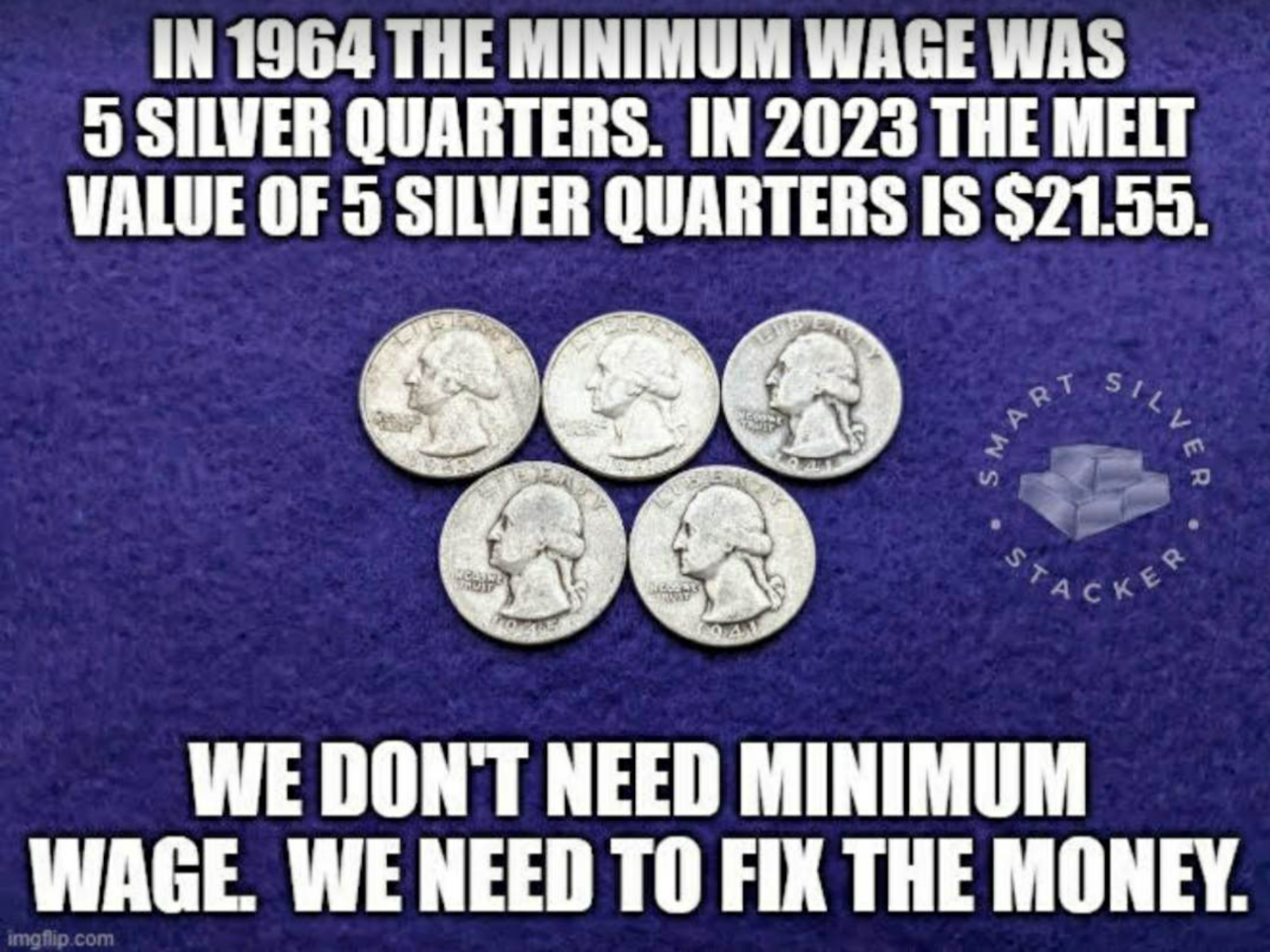
I recently stumbled upon this picture. 

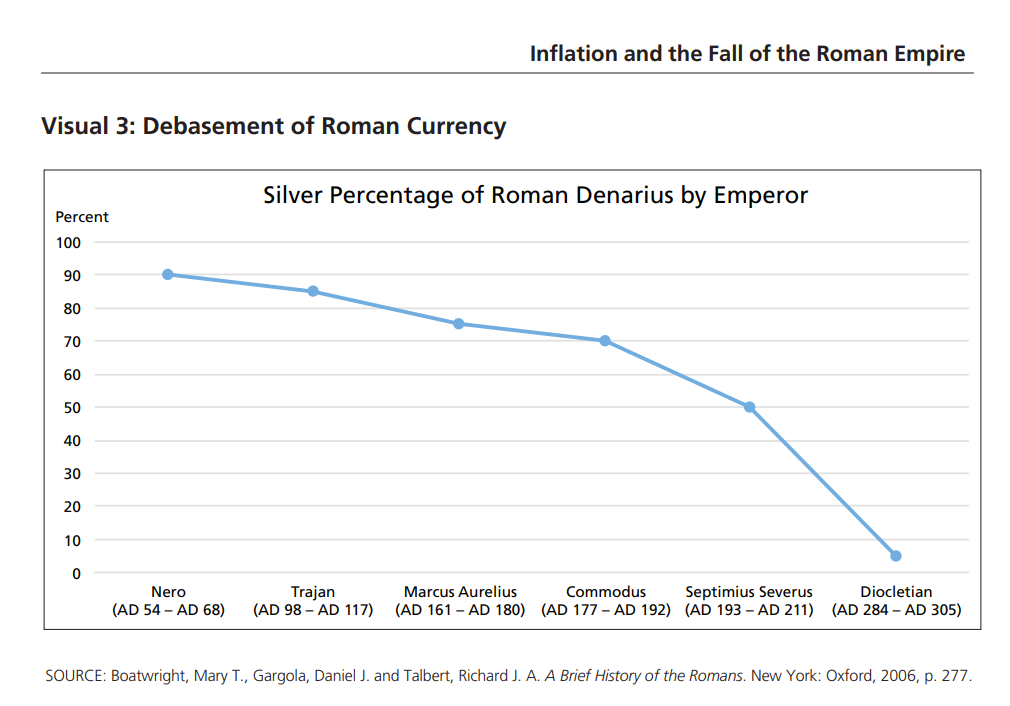
Through 1964 American quarters and dimes were made of 90% silver. Starting in 1965 the inner core is pure copper and the outer covering is copper mixed with nickel. I was discussing this with some friends so I decided to look up some history I recalled about Rome’s debasement of their currency. The first link I found was the below comment and this link to a FEDERAL RESERVE BANK OF ST. LOUIS work book for kids grade 8-12.  

“Commodus (AD 177–AD 192) debased the Roman denarius to about 70 percent silver. Septimius Severus (AD 193–AD 211) debased the Roman denarius to about 50 percent silver. With the added currency, the government could pay for more soldiers and pay existing soldiers more.”

What is incredible is that the Romans “slowly” debased their currency by recalling the money, melting it down and reissuing with a lower percentage of silver. The US government did it quickly by going from 90% to 0% in 1 year! Subsequent dollars were created by adding numbers in the Fed ledger with nothing backing the new money!

Fort Knox holds about 4,580 metric tons of gold which is worth about $250 billion dollars. The US government budget was $6.27 trillion in 2022.

The Government budget deficit in 2022 was $1.38 trillion in 2022.

“A Cantillon effect is a change in relative prices resulting from a change in money supply.” –SWFI

Be Close to the President and Congress

Cantillon also had a theory in which the beneficiaries of the state creating the currency is based on the institutional setup of that state. This essentially means, “he who was close to the king and the wealthy”, likely benefited from the distributional choices of currency through the system. –SWFI

Realizing that the government is constantly creating new money and decreasing the purchasing power of the money you hold in your bank account, what is the average person to do?

See my other posts for a potential answer.

Maintain Purchasing Power

Bitcoin Intrinsic Value

Maintain Purchasing Power

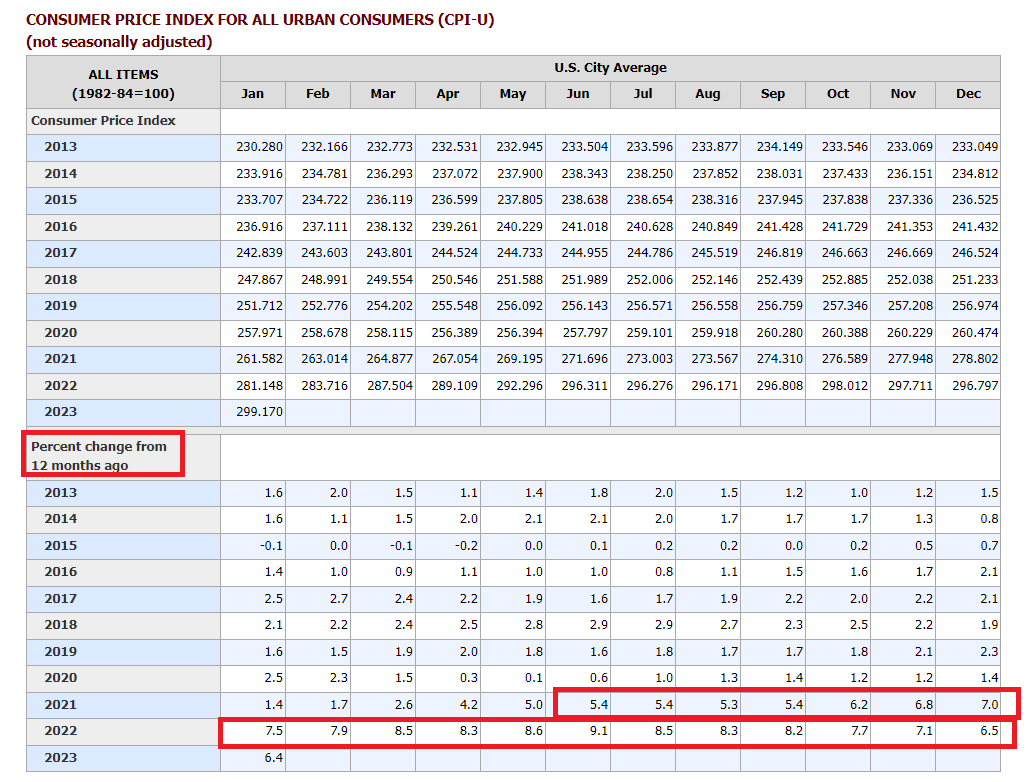
I’ve had more conversations in 2022 and 2023 about “maintaining purchasing power” or “keeping my money from losing value” than ever before in my life, from people who’ve never asked questions like that before. I have to assume it’s because inflation has been between 5%-9% for the past 18 months in the USA, much much higher than the 0%-2% we’ve seen for the previous 10 years and longer. 

The answers people are coming up with are the typical ones. I-bonds, which pay interest linked to inflation. A problem with them is you can only put $10,000/year per person into I-bonds. 

The next likely targets are either treasury bills or high yield savings accounts. As of today a 180 day treasury bill is paying 4.5%. My personal high yield savings account is paying 4.1%. It’s not worth the extra hassle of buying treasury bills for me personally to get an extra 0.4% yield, but for some people it is. The problem is, with a 6.4% inflation rate over the last 6 months, you are still losing 2% of your purchasing power to inflation, which admittedly is the historic amount people have decided they are “OK” with losing, since the FED inflation target is 2%.

Many people buy real estate and get income from renters each month. Obviously not everyone wants to buy real estate or be a landlord. I have tried it. I am in the process of getting out of it. It wasn’t for me either! 

Many people buy stocks as the classic inflation hedge. As we saw last year, stocks can also go down 20% or more in a year. But over long time frames they seem to be the best we have. 

Gold is one of the best inflation hedges, over time. I have actually personally considered gold (and to a lesser extent silver) an interesting inflation hedge lately. Like all investing and savings, you need to evaluate the risks and rewards and determine what the right percentage is for each investment relative to your net worth and goals. For me 1% of net worth in gold and silver seems like a safe investment. I wouldn’t say anyone should be 50% or 100% into gold! 

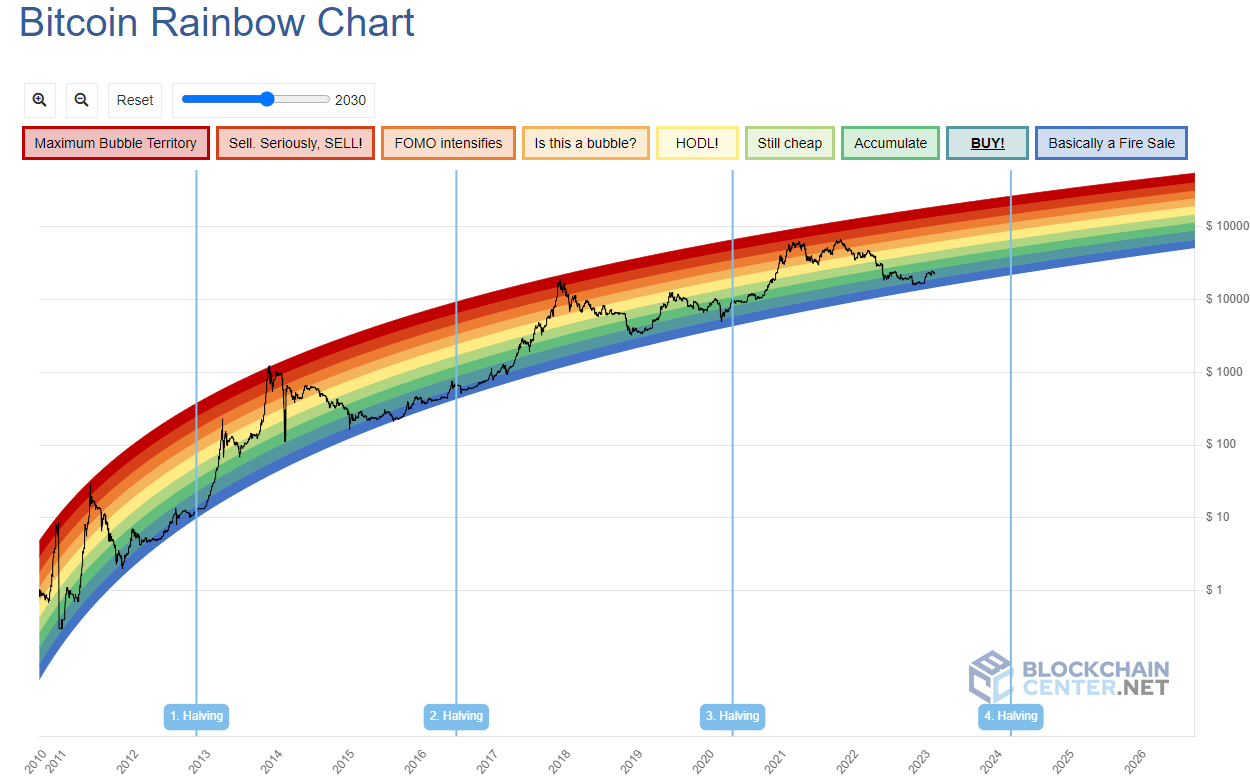
While a lot of these are ways to try to fight inflation there is another new way that might also work. Bitcoin. To me, it seems like a good inflation hedge, in the long term. I can see why many people are hesitant to get into it though. From a high of $69,000 in 2021 it fell all the way down to $15,000 earlier in 2023. It is back up to the low $23,000’s. But for people who just compare to the peak of $69,000 that’s still a long way down. But what people need to remember is, for most any investment, you don’t put every bit of your money in at the peak, usually! I bought some bitcoin for as low as $5,000 in 2018. I bought through the peak and the highest I paid for some bitcoin was $65,000, almost the peak! But that was only maybe $100 worth. I continued buying as it fell all through 2022 and even into the start of 2023. From June-Dec 2022 I bought for less than $20,000 per BTC. So now all that bitcoin is sitting in a profit. While my overall cost basis is about $28,000 and the value is sitting at $23,000, so I am down about 21%. But that is a lot less than the 66% you’d be down if you had bought every coin at the peak of 66%. I think that’s an important lesson for people to learn is that while there are volatile assets, if the asset makes sense, you should still consider allocating a percentage of your net worth towards it. I personally think people should consider 1% of Bitcoin a safe allocation. If you have $50,000 worth of assets that’s only $500. If you lose $500 will you be ruined? Probably not. As with every investment, you should only buy what you plan to keep for 10 years. You also shouldn’t sell when it goes down 50%. In fact you should expect it to go down 50%, whether it’s Bitcoin or stocks.Overall we need to better understand volatility. I believe as more people continue to add their wealth to Bitcoin, $10 at a time, its volatility will reduce and its value will continue to go up. This has already happened over many cycles. As you can see in the bitcoin rainbow chart below. It’s a simple chart tracking the highs and lows of bitcoin. 

The Bitcoin Rainbow Chart

The best time to get into something is when fewer people are talking about it. A lot of people bought into bitcoin at the peak in 2021 when it was $69,000. That is the exact wrong time to learn about it and buy in because of fear! The best time to buy bitcoin, or anything, is when you have time to buy it and the price isn’t rising dramatically everyday and you get huge FOMO!

In 2017 I bought $100 worth of Bitcoin “just to learn about it”. It took me years to finally get around to learning more about it, as well as the price drastically rising to $40k, to pique my interest. I want to help others learn about it in a calmer state. Learning when it’s at a lower price also gives people a lower cost basis so there is a lot more room to go up! As more people pile into Bitcoin, and adoption is continuing, it will rise. Don’t buy in when the price rises from $40k to $60k in a month. You are already missing out at that point. If you do buy then, don’t be surprised when it falls back to $40k and you are out 50%. You’ve learned the wrong lesson. Start learning now while the price is low. Ask me anything! Start small and slow $50! $10! Good luck!

Bitcoin Blocks and Fees

Bitcoin at it’s simplest is a ledger keeping track of transactions. On average every 10 minutes a new “block” of transactions is validated. Using this link you can watch as transactions are added to the next block. I think it’s truly mesmerizing. I think it needs to be made into an easy to watch app or screen saver (hint to someone). It is essentially watching each bitcoin block be organized. Transactions are added to the block and finally confirmed.

There is a lot of interesting data in each bitcoin block. 

Bitcoin miners validate a new block on average ever 10 minutes. Each block confirms the transactions that have happened in that time. Money sent from person X to person Y. 

You can also learn how much is paid in block rewards (currently 6.25 BTC every block) and in block fees. 

It does cost money to send your bitcoin from your wallet to someone else. You might think that’s bad since you can send money via your bank account to people now and “not pay a fee”.

But that is where you are wrong. Banks have tons of fees, from monthly fees to the “fee” of paying you 0% interest. 

Every time you swipe a credit card you are paying approximately a 3% fee. The price is just baked into the price of whatever you are buying as sellers assume you will be using a credit card at this point. 

Here’s all the data from a specific completed block. 

Block 767418

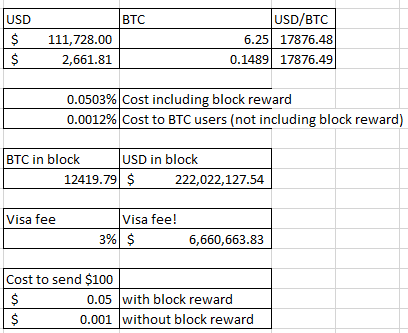
A total of 12,419.79 BTC ($222,022,574) were sent in the block with the average transaction being 4.4515 BTC ($79,577.28). ViaBTC (the miner who solved the block) earned a total reward of 6.25 BTC $111,728. The reward consisted of a base reward of 6.25 BTC $111,728 with an additional 0.1489 BTC ($2,661.81) reward paid as fees of the 2,790 transactions which were included in the block.

6.3989/12,419.79 = 0.000515 *100 = 0.05% of the value of the money sent was used to pay fees. 

As you can see the total of 12419.79 BTC were sent during that 10 minutes worth $222 million dollars. Users were charged 0.1489 BTC which comes out to a 0.0012%! That is insanely low.

If you were paying that percentage to send $100 it would be $0.001 dollars. 1/10 of 1 penny!

If you compare this to a credit card transaction at 3% that would cost you $3 vs $0.001 for a transaction. Imagine if everything we did got 3% cheaper overnight? Why haven’t more sellers adopted BTC?