Who Gets the Income? Who Pays the Taxes?

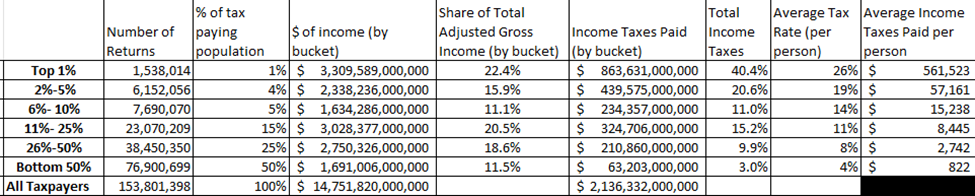
Data gathered from this link – https://taxfoundation.org/data/all/federal/latest-federal-income-tax-data-2025/

When we talk about taxes in America, the debate often gets sloppy. People use “income” and “wealth” almost interchangeably, but they’re very different things.

  • Income is the flow of money earned each year — wages from a job, dividends, or realized capital gains.
  • Wealth is the stock of assets someone already owns — businesses, real estate, stocks, Bitcoin, etc.

Our tax system is built mainly on income, not wealth. And when commentators conflate the two, it clouds the conversation about fairness and policy.


Income Snapshot

In 2022, the U.S. collected $2.1 trillion in federal income taxes on about $14.8 trillion in total income. That’s about 14.4% of taxable income.

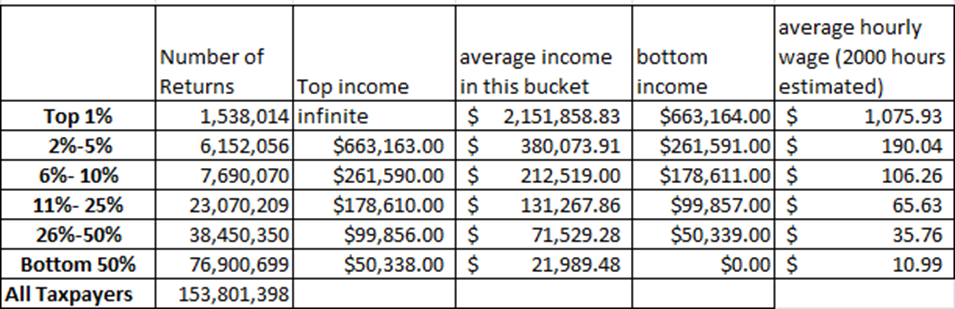
Divide that income across all 153 million taxpayers, and the average income comes out to $95,915, or about $47.96 per hour assuming 2,000 hours of work per year. Of course, averages can mislead — the distribution is anything but equal.


The Top 1%

To qualify for the top 1% in 2022, you needed at least $663,164 of income. On average, these 1.5 million taxpayers earned $2.1 million each.

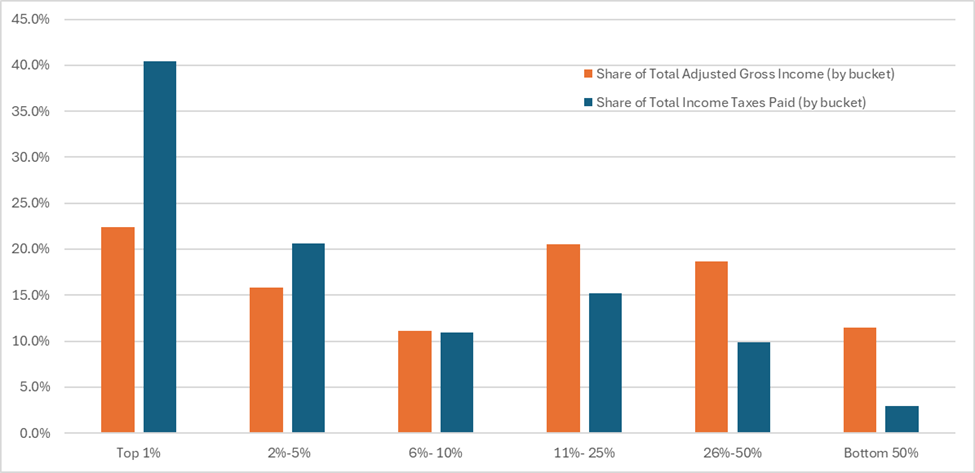
  • Share of income: 22.4%
  • Share of taxes paid: 40.4%
  • Effective tax rate: 26%

The Bottom 50%

The bottom half — about 76 million taxpayers — earned less than $50,339 per year. Their average income was just $21,000, totaling $1.7 trillion across the group.

  • Effective tax rate: ~4%
  • Many pay no federal income tax at all, often due to credits like the Earned Income Tax Credit (EITC) or child tax credits.

Wealth Snapshot

If we shift from income to wealth, the picture looks even starker. As of mid-2025, U.S. billionaires hold over $6.2 trillion in wealth, spread across only about 813–867 individuals.

But here’s the catch: the U.S. government is adding about $2 trillion in deficit spending every year. Even if you taxed billionaires at extremely high rates, it might cover only a year or two of deficits. After that, the wealth pool would shrink — and most billionaires would likely relocate to avoid such aggressive taxation.

That doesn’t mean we shouldn’t debate fairness, redistribution, or even wealth taxes. But it does mean we need to be realistic about the math.


Why This Matters

The key takeaway is that income and wealth are different conversations. Most tax debates focus on income flows, yet the loudest arguments are often about wealth concentration. If we mix those together, we miss the real tradeoffs.

I’m happy to debate how much each group should earn, or whether a wealth tax makes sense (though I personally think it doesn’t). But if we want an honest conversation, we have to separate what we’re actually measuring.

Because when we ask, “Who should pay more?” the first step is being clear: are we talking about annual income, or about the stock of wealth built up over decades?

Data – https://taxfoundation.org/data/all/federal/latest-federal-income-tax-data-2025/

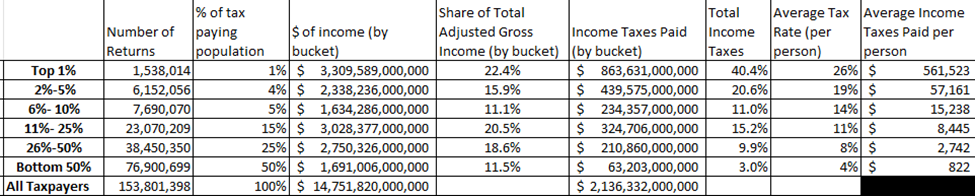
You will notice myd ata is slightly different than from the website. The website continually aggregates so their “top 5%” data includes all the income & people from the top 1% + the 2%-5%.
I have broken it down so you can see how much income is in each bucket. I think my method is much more useful.
It also allows you to see how much income, taxes, average income, is in each bucket.

When the data is aggregated it always is skewed due to the higher amount of income above it.

From Complaints to Cures: What YouTube Gets Right (and Wrong) About America’s Decline

Over the past few weeks I’ve been listening to a wide range of YouTube voices — from The Functional Melancholic and Large Man Abroad to Jacob Whelan, Things Your Mom Should’ve Told You, Offended Outcast, and others. Their videos share one consistent theme: frustration. Frustration with wages that don’t cover rent, with groceries that cost double what they used to, with insurance that feels like a scam, and with a political system that seems captured by the wealthy.

Complainers –

The Functional Melancholic

Large Man Abroad

Jacob Whelan

Things Your Mom Should’ve Told You

Offended Outcast

The Enemy From Within

Raymond – Thoughts and MindAmericans are broke!
Satirical commentary on consumer debt and auto loan delinquencies. Half-jokingly suggests profiting from the repo wave. Dark humor, but still fundamentally a complaint.

On some level, they’re right. The complaints are grounded in reality — life really has gotten harder for working- and middle-class Americans. Watching and listening, I recognize the truth in their stories. But here’s the problem: naming the pain isn’t the same as finding a cure. The complainers stop at diagnosis.

That’s why I’ve also been digging into a different set of channels — Retire Early 500k, Timothy Ward, and Charles on F.I.R.E. These creators focus less on outrage and more on action. They show practical ways to save, invest, and build freedom within the system. Their message is: yes, the game is rigged — but here’s how to play it smarter.

Solution providers!

Retire Early 500k

Timothy Ward

Charles – on F.I.R.E.

At the same time, I don’t want to ignore another option that came up from the complainer side: leaving. The channel Things Your Mom Should’ve Told You pointed to moving abroad as an escape hatch. And honestly, that’s a real solution too. If your country makes it impossible to thrive, finding a place where you can is a perfectly valid strategy. In fact, it may be the most rational one for some people.

Put together, these voices show two sides of the same coin. One side shouts about the brokenness of the system; the other quietly builds alternatives, whether at home through saving and investing, or abroad by starting over. Both matter. The truth of the complaints highlights the need, and the courage of the solutions points the way forward.

Wealth Inequality: The Quiet Apocalypse… and What Comes After

I recently watched a powerful video titled Wealth Inequality: The Quiet Apocalypse.” It’s honest, emotional, and brutally accurate in describing what it feels like to live in a system that seems to squeeze you harder every year. I found myself nodding along for much of it—but also wanting to widen the lens a little.

Before offering my response, here are five key points I took from the video:

Five Core Points from “Wealth Inequality: The Quiet Apocalypse”

  1. The system isn’t broken—it’s working as designed. It extracts time and value from most people and consolidates wealth at the top.
  2. Capital outpaces labor. Referencing Piketty: when the rate of return on capital exceeds growth, wealth concentrates.
  3. The American Dream is largely a delusion. Doing everything right doesn’t mean you’ll get ahead.
  4. Wealth inequality creates spiritual and psychological harm. It hollows out people’s sense of identity and worth.
  5. What we need is a cultural shift—not just policy. Minimalism, rest, and meaning are antidotes to hustle culture and economic extraction.

Here’s my reply, point by point.


1. The system isn’t broken—it’s working as designed

Yes, the system is designed to reward capital—not labor. But that doesn’t mean we need to burn the whole thing down. In fact, we should want capital to outperform labor—because that means more productivity with less effort.

The real problem? Capital is too concentrated.

What if we built systems that allowed more people to own capital? That would mean more people benefiting from productivity gains, without needing to grind themselves into dust. In the U.S., this is more accessible than we sometimes realize. Low-cost investing tools, like Fidelity or Vanguard, allow everyday people to start building wealth—even with modest means.

I wrote about how just $2,000/year for 10 years can grow to over $365,000 by retirement:
👉 The Power of Investing Early

The system does work—as designed. We just need to make sure more people have a stake in it.


2. Capital outpaces labor

Piketty’s point is mathematically true: capital grows faster than wages, and that concentrates wealth. But instead of treating that as a death sentence, let’s treat it like a map.

If labor will always lose, then we need to stop relying on labor alone. We need to become capital owners.

That’s the core of Post-Labor Economics: a future where AI and automation do the work, and human beings benefit from ownership rather than employment. That’s only dystopian if ownership remains exclusive.

I broke this down further here:
👉 Post-Labor Economics – David Shapiro Video Summary

The real answer isn’t to slow capital—it’s to distribute capital.


3. The American Dream is a delusion

We agree: doing everything “right” no longer guarantees success. Degrees, hard work, and even smart money habits don’t always lead to stability.

But here’s the truth: that level of frustration is itself a luxury in global terms. If you’re in the U.S., have internet, clean water, and access to banking—you are already in the global top 10%, maybe even the top 1%.

I say this not to invalidate anyone’s struggle—but to widen the perspective. There are billions of people who would love to have the problems you have. That realization isn’t meant to inspire guilt—it’s meant to highlight opportunity.

You don’t have to “win” the American Dream to live a meaningful life. But if you understand your relative position in the world, you can use it to lift others up while building your own path.


4. Wealth inequality creates spiritual and psychological harm

Yes. When everything becomes transactional, identity collapses into productivity and income. And when we don’t measure up, we blame ourselves.

But here’s the twist: even while critiquing this system, you might still be letting it define you.

There are other ways of living. You don’t need to win the game. You can just stop playing—and focus instead on living intentionally, giving what you can, and creating meaning through service or simplicity.

Some books that shaped my thinking:

Even if just 5% of your life is dedicated to helping others, that’s enough. That’s opting out of the culture in a way that matters.


5. We need a cultural shift—not just policy

Yes. A shift away from hustle culture, productivity obsession, and materialism is overdue. Minimalism, rest, and meaning are powerful forms of resistance.

But there’s another layer: you don’t just have to escape the culture—you can help reshape it.

That might mean:

  • Raising your kids with different values
  • Giving consistently, even in small amounts
  • Choosing a simple life so others can simply live

You don’t need to be an influencer or a billionaire to change the culture. You just need to stop waiting for permission—and start living by a better scorecard.

Opting out is good. But opting into something better is even stronger.


Final Thoughts

Wealth Inequality: The Quiet Apocalypse is a powerful wake-up call. But let’s not stop at diagnosis. Let’s ask: what comes next?

You don’t need to be rich to make a difference. You don’t need to have all the answers to start living a better one. And even in a rigged game, you can still choose your own values.

In a collapsing world, the most radical thing you can do is refuse to collapse with it.

And if you’re someone with a platform—as the video’s creator clearly is, with 80,000+ subscribers—then that gives you not just a voice, but a real opportunity. You can lead. You can educate. You can help people see a way forward.

Not everyone has that kind of reach. So if you do, I hope you use it.


If you want to learn more about effective giving, post-labor economics, or investing with purpose, browse around MyWheelLife.com.

🧊 From Fridges to Bots: What the Adoption Curve of Refrigerators Tells Us About the Future of Household Robots

“Any sufficiently advanced technology is indistinguishable from a luxury—until it’s not.”

In the early 1920s, if you wanted a refrigerator, you were part of the elite. The first electric fridges—bulky, loud, and experimental—cost the equivalent of $7,000 to $15,000 in today’s dollars. They were marvels of innovation but inaccessible to all but the wealthiest households.

Fast forward to today: 99.8% of U.S. households own a refrigerator. They’re so commonplace that we hardly think about them—until they break.

Now imagine we’re at the beginning of the same curve, not for food storage, but for household robots.


📈 Historical Tech Adoption: The Refrigerator Curve

Take a moment to explore this interactive chart from Our World in Data. It tracks the adoption of various home technologies—from refrigerators to microwaves to dishwashers—across the 20th century.

Here’s what the refrigerator’s rise looked like:

  • 1920s–30s: Early adopters only; ~10% of households
  • 1940s: Over 50% adoption, thanks to Freon technology and mass production
  • 1950s: Ownership skyrockets past 80% after WWII
  • By 1960: Nearly universal in U.S. homes

In roughly 30–40 years, refrigerators went from a rich man’s curiosity to a household necessity. Price dropped. Reliability improved. Social expectations shifted.


🤖 Robot Labor Is on the Same Curve

Elon Musk has claimed that every household will eventually have a humanoid robot—a general-purpose machine that can walk, see, understand commands, and perform physical labor. His company Tesla is building “Optimus,” a robot intended to work in factories first, then homes.

This might sound futuristic. But so did refrigerators once.

Currently:

  • A robot costs $20,000–$100,000
  • Only companies or the ultra-wealthy can afford one
  • Reliability is limited, and functionality is narrow

But if history is a guide, we might see a similar trajectory:

YearPhaseApproximate Robot Cost
2025Early adopters only$20k–$100k
2035Middle-class adoption begins$5k–$15k
2045Widespread, household norm<$3k

Just as refrigerators eliminated the need for daily ice deliveries and manual food preservation, robots could eventually eliminate repetitive home labor—cleaning, organizing, even assisting the elderly.


🌍 The Inequality Question

Of course, global access will vary. In the U.S., even $1,000 robot labor might feel cheap. But in parts of India or sub-Saharan Africa, it could be out of reach for decades without intervention—just as electricity and refrigerators took far longer to reach the developing world.

This raises critical questions for post-labor economics:

  • Will robots become tools of empowerment—or deepen the divide?
  • Who will own the robots—individuals, corporations, or governments?
  • Should we envision public “robot libraries” like we once had rural electrification programs?

🔁 The Past is Prologue

When we think about technological change, it’s tempting to view each new device as unprecedented. But the story of household refrigerators shows a clear pattern: steep initial cost, followed by mass adoption and ubiquity.

Robots may follow the same arc. And if they do, the fridge might just be their closest ancestor—not in function, but in social and economic impact.


Explore the data here:
📊 Our World in Data – Technology Adoption Chart

America’s Crumbling House: Left, Right, and the Missing Foundation

America feels broken. Everyone knows it—whether you’re arguing with your uncle over turkey at Thanksgiving or doomscrolling through social media. But what’s fascinating (and disturbing) is that people across the political spectrum are noticing the same fractures: collapsing birth rates, unaffordable housing, dead-end jobs, institutional rot, and youth malaise.

I recently listened to three different voices, each from a different ideological “neighborhood”:

  • A far-right cultural critic, furious about the destruction of the family unit and what he sees as elite-led population control.
  • A center-left economist, frustrated by how every group benefits from a rigged economy while pretending someone else is to blame.
  • A far-left progressive, warning that America has become a pariah nation, economically and morally isolated, lurching toward authoritarianism.

They couldn’t be more different in tone or political tribe. One quotes Blink-182 and rails against birth control. Another explains tiger parenting with nuance and lived experience. The last one drops historical comparisons to Nazi Germany while pointing at collapsing tourism and empty shelves. And yet, they’re all describing the same crumbling house.

💥 The House Is Falling Apart

The symptoms they describe are unmistakable:

  • Broken families and a collapsing birth rate
  • Wages stagnating while cost of living skyrockets
  • Distrust in institutions from schools to elections
  • Youth alienation in relationships, work, and meaning
  • Global disillusionment with American leadership
  • Cultural fragmentation and a sense of existential decline

Some blame immigration. Others blame billionaires, churches, or elite schools. But whatever the cause, all three perspectives agree: America is not correcting itself. The systems that once promised prosperity and stability no longer deliver.

🧱 We’re Trying to Fix the Walls

You can think of the U.S. like a house. We see cracks in the drywall—so we patch them. But then another crack shows up. We reinforce a beam. Then a window shatters. We debate whether the left side or the right side is more broken.

What none of us are doing—at least not seriously enough—is inspecting the foundation.

That foundation is our money system.

🪙 The Money Is the Root of It

Our economic system runs on a fiat currency that:

  • Encourages endless debt and consumption
  • Funnels wealth upward through asset inflation
  • Devalues labor by design
  • Rewards speculation over contribution
  • Incentivizes short-term thinking in both business and government

All of these things show up in the critiques from the left, right, and center. But they often miss the fact that these aren’t isolated symptoms. They stem from a rotted monetary foundation that no longer serves the people who live in the house.

🧱 Bitcoin: Fix the Foundation First

Bitcoin is not a magic solution to all social and economic ills. But it is a foundation repair tool. It offers:

  • Hard money that can’t be printed into oblivion
  • Decentralization that resists capture by any single party, institution, or ideology
  • Incentives for long-term thinking—saving, building, and responsibility
  • A chance for global cooperation without relying on coercive power

Fixing money doesn’t solve everything. But without fixing the foundation, trying to repair the walls is a waste of time.

🔁 Common Pain, Fragmented Response

The tragedy of our current moment is that everyone feels the pain, but we’re tearing each other apart over the symptoms instead of joining forces to solve the root cause.

  • The far-right influencer sees collapsing families and thinks: “Return to tradition.”
  • The centrist economist sees rigged systems and thinks: “Reform the meritocracy.”
  • The far-left voice sees global collapse and thinks: “Dismantle the empire.”

All have valid critiques. All are trying to fix walls in a house with a rotting foundation.

Bitcoin isn’t left or right. It’s not even center. It’s underneath all of it. A chance to rebuild the ground we all stand on—before the entire structure falls.

How Long Can You Ignore Bitcoin?

Bitcoin doesn’t need you. But maybe—just maybe—you need Bitcoin.

Every cycle, new people show up thinking they’ve discovered something revolutionary—whether it’s questioning Bitcoin’s energy use, proposing faster payment layers, or trying to “fix” volatility. But every idea you’ve had about Bitcoin… has already been debated, attacked, memed, improved, or discarded years ago. The Bitcoin rabbit hole is deep, and it’s been dug for over 15 years by some of the most paranoid, visionary, and relentless minds on the planet.

Bitcoin isn’t some niche internet plaything anymore. It’s now held on balance sheets, integrated into national energy grids, and embedded in the financial strategies of countries and corporations alike. And yet, most people still ignore it—until they can’t.

How long can you ignore a monetary network that’s eating inflation, resisting censorship, and refusing to die?

Bitcoin doesn’t wait. It doesn’t care if you “believe” in it. It just keeps producing blocks every 10 minutes, no matter what. The longer you delay engaging with it, the more ground you lose—not just financially, but intellectually. Because by the time you show up with your “fresh” take, there’s already a thousand-page thread archived on Bitcointalk dismantling it.

Bitcoin doesn’t need you. But maybe—just maybe—you need Bitcoin.


🧠 Common Questions (Yes, They’ve Already Been Answered)

Before you leave a comment or dismiss Bitcoin entirely, check below—your question has probably been asked, answered, and refined for years. But if it hasn’t, ask! The Bitcoin rabbit hole only gets deeper when you engage.

🔒 1. What about quantum computing?

Won’t it break Bitcoin?


⚡ 2. Why is Bitcoin so slow and expensive?

Visa is faster. Why would I use this?


🌱 3. Isn’t Bitcoin bad for the environment?

It uses more energy than countries!


📉 4. Isn’t Bitcoin too volatile to be money?

I can’t buy groceries with it!


🪙 5. Can’t someone just make a better Bitcoin?

Isn’t tech supposed to improve over time?


🧠 6. Isn’t this all just speculative gambling?

Feels like tulips and meme coins.


💬 Got More Questions?

Drop them in the comments or send me a message—I’m always open to honest discussion. But I strongly encourage you to do a little digging first. Chances are, someone’s already asked your exact question… and the answer is better than you’d expect.

Start here. Stay curious. See where it leads. 🟠

Bitcoin Is Not an Investment — It’s a Revolution (Synthesis of Jack Mallers’ Talk at Bitcoin Prague 2025)

🎯 Final Word: Choose Ethical Money

Bitcoin is not just about beating inflation or outperforming Wall Street.
It’s about dignity. It’s about sovereignty.
It’s about creating a world where value can’t be stolen.

So the next time someone asks what Bitcoin is, tell them this:

It’s not an investment. It’s a revolution.

Why the youth are turning to math instead of politicians to fix what was broken before they were born.

“If we could just print money, why is there poverty, war, and hunger?”
— Jack Mallers


👋 Jack Mallers Is Saying What I’ve Been Trying to Say

Every once in a while, someone steps up and articulates your beliefs more clearly, more passionately, and more publicly than you could yourself.

That’s what Jack Mallers did in his recent keynote.
He didn’t just explain Bitcoin — he captured the emotional, moral, and generational reasons I’ve written about on my blog:

We aren’t just investing in Bitcoin.
We’re opting out of a broken system.
We’re building something better.

If you’ve read my post “Why I Support Bitcoin: A Personal Journey Through the Global Failure of Fiat”, you know I believe the fiat money system is robbing our generation of hope, stability, and purpose. Mallers echoes that — and then takes it even further.

This summary breaks down his talk. It’s one of the clearest cases I’ve seen for Bitcoin as a moral revolution, not a financial asset.


🧠 Mallers’ Core Thesis: Bitcoin Is a Moral Revolution

Not a speculative asset. Not a tech fad. Not a hedge fund toy.

🧨 Bitcoin is an ethical, generational response to a broken fiat system that’s hollowed out society.


🚨 A Generation in Crisis

Millennials and Gen Z were told to go to college — and walked away with six-figure debt.
We were told the economy is booming — while we’re priced out of homes.
We were told to “just work hard” — while real wages stagnate and healthcare bankrupts families.

The data speaks volumes:

  • Youth suicide and overdose deaths are rising.
  • Obesity, divorce, and depression all spike post-1971 — the year the U.S. left the gold standard.
  • Young adults living with parents now exceeds levels from the Great Depression.

This is not normal. And deep down, we all know it.


🏦 The System Was Designed to Exploit

Jack Mallers walks us through the rot:

  • Bretton Woods (1944): U.S. dollar is pegged to gold.
  • Nixon Shock (1971): That peg is severed. Money becomes paper.
  • Petrodollar (1974): The dollar’s global dominance is enforced by oil deals and military might.

The U.S. prints money. The world ships us real goods.
We don’t produce — we consume.
We don’t export labor — we export inflation, instability, and war.

“Fiat currency is a moral violation,” Mallers says. “It’s time travel. You’re spending your kids’ future without their consent.”


⚖️ The Triffin Dilemma: Why the Middle Class Had to Die

Economist Robert Triffin warned that a nation with the global reserve currency must choose between:

  • Domestic stability
  • Global demand

America chose global demand.

The result?
We shipped jobs overseas.
We poisoned our food.
We hollowed out our towns and our families.
We replaced meaningful work with dependency — then blamed the poor for being poor.

And it was on purpose.

“They knew,” Mallers reminds us. “This wasn’t an accident. It was the cost of empire.”


⚰️ 50 Years of Consequences

Mallers lays it out plainly: when you debase money, you debase everything else.

  • 📉 Wages stagnated while assets inflated.
  • 🍔 Diets worsened as processed food replaced real nutrition.
  • 💊 Mental health and family formation collapsed.
  • 🧱 Hard work stopped paying off.

“All of this started in 1971,” he says again and again. “That’s weird, isn’t it?”


🔐 Bitcoin: A Peaceful Revolution Built on Math

Against this backdrop, Bitcoin isn’t just a shiny asset — it’s a moral tool.

It’s a response to a system built on theft, control, and decay.

Bitcoin’s moral code:

  • You shall not inflate.
  • You shall not confiscate.
  • You shall not censor.
  • You shall not counterfeit.

Unlike fiat, Bitcoin is enforced by math, not military.
Private keys are stronger than guns.
You can steal a house. You can loot a bank.
But you can’t steal 256-bit encryption locked in someone’s mind.

“Bitcoiners are Bitcoin,” Mallers says. “Before it’s a network, it’s a movement. Before it’s code, it’s ethics.”


💡 The Future Isn’t Given — It’s Built

We didn’t ask for this system.
We didn’t choose to be born into debt and decay.
But we get to choose what comes next.

Bitcoin is the latest chapter in the story of human innovation.
Like fire, the printing press, the computer — it’s a tool to reclaim our agency.
It lets us opt out of a system that exploits us and build one based on fairness and freedom.

“After you wipe your last tear,” Mallers asks, “what do you want to do?”


🎯 Final Word: Choose Ethical Money

Bitcoin is not just about beating inflation or outperforming Wall Street.
It’s about dignity. It’s about sovereignty.
It’s about creating a world where value can’t be stolen.

So the next time someone asks what Bitcoin is, tell them this:

It’s not an investment. It’s a revolution.

Join the Revolution!

Analysis of – Geo-Strategy #3: How Empire is Destroying America

You Were So Close: Where the Anti-Empire Analysis Misses Bitcoin’s Role as the Fix

A year old video titled Geo-Strategy #3: How Empire is Destroying America delivers a sharp, compelling critique of the United States’ transformation from a productive manufacturing economy into a hollowed-out empire addicted to easy money, foreign capital, and speculative finance. The lecturer nails several things before they happened:

  • Trump won
  • The U.S. dropped bombs on Iran (June 21, 2025).
  • Empire—not capitalism alone—is the real structural disease.

So far, so good.

But here’s where it falls short: when it comes to solutions, the analysis stops at nostalgia. It groups Bitcoin in with the broader financialized, speculative mindset of the current era—instead of recognizing it as the clearest path out of the collapsing fiat-imperial system.


What the Video Gets Right

1. The Shift to Financialization Was a Disaster
The U.S. economy went from 40% of profits coming from manufacturing to only 10%. Meanwhile, financial services ballooned to 40% of profits but employ only 5% of the workforce. It’s not a real economy anymore—it’s rent-seeking on a grand scale.

2. Empire Crowds Out Domestic Prosperity
As the video rightly says: the U.S. has 800+ overseas bases, trillions in defense spending, and a growing dependency on foreign goods. Meanwhile, infrastructure decays, wages stagnate, and people struggle to own homes.

3. Easy Money Has Warped the Psyche
He astutely observes that young people have a speculative mindset. They want to gamble their way to freedom because working hard for 40 years no longer gets you a house or family. The fiat system broke the ladder.

4. Empires Collapse from Hubris
Rome did it. So did Britain. The U.S. has reached a point where it can’t imagine losing, but is too bloated and fragile to truly win.


What the Video Misses Entirely

Bitcoin isn’t a symptom of decline. It’s the cure.

Here’s where the logic fails: Bitcoin gets lumped in with real estate speculation, meme stocks, and Wall Street grifting. That’s a category error.

Bitcoin is:

  • Not tied to Wall Street.
  • Not controlled by central banks.
  • Not created through debt.

It is, in fact, everything the empire cannot print, inflate, or manipulate.

If fiat money is what powers the empire’s global dominance and fiscal addiction, then Bitcoin is the tool that cuts the cord. It’s what lets young people store value, opt out of inflation, and build sovereign systems outside elite capture.


The Real Problem: Fiat, Not Just Empire

Let’s go one layer deeper:

  • Empire needs fiat to fund wars, bailouts, and pensions.
  • Fiat needs empire to enforce its global dominance (petrodollar system, SWIFT sanctions, military threats).

It’s a closed loop. And Bitcoin breaks it.

Bitcoin is the only monetary system with no central issuer, no forced trust, no inflationary mandate, and no border. It’s not speculative escapism. It’s the foundation for a post-imperial world.


Final Thought

The lecturer in Geo-Strategy #3 is brave and accurate in his breakdown of how empire is destroying America. But like many critics, he sees the collapse clearly yet misses the exit sign flashing in orange behind him:

Bitcoin isn’t the distraction. It’s the lifeboat.

💵 How Fiat Money Hollowed Out America’s Job Market and How to Fix it


Intro – Why can’t Americans find good jobs anymore?

Because the U.S. dollar’s role as the world’s reserve currency lets us import everything without producing anything.

Fiat money didn’t just change our economy—it hollowed it out.

This article explains how we got here—and why only a return to hard money, like Bitcoin, can bring us back.

There’s a sentence I keep coming back to:

Without fiat, we’d have to export goods to earn gold or foreign currency before we could import.

Quick note: “Fiat” money just means paper money that isn’t backed by anything tangible like gold or silver. Its value comes entirely from government decree (“fiat” is Latin for “let it be done”)—and trust.

That’s it. That’s the whole game.

Donald Trump spent years hammering America’s trade deficit, accusing China of taking advantage of us and blaming past politicians for “bad deals.” But the truth is deeper—and more systemic.

The trade deficit isn’t just a negotiating failure. It’s a structural requirement of the global dollar system.

Since the 1970s, the U.S. has run chronic trade deficits not because we’re dumb—but because we have to. That’s how the world gets its dollars. It’s the price of running the global reserve currency.

Fiat money—and specifically, the U.S. dollar’s role as global reserve—didn’t just change how we buy and sell. It rewired the entire global economy. It made it profitable to consume without producing, and to outsource labor while importing goods with nothing more than printed IOUs.

Let’s break that down.


📜 A Brief History of the Cheat Code

After World War II, the U.S. dollar became the centerpiece of the global financial system through the Bretton Woods Agreement. Other countries pegged their currencies to the dollar, and the dollar was pegged to gold at $35/oz. Global trust was strong—because dollars were redeemable for something real.

But by the late 1960s, the system was already cracking.

The U.S. was printing more dollars than it had gold to back, funding both the Vietnam War and LBJ’s Great Society programs. Foreign nations started to notice. The promise of gold convertibility was still on paper, but the gold simply wasn’t there to cover all the dollars in circulation.

Then came the bluff-calling moment: France sent a warship to New York Harbor in 1971 to collect its gold. The U.S. honored the request—but it was a wake-up call. If one country could demand gold, others would follow—and the U.S. didn’t have enough gold left to fulfill those redemptions.

Rather than continue the outflow—and risk total collapse of the system—President Nixon closed the gold window, ending the dollar’s convertibility to gold and defaulting on the original Bretton Woods promise. He called it “temporary,” but we’re still living with the consequences.

The U.S. had just rugged the global economy—but there was no better option available. All other currencies were fiat too.

And so, by default—not by merit—the dollar remained the foundation of global trade.


🛢️ The Petrodollar Patch

To maintain global demand for the dollar, the U.S. struck a 1974 deal with Saudi Arabia:

  • The Saudis would price oil only in dollars,
  • And the U.S. would provide military protection.

This created the petrodollar system, locking in global demand for dollars—because energy runs the world. Every country that wanted oil had to first acquire dollars.

That meant: even without gold, the dollar was still backed—by oil, debt, and military force.

This gave the U.S. a unique superpower:

  • Print money (or sell Treasuries),
  • Ship it overseas,
  • And receive real goods, labor, and resources in return.

No other nation could do this. And no other empire in history ever got away with it for so long.


🏭 The Fallout: Jobs Go Offshore, But Dollars Still Flow

Because the world kept accepting dollars, American companies could:

  • Shut down U.S. factories,
  • Hire cheaper labor abroad,
  • Import those same goods back to the U.S.,
  • And sell them to consumers who were buying with borrowed or printed money.

The fiat system didn’t make foreign workers cheaper, but it made it possible to use them without consequences.

We stopped needing to earn our imports by making things. We could just finance everything with paper and debt. Capital loved it. Wall Street loved it. Politicians loved it.

But working people? Not so much.

From Janesville to Youngstown, from Flint to the Bronx, the outcome was the same: a slow, grinding hollowing-out of America’s industrial base and middle class.


🏦 Makers and Takers: How Finance Replaced Work

In Makers and Takers, journalist Rana Foroohar lays out how U.S. corporations gradually stopped investing in workers, R&D, and physical capital—and instead prioritized stock buybacks, dividends, and debt-fueled growth.

But here’s the uncomfortable truth:

Many of those companies had to play that game—or risk being eaten alive.

In a fiat system with low interest rates, abundant capital, and massive global competition:

  • Shareholder pressure rewards short-term profit over long-term investment.
  • Stock buybacks boost prices faster than hiring or training workers.
  • Outsourcing and financial engineering became necessary survival tools—not just greed.

This wasn’t just a few bad CEOs. It was a system-wide shift in incentives.
The rise of finance wasn’t a deviation—it was an adaptation.


🤖 You Can’t Skill Your Way Out of This

Today, people are told to just “learn to code” or “work harder.” But what they’re really up against is a global fiat machine that rewards capital over labor, and extraction over production.

That’s why:

  • Degrees don’t guarantee jobs,
  • Effort doesn’t guarantee stability,
  • And “just working harder” feels like treading water.

It’s not that Americans don’t want to work. It’s that the system no longer rewards domestic labor—because it doesn’t need to.


🧱 What Comes Next?

The world is starting to wake up. Countries are buying gold. Some are experimenting with Bitcoin. Others are trying to de-dollarize trade altogether. Trust in the U.S. dollar isn’t infinite—and neither is the empire it props up.

The dollar still works—not because it’s sound, but because there hasn’t been a better option. Yet.

But every empire that runs on paper eventually runs out of trust. And when that happens, the real cost of all those “free” imports comes due.


₿ A Hard Money Future: Why Bitcoin Matters

The only real way to end this game is to remove the cheat code: fiat money itself.

A return to hard money—like Bitcoin—could force the system to reorient around real productivity, long-term investment, and sustainable value creation.

Without the ability to endlessly paper over deficits, businesses would once again have to:

  • Build resilient supply chains
  • Invest in their workers
  • Serve customers over shareholders
  • Plan for decades, not quarters

Bitcoin doesn’t just offer escape—it offers discipline. It turns off the short-term game and invites long-term thinking back into the economy.


💬 Closing Thought

Fiat gave us the illusion that we could consume without producing.
But in the long run, reality has a way of settling the bill.
Maybe it’s time we stopped running the tab—and started building again.

Why I Support Bitcoin: A Personal Journey Through the Global Failure of Fiat

For most of my life, I’ve worked with businesses and nonprofits trying to make the world better. I’m a mechanical engineer by trade. I like building things that work. But the more I’ve worked across systems, the more I’ve realized something deeply broken sits at the root of almost every failure: fiat money.

A Friend, a Business, and a Broken Economy

A few years ago, a friend of mine was helping advise a small, sustainable clothing business in Sri Lanka. They used natural dyes and traditional techniques to create jobs for locals—especially for people who often couldn’t access the formal economy. It was working. Until it wasn’t.

The Sri Lankan currency collapsed during a financial crisis. Inflation soared. Imports became unaffordable. And the business, despite doing everything right, failed—not because of bad management or a poor product, but because the foundation it was built on—its currency—was rotten.

This is what fiat does. It breaks systems from the bottom up. And it leaves regular people holding the bag.

How Fiat Hollowed Out America

We often think of developing countries suffering from bad money, but the same decay has hit the United States. The post-WWII American economy was built on sound money and a manufacturing base that rewarded long-term planning and production.

That changed in 1971, when Nixon took the U.S. off the gold standard. With no monetary anchor, we entered the era of fiat—the era of cheap credit, endless deficits, and quarterly capitalism. Easy money made it easier to offshore jobs , because capital flowed wherever short-term profits looked best. Domestic manufacturing collapsed (such as in Janesville, Wisconsin). Towns hollowed out. Entire regions like the Midwest were gutted for the sake of Wall Street’s earnings calls.

Short-termism infected everything:

  • Companies spent more on stock buybacks than R&D or wages
  • Governments ran up debt with no repayment plan
  • Individuals chased consumption over savings, just to stay ahead of inflation

Economic Hitmen and Empires of Debt

In Confessions of an Economic Hitman, John Perkins explains how U.S. institutions loaned billions to developing nations for infrastructure that looked good on paper but benefited U.S. contractors more than locals. When those countries couldn’t repay, they were forced into austerity, resource sell-offs, and geopolitical obedience. Debt became a weapon.

Today, China is doing the same through its Belt and Road Initiative. In Sri Lanka, China took control of the Hambantota Port on a 99-year lease when the country couldn’t pay its debts. In Greece, China’s COSCO controls the Port of Piraeus. In Australia, they secured a 99-year lease on the Port of Darwin, now under review due to national security concerns.

This isn’t charity. It’s colonialism with spreadsheets.

Fiat Money Rewards the Few, Punishes the Many

Every time a central bank prints new money, it steals from savers and wage earners. Those who hold fiat see their purchasing power decay. This is especially cruel during periods of inflation, like the 8% spike in the U.S. in recent years.

Bitcoin fixes this.

  • It has a fixed supply: 21 million coins, ever.
  • It can’t be printed or manipulated by any government.
  • It rewards saving, planning, and long-term thinking.

It flips the fiat incentives:

  • Instead of spending now, you’re rewarded for holding.
  • Instead of inflation eating your wealth, deflation preserves it.
  • Instead of trusting a corrupt institution, you trust code and math.

Why I Share Bitcoin With Others

I’ve read the books. I’ve seen the failures. I’ve lived through broken systems and watched people I care about suffer—not from laziness or ignorance, but because the monetary foundation was cracked.

Bitcoin is the best alternative I’ve found to a rigged, decaying system. It’s not just about investment. It’s about dignity. Agency. Fairness. It’s about building something that can last.

This is why I support Bitcoin. And this is why I speak up.