How I’m Using Covered Calls on Tesla as a “Safe” Portion of My Portfolio


Disclaimer – If you aren’t comfortable with all potential outcomes, including your Tesla shares dropping 50% in value, you shouldn’t consider this idea. 

You also should not consider this if you are unfamiliar with trading options. 

I am only sharing this to share information and educate. 
I’ve been a Tesla shareholder for years, and I don’t plan to sell my core position anytime soon. But I’ve also been learning about covered calls as a way to generate income at a higher rate than today’s money market funds which currently are paying ~3.5% and going down as rates decrease!. Right now, I see the potential for about a 14% annual yield using this strategy — and I want to take advantage of that while keeping my long-term conviction in Tesla intact.


What’s a Covered Call?

A covered call is one of the simplest options strategies. It works like this:

  • You own at least 100 shares of a stock. Most options are written where 1 option = a contract for 100 shares.
  • You sell a call option to someone else, giving them the right (but not the obligation) to buy your shares at a set price (the strike price) by a certain date. For example – “You have the option to buy 100 shares of Tesla from me at $600 on or before 3-20-2026”
  • You are paid a premium when you sell the option.

Two big things can happen:

  • If the stock stays below the strike price, the option expires worthless. You keep both the shares and the premium.
  • If the stock rises above the strike, you may have to sell your shares at that strike price. You still keep the premium, but you miss out on gains beyond that level.

Think of it like renting out your shares — you earn income while you hold them, but you’re capping your upside in exchange.


Why Tesla?

Tesla is currently trading around $440. My existing 400 shares make up about 12–13% of my overall portfolio (roughly $176k out of $1.4M). That’s a meaningful bet, but not my entire net worth. I personally have never looked at options before when I had less money. But I am considering it now with a very small part of my portfolio. 

I’ve been holding Tesla for years and plan to continue. I believe in its long-term growth story, Elon Musk’s ability to deliver, and even the possibility of the company eventually reaching an $8 trillion valuation — nearly 6x its current $1.38 trillion market cap. That would potentially happen if Tesla hits all the growth targets in Elon’s proposed new pay package, that is voted on in November 2025. I have already voted yes and hope everyone else does also!

That conviction is what allows me to buy an extra 100 shares — not to hold forever, but to use specifically for covered calls.


The Trade

  • Underlying: Tesla at ~$440
  • Shares purchased for strategy: 100 ($44,000)
  • Option sold: $600 strike, expiring March 2026
  • Premium collected: ~$30/share = $3,000

The Three Outcomes

Here’s how the trade plays out depending on Tesla’s price by March 20th, 2026:

ScenarioTesla PriceOutcomeReturn
1. Tesla < $440Falls below my purchase priceShares drop in value, but I still keep the $3,000 premium. I’ll hold and sell another call in 6 months.Paper loss on stock, but income cushions downside
2. Tesla $440–$600Rises but stays under $600I keep both the shares and the $3,000 premium.~7% in 6 months (~14% annualized) + stock appreciation
3. Tesla > $600Blows past $600Shares are called away at $600. I keep the $3,000 premium plus $16,000 in gains ($160/share).~$19,000 profit on $44,000 (~43% in 6 months)

How This Fits My Long-Term Tesla Plan

Part of my long-term Tesla strategy for my original 400 shares has always been to gradually divest once it grows too large a percentage of my portfolio — say once it approaches 30–50%.

This covered call approach fits that plan perfectly: it generates income now and gives me a way to get paid while reducing exposure if Tesla keeps climbing.

  • At $600/share, my portfolio would grow to about $1.5M, and Tesla would represent ~$300k of that (~20%). If 100 shares are called away, I’d reduce Tesla to 400 shares ($240k), which still leaves me with significant exposure.
  • At $800/share, my portfolio could be around $1.6M. Selling another 100 shares would leave me with 300 shares worth $240k — still ~15% of my portfolio, almost the same weighting Tesla holds today (~12.6%). This is assuming the rest of my portfolio doesn’t also rise. It likely would so really Tesla would end up an even smaller percentage of my portfolio.

So even as I trim, Tesla stays a core but not outsized piece of my investments.


The Long-Term Upside

At $800/share, Tesla would be about a $2.5 trillion company. Even if I’m down to 300 shares at that point, that’s still $240k invested.

And if Tesla grows to an $8 trillion valuation as some expect — a 3.2x increase from $2.5T — my 300 shares could climb to about $768k.

That means even after trimming, I’d still capture massive upside if Tesla’s long-term growth story plays out.


Why This Works for Me

  1. It’s a small slice of my overall portfolio. At ~$44,000, the covered call sleeve is just 3% of my total assets. That makes it a safe experiment that doesn’t threaten my financial foundation.
  2. My core Tesla is protected. My long-term 400 shares are untouchable. The 100 new shares are my “income Tesla” — designed to work harder without risking my conviction stake.
  3. All three outcomes are acceptable. If Tesla dips, I’ll just sell another call. If it grinds sideways, I pocket income. If it rips higher, I still earn a great return, even if I give up some upside.
  4. It aligns with my long-term plan. Selling calls is a structured way to generate income and gradually reduce Tesla’s weight in my portfolio as it grows.
  5. Conviction makes it possible. I’m comfortable capping the upside on 100 shares because I still own 400 more shares that will fully benefit if Tesla continues to grow. This way, I get income from a small slice of my position, while my larger core holding remains positioned for the long-term upside.

Testing My Future Retirement Plan

This trade is also a trial run for my early retirement plan. If I eventually trim my Tesla position to around $240k (say 300 shares at $800), I could use the same covered call strategy to generate income.

At ~14% annualized, that $240k could potentially produce about $33k per year in income — without me ever touching the rest of my portfolio.

That’s a powerful idea: one high-conviction stock position, managed carefully with covered calls, could provide a meaningful cash flow stream in retirement while my index fund base continues to compound.


My Investing Context

Most of my portfolio is in index funds. That’s my base strategy — low-cost, diversified, and reliable.

But Tesla (and Bitcoin) are my two exceptions. I’ve listened to years of Tesla content, followed the company’s progress, and watched Elon Musk repeatedly deliver on ambitious goals. I believe in the growth story.


Final Thoughts

Covered calls aren’t “free money.” They limit your upside, and they only work if you’re comfortable with all possible outcomes. For me, splitting my Tesla into two buckets — 400 shares conviction hold, 100 shares income strategy — strikes the right balance.

Tesla remains my long-term hold. The extra 100 shares are simply there to spin off cash flow, provide income, and help me get paid while gradually divesting. That way, Tesla stays a meaningful but balanced piece of my portfolio — while still giving me the chance to benefit if Elon Musk delivers on the $8 trillion vision.

And looking ahead, this strategy doubles as a test run for retirement income — showing how one well-managed conviction position can help fund financial independence.

If you aren’t comfortable with all potential outcomes, including your Tesla shares dropping 50% in value, you shouldn’t consider this idea. 

You also should not consider this if you are unfamiliar with trading options. 

I am only sharing this to share information and educate. 
Why Bitcoin? And Why Social Security Is Awful.

Why do I spend so much time reading about Bitcoin and writing about Bitcoin and telling others about Bitcoin? I do it because I want the world to be a better place. Historically, I have given money to many charities to try to make the world a better place. I think that is still a good thing to do. But I’ve always wondered why the world is so messed up in the first place? Many things don’t seem to work. 

At a more naive point in my life I told a friend “I want to work to get rid of money.” Because I had this feeling that somehow money was making the world a worse place. I have obviously grown in my thinking immensely since then.
I now see money as the clear tool it is to foster trade and specialization. Money is actually imperative to a functioning society.
Trade and specialization increase efficiency and make the world a more abundant place.

Unfortunately, the money we have is not functional itself. There are over 100 fiat currencies in the world, Yen, Yuan, USD, Euro, and a hundred more.
So while there is more abundance for some, the abundance is actually concentrated and many are exploited.

Each currency is dysfunctional in the same way. New units are created everyday, reducing the value of each existing Dollar, Euro, Yen, etc.
It is no wonder that there are so many issues in the world when an entity, (the Government) is able to print money and manipulate the market to purchase as much as they want for any pet project that a politician has.

Just 1 example that I am highly against is Social Security.
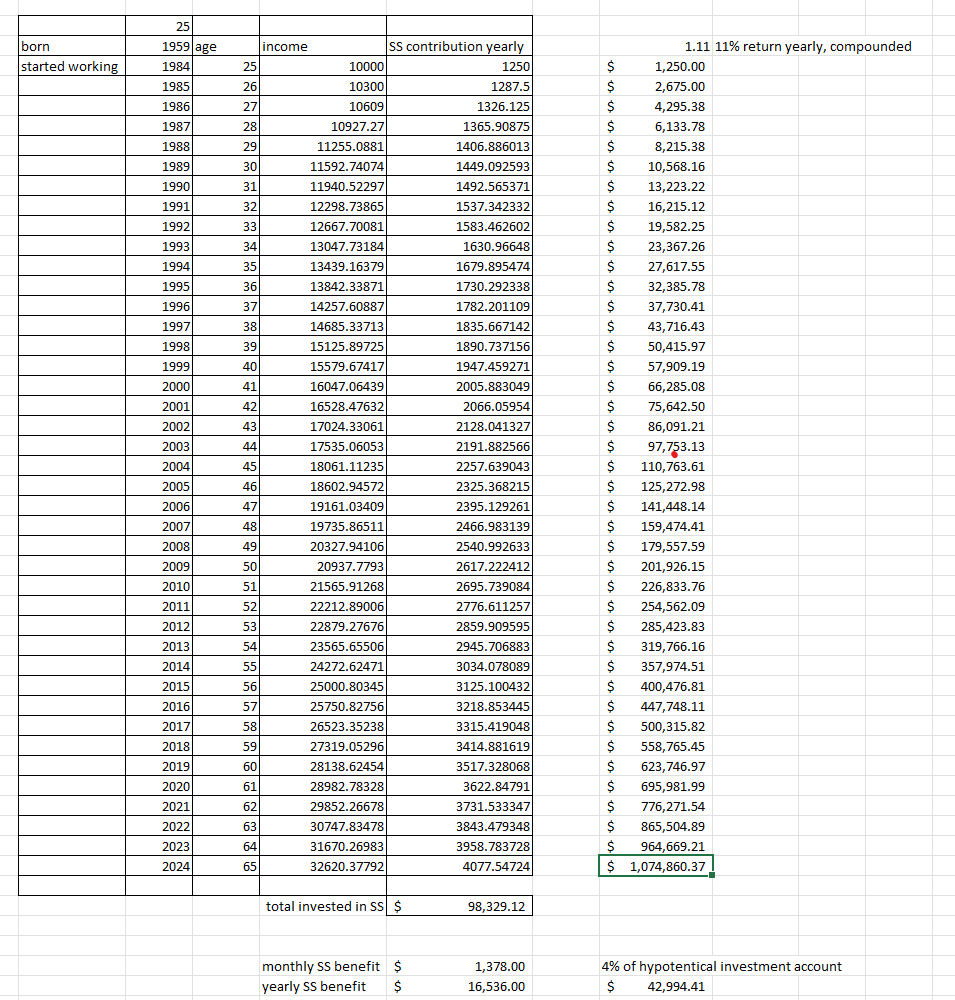
I went through and created a hypothetical person who started working in 1984 at the age of 25 (after being born in 1959). 

If that person started making $10k in 1984 that would be equivalent to $30k/year in 2024.
I gave this person a 3% raise a year. You can see that in the “income column” below. So this person would have ended working in 2024 with a salary of $32k/year (being 65 years old).

The next column shows the 12.5%/year that this person + their employer is paying into Social Security. After 40 years this person would have paid $98k into Social Security.
I went through and put all the earnings data into the Social Security website benefit calculator, found here. 

https://www.ssa.gov/benefits/retirement/planner/AnypiaApplet.html

It provided an estimate of $1,378/month or $16,536/year. 

I provided an alternative column, where you would instead take that 12.5%/year and invest that in the S&P 500 for 40 years.

As of January 26, 2024, the S&P 500’s price is 4,890.97. If you invested $100 in the S&P 500 at the beginning of 1984, you would have about $6,606.25 at the end of 2023, assuming you reinvested all dividends. This is a return on investment of 6,506.25%, or 11.14% per year.
This person would have $1,074,860.37  in their 401k. They could safely withdraw $42,944/year from this (4%) as well as having a portfolio worth $1 million dollars! This is making a relatively low $30k per year equivalent for 40 years!

But most people I know who have made $30k a year for 40 years do not have a million dollar portfolio. Why is that?

It’s because they are unable to invest 12% of their salary a year, because it is required to go to the government and the Social Security Fund. This is robbing millions of workers of $25k/year in their retirement. 

You could go through this same exercise. Simply go to https://www.ssa.gov/benefits/retirement/planner/AnypiaApplet.html

And input the dollar amount in the table for each year to find the benefit. 

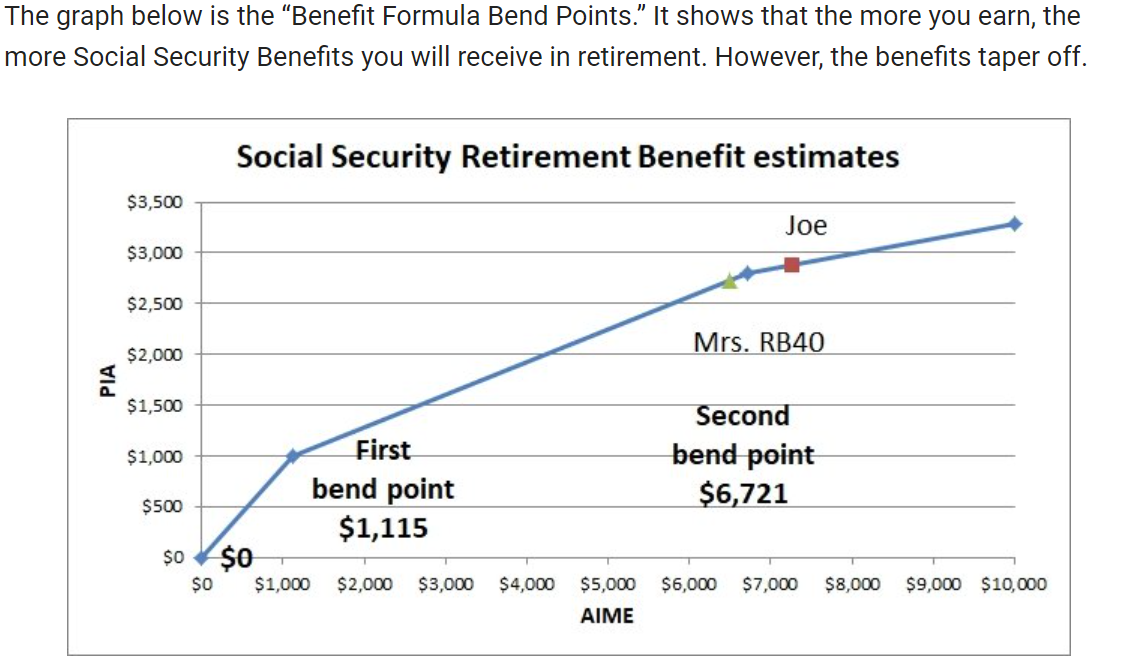
This is bad enough for a $30k/year equivalent worker. The more money you make though, the worse of a deal Social Security is. This is because of the “knee points” in the Social Security return table. The more you pay in, the less you get out. https://retireby40.org/early-retirement-impact-social-security-benefit/

While Social Security being a terrible return on your money is something of a first world problem, there are plenty of other instances of money losing value in other countries that really hurts people in those countries. 

You can read from Alex Gladstein to learn about some of those. 

“The rate of inflation in the U.S. is paltry compared to many other countries worldwide. The chief strategy officer for the Human Rights Foundation, Alex Gladstein highlighted this issue on Monday in a series of tweets. Gladstein is also a bitcoin (BTC) proponent and has been an evangelist for the leading crypto asset for quite some time.

“Many might think that extreme inflation is a rare occurrence in today’s modern world,” Gladstein said to his 27,000 Twitter followers on Monday. “That’s simply not the case. There are 1.2 billion people currently living in countries experiencing double or triple-digit inflation,” Gladstein insisted.”

https://news.bitcoin.com/1-2-billion-people-live-under-double-digit-inflation-many-have-found-escape-in-bitcoin-says-hrfs-alex-gladstein/

You Probably Aren’t Saving Enough to Retire

This is an update and expansion of “You Might Need $3 Million to Retire at Age 65”.

See disclaimer at end. There are assumptions in these calculation that inflation is 3% constantly every year.

Your investments will return 7%/year.

These tables change if either of those numbers change. But these are useful historic numbers to help people start thinking if they are in the ballpark of saving enough or not. 

In the previous post I considered how much someone my current age at the time (28), might need to retire when they are 65. I have thought about this and it’s actually quite easy to make a table so that anyone whatever age and income level they think they might need could identify how much they need to save without doing any math!

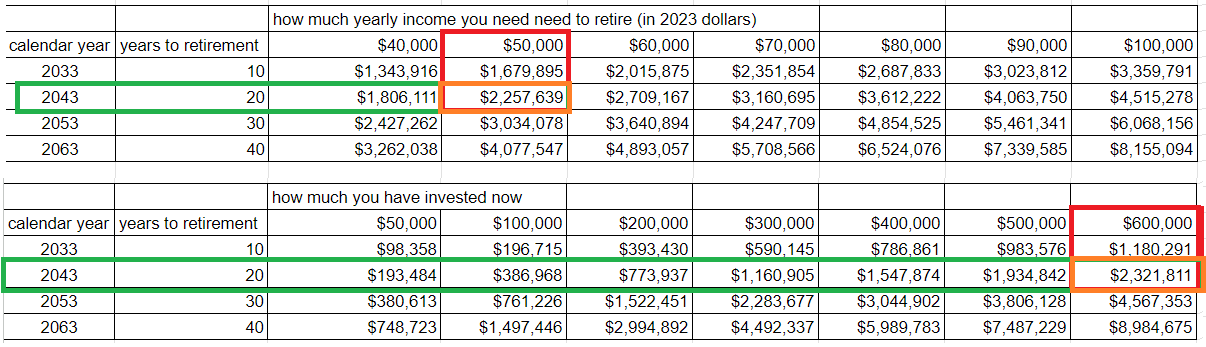
How you read the below table is:

Identify from the top row “how much yearly income you need to retire (in 2023 dollars). So if you are spending say $50,000 this year and you think you’ll continue to spend that much in retirement go to that column.

Then identify your age and the age you want to retire. 

For this example say you are 40 and you want to retire at 60.

60-40 = 20 years to retirement. So you look in the left column and go to the row “20 years to retirement”

Where the column and row intersect is how much you might need to have at that age to retire. 

So in the example, if you are 40 years old, and you want to retire in 20 years and withdraw $60,000 a year (in 2023 dollars) from your portfolio you would probably need to have saved $2.7 million dollars in 2043 dollars)

The dollars in the resulting boxes are all in the calendar year of the year you’d retire. 

So in 2043 you’d need to have $2.7 million to retire. 

The table assumes you can safely withdraw 4% of your portfolio a year. 

4% of $2.7 million is $108,000, but that $108,000 is in 2043 dollars. 

Adjusted for inflation $108,000 is worth $60,000 in 2023 dollars, which is what the top column tells you. 

I tried to make this easy since everyone knows what their current spending is. That is why the top column is in present day dollars.

The next step would be to identify how much money you have now and determine if you’ll have enough at the time you retire to reach the goal in the table above!

The table below helps with that. 

How to read this table is to sum up your investments in all your accounts today.

Ex: 401k, IRA, Brokerage account etc. 

That is the top row.

Again, look at the column to identify “how many years until you want to retire”

The resulting orange box will tell you “how much you will have in that year if you don’t invest another dollar today.”

So in the below table our 40 year old person who wants to retire in 20 years and has $600k in their 401k & IRA & any other investments  will have $2.3 million in 2043, assuming they don’t invest another dollar between today and 20 years from now. 

Now this might at first seem unhelpful because you might be thinking “but they will likely be investing more between now and then”. 

And that is true!

But what this table tells you is that you NEED to invest more to reach you $2.7 million goal from table 1 if you want to retire with your expected withdrawal of $60k a year. 

Here’s a clean table for you to identify yourself on. 

Let’s look at a different scenario:

Say you are 40 years old and think you can live on $50,000/year in 20 years when you retire.

You’d look up that you’d need $2,257,639 in the year 2043 when you retire.

If you look at table 2 you can see that if you have $600,000 invested today, and plan to retire in 20 years you’d have $2,321,811 when you retire. 

Since you need $2.2 million but your investments will grow to $2.3 million this might mean that you don’t need to invest anything else for the next 20 years! 

This idea, that you might not need to invest any more money to retire in the future is known as “CoastFI”.

You can learn more about CoastFI here

Now as I mentioned right at the start there are 2 assumptions in all these tables.

  1. Inflation is 3% every year. It might be more or less in the real world.
  2. Your investments will grow at a steady 7%/year. This will certainly be more or less every year. It’s easy to do math with averages though and over time the ups and downs of the market average out. 

You have to make assumptions like this when doing these types of calculations. These are based on historic averages. Every person needs to do their own calculations or work with a financial advisor to get these numbers exactly right for themselves. 

But these are good starting points to just give you a high level view if you are even close to having enough money or if you’ll need to continue investing!

For most people you are likely going to not have enough invested now that you can stop investing. But how close are you?

Are you millions of dollars away? Or hundreds of thousands? Or only thousands?

I will create another post in the future to try to help understand how much you will need to invest to reach your goal, but I thought this was a sufficiently long post for now.

Gravity Payments, $70,000 For All Employees

“What is it to you if I am generous?”- God

A link to a page to follow the Gravity Payments results of the $70,000 a year minimum wage for employees. – Added 8-29-02016

A link to a page to an update on Gravity Payment in 9-26-2019.

Dan Price (Gravity Payments CEO) On  Yang Speaks Podcast (On Youtube) Very good discussion! – Added 9-9-02020

The above quote was shared with me via a friend. There is no argument that there is income inequality in the USA. This week there was a huge story from Gravity Payments founder Dan Price that he will both slash his own salary to $70,000 and raise the minimum salary of each employee to $70,000, even the office clerk. This was happening the same week as strikes for $15/hour minimum wage by fast food worker across the country.

Gravity is not the first company to voluntarily pay their employees higher than minimum wage. QuikTrip which pays cashier’s $40,000 a year and Costco which pays its employees $44,000 a year are two other noted examples. They are also much larger than Gravity Payments as they have thousands of employees while Gravity has 120. That is not to diminish it’s accomplishments but just to highlight facts. This is a big deal!

After I read this news I was initially quite excited at the change we are seeing these days. I have been quietly debating with friends and myself the merits of a higher minimum wage. This was exactly what I wanted! People were finally able to have a comfortable living. Shortly after that I began to contemplate further. Even the “lowest paid clerk” will make $70,000, over double their current salary, earning the promised $70,000 within the next three years. How will the, currently,  higher paid personnel react? Will their salaries raise also? For example if there was a person earning $80,000 already, compared to someone earning $40,000 currently, the $80,000 earner might be a bit peeved to learn that someone’s salary has raised $30,000 while his has remained stagnant. We are not sure if that’s the case or if higher earners wages were also increased. I will speculate that they were not. I must hope that they will take it in swing. They will recognize that it is his money and they are not losing money simply because their neighbors are now making more. They also have the opportunity to leave a company that has already showed it’s a generous company, to make more money elsewhere if they can.

This reminds me of a passage from the bible.

Friend, I am not being unfair to you. Didn’t you agree to work for a denarius? Take your pay and go. I want to give the man who was hired last the same as I gave you. Don’t I have the right to do what I want with my own money? Or are you envious because I am generous?’ “So the last will be first, and the first will be last.”” (Matthew 20:1-16, NIV)

The workers who came late and worked only one hour were paid as much as the people who worked the full day. Naturally the people who worked the full day were pissed! But they were reminded that no money was taken from them.

As for the people who received the huge raises, I hope they recognize how lucky they are. I hope that they all recognize the good fortune they have been given and pass some along to others who are less fortunate than themselves.One driver for inflation, in my mind, is the excess of money in the hands of individuals. If 2 people both want a thing that is $50 and there is only one left, this will create an increased price for that part. They may end up paying $100 for something that was only worth $50 initially. To combat this price war on things, we need to focus on being less materialistic. If we become happier with what we have, then the increased salaries will be just fine. The people might spend them responsibly, paying off loans or securing a future via a larger down payment on a home or larger retirement deferrals. They would do good to reference this article about retiring a millionaire. If this creates a culture of people worrying about others happiness and their own future instead of buying more material things,  this will have been a great experiment indeed.

I have found through my own journey thus far that I was really only able to realize that I could give some away more after I realized that I had enough. It’s natural for people to seek security. If that means saving up $50,000 or $100,000 before they start donating to charities that’s fine. Another good way to give without giving money is by volunteering time. Your time is just as valuable as money. You could use your time to make money or you could give it away freely. When donating time, don’t feel bad that you aren’t donating money,and don’t let others make you feel bad you aren’t donating money either. This is one issue with our culture is we like to point out the flaws we see in others instead of pointing out the positive. I have done this above a bit, in pointing out that the higher earners could be upset, but I did that just as a thought experiment and to provide discussion that I’m sure others were thinking. When I discussed this topic with friends and they mentioned it I told them what i have written. Let’s be happy that the CEO is doing good!

I did a cost of living using this calculator and found that $70,000 in Seattle is comparable to $56,000 in my current city of Cedar Falls, Iowa. While this is still above the median USA household income, it’s not by much, and it is still $70,000.

How would you react to a situation like this?