
Stablecoins: The Offshore Demand Engine for a Decaying Fiscal Regime

Over the last decade, stablecoins have quietly grown from a crypto curiosity into a multi-hundred-billion-dollar shadow banking system. Pegged to the U.S. dollar and backed largely by short-term U.S. Treasury debt, they serve as the grease in the wheels of global crypto markets, offshore exchanges, and dollar-hungry economies.

But beneath the surface, something much bigger is happening.


The Dollar Finds a New Buyer

Traditionally, U.S. Treasuries—the lifeblood of American government spending—have been snapped up by major institutions: foreign governments (like China and Japan), domestic banks, and pension funds. But in recent years, these traditional buyers have pulled back. Geopolitical tensions, rising debt levels, and concerns over inflation have made U.S. debt less attractive, even as the U.S. continues running multi-trillion dollar deficits.

Enter the stablecoin.

Today, companies like Tether (USDT) and Circle (USDC) hold tens of billions of dollars in U.S. government debt to back their tokens. When someone in Argentina, Nigeria, or a Binance trading desk mints USDT, they’re not just getting a “digital dollar”—they’re triggering a real-world Treasury purchase. The crypto user thinks they’re opting out of the fiat system. But in reality, they’re becoming its final buyer.


The Crypto User Thinks They’re Opting Out of the Fiat System

Why do people in Argentina, Turkey, Lebanon, or Nigeria rush to buy USDT?

Because their own currencies are collapsing. Hyperinflation, capital controls, corrupt central banks—these people aren’t speculating; they’re fleeing. To them, the U.S. dollar—even in stablecoin form—is a lifeline. A way to store value. A way to escape the chaos of their local monetary regimes.

But here’s the catch:

They think they’re opting out of fiat. But in reality, they’re just opting into a slightly better fiat—one that’s still built on debt, political manipulation, and unsustainable spending.

The stablecoin looks like freedom. It feels like safety. But under the hood, it’s still backed by U.S. government debt, not hard money.

Ironically, while individuals are rushing into dollars, governments and central banks are quietly opting outdumping Treasuries and buying gold. China, Russia, and other major players are de-dollarizing their reserves, building gold stacks instead of paper promises.

So while everyday people buy USDT thinking they’re escaping a broken system, they’re actually becoming the last line of support for it.


A Bad Deal for the User, A Great Deal for the Issuer

This system is not just ironic—it’s rigged.

When a user buys a stablecoin, they hand over real money (often hard-earned in volatile, inflation-ridden economies) and receive a token that loses value over time. Meanwhile, the stablecoin issuer uses that cash to buy U.S. Treasuries yielding 5%, pocketing the interest for themselves.

It’s a classic arbitrage:

The company gets the yield. The user gets the illusion of stability.

And what does the company do with the profits?

Tether, the world’s largest stablecoin issuer, has been using its surplus to buy Bitcoin and gold.
Yes—they are converting fiat yield into hard assets while their users hold yieldless tokens that depreciate.

Stablecoins aren’t neutral tools—they’re a form of rent extraction on unequal access to dollars. The poor and marginalized, locked out of the global banking system, pay the premium. They provide the capital, but don’t share in the returns. It’s dollar apartheid dressed up as digital liberation.

Ironically, while the wealthy and powerful are exiting Treasuries and moving into gold, the global poor are herded into yieldless tokens that prop up a collapsing system—tokens whose issuers are quietly stacking Bitcoin behind the scenes.


Exit Liquidity for the Empire of Debt

Here’s the twist: stablecoin users—retail traders, global remitters, DeFi participants—are providing exit liquidity for traditional U.S. Treasury holders.

As old institutions reduce exposure to U.S. debt, stablecoin issuers step in, fueled by global crypto demand. The American government still gets to sell its debt. But the buyer has changed. The new buyer is a protocol, backed by offshore exchanges, remittance flows, and millions of anonymous wallets.

This system works—until it doesn’t.


When the Music Stops

What happens in the next crypto bear market? What happens if regulators crack down on stablecoins? If demand for stablecoins dries up, the artificial demand for Treasuries does too. The U.S. government will have to find new buyers—or offer much higher interest rates.

That’s the risk of this hidden system: a shadow Treasury market tied to the most volatile and politically uncertain asset class on earth.


The Ironic Truth

Crypto was born to escape fiat. But stablecoins—its most widely used product—are deeply tied to the health of the fiat regime. They don’t disrupt the dollar. They extend its life. They distribute it further. They help the empire keep borrowing.

In this light, stablecoins aren’t just a tool for freedom. They’re also a backdoor bailout for a bloated fiscal machine, enabled by the very people it exploits.

And if that’s true, the real question isn’t whether the U.S. dollar will survive—but how long crypto will prop it up… while its issuers quietly prepare for the next system.


💡 Want to understand the global mechanics behind this better?
Look up The Dollar Milkshake Theory by Brent Johnson.
It explains how a structurally flawed but globally dominant dollar continues to suck in capital from weaker economies—even as the system cracks.

💵 Dollars Are Just Fancy Scrip

Why real freedom starts with escaping centralized money


Most people think money is neutral. You earn it, you spend it, you save it. Simple. But what if the money in your wallet isn’t really yours? What if it works more like company scrip than true, independent money?

Let’s take a step back in time — and a step deeper into the system we live in.


🏭 Company Scrip: The Original Trap

In mining and lumber towns of the 19th and early 20th century, companies often paid workers in “scrip” — private money usable only at the company store.

  • Could you spend it elsewhere? Nope.
  • Could you build wealth? Not easily.
  • Were prices fair? Absolutely not.

It was a closed-loop system. One that looked like money, but ultimately existed to control labor and consumption.


🏛️ Fiat Currency: The Scrip Goes National

Now look at the dollar, the rupee, the euro.

These are government-issued fiat currencies. But just like scrip:

  • They’re created at will by central banks.
  • They lose value over time through inflation.
  • They’re political tools, subject to manipulation and control.
  • And they limit your economic choices to within a system you didn’t design.

It’s still scrip — just at scale. You’re still in the company town. The company just got a flag and a central bank.


🪙 Bitcoin, Gold, and Financial Exit

Real money — money that promotes freedom — should be:

  • Scarce
  • Neutral
  • Borderless
  • Independent of politics

That’s why people turn to Bitcoin and gold. They’re not controlled by anyone, and that matters.

When your wealth is stored in something you control, your freedom becomes harder to take away.


⚠️ The Real Issue: Agency

The bigger point isn’t about currencies.
It’s about control.

Whoever controls your money controls your choices.

If a central bank, a political party, or a single institution can dilute or freeze your money — you don’t own your life. Not really.

Financial agency isn’t just a luxury. It’s a requirement for freedom.


🧠 Final Thought

So yes, your dollars function. But they’re not neutral. They’re managed, manipulated, and diluted — all without your consent.

They’re just fancy scrip — and you don’t own the store.

Study Bitcoin!

What Is Money, Really? A Fresh Look at Why Bitcoin Matters

💡 Money Isn’t What You Think It Is

Most of us think of money as the bills in our wallets or numbers in our bank accounts. But money isn’t a physical thing—it’s a system of IOUs. It’s how we track value we’ve created, whether that’s building a fence, baking bread, or writing software.

Here’s the key insight: money itself doesn’t hold value.
If it did, you’d want to hoard it. But you don’t. You probably try to get rid of your dollars by putting them into stocks, real estate, or gold—anything to escape inflation.


🧱 A Story About a Fence (and a Broken System)

Imagine this:
You build a 100-foot fence for someone. They pay you $100. One year later, you ask them to build a fence for you. They say, “Sure, but now it’ll cost $105.”

Why? Inflation. Your money didn’t hold its value. The effort you gave last year is worth less this year.

And while the U.S. has “low” inflation, other countries—like Argentina—see 100% inflation annually. In places like that, people rush to convert their paychecks into food, bricks, or U.S. dollars just to preserve value.

But let’s be honest: the U.S. dollar and Argentine peso aren’t fundamentally different. Both are government-issued currencies that lose value over time due to overspending and excessive money printing.


⚙️ Enter Bitcoin: Fixed, Transparent, and Decentralized

Bitcoin was designed to fix this exact problem.

  • There will only ever be 21 million bitcoins.
  • Each one can be divided into 100 million sats (Satoshis).
  • Bitcoin is basically a global, digital IOU ledger that nobody controls—but everyone can verify.

Think of it as an open-source Excel spreadsheet that tracks who owns what. But instead of one person controlling it, thousands of computers (nodes) maintain the same list and agree on changes only when a valid transaction is made.


🔨 How Bitcoin Transactions Work

  1. You send a transaction using your app or wallet.
  2. It enters the mempool, a kind of digital waiting room.
  3. Miners select and bundle transactions into a block.
  4. They solve a math puzzle to earn the right to add the block to the chain.
  5. Once added, it’s permanent—and verified by the entire network.

Each block takes about 10 minutes to process. Miners are rewarded with both newly “unlocked” bitcoin (currently 3.125 BTC) and small transaction fees—typically less than 1%, cheaper than credit cards.


🆚 Bitcoin vs “Altcoins”

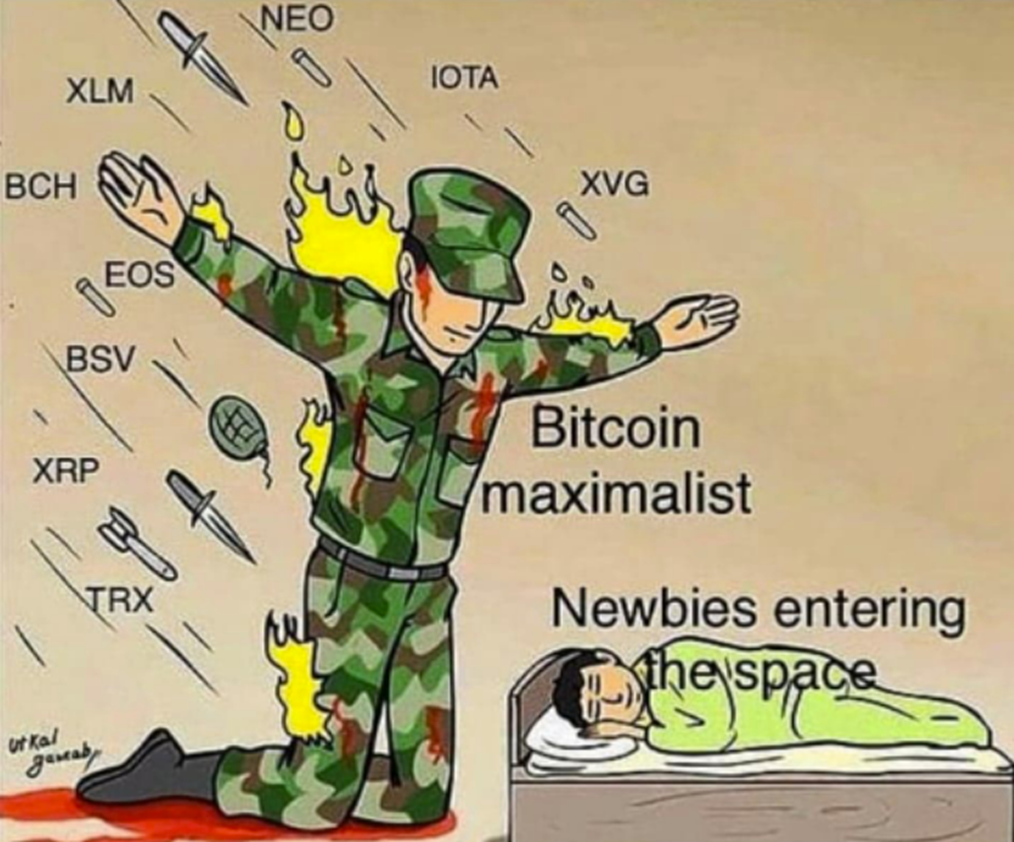
Bitcoin has no premine, meaning the creator didn’t secretly give themselves coins before anyone else could buy them. Most altcoins (alternative cryptocurrencies) do. That makes many of them less like open money and more like disguised businesses.

Ask yourself: What real problem is this altcoin solving?

The answer is likely that the coin is built around a company structure, because it can’t solve the store of value problem. Bitcoin already solved that problem.


💸 How to Buy Bitcoin Today

Option 1: Brokerages

  • Buy FBTC, the Fidelity Bitcoin Trust, just like a stock or ETF
  • Available through Fidelity, Schwab, and others
  • Small fee: ~0.25% expense ratio

Option 2: Direct Purchase

  • Use apps like Strike, River, or Cash App
  • You can hold your own Bitcoin (self-custody) or keep it with the app

📈 Why Bitcoin Could Hit $13 Million

There are $750 trillion in global assets.

Asset CategoryEstimated Value (USD)
Real estate~$360 trillion
Equities (stocks)~$110 trillion
Bonds (debt markets)~$135 trillion
Broad money (M2)~$100 trillion
Gold (above ground)~$14–15 trillion
Private businesses, art, collectibles, etc.~$20–30 trillion (est.)


If even $273 trillion of that (stocks, real estate, bonds, money supply) flows into Bitcoin, that’s:

$273 trillion ÷ 21 million BTC = $13 million per coin

This isn’t speculation—it’s about monetary premium, the extra value people add to assets (like real estate or art) just because they don’t trust cash.

Bitcoin is absorbing that value because it’s better money.


🧠 Strategy: It’s Not Too Late

A $10,000 investment today could get you 0.1 BTC.
If Bitcoin hits $13 million, that’s worth $1.3 million.

Of course, you shouldn’t invest money you can’t afford to lose. But for many, $10K is a small bet with a big upside.

Bitcoin isn’t just about price—it’s about a fundamentally better way to store and transmit value.


🎯 Final Thought: We’re All Fish in Fiat Water

You’ve lived your whole life in a system where money loses value. It feels normal, but it’s not natural.

Bitcoin is a new kind of money: scarce, digital, decentralized, and global.

Once you understand what money really is, it becomes clear: Bitcoin is not just better money—it’s the future of value itself.

Why ChooseFI and Bitcoin Should Be Allies (But Aren’t Yet)

In theory, the ChooseFI and Bitcoin communities should be natural allies. Both value independence, long-term thinking, and building a future that’s not dependent on the whims of politicians or corporations. But in practice, there’s an odd divide: the ChooseFI crowd leans hard into index funds and conventional investing, while Bitcoiners are laser-focused on fixing the money itself.

As someone who walks between both worlds, I think it’s time to bridge this gap.

The ChooseFI Perspective: Smart, but Incomplete

The Financial Independence (FI) movement is one of the best ideas to come out of the last 20 years. It’s a rejection of consumerism and dependence on a 9–5 job. It promotes saving, intentionality, and investing in low-cost index funds to build wealth over time.

But here’s where it falls short: the movement assumes the system is stable enough to invest in indefinitely.

ChooseFI thinkers often acknowledge that inflation erodes purchasing power. That’s why they invest. But they rarely ask why inflation exists or what kind of inflation we’re talking about. They trust the market to keep delivering 7% annual returns because, historically, that’s what it’s done. It’s a comforting narrative—but it’s built on the assumption that the dollar is sound money. It isn’t.

The Bitcoiner’s View: Start With the Root Cause

Bitcoiners take the opposite approach. They start by asking: What if the money itself is broken?

If money is supposed to store value over time and across space, then fiat currency fails that test. Central banks manipulate interest rates and print trillions to bail out markets. This isn’t capitalism—it’s financial engineering.

Bitcoiners understand that if the base layer of the economic system is corrupted, then all the “smart investing strategies” built on top of it are sitting on shaky ground. They argue that if we had sound money—money that couldn’t be debased—then saving would be investing. You wouldn’t have to chase yield to stay ahead of inflation.

In other words, Bitcoin doesn’t replace the FI mindset—it completes it.

The Missed Opportunity

ChooseFI and Bitcoin share the same end goal: personal sovereignty, freedom from wage dependence, and the ability to live life on your own terms. But their tactics differ, mostly because of assumptions they make about the system.

  • ChooseFI says: “Inflation exists, so invest wisely to beat it.”
  • Bitcoin says: “Inflation exists because the money is broken—so let’s fix the money.”

Both strategies have value. But only one questions the foundation.

And here’s the deeper issue: too many in the ChooseFI world are afraid to deviate from the script. There’s a culture of “stay the course,” which, while helpful during market turbulence, often becomes a dogma that discourages curiosity. I’ve met people in the FI community who understand something feels off—whether it’s the Fed printing trillions or housing prices going vertical—but they suppress those questions because they fear sounding like conspiracy theorists or rocking the boat.

I want to say this clearly: it’s okay to ask questions. In fact, if you’re pursuing financial independence, you should be asking deeper questions—about the money, the system, and whether the rules we’ve been taught still make sense in a world that’s changing fast.

A Better Future: Combine the Philosophies

Imagine if ChooseFI thinkers began to see Bitcoin not as a speculative gamble, but as a form of saving that aligns with their most cherished values: delayed gratification, personal responsibility, and building a more secure future.

If these two groups came together, we’d have something powerful: a community that not only escapes the rat race—but understands why the race exists, who designed it, and how to stop participating in it altogether.

For ChooseFIers interested in Bitcion I’ll point you to a few of my previous articles below.

What Problem Does Bitcoin Solve? part 3 Buckminster Fuller, F.A Hayek & Henry Ford’s comments

Why Bitcoin?

The Intellectual Stagnation in Academia: Ignoring the Corporate Shift to Bitcoin

Introduction In recent years, the corporate world has witnessed a historic shift in treasury strategies, with several prominent companies incorporating Bitcoin into their reserves. Despite these significant changes, many finance professors continue to dismiss or ignore the implications of this trend. During my MBA studies, I have personally discussed or emailed with six finance professors over the last three years about Bitcoin. None of them have shown any curiosity or willingness to engage in meaningful discussions about this topic. While I cannot speak for all finance professors, this has been my experience with those I have interacted with. This paper aims to highlight the lack of intellectual curiosity among academics in the face of obvious transformations in corporate and global environments.

The Corporate Shift to Bitcoin The adoption of Bitcoin by companies such as MicroStrategy, Tesla, and Block Inc. marks a pivotal change in how corporate treasuries manage their assets. These companies view Bitcoin as a strategic asset, providing a hedge against inflation and currency debasement. MicroStrategy, for instance, has aggressively acquired Bitcoin, making it the largest Bitcoin treasury in the world. This trend began around 2020 and has continued to gain traction, signaling a shift in corporate treasury management.

In the last month, several other companies have also announced Bitcoin treasury strategies:

  • Genius Group: An AI-powered education group that has committed 90% or more of its current and future reserves to be held in Bitcoin 1.
  • Worksport: A U.S.-based provider of pickup truck solutions that is adding cryptocurrency to its corporate treasury strategy 1.
  • Rumble: A video platform targeting a conservative audience, planning to invest up to $20 million of surplus cash in Bitcoin 2.
  • Metaplanet: A company with clearly stated strategy reserve asset goals and reasoning 3.
  • Strategy (previously MicroStrategy): Continues to lead the way with its Bitcoin treasury strategy 3.

Government Recognition of Bitcoin The U.S. government has also acknowledged the significance of Bitcoin by establishing a Strategic Bitcoin Reserve and a U.S. Digital Asset Stockpile. This move underscores the growing acceptance of Bitcoin as a store of value and its potential role in national economic strategies.

Personal Experience with Academic Dismissal Over the past three years, I have personally discussed or emailed with six finance professors during my MBA studies about the topic of Bitcoin. Despite the clear and significant changes in corporate treasury strategies, none of these professors have shown any curiosity or willingness to engage in meaningful discussions about Bitcoin. This lack of interest is particularly surprising given the relevance of Bitcoin to contemporary financial practices and corporate strategies and the fact that there are not many innovations in Corporate Treasury operations. When a new idea comes along you would expect people to be interested to consider if it has any value.

The Importance of Intellectual Curiosity Intellectual curiosity is a cornerstone of academic excellence. It drives innovation, fosters critical thinking, and encourages the exploration of new ideas. The reluctance of finance professors to engage with the topic of Bitcoin reflects a stagnation in intellectual curiosity that is detrimental to both students and the broader academic community.

Conclusion The corporate shift to Bitcoin represents a significant change in treasury strategies that warrants academic attention. Professors should embrace intellectual curiosity and explore the implications of this trend, rather than dismissing it. By doing so, they can provide students with a comprehensive understanding of the evolving financial landscape and prepare them for the future.

Essay: Why Gary Stevenson Should Rethink Bitcoin

@garyseconomics

Gary, your crusade against inequality is spot-on—the rich hoard wealth, wages stagnate, and housing slips out of reach. You’ve nailed how the system’s rigged, profiting off disparity as you did at Citibank. But your dismissal of Bitcoin as a “scam” or “musical chairs” misses its point. Let’s break it down through your lens. You see value in what’s tangible—property, bonds, cash flows. Bitcoin’s different: it’s digital scarcity, forged by energy-intensive mining, not free “points on the internet.” It costs real resources—miners burn electricity rivaling small nations to secure it. That’s not hype; that’s a backbone. You’ve said wealth concentration tanks demand, keeping rates low. Bitcoin flips that script. It’s not controlled by banks or governments printing money for the elite—it’s capped at 21 million coins, a hedge against inflation you’ve seen erode workers’ lives. You fear Satoshi’s a shadowy puppetmaster, selling off a million coins to dupe the masses. Check the blockchain—those wallets haven’t moved in 16 years. No secret dump, no conspiracy. Bitcoin’s transparent; anyone can verify it. You’d spot a scam in derivatives a mile away—apply that here. It’s not a rich man’s toy; it’s open to anyone with a phone, from East London to Lagos, leveling a field you know is uneven. You’re right about speculative bubbles, but Bitcoin’s survived crashes—$20K in 2017 to $3K, now thriving in 2025 with institutional buy-in. It’s not about quick riches; it’s a store of value, like digital gold, for a world you’ve seen fail the poor. You’ve bet against broken systems before. Bitcoin’s a bet for one—decentralized, fair, and tough as nails. Give it a trader’s eye, Gary. It’s not the enemy; it’s a tool.

@satmojoe

@Jcastweet

@PeterMcCormack

@HawkMcFlipster

@Oriflamme87

What Problem Does Bitcoin Solve? part 3 Buckminster Fuller, F.A Hayek & Henry Ford’s comments

I’ve written a few things about why bitcoin is the solution to many problems. 

Here for What problem does Bitcoin solve part 1 and here for what problem does bitcoin solve part 2 and here for “Why Bitcoin?

I wanted to share a few quotes from history to highlight that the control and debasement of money by governments has been an issue for a long time. The faster everyone understands this the faster we can all get on the bitcoin standard for value preservation. 

I explain here why we should support the bitcoin experiment. It solves the problem. If it ends up failing for some reason in the future, we need to recreate Bitcoin and address whatever issue made it fail because we need a currency that can’t be debased by governments. 

The Idea of Bitcoin Needs to Succeed, Even if Bitcoin Fails

“It is utterly clear to me that the highest priority need of world society at the present moment is a realistic economic accounting system which will rectify, for instance, such nonsense as the fact that a top toolmaker in India, the highest paid of all craftsman, gets only as much per month for his work in India as he could earn per day for the same work if he were employed in Detroit, Michigan.  – Page 112 Operating Manual For Spaceship Earth, Buckminster Fuller

F.A. Hayek in 1984: “I don’t believe we shall ever have a good money again before we take the thing out of the hands of government, that is, we can’t take it violently out of the hands of government, all we can do is by some sly roundabout way introduce something that they can’t stop.”

“It is well enough that people of the nation do not understand our banking and monetary system, for if they did, I believe there would be a revolution before tomorrow morning.”

― Henry Ford

Ford, who founded Ford Motor Company in 1903, told the publication:

“Under the energy currency system the standard would be a certain amount of energy exerted for one hour that would be equal to one dollar. It’s simply a case of thinking and calculating in terms different from those laid down to us by the international banking group to which we have grown so accustomed that we think there is no other desirable standard.”

Bitcoin is $100k, Should I Buy It Now Or Is It Too Expensive?

Bitcoin recently breached the $100k price per bitcoin on December 4th 2024. It has retreated slightly but has continued to hover between $90k -$108k/bitcoin. 

Historically bitcoin has had a performance of 3 positive years followed by 1 negative year. While you can’t expect history to repeat itself, it might!

Looking at the below chart you can see we are on track to repeat that performance so far. While not shown 2024 was also a great positive return year for bitcoin so we have 2 years of positive returns. 2025 would be the 3rd year. 

Due to that expectation I fully expect bitcoin to have a good performance in 2025. It is also possible that it has a negative year in 2026 if it continues to follow the historic trend. 

 Of course it is also possible it has a negative year in 2025! We could break the trend. 

We could also break the trend and see that we have a positive year in 2025 and 2026! The future is unknown and unknowable!

When people ask me if they should buy bitcoin now I say that they obviously don’t understand bitcoin. If you don’t understand it then I would say “No” you probably shouldn’t buy it. What I tell people is to continue to learn more about why other people buy it. 

Learn about “What problem bitcoin solves.” I have written 2 articles about that here. 

What Problem Does Bitcoin Solve?

We, every person in the world, is in a fight with their own government to keep as much of the value they create as they can.  The government explicitly taxes you, which we can debate but at least it is obvious.  But the government also stealthy steals value from your bank account or savings via inflation and money printing that you have no control over.

What is Money? (What Problem Does Bitcoin Solve -2)

Bitcoin is not an investment. Bitcoin is a store of value. The value you create. Bitcoin is an agreement between people who create value in the world that they will trade their value for other value. The value you create and store in Bitcoin cannot be debased or inflated away by any government by money printing.
I’ve also created a list of great resources to learn more about bitcoin here. 

Books & Videos to Learn About Bitcoin

What I generally recommend people to do is to buy just a little bitcoin so that they will start creating a little interest with themselves. This is how I did it. I bought just $100 and then that made me interested to learn more about what I had bought and why.
You should not plan to sell the bitcoin you buy. This is true for most investments, in my opinion. You should only be investing money you are ready to have invested for 5+ years. 

You shouldn’t try to time the market. You aren’t smart enough for that and neither am I. 

Just buy things that you understand and continue to do research. 

Metaplanet – Japanese Public Company Buying Bitcoin as a Treasury Reserve Asset

Metaplanet  – Japanese Public Company Buying Bitcoin as a Treasury Reserve Asset

Metaplanet is a publicly traded company in Japan that has set Bitcoin as its primary treasury reserve asset. You can read about it here. You will have to click on their link to their “official disclosure” or you can link directly to the PDF of the official disclosure here. 

You can listen to Dylan LeClair, the Director of Bitcoin Strategy at MetaPlanet, here talk about MetaPlanet and their Bitcoin Strategy. The link takes you to the correct timestamp in the Youtube Video.

 I highly recommend everyone reads this. It lays out in simple, clear language, the benefits to the company of buying bitcoin as their treasury reserve asset. Most of their reasoning applies to individuals also.  I’d like to repost it here directly, but they have requested no reproductions. I have emailed them asking if it’s possible to repost it and will if they allow it. But if not, you can read at the link above. It’s only a 3 page document. 

Metaplanet is the first public company in Japan I am aware of that has started using Bitcoin as it’s treasury reserve asset. But it wasn’t the first worldwide and I’m sure it won’t be the last. 


Here is a previous article I wrote about companies and pension funds starting to buy Bitcoin. 

A short list of those companies is below.

Metaplanet – Metaplanet direct link to PDF

Microstrategy 

Mara – Bitcoin miner

Semler Scientific

Onemed

Block (formally Square, owns Square processing points and Cashapp app)

Private company –

Tahini’s (corporate page) – Restaurant in Canada – Tahini bitcoin article

As well as all these companies continually buying bitcoin, there are 2 US state pension funds that have bought bitcoin they have disclosed so far.

Wisconsin Pension Fund

Michigan Pension Fund

And one, Arizona, that has a resolution for their pension fund to learn about it. Here is the resolution directly.

There are a few other countries that are involved in mining bitcoin. 

Bhutan 

Oman

Ethiopia

Finally, El Salvador is the first country to adopt bitcoin as legal tender. It is also committed to buying 1 bitcoin a day. You can follow directly in their bitcoin address. 

Again, it was the first ,but I doubt it will be the last. 

At this link is a list of all companies holding bitcoin. The above lists are more recent companies and companies that are actively proclaiming that they are accumulating more bitcoin aggressively. 

A second link with entities holding bitcoin. 

0.1 Bitcoin

There are about 8 billion (8,000,000,000) people in the world. 

According to Kiplinger, globally there are about 59 million millionaires. 

59,000,000/8,000,000,000 = 0.007375 =  0.7375% of people in the world are millionaires. So less than 1% of people are millionaires. 

If you divided the 21 million (21,000,000) bitcoin among the 8 billion people

21,000,000/8,000,000,000 = 0.002625

0.002625 x $60,000/btc = $157.50

You only need to buy $157.50 worth of bitcoin to get “your share” today. 

There are 21 million bitcoin that will ever be made. 

There are 59 million millionaires. So it’s not possible for every millionaire to have 1 bitcoin. 

If we divide the 21 million bitcoin by 59 million millionaires we get 

21/59 = 0.35593220 btc per millionaire.

 0.35593220 x $60,000/btc = $21,355.93 if every millionaire wanted to get “their share” of bitcoin and it was only split among millionaires.

If we go down to units of 0.1 bitcoin then 210 million people could own 0.1 bitcoin.

That is still only 

210,000,000 people/ 8,000,000,000 people = 0.02625 = 2.625% of people would have 0.1 bitcoin.

0.1 bitcoin x $60k/bitcoin = $6,000 to buy 0.1 bitcoin today.

If I was someone with no bitcoin today I’d think hard about setting a goal of getting to 0.1 bitcoin. 

The market capitalization of Gold is $16,590,000,000,000 ($16.59 Trillion) as of 8-11-2024 when I write this.  Note that this changes daily as the price of gold fluctuates and as more gold is mined each year. 

If bitcoin was to attaining the same market capitalization  

$16,590,000,000,000/21,000,000 bitcoin = $790,000 per bitcoin

$790,000 x 0.1 bitcoin = $79,000

If bitcoin was to reach a value of $10 million per Bitcoin then 0.1 bitcoin would be worth $1 million. 

Plenty of people have made a prediction in the millions for the future price of bitcoin. You will have to do research for yourself to determine if you think this is reasonable. But I would encourage you to be inquisitive about why people are prediction such a high price for Bitcoin. 

This isn’t all to tell you you have to buy bitcoin. But it’s to encourage you to look into why many people think bitcoin has value. 


There is not much bitcoin and we are still early as far as world wide adoption. You don’t need to buy much (0.1 bitcoin = $6k today) to potentially have $1 million in the future. 


Of course, only buy as much as you are able to lose! Many people are able to have a risky bet of $6k and if it did happen to go to $0 (which is of course a possibility) they’d still be fine. 

But if that is not you then definitely DON’T buy bitcoin. 


But if you are a person who has sufficient assets, you might try thinking about why so many people have such a high conviction in bitcoin.