Why ChooseFI and Bitcoin Should Be Allies (But Aren’t Yet)

In theory, the ChooseFI and Bitcoin communities should be natural allies. Both value independence, long-term thinking, and building a future that’s not dependent on the whims of politicians or corporations. But in practice, there’s an odd divide: the ChooseFI crowd leans hard into index funds and conventional investing, while Bitcoiners are laser-focused on fixing the money itself.

As someone who walks between both worlds, I think it’s time to bridge this gap.

The ChooseFI Perspective: Smart, but Incomplete

The Financial Independence (FI) movement is one of the best ideas to come out of the last 20 years. It’s a rejection of consumerism and dependence on a 9–5 job. It promotes saving, intentionality, and investing in low-cost index funds to build wealth over time.

But here’s where it falls short: the movement assumes the system is stable enough to invest in indefinitely.

ChooseFI thinkers often acknowledge that inflation erodes purchasing power. That’s why they invest. But they rarely ask why inflation exists or what kind of inflation we’re talking about. They trust the market to keep delivering 7% annual returns because, historically, that’s what it’s done. It’s a comforting narrative—but it’s built on the assumption that the dollar is sound money. It isn’t.

The Bitcoiner’s View: Start With the Root Cause

Bitcoiners take the opposite approach. They start by asking: What if the money itself is broken?

If money is supposed to store value over time and across space, then fiat currency fails that test. Central banks manipulate interest rates and print trillions to bail out markets. This isn’t capitalism—it’s financial engineering.

Bitcoiners understand that if the base layer of the economic system is corrupted, then all the “smart investing strategies” built on top of it are sitting on shaky ground. They argue that if we had sound money—money that couldn’t be debased—then saving would be investing. You wouldn’t have to chase yield to stay ahead of inflation.

In other words, Bitcoin doesn’t replace the FI mindset—it completes it.

The Missed Opportunity

ChooseFI and Bitcoin share the same end goal: personal sovereignty, freedom from wage dependence, and the ability to live life on your own terms. But their tactics differ, mostly because of assumptions they make about the system.

  • ChooseFI says: “Inflation exists, so invest wisely to beat it.”
  • Bitcoin says: “Inflation exists because the money is broken—so let’s fix the money.”

Both strategies have value. But only one questions the foundation.

And here’s the deeper issue: too many in the ChooseFI world are afraid to deviate from the script. There’s a culture of “stay the course,” which, while helpful during market turbulence, often becomes a dogma that discourages curiosity. I’ve met people in the FI community who understand something feels off—whether it’s the Fed printing trillions or housing prices going vertical—but they suppress those questions because they fear sounding like conspiracy theorists or rocking the boat.

I want to say this clearly: it’s okay to ask questions. In fact, if you’re pursuing financial independence, you should be asking deeper questions—about the money, the system, and whether the rules we’ve been taught still make sense in a world that’s changing fast.

A Better Future: Combine the Philosophies

Imagine if ChooseFI thinkers began to see Bitcoin not as a speculative gamble, but as a form of saving that aligns with their most cherished values: delayed gratification, personal responsibility, and building a more secure future.

If these two groups came together, we’d have something powerful: a community that not only escapes the rat race—but understands why the race exists, who designed it, and how to stop participating in it altogether.

For ChooseFIers interested in Bitcion I’ll point you to a few of my previous articles below.

What Problem Does Bitcoin Solve? part 3 Buckminster Fuller, F.A Hayek & Henry Ford’s comments

Why Bitcoin?

You Probably Aren’t Saving Enough to Retire

This is an update and expansion of “You Might Need $3 Million to Retire at Age 65”.

See disclaimer at end. There are assumptions in these calculation that inflation is 3% constantly every year.

Your investments will return 7%/year.

These tables change if either of those numbers change. But these are useful historic numbers to help people start thinking if they are in the ballpark of saving enough or not. 

In the previous post I considered how much someone my current age at the time (28), might need to retire when they are 65. I have thought about this and it’s actually quite easy to make a table so that anyone whatever age and income level they think they might need could identify how much they need to save without doing any math!

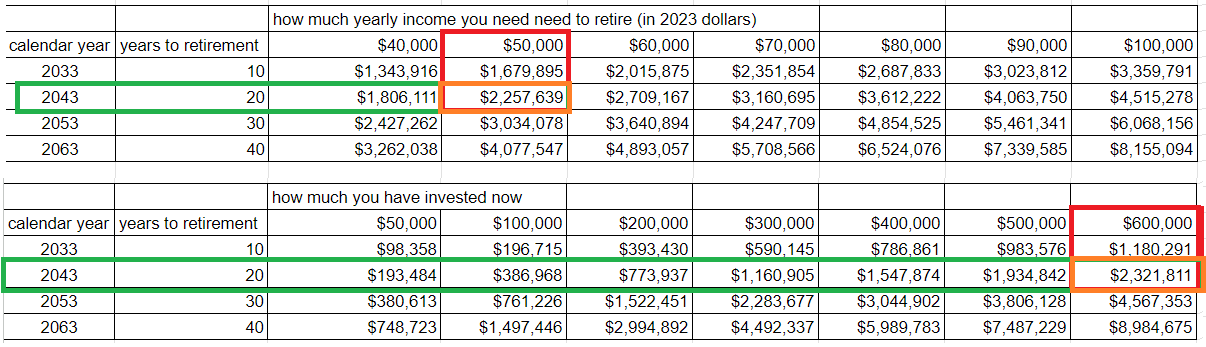
How you read the below table is:

Identify from the top row “how much yearly income you need to retire (in 2023 dollars). So if you are spending say $50,000 this year and you think you’ll continue to spend that much in retirement go to that column.

Then identify your age and the age you want to retire. 

For this example say you are 40 and you want to retire at 60.

60-40 = 20 years to retirement. So you look in the left column and go to the row “20 years to retirement”

Where the column and row intersect is how much you might need to have at that age to retire. 

So in the example, if you are 40 years old, and you want to retire in 20 years and withdraw $60,000 a year (in 2023 dollars) from your portfolio you would probably need to have saved $2.7 million dollars in 2043 dollars)

The dollars in the resulting boxes are all in the calendar year of the year you’d retire. 

So in 2043 you’d need to have $2.7 million to retire. 

The table assumes you can safely withdraw 4% of your portfolio a year. 

4% of $2.7 million is $108,000, but that $108,000 is in 2043 dollars. 

Adjusted for inflation $108,000 is worth $60,000 in 2023 dollars, which is what the top column tells you. 

I tried to make this easy since everyone knows what their current spending is. That is why the top column is in present day dollars.

The next step would be to identify how much money you have now and determine if you’ll have enough at the time you retire to reach the goal in the table above!

The table below helps with that. 

How to read this table is to sum up your investments in all your accounts today.

Ex: 401k, IRA, Brokerage account etc. 

That is the top row.

Again, look at the column to identify “how many years until you want to retire”

The resulting orange box will tell you “how much you will have in that year if you don’t invest another dollar today.”

So in the below table our 40 year old person who wants to retire in 20 years and has $600k in their 401k & IRA & any other investments  will have $2.3 million in 2043, assuming they don’t invest another dollar between today and 20 years from now. 

Now this might at first seem unhelpful because you might be thinking “but they will likely be investing more between now and then”. 

And that is true!

But what this table tells you is that you NEED to invest more to reach you $2.7 million goal from table 1 if you want to retire with your expected withdrawal of $60k a year. 

Here’s a clean table for you to identify yourself on. 

Let’s look at a different scenario:

Say you are 40 years old and think you can live on $50,000/year in 20 years when you retire.

You’d look up that you’d need $2,257,639 in the year 2043 when you retire.

If you look at table 2 you can see that if you have $600,000 invested today, and plan to retire in 20 years you’d have $2,321,811 when you retire. 

Since you need $2.2 million but your investments will grow to $2.3 million this might mean that you don’t need to invest anything else for the next 20 years! 

This idea, that you might not need to invest any more money to retire in the future is known as “CoastFI”.

You can learn more about CoastFI here

Now as I mentioned right at the start there are 2 assumptions in all these tables.

  1. Inflation is 3% every year. It might be more or less in the real world.
  2. Your investments will grow at a steady 7%/year. This will certainly be more or less every year. It’s easy to do math with averages though and over time the ups and downs of the market average out. 

You have to make assumptions like this when doing these types of calculations. These are based on historic averages. Every person needs to do their own calculations or work with a financial advisor to get these numbers exactly right for themselves. 

But these are good starting points to just give you a high level view if you are even close to having enough money or if you’ll need to continue investing!

For most people you are likely going to not have enough invested now that you can stop investing. But how close are you?

Are you millions of dollars away? Or hundreds of thousands? Or only thousands?

I will create another post in the future to try to help understand how much you will need to invest to reach your goal, but I thought this was a sufficiently long post for now.