World Wage and Work

I have been reading and thinking about money, economics, wages,fair wages, trade imbalances and business stuff for years. This is a list of links and some books that I have found interesting related to the topic. I don’t have a take away conclusion from this reading yet. 

“It is utterly clear to me that the highest priority  need of world society at the present moment is a realistic economic accounting system which will rectify, for instance, such nonsense as the fact that a top toolmaker in India, the highest paid of all craftsman, gets only as much per month for his work in India as he could earn per day for the same work if he were employed in Detroit, Michigan.  – Page 112 Operating Manual For Spaceship Earth, Buckminster Fuller

 I am sharing a few articles I’ve read the last years about various impacts of higher wages in different parts of the world. I still don’t have a big conclusion from this.

As jobs are exported slowly the world wide wage should rise, but likely America’s will fall, which is fine. 

I do share the concern that some businesses “can’t afford to pay people $15/hr” but if that is the case should they be businesses?

I mentioned that there are a lot of things that challenge starting businesses (wages/paying SS, and medicare/insurance).

I have been a big proponent that nationwide healthcare will allow smaller businesses to be more competitive with larger businesses because they should only have to compete on wages, not healthcare. This same idea came from Andrew Yang. His book “The War on Normal People” is very good, for many ideas, not just UBI.

 I like the below articles for worldwide perspectives on income and economics.

Australia = $15/hr. Less for 16-18 year olds.

https://www.theatlantic.com/business/archive/2013/08/the-magical-world-where-mcdonalds-pays-15-an-hour-its-australia/278313/

The country allows lower pay for teenagers, and the labor deal McDonald’s struck with its employees currently pays 16-year-olds roughly US$8 an hour, not altogether different from what they’d make in the states. In an email, Greg Bamber, a professor at Australia’s Monash University who has studied labor relations in the country’s fast food industry, told me that as a result, McDonald’s relies heavily on young workers in Australia.

Jobs moved to Mexico. Seems to have worked out well for the new employees in Mexico. Seems to have “busted” the people who lost jobs in USA,

https://www.daytondailynews.com/news/gen-politics/what-happened-when-factory-jobs-moved-from-ohio-mexico/kntmqdH7H95KQBhwBHgixN/

https://jalopnik.com/gm-factory-workers-in-mexico-make-3-an-hour-and-want-a-1848855358

The reason many jobs are moved to Mexico is because the labor rates are so much cheaper there. 

Janevsille: An American Story – Book about what happened when GM plant left Janesville, WI.

These are some of the jobs that moved to mexico from the Janesville book above. 

 Haiti $5 day? – Very interesting discussing moving production based on wages.

https://www.npr.org/sections/money/2011/06/10/137064161/would-a-5-a-day-minimum-wage-make-life-better-in-haiti

Now, of course, to an American audience this seems so minor, so unbelievably reasonable, it’s hard to see how there can be any opposition: Five bucks a day? As a minimum? It’s easy to be outraged that the U.S. government wouldn’t push for a minimum of more. Who can live on five bucks a day?

https://www.npr.org/sections/money/2011/06/10/137064161/would-a-5-a-day-minimum-wage-make-life-better-in-haiti

Haiti’s industry is focused on commodity white T-shirts for brands like Hanes. The commodity white T-shirt is one of the cheapest, easiest things in the world to make. With $500,000 you could buy a bunch of used sewing machines in Alabama or Guangzhou, rent a cement shell in some poor country, and be in business in a few weeks.

In short, Dominican textile workers have real bargaining power because they have real, globally competitive skills. I’m sure manufacturers would love to pay them $3 a day, but they can’t because the Dominicans know how to do stuff that commands a higher wage.

I have no idea what would happen if Haiti did have a $5-a-day minimum wage. But I do think it’s reasonable to assume that some factories would close and far fewer new ones would be built. Far fewer Haitians would be allowed to take that first tentative step on to the ladder of industrial development.

https://qz.com/1064679/a-new-t-shirt-sewing-robot-can-make-as-many-shirts-per-hour-as-17-factory-workers/

It looks like LOWRY sewing robot has been made into a company.

ABOUT SOFTWEAR AUTOMATION

We are an Atlanta-based advanced machine-vision and robotics startup disrupting the $1.5 trillion apparel industry. Our fully automated Sewbots enable on-demand manufacturing by moving supply chains local and closer to the customer, while creating higher quality products at comparable cost to imports from low-wage countries.

This is the future of everything. Automate as much as possible, for mass production. It is how the past has always gone and it’s the way of the future. More things will be automated. Automated things will be cheaper, or they wouldn’t be automated! Cheaper things means people can actually buy more things! Think of TV’s. In 1990 a 20” tv was relatively expensive and maybe a family had 1. Now it’s cheaper to have 3 55” tv’s. 

LA garment worker pay- Many garment workers in the USA are here illegally. The employers should be held responsible for hiring illegal immigrants. They are also taking advantage of these people. 

https://www.cbsnews.com/news/la-garment-factories-investigation/

A 2016 U.S. Department of Labor investigation found pay violations in 85% of the L.A. garment shops it looked into. – How do these places stay in business? If they are investigated and found to be violating the US DOL how do they stay in business????

https://www.jacobinmag.com/2021/10/haitian-dominican-republic-sugarcane-immigration-poverty-rights

Vernette speaks in Haitian Creole, as he has trouble communicating in Spanish.

He arrived in the Dominican Republic “under the fence,” or irregularly, about a year ago.- It appears that illegal immigration is a problem worldwide, and they are treated poorly everywhere.

You Probably Aren’t Saving Enough to Retire

This is an update and expansion of “You Might Need $3 Million to Retire at Age 65”.

See disclaimer at end. There are assumptions in these calculation that inflation is 3% constantly every year.

Your investments will return 7%/year.

These tables change if either of those numbers change. But these are useful historic numbers to help people start thinking if they are in the ballpark of saving enough or not. 

In the previous post I considered how much someone my current age at the time (28), might need to retire when they are 65. I have thought about this and it’s actually quite easy to make a table so that anyone whatever age and income level they think they might need could identify how much they need to save without doing any math!

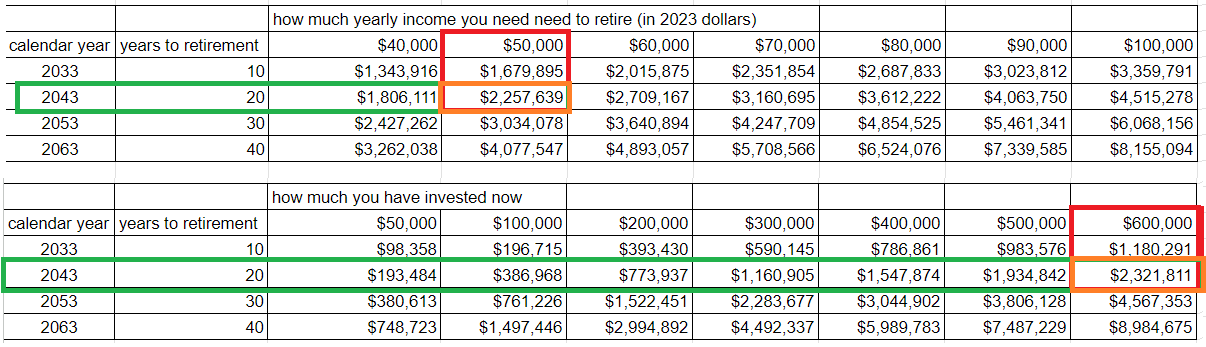
How you read the below table is:

Identify from the top row “how much yearly income you need to retire (in 2023 dollars). So if you are spending say $50,000 this year and you think you’ll continue to spend that much in retirement go to that column.

Then identify your age and the age you want to retire. 

For this example say you are 40 and you want to retire at 60.

60-40 = 20 years to retirement. So you look in the left column and go to the row “20 years to retirement”

Where the column and row intersect is how much you might need to have at that age to retire. 

So in the example, if you are 40 years old, and you want to retire in 20 years and withdraw $60,000 a year (in 2023 dollars) from your portfolio you would probably need to have saved $2.7 million dollars in 2043 dollars)

The dollars in the resulting boxes are all in the calendar year of the year you’d retire. 

So in 2043 you’d need to have $2.7 million to retire. 

The table assumes you can safely withdraw 4% of your portfolio a year. 

4% of $2.7 million is $108,000, but that $108,000 is in 2043 dollars. 

Adjusted for inflation $108,000 is worth $60,000 in 2023 dollars, which is what the top column tells you. 

I tried to make this easy since everyone knows what their current spending is. That is why the top column is in present day dollars.

The next step would be to identify how much money you have now and determine if you’ll have enough at the time you retire to reach the goal in the table above!

The table below helps with that. 

How to read this table is to sum up your investments in all your accounts today.

Ex: 401k, IRA, Brokerage account etc. 

That is the top row.

Again, look at the column to identify “how many years until you want to retire”

The resulting orange box will tell you “how much you will have in that year if you don’t invest another dollar today.”

So in the below table our 40 year old person who wants to retire in 20 years and has $600k in their 401k & IRA & any other investments  will have $2.3 million in 2043, assuming they don’t invest another dollar between today and 20 years from now. 

Now this might at first seem unhelpful because you might be thinking “but they will likely be investing more between now and then”. 

And that is true!

But what this table tells you is that you NEED to invest more to reach you $2.7 million goal from table 1 if you want to retire with your expected withdrawal of $60k a year. 

Here’s a clean table for you to identify yourself on. 

Let’s look at a different scenario:

Say you are 40 years old and think you can live on $50,000/year in 20 years when you retire.

You’d look up that you’d need $2,257,639 in the year 2043 when you retire.

If you look at table 2 you can see that if you have $600,000 invested today, and plan to retire in 20 years you’d have $2,321,811 when you retire. 

Since you need $2.2 million but your investments will grow to $2.3 million this might mean that you don’t need to invest anything else for the next 20 years! 

This idea, that you might not need to invest any more money to retire in the future is known as “CoastFI”.

You can learn more about CoastFI here

Now as I mentioned right at the start there are 2 assumptions in all these tables.

  1. Inflation is 3% every year. It might be more or less in the real world.
  2. Your investments will grow at a steady 7%/year. This will certainly be more or less every year. It’s easy to do math with averages though and over time the ups and downs of the market average out. 

You have to make assumptions like this when doing these types of calculations. These are based on historic averages. Every person needs to do their own calculations or work with a financial advisor to get these numbers exactly right for themselves. 

But these are good starting points to just give you a high level view if you are even close to having enough money or if you’ll need to continue investing!

For most people you are likely going to not have enough invested now that you can stop investing. But how close are you?

Are you millions of dollars away? Or hundreds of thousands? Or only thousands?

I will create another post in the future to try to help understand how much you will need to invest to reach your goal, but I thought this was a sufficiently long post for now.

What is Counterfeit money?

Former Chairman of the Federal Reserve Alan Greenspan explains how the United States can pay down the debt. By printing money. Transcript:

David Gregory, moderator of “Meet The Press” on NBC: “Are U.S. treasury bonds still safe to invest in?”

Alan Greenspan, Former Chairman of the Federal Reserve: “Very much so. This is not an issue of credit rating, the United States can pay any debt it has because we can always print money to do that. So, there is zero probability of default.”

If I were to print new money it would be counterfeiting, which is illegal in the USA, and every other country in the world. When the US government creates new money it is not counterfeiting. The action and result is exactly the same, there are more dollars in circulation, except in magnitude. If I were to print new money it’d be maybe $1 million? When the government creates new money it is $1 trillion! Every year! What’s the difference? Every new dollar decreases the purchasing power of every dollar that currently exists. Why do we put up with this?

Silver – Buying and Premiums

I bought my first silver 1 oz coin just over a year ago. I ended up paying $24.25 from a local coin shop. At the time the silver spot price was $19.43. This means I paid a premium of $4.82 or 24.81%. This was actually the lowest premium I paid for quite a while until November 2022 when I found some sales on www.SDBullion.com

By that time the silver spot price had risen to $21.43 and I paid $25.97 or $4.54 premium which was a 21% premium. The high premiums were partially because these were on sale. I was paying these 20%+ premiums because the stock market was doing poorly and people were selling out of stocks and buying into precious metals because they were seen as safe. 

Today, the stock market has been roaring, most of the year. The S&P 500 is up 17% this year as I am writing this. When the stock market is going up, people often sell gold and silver, and bonds, and buy into the stock market. 


When people aren’t interested in something is when you should consider buying it, if you are going to. 

The best deal I found was these 1 oz Golden State mint generic silver coins. The silver spot price was 22.84 and they were selling for a $2 premium, $24.84! Or 8.7% premium. This is just a little more than the first silver I bought over 1 year ago when the spot price was $19.43 or $3.41 lower than it is today. $24.84 is also lower than I paid in November 2022!

This is a trend I’ve watched over the last year. The spot price for gold and silver has risen but the premiums have actually fallen more! This makes it possible for you to buy the same amount of silver or gold for less than was possible a year ago, despite the higher spot price. 

The 2 websites I check frequently are https://sdbullion.com/deals . Specifically their “Doc’s deals” page which is linked here. The 2nd is https://monumentmetals.com/deals.html?page=1 Monument Metals – Deals page also. Basically every metals dealer has a “deals” page. And when you are looking for the cheapest premium that is often where it is. 
Other good sites are JM bullion (although usually more expensive) or as mentioned at the start Golden State Mint


The deals change weekly. It’s even possible that premiums or spot price continue to go down in the future! Buyer beware!


Read this before considering metals and know why you are buying physical metals, similar to any purchase or investment.

What Problem Does a Central Bank Digital Currency (CBDC) Solve?

If you read my previous post you will learn what problem bitcoin is trying to solve. But there is another thing that governments love to talk about when anyone mentions bitcoin or cryptocurrencies. To be clear on the difference between bitcoin and cryptocurrencies read this. The thing Governments love to bring up is a Central Bank Digital Currency or a CBDC for short.  

What is a CBDC and what benefit does it have? The most important thing to know about a CBDC is it is 100% Government controlled, just like money today. It has no limit on how much of it there can be.  Because of this they can create more new CBDC everyday and reduce the value of the ones you own.  This is inflation and that is the problem that bitcoin solves by having a limit that is 21 million bitcoin ever. The fact that  CBDC does not have a limit, means it is not a substitute for bitcoin and you should not be fooled by anyone on tv, or anywhere, saying a CBDC can replace bitcoin and now we don’t need bitcoin.

One thing a CBDC may do is either make settlements at the store faster or international settlements faster. Today international settlements usually go through a company like Western Union.  It is very expensive to send money out of the country. Visa and Mastercard process most payments via their credit system and charge between 1.5%-4%  to the businesses using their network. A CBDC could remove the need for Visa and Mastercard and for Western Union. Basically it could remove any intermediaries as a CBDC would be infinitely and immediately traceable. While to me all our money seems digital and traceable anyway, a CBDC would make it even more easily so. There may be a push from a government to use it as a form of punishment or denial of purchase for certain things which would be another option that opens up even more with the abilities of a CBDC. For example the government could say that buying meat is bad or buying more than 1000g/ month of meat is illegal and could limit your CBDC credit card to purchases of meat, or anything they wanted. 

The main point I wanted to help people understand with that post is that a CBDC certainly does not do anything that would replace bitcoin or reduce inflation and could even potentially be used to control purchases by individuals.

Consider buying a little Bitcoin!

What Problem Does Bitcoin Solve?

To understand the reason behind why some people (like me) buy bitcoin you need to think about the problem we think bitcoin is trying to solve.  When you use a government currency, like USD, the Government can effectively steal value from your bank account via money printing. How does this work?

To understand that you need to understand what the point of money is. Money is just a measurement of the value of something.  We have all been trained that the value of things goes up over time because the price goes up over time. But just because a house rises in value by $100k over 5 years,  does not mean its intrinsic value has risen. It’s the same house providing the same amount of shelter.  It really shouldn’t gain value. What has really happened is the money,  used to measure the value of the house, has lost value! It’d be like if you used a tape measure with 12 inches to 1 foot  to measure a board and then you changed the tape measure to use 13 inches to 1 foot,  where the foot is still the same length but each inch is smaller so you have “more inches”. But is the 1 foot board actually any more useful or longer if you use 13 shorter inches or 12 inches to 1 foot? No.  This is how the government confuses us. They print more money and then our houses “go up” in value,  but it’s because the measuring stick is changing.  Why does the government do this though? They do it because that’s how they pay for the $1 trillion to $4 trillion budget deficit the Government has each year. 

In WW1, while we were on the gold standard (every dollar was supposedly able to be converted back to gold at a bank), the government had to sell “war bonds” to pay for the war.  This at least provided a little link between Americans turning over money for what they thought was a just cause. If people didn’t buy the bonds the government couldn’t pay for the war. 

Since the US dollar was removed from the gold standard in 1971, the Government has had no restrictions on how much money they can print. The US government is able to fund any war ad infinitum via money printing. When this new money is printed the government uses it to buy good (ships,  tanks,  steel, sometimes roads,  etc). Since they have unlimited purchasing power they can keep printing money until they can pay for what they need.  Meanwhile,  the average person might be unable to buy a new truck because the price of steel was pushed up by the government demanding 200 billion tons of steel for planes and warships.

When thinking about if you should buy bitcoin this is the fundamental issue you need to consider, how is my purchasing power being diluted via inflation? 

Since bitcoin has a limited supply (21 million) as more US dollars are printed a single bitcoin’s value, measured in USD, or any other currency, will continue to go up. 

In fact bitcoin recently hit all time highs, when measured in Argentine pesos,  Lebanese pounds and Venezuelan bolivars

This is due to those countries experiencing extremely high levels of inflation 50%-100% a year.  I can’t even imagine what that would be like to live in. At 100% inflation,  or even 50% you need a raise every paycheck! Your money would lose 1% of its value every week at 50% inflation.

While it seems like high inflation only happens in “far away” places with bad Governments that’s not the case. It has happened thousands of times in history

We, every person in the world, is in a fight with their own government to keep as much of the value they create as they can.  The government explicitly taxes you, which we can debate but at least it is obvious.  But the government also stealthy steals value from your bank account or savings via inflation and money printing that you have no control over. 

Because in the USA inflation has been a relatively small issue (1%-3%) for most of the last 25 years most people in the USA haven’t thought about wealth preservation much.  Now that we’ve seen 10% inflation it’s new to people and they aren’t sure how to protect their purchasing power! A bond paying 5% is really losing 5% a year to inflation if inflation is 10%.

I know bitcoin is volatile but the inherent properties of it (ultimate scarcity, 21 million total coins ever), make it the best chance we have ever had to get out of the system and protect our wealth. If bitcoin doesn’t succeed then we will have lost every opportunity to preserve value!

 I think that is a cause worth supporting, by buying and holding Bitcoin. And you’re not just supporting it, but you’re protecting your wealth! 

I have written politicians and blog posts trying to encourage people to understand this while bitcoin is relatively cheap ($30k). I know once it is $50k or $100k more people will have Fear Of Missing Out and will buy in which could happen in the next year or 2. It’s best to learn about bitcoin when it’s price isn’t rising like crazy and you aren’t having FOMO. 

If you’ve wondered this last year or 2 how to avoid losing value to inflation I’d enjoy talking to you more about bitcoin. I only recommend 1% of your net worth in it to start.  So if you have $100,000 of net worth you can just buy $1,000 worth of bitcoin. That’s a small risk to be part of a monetary revolution that just might pay off. 

Bitcoin Letter to a Politician 2023

I try to occasionally share my thoughts with politicians that represent me. Who knows how much they take heed of what we say? We all have our own pet projects that interest us and perhaps these don’t interest our politicians. I also try to share my thoughts with others through this blog and in person, in hopes that it will influence them to also come around to my way of thinking. That all being said, below is an email I recently sent to an Iowa state representative about Bitcoin. The history is this person is a Democrat. We have had a couple previous emails about Bitcoin and they were concerned about the environmental impacts of Bitcoin.

Dear Representative – 

Quick thoughts for the night. I really hope you will continue to learn about bitcoin. It is a  very important tool for protecting individuals’ wealth in the future. It is also helping people in developing countries today.

Perhaps you’ve seen this article sent to the US Congress by Human Rights leaders asking them to learn about how bitcoin is helping the poorest in the world.

The next article and video are complimentary. 

Bitcoin helps people in developing countries. 

The other point about bitcoin mining specifically is it helps reduce emissions.  It does not add emissions.  It uses the cheapest waste power. Most miners have load sharing agreements to turn off when excess power is needed. This is good for grid stability and for emissions reduction. 

There is a bitcoin mining company in town partnering with Cedar Falls Utilities. I urge you to talk to both CFU and the miner about their agreement. 

https://simplemining.io/

Bitcoin mining reduces Emissions

Bitcoin mining is also able to help subsidize grid build out in developing nations.

Finally,  the US military paid for Jason Lowery to attend MIT for 2 years to learn about bitcoin and its national security implications.  He released his thesis on this and I have read it and you can too.

Softwar: A Novel Theory on Power Projection and the National Strategic Significance of Bitcoin – By Jason Lowery

Please consider the points I have presented here.

Of note,  I voted for Joe Biden in 2020 as we could not have another Trump.  I have already decided I will not be voting for Biden again as he has proposed a 30% tax on bitcoin mining.  This shows me he has no understanding of bitcoin. Or he knows it’s threatening to the USD and the government is fighting tooth and nail to ban it. Either way, I prefer freedom.  I do not like the government devaluing my money every day with the $1T +deficit. I didn’t like it under, George Bush,  under Obama, under Trump or under bBiden. 

Please watch this very short video on this (30 seconds).

I hope others will consider writing to their local politicians to inform them of the good that Bitcoin does. They also need to know that they will not be getting votes if they are against something we are for. This applies to everything. It would be good for more people to write their politicians on all topics. Let this be an inspiration to you. If you want you could even copy this one and send it to your local politician.

EV News – 2022 Reveiw and 2023 Coming Soon!

I had a short conversation with someone about EV’s (electric vehicles) who admitted that they didn’t know much about the current adoption/industry. I took it upon myself to gather a few highlights from 2022 as well as some info about exciting near term developments for 2023. Below are those articles!

A short deviation from all the EV stuff that will follow.

Porsche begins production of ‘e-fuel’ that could provide gas alternative amid EV push. Porsche said Tuesday that a pilot plant in Chile started production of the alternative fuel, as it aims to produce millions of gallons by mid-decade.

https://www.cnbc.com/2022/12/20/porsche-starts-production-of-e-fuel-that-could-provide-gas-alternative.html

 A big deal for 2023 is that most EV’s are again open to the $7,500 tax credit, depending on where the batteries are made and some other rules.

Previously after any specific manufacturer had sold 200k EV’s that company’s cars would lose a tax credit.

So GM and Tesla EV’s were not getting a $7,500 tax credit at the end of 2022 while Ford’s were.

https://www.irs.gov/credits-deductions/credits-for-new-clean-vehicles-purchased-in-2023-or-after

Tesla Cybertruck – Many Tesla fans are closely watching as tooling rolls into the Texas production plant, getting ready for Cybertruck production later in 2023!

Tesla takes delivery of army of robots to build Cybertruck

Tesla Cybertruck Coming, Giga Press Shipments Arrive At Giga Texas

https://insideevs.com/news/630127/tesla-cybertruck-coming-giga-press-shipments-arrive/

TeslaSsemi – Initially 36 delivered to Pepsi. More being delivered in 2023

500 mile range on the Tesla Semi, pulling a load.

Tesla expanding Texas plant – $700 million capital expenditure https://electrek.co/2023/01/10/tesla-applies-massive-million-expansion-gigafactory-texas/

Vinfast – Vietnamese car company. Up and coming! Sounds like a bit of a rough start though.

Part of a huge company – Vingroup that seems to own everything in Vietnam.

https://jalopnik.com/vinfast-vf8-electric-car-first-drive-not-ready-for-u-s-1849892217

 Vingroup Joint Stock Company is the largest conglomerate of Vietnam,focusing on technology, industry, real estate development, retail, and services ranging from healthcare to hospitality. The company was founded by property developer and entrepreneur Phạm Nhật Vượng.

https://en.wikipedia.org/wiki/Vingroup

It’s hard to tell how many cars Vinfast has sold in 2022. It sounds like only a few thousand. But hopefully they will start producing more in 2023! More EV companies the better.

https://www.marklines.com/en/news/274025

 Ford

The company said it sold 15,617 F150 Lightning EV pickups in 2022. Plans to sell many more in 2023. 

 Rivian

On a full-year 2022 basis, Rivian produced 24,337 electric vehicles and delivered 20,332 to customers. Rivian is a new EV only car (currently only making Trucks and SUV’s) company.

https://insideevs.com/news/629288/rivian-ev-production-deliveries-2022q4

VW bus -ID.Buzz –

saw the start of production of the ID.Buzz electric van after it was officially unveiled last March.

6,000 Buzz deliveries alone by the end of 2022

 In 2022, 20,511 Volkswagen ID.4 (small electric sedan) were sold in the US, which is 22.5 percent more than in 2021 (16,742) and 6.8 percent of the brand’s total volume. Cumulatively, more than 37,000 ID.4 were delivered to customers

https://insideevs.com/news/629719/us-volkswagen-id4-sales-record-2022q4/

2023 Chevy Bolt EV and EUV get $6,000 price cut, start at $25,600 –. Probably cheapest/best value EV for sale in USA.

Canoo – New EV company. Has multiple sale agreements with Walmart, US military, others.

https://www.press.canoo.com/press-release/walmart-purchases-canoo-electric-delivery-vehicles

United states post office – Personally I think this is a great application for EV’s. standard daily route length. Can recharge at night. Should save USPS a lot of money. 

https://about.usps.com/newsroom/national-releases/2022/1220-usps-intends-to-deploy-over-66000-electric-vehicles-by-2028.htm

 o Postal Service anticipates increasing the quantity of purpose-built Next Generation Delivery Vehicles (NGDV) to a minimum of 60,000 of which at least 45,000 will be battery electric by 2028. NGDV acquisitions delivered in 2026 and thereafter expected to be 100% electric.

o Postal Service expects to purchase an additional 21,000 battery electric delivery vehicles through 2028, representing a mix of commercial-off-the-shelf (COTS) vehicles. Acquisitions delivered in 2026 through 2028 expected to be 100% electric.

 Chinese EV companies – NIO, Xpeng, Li auto – are the 3 new big upcoming Chinese EV companies.

NIO – . NIO delivered 122,486 vehicles in 2022 in total, increasing by 34.0% year-over-year. Cumulative deliveries of NIO vehicles reached 289,556 as of December 31, 2022.

https://www.nio.com/news/nio-inc-provides-december-fourth-quarter-and-full-year-2022-delivery-update

Nio is also working on battery swap stations, not just charging like most other EV companies are doing.

https://insideevs.com/news/622519/nio-1200-battery-swapping-stations-china-2022/

Xpeng – Xpeng ranked third, delivering 11,292 vehicles in December, down from 16,000 last year, for a total of 120,757 in 2022.

Li Auto – They are the 3rd hot Chinese EV car company. Honestly I don’t know much about them but apparently they delivered just slightly more EV’s than Nio or Xpeng in 2022 (Li Auto – 133,000 deliveries in 2022. See above link.

BYD – BYD auto is a legacy car company that has delivered a lot of hybrids in china.They sell more plug in hybrids than pure EV’s. but still a good company/force in EV world.

https://insideevs.com/news/629273/byd-plugin-car-sales-december2022/

In 2022, BYD sold more than 1.85 million plug-in electric cars, more than tripling its 2021 result of 593,745. This makes the company the world’s largest manufacturer of rechargeable cars, although, in the case of all-electric cars, Tesla still has a significant edge (over 1.3 million deliveries).

BYD plug-in sales year-to-date:

BEVs: 911,141 (up 184% year-over-year)

PHEVs: 946,238 (up 247% year-over-year)

Total: 1,857,379 (up 213% year-over-year)

Check your Financial Privilege

I recently read an interesting book called Check Your Financial Privilege- Alex Gladstein.  This started as a series of posts on Bitcoin Magazine. 

You can read some of the articles below.

Check Your Financial Privilege

 UNCOVERING THE HIDDEN COSTS OF THE PETRODOLLAR

FIGHTING MONETARY COLONIALISM WITH OPEN-SOURCE CODE

CAN BITCOIN BE PALESTINE’S CURRENCY OF FREEDOM?

The reason for the book is because they are very long and in depth articles such that many people may not read them on the internet. But if you want to, they are free there. 

Living in the USA it’s very easy to take a US centric view of the world. That view involves a relatively stable currency, at least for the last 40 years. The last time we really saw high inflation was 1982 when it was 6% and the few years before that. Since then it’s been under 5% and some years as low as 1%. Many other countries have not had this privilege. 

In the USA we also have a pretty robust stock market, averaging 9%/year in gains and usually about 6% over inflation.

Because many people are unable to trust their own currency they try to trust the USD to maintain their local purchasing power. This is not always practical as trying to transact in a foreign currency can cause a lot of confusion. Change may also not be available. 

Two countries that I highlight below have had very high inflation over the last year (and years), relative to the USD. Those countries being Argentina and Haiti. They have lost 25% vs USD  for Argentina Peso and 27% for the Hatian Gourde respectively.

Many people complain about Bitcoin’s volatility. For example, if you had bought BTC in the USA 1 year ago you would be down 20% but since these other countries have such high inflation if people in Argentina and Haiti had held BTC instead of their local currency they would have maintained their purchasing power instead of losing 25%.

Even the Euro, which is a relatively stable currency, has only lost 7% relative to BTC over the last year, whereas the USD has lost 20% over the last year. Bitcoin’s performance over the last year relative the the dollar, the strongest currency, which is not widely available, really only highlights the benefits of the dollar being the world reserve currency. 

Compared to many other assets, bitcoin has performed very well, even when measured against the Euro!

This is what is meant when saying we should “Check our Financial Privilege”. A real fear is that perhaps the USA will fall victim to extreme inflation in the future. 

While stocks have historically been an inflation hedge and will likely continue to be the best hedge, the USD as the world reserve currency may have completed its time. The world reserve currency has changed many times in the past. Before WW2 the British Pound was the world reserve currency. Before that it was the Dutch Guilder, which doesn’t exist anymore.

For a very interesting history on that you can read Principles for Dealing with the Changing World Order: Why Nations Succeed and Fail – Ray Dalio.

Here is a short (1 hr) Youtube Video summary of the book, by the author, if you don’t want to read the book.  https://www.youtube.com/watch?v=xguam0TKMw8

In conclusion, when considering if “bitcoin is good for me” you should try to expand your scope a little. While you may not realize the problem of inflation, even low inflation, as it’s been ever present, many people around the world have seen the damage inflation has done and see the potential that bitcoin may provide to hedge against inflation.

USD to BTC –
May 22, 2021 – $37,59610
May 22, 2022 – $29,985.50
20.25% decrease

Hatian Gourde to BTC –
May 22, 2021 – 3,318,494.21
May 22, 2022 – 3,361,197.64
1.29% increase

Argentine Peso to BTC –
May 22, 2021 – 3,541,519.54
May 22, 2022 – 3,549,033.05
0.21% increase

Hatian Gourde to USD
May 22, 2021 – 88.27
May 22, 2022 – 112.09
27% increase

Argentine Peso to USD
May 22, 2021 – 94.20
May 22, 2022 – 118.47
25.7% increase

Euro to USD
May 22, 2021 – $1.22
May 22, 2022 – $1.06
13.1% decrease

Euro to BTC
May 22, 2021 – 30,863.91
May 22, 2022 – 28,415.65
7.93% decrease

Bitcoin

I’ve been thinking about bitcoin off and on since approximately 2017. More intensely since about Dec 2020. Here is a short distillation of my thoughts. 

My main interest in bitcoin is not bitcoin itself but its characteristics of being “hard” currency. Currency that can not be debased or inflated for use by a central authority. Beyond that, bitcoin itself has very few special properties. Any economic research that is interested in sound monetary policy applies to bitcoin, of which there has been much

But Bitcoin does have a few key properties that give it great benefits as a sound monetary unit. 

Bitcoin is much better than gold, the historical hard currency, as a hard currency. 

It has 3 key features. 

One. It can be purchased or transacted from your home, or anywhere else with internet access, to anywhere else with internet access. I can send bitcoin to anyone in China, Haiti or Argentina, or next door. 

Two. It can be split into much smaller pieces than gold. The smallest unit of a bitcoin is a Satoshi. With $1 you can buy ~ 2100 satoshis today (when 1 full bitcoin is worth $~$46,000)  whereas transacting in gold in small useful units is basically impossible. You cannot really buy $1 worth of gold or even $100. 1 oz of gold is nearly $1k. 1 gram of gold is still ~ $60. That is not a useful transaction unit at all. 

The third is that bitcoin has a hard fixed amount that will ever be created. Gold is not truly scarce in the universe. While mining gold is difficult and allows a relatively fixed amount. There is still growth in the total gold supply each year and potential to find new deposits at any time or get a massive amount from asteroids in space. In contrast, Bitcoin is capped at 21 million bitcoins that will ever exist, providing ultimate scarcity. 

For a primer on bitcoin, I recommend the Fidelity Paper Bitcoin First

Sound money not only imposes fiscal discipline upon government, impeding reckless federal spending and imprudent warfare, but it also provides a stable unit of account, store of value, and medium of exchange for entrepreneurs, businesses, and individuals.” 

If you have any interest in talking about bitcoin let me know!