What to Buy in 2025? My Thoughts on Global Investing

Quick Take:
International markets are finally outperforming the U.S. in 2025, with VXUS up 25% versus the S&P 500’s 13%. But much of that gain is tied to a weakening dollar and global money printing — not just fundamentals. I also see potential in small-cap value stocks and India as a long-term growth story. – Not financial advice!

I was replying with a long comment to a YouTube video about investing, and it turned into something worth sharing here. I’ve cleaned it up a bit to make it flow like a proper post — but the ideas are the same: how I’m thinking about markets right now and where opportunities might lie.

When people ask me what to buy, I always start with one key principle:
focus on total return, not dividends.

Dividends are nice, but they’re just one piece of the puzzle. What really matters is total return — the combination of price growth plus dividends. That’s what grows your wealth over time.


International Markets Are Finally Waking Up

In November 2024 a friend told me what a dog his internationl stocks were and said he was going to sell them adn buy all S&P 500 I mentioned to him the idea of reversion to the mean While I was rewarded quickly, after years of underperformance, international markets have been on an absolute tear in 2025.

  • VXUS — the total international ETF (about 25% emerging markets) — is up roughly 25% year to date.
  • VWO, which tracks only emerging markets, is up around 21%.
  • Meanwhile, the S&P 500 (VOO) is up just 13% this year.

It’s been a long time since we’ve seen this kind of outperformance from non-U.S. stocks. But before we get too excited, it’s worth asking why.


Factors Driving International Resurgence

Several factors have driven the recent resurgence in international markets.
Concerns about the U.S. trade war and tariffs have pushed investor attention abroad, while a weaker U.S. dollar has amplified gains for dollar-based investors holding foreign assets.

The U.S. Dollar Index has declined roughly 9% this year, giving a lift to unhedged international equities.

That currency impact is easy to see when comparing VXUS to hedged strategies.
For example:

  • Xtrackers MSCI EAFE Hedged Equity ETF (DBEF) and
  • iShares Currency Hedged MSCI EAFE ETF (HEFA)

are both up about 11.4% this year — solid returns, but well below the 25% gains seen in unhedged funds like VXUS.

In other words, a large portion of the international rally is being driven by the decline in the U.S. dollar, not just by improving fundamentals abroad.

👉 You can read more about this dynamic in a recent ETF.com article here:
“VXUS Tops $100B as ETF Investors Embrace International Stocks”


Inflation, Money Printing, and “Bigger” Returns

I suspect that in the future, the stock market’s returns might look higher than historical averages — not necessarily because companies are more productive, but because money printing and inflation are inflating nominal returns.

Historically, the S&P 500 returned about 11% per year, with maybe 3% of that driven by inflation and monetary expansion.
If we enter a world where inflation runs closer to 7%, then even if the real return stays about the same (around 8%), the headline number could look like 15% annual returns.

Obviously, that’s not guaranteed — just a thought experiment. But it’s a good reminder that higher nominal returns don’t always mean higher real returns.

Be Greedy When Others Are Fearful

Warren Buffett’s old rule still applies:

“Be fearful when others are greedy, and greedy when others are fearful.”

So what are investors fearful of right now?
Small-cap stocks.

  • VIOV (small-cap value ETF) is up only 2% this year.
  • VB (small-cap blend) is up around 6.5% year to date, and about 52% over the past 5 years.
  • The S&P 500, by comparison, is up 90% over that same period.

Historically, small caps have outperformed large caps over the long term — and markets tend to revert to the mean. That doesn’t mean small caps will outperform next year, but it might be time to start paying attention to them again.


A Closer Look at India

One specific market I’ve been watching is India, through the INDA ETF. I’ve personally allocated about 1% of my portfolio there. While it is actually -1% for the year that adds to it’s intregue! As I noted you want to consider buying the losers as they will likely revert to their mean higher returns.

I’ve traveled to India and work with suppliers there who produce castings and tubing. The country reminds me a lot of where China was a couple of decades ago — rapid growth, huge labor pool, and rising industrial capacity.

Here’s a quick comparison:

  • Average income in India: about $2,000 per year
  • Average income in China: about $15,000 per year

India also has another advantage — it’s a democracy, politically more aligned with the U.S., and open to global capital and trade. That combination of low base income (meaning huge growth potential) and political stability makes India a fascinating market to watch over the next decade.


Wrapping It Up

So, what should you buy?
That depends on your goals — but here are the themes I’m watching:

  • International markets, especially emerging economies
  • Small-cap value stocks that have been left behind
  • And long-term growth plays like India

Just remember — higher returns on paper may reflect inflation, not real productivity. Always think in terms of real value creation, not just nominal gains.

And, of course, this isn’t financial advice — just my perspective on how I’m thinking about global investing in 2025.

What do you think? Are you adding international exposure or doubling down on U.S. stocks?
Share your thoughts below — I love reading different perspectives on where people see opportunity.


How I’m Using Covered Calls on Tesla as a “Safe” Portion of My Portfolio


Disclaimer – If you aren’t comfortable with all potential outcomes, including your Tesla shares dropping 50% in value, you shouldn’t consider this idea. 

You also should not consider this if you are unfamiliar with trading options. 

I am only sharing this to share information and educate. 

I’ve been a Tesla shareholder for years, and I don’t plan to sell my core position anytime soon. But I’ve also been learning about covered calls as a way to generate income at a higher rate than today’s money market funds which currently are paying ~3.5% and going down as rates decrease!. Right now, I see the potential for about a 14% annual yield using this strategy — and I want to take advantage of that while keeping my long-term conviction in Tesla intact.


What’s a Covered Call?

A covered call is one of the simplest options strategies. It works like this:

  • You own at least 100 shares of a stock. Most options are written where 1 option = a contract for 100 shares.
  • You sell a call option to someone else, giving them the right (but not the obligation) to buy your shares at a set price (the strike price) by a certain date. For example – “You have the option to buy 100 shares of Tesla from me at $600 on or before 3-20-2026”
  • You are paid a premium when you sell the option.

Two big things can happen:

  • If the stock stays below the strike price, the option expires worthless. You keep both the shares and the premium.
  • If the stock rises above the strike, you may have to sell your shares at that strike price. You still keep the premium, but you miss out on gains beyond that level.

Think of it like renting out your shares — you earn income while you hold them, but you’re capping your upside in exchange.


Why Tesla?

Tesla is currently trading around $440. My existing 400 shares make up about 12–13% of my overall portfolio (roughly $176k out of $1.4M). That’s a meaningful bet, but not my entire net worth. I personally have never looked at options before when I had less money. But I am considering it now with a very small part of my portfolio. 

I’ve been holding Tesla for years and plan to continue. I believe in its long-term growth story, Elon Musk’s ability to deliver, and even the possibility of the company eventually reaching an $8 trillion valuation — nearly 6x its current $1.38 trillion market cap. That would potentially happen if Tesla hits all the growth targets in Elon’s proposed new pay package, that is voted on in November 2025. I have already voted yes and hope everyone else does also!

That conviction is what allows me to buy an extra 100 shares — not to hold forever, but to use specifically for covered calls.


The Trade

  • Underlying: Tesla at ~$440
  • Shares purchased for strategy: 100 ($44,000)
  • Option sold: $600 strike, expiring March 2026
  • Premium collected: ~$30/share = $3,000

The Three Outcomes

Here’s how the trade plays out depending on Tesla’s price by March 20th, 2026:

ScenarioTesla PriceOutcomeReturn
1. Tesla < $440Falls below my purchase priceShares drop in value, but I still keep the $3,000 premium. I’ll hold and sell another call in 6 months.Paper loss on stock, but income cushions downside
2. Tesla $440–$600Rises but stays under $600I keep both the shares and the $3,000 premium.~7% in 6 months (~14% annualized) + stock appreciation
3. Tesla > $600Blows past $600Shares are called away at $600. I keep the $3,000 premium plus $16,000 in gains ($160/share).~$19,000 profit on $44,000 (~43% in 6 months)

How This Fits My Long-Term Tesla Plan

Part of my long-term Tesla strategy for my original 400 shares has always been to gradually divest once it grows too large a percentage of my portfolio — say once it approaches 30–50%.

This covered call approach fits that plan perfectly: it generates income now and gives me a way to get paid while reducing exposure if Tesla keeps climbing.

  • At $600/share, my portfolio would grow to about $1.5M, and Tesla would represent ~$300k of that (~20%). If 100 shares are called away, I’d reduce Tesla to 400 shares ($240k), which still leaves me with significant exposure.
  • At $800/share, my portfolio could be around $1.6M. Selling another 100 shares would leave me with 300 shares worth $240k — still ~15% of my portfolio, almost the same weighting Tesla holds today (~12.6%). This is assuming the rest of my portfolio doesn’t also rise. It likely would so really Tesla would end up an even smaller percentage of my portfolio.

So even as I trim, Tesla stays a core but not outsized piece of my investments.


The Long-Term Upside

At $800/share, Tesla would be about a $2.5 trillion company. Even if I’m down to 300 shares at that point, that’s still $240k invested.

And if Tesla grows to an $8 trillion valuation as some expect — a 3.2x increase from $2.5T — my 300 shares could climb to about $768k.

That means even after trimming, I’d still capture massive upside if Tesla’s long-term growth story plays out.


Why This Works for Me

  1. It’s a small slice of my overall portfolio. At ~$44,000, the covered call sleeve is just 3% of my total assets. That makes it a safe experiment that doesn’t threaten my financial foundation.
  2. My core Tesla is protected. My long-term 400 shares are untouchable. The 100 new shares are my “income Tesla” — designed to work harder without risking my conviction stake.
  3. All three outcomes are acceptable. If Tesla dips, I’ll just sell another call. If it grinds sideways, I pocket income. If it rips higher, I still earn a great return, even if I give up some upside.
  4. It aligns with my long-term plan. Selling calls is a structured way to generate income and gradually reduce Tesla’s weight in my portfolio as it grows.
  5. Conviction makes it possible. I’m comfortable capping the upside on 100 shares because I still own 400 more shares that will fully benefit if Tesla continues to grow. This way, I get income from a small slice of my position, while my larger core holding remains positioned for the long-term upside.

Testing My Future Retirement Plan

This trade is also a trial run for my early retirement plan. If I eventually trim my Tesla position to around $240k (say 300 shares at $800), I could use the same covered call strategy to generate income.

At ~14% annualized, that $240k could potentially produce about $33k per year in income — without me ever touching the rest of my portfolio.

That’s a powerful idea: one high-conviction stock position, managed carefully with covered calls, could provide a meaningful cash flow stream in retirement while my index fund base continues to compound.


My Investing Context

Most of my portfolio is in index funds. That’s my base strategy — low-cost, diversified, and reliable.

But Tesla (and Bitcoin) are my two exceptions. I’ve listened to years of Tesla content, followed the company’s progress, and watched Elon Musk repeatedly deliver on ambitious goals. I believe in the growth story.


Final Thoughts

Covered calls aren’t “free money.” They limit your upside, and they only work if you’re comfortable with all possible outcomes. For me, splitting my Tesla into two buckets — 400 shares conviction hold, 100 shares income strategy — strikes the right balance.

Tesla remains my long-term hold. The extra 100 shares are simply there to spin off cash flow, provide income, and help me get paid while gradually divesting. That way, Tesla stays a meaningful but balanced piece of my portfolio — while still giving me the chance to benefit if Elon Musk delivers on the $8 trillion vision.

And looking ahead, this strategy doubles as a test run for retirement income — showing how one well-managed conviction position can help fund financial independence.

If you aren’t comfortable with all potential outcomes, including your Tesla shares dropping 50% in value, you shouldn’t consider this idea. 

You also should not consider this if you are unfamiliar with trading options. 

I am only sharing this to share information and educate. 

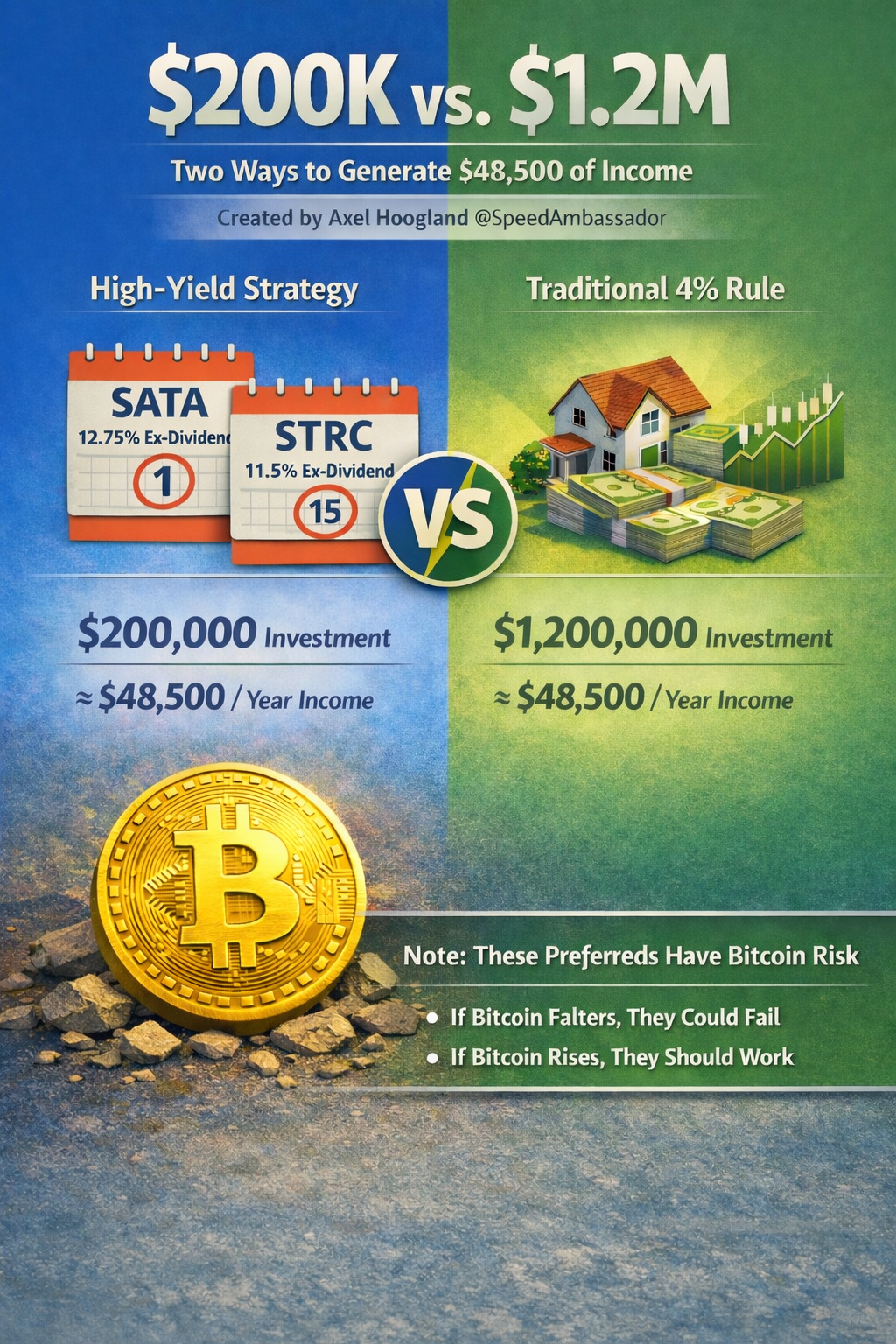
From 3% to 10%: STRC and STRD Show How Bitcoin-Backed Preferreds Beat High-Yield Accounts

Money market funds have quietly become a $7.7 trillion behemoth. They’re the go-to “safe yield” for investors and savers alike. But with the Federal Reserve now in an easing cycle, those yields — currently around 3.5%–4% — are headed lower.

That’s where Strategy’s Bitcoin-backed perpetual preferreds come in. While most people know Strategy (MSTR) as the largest corporate holder of Bitcoin, fewer realize that it has built a full yield curve of preferred instruments, each engineered for different investors.


Where These Instruments Sit in the Capital Stack

Most senior → Debt (convertible notes)STRF (Strife)STRC (Stretch)STRK (Strike)STRD (Stride)Common (MSTR) → most junior / volatile.


The Rationale: Building a Bitcoin Yield Curve

  • STRF (Strife): Senior, cumulative, fixed dividend, long-duration. Currently yielding about 9%.
  • STRC (Stretch): Senior to STRD and STRK. Variable monthly dividend, engineered to trade around $99–$101, currently yielding about 10.25%.
  • STRK (Strike): Convertible hybrid with both dividend and equity-conversion features. Not my focus here, but it’s an important part of the structure.
  • STRD (Stride): Junior high-yield, fixed 10% dividend, currently yielding about 12.7% due to market pricing in more perceived risk. Functionally similar to STRF, except dividends are non-cumulative (can technically be skipped). That said, I believe skipping would be highly unlikely, as it would damage trust and Strategy’s ability to raise future capital. Dividends are paid quarterly.

Visualizing the Yields

Here’s how these instruments compare against traditional money markets:

  • Money Market (green): conservative baseline at ~3.5–4%.
  • STRF (orange): senior, stable preferred with ~9%.
  • STRC (orange): short, steady instrument at ~10.25%, engineered to trade near $100.
  • STRD (orange): dynamic junior instrument at ~12.7%.

Why I Prefer STRC and STRD

I’m drawn most to STRC and STRD.

  • STRC is designed to be the least volatile of the group, with a monthly payout and mechanisms (ATM issuance, variable rate, call option) that help stabilize its price.
  • STRD is the high-yield gear, juiced by its junior position in the stack. While the market demands extra yield for perceived risk, I personally think that risk is overstated given Strategy’s Bitcoin reserves and incentives to maintain dividend trust.

Together, they cover two ends of the spectrum: steady monthly yield vs. higher-octane quarterly yield.


A Practical Emergency Fund Example

Suppose you have a $10,000 emergency fund.

  • All in Money Market: $10,000 × 4% ≈ $400/year.
  • Blend with STRC: Keep $7,500 in money markets (=$300/year) and put $2,500 into STRC (=$256/year).
    • Total = $556/year — a 39% boost without overcommitting.

I wouldn’t put my entire emergency fund into a new instrument like STRC — safety and liquidity should come first. But even a modest allocation can noticeably lift your yield while still keeping most reserves conservative.


Closing Thought

Strategy is essentially pioneering a new financial system built on Bitcoin collateral. If they can consistently pay these dividends — even through Bitcoin downturns — it would be revolutionary. It would prove that Bitcoin isn’t just “digital gold,” but the foundation for a new class of yield-bearing, creditworthy instruments.

Here are 2 videos of when STRC and STRD were initially offered. They offer a lot of information about how these work. 

Strategy’s Stride STRD Perpetual Preferred Stock IPO Backed by Bitcoin | Michael Saylor and Phong Le

Strategy’s Stretch STRC Perpetual Preferred Stock IPO Backed by Bitcoin | Michael Saylor & Phong Le