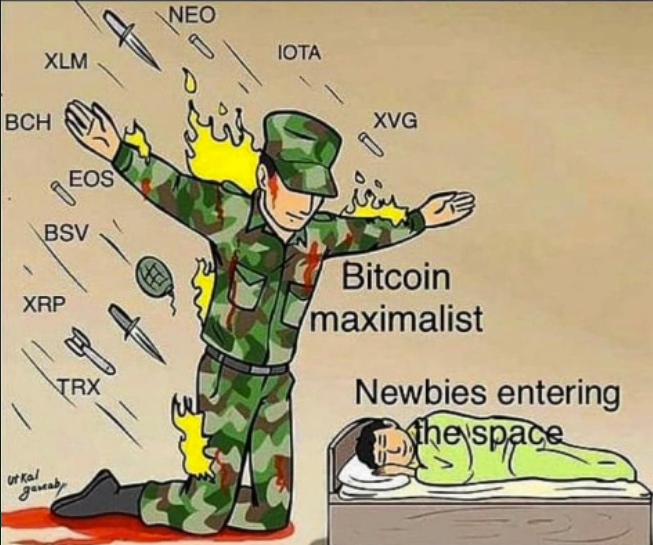
Isn’t The Bitcoin Guy in Jail?

I was recently in the hospital (that part of the story isn’t important) and had a Bitcoin book, A Progressive’s Case for Bitcoin: A Path Toward a More Just, Equitable, and Peaceful World, out on my desk to read while I was sitting around doing nothing. One of the nurses asked me if I “Was into Bitcoin?”. I naturally said “yes” enthusiastically and asked her if she wanted to talk about it. Her first comment was “Isn’t the bitcoin guy in jail?” I explained to her that “no there is no ‘bitcoin guy’” The guy who is in jail, who I’m assuming she meant Sam Bankman-Fried (SBF), although we didn’t clarify that, I explained to her, was a fraudster but not directly linked with bitcoin. I explained to her that Sam and his company FTX were more or less committing fraud on a level similar to Enron. She seemed to understand that. 

Fighting basic narrative errors about bitcoin like this is important for bitcoin adoption. There is so much false news and when people don’t really have that much interest, this is the type of error they can make. 

I also got to mention to her that there is a limit of 21 million bitcoin ever and it fixes the problem of governments stealing our savings via inflation. She did like that! She mentioned that she had a “lot of cash” and “wished the government would stop stealing things”. Not the most technical conversation, but I’m hoping that by.

1 . removing the connection of SBF/FTX to bitcoin and

2. Connecting the idea of bitcoin saving you from government created inflation, she might be more open to bitcoin the next time she hears about it. 

She also mentioned that she “isn’t tech savvy” but somehow mentioned she has Venmo. You can buy bitcoin on Venmo (it’s not the favorite platform for the “hardcore” bitcoin folks but it works). So I did mention to her that she would be able to buy it there pretty easily.

What Problem Does a Central Bank Digital Currency (CBDC) Solve?

If you read my previous post you will learn what problem bitcoin is trying to solve. But there is another thing that governments love to talk about when anyone mentions bitcoin or cryptocurrencies. To be clear on the difference between bitcoin and cryptocurrencies read this. The thing Governments love to bring up is a Central Bank Digital Currency or a CBDC for short.  

What is a CBDC and what benefit does it have? The most important thing to know about a CBDC is it is 100% Government controlled, just like money today. It has no limit on how much of it there can be.  Because of this they can create more new CBDC everyday and reduce the value of the ones you own.  This is inflation and that is the problem that bitcoin solves by having a limit that is 21 million bitcoin ever. The fact that  CBDC does not have a limit, means it is not a substitute for bitcoin and you should not be fooled by anyone on tv, or anywhere, saying a CBDC can replace bitcoin and now we don’t need bitcoin.

One thing a CBDC may do is either make settlements at the store faster or international settlements faster. Today international settlements usually go through a company like Western Union.  It is very expensive to send money out of the country. Visa and Mastercard process most payments via their credit system and charge between 1.5%-4%  to the businesses using their network. A CBDC could remove the need for Visa and Mastercard and for Western Union. Basically it could remove any intermediaries as a CBDC would be infinitely and immediately traceable. While to me all our money seems digital and traceable anyway, a CBDC would make it even more easily so. There may be a push from a government to use it as a form of punishment or denial of purchase for certain things which would be another option that opens up even more with the abilities of a CBDC. For example the government could say that buying meat is bad or buying more than 1000g/ month of meat is illegal and could limit your CBDC credit card to purchases of meat, or anything they wanted. 

The main point I wanted to help people understand with that post is that a CBDC certainly does not do anything that would replace bitcoin or reduce inflation and could even potentially be used to control purchases by individuals.

Consider buying a little Bitcoin!

What Problem Does Bitcoin Solve?

To understand the reason behind why some people (like me) buy bitcoin you need to think about the problem we think bitcoin is trying to solve.  When you use a government currency, like USD, the Government can effectively steal value from your bank account via money printing. How does this work?

To understand that you need to understand what the point of money is. Money is just a measurement of the value of something.  We have all been trained that the value of things goes up over time because the price goes up over time. But just because a house rises in value by $100k over 5 years,  does not mean its intrinsic value has risen. It’s the same house providing the same amount of shelter.  It really shouldn’t gain value. What has really happened is the money,  used to measure the value of the house, has lost value! It’d be like if you used a tape measure with 12 inches to 1 foot  to measure a board and then you changed the tape measure to use 13 inches to 1 foot,  where the foot is still the same length but each inch is smaller so you have “more inches”. But is the 1 foot board actually any more useful or longer if you use 13 shorter inches or 12 inches to 1 foot? No.  This is how the government confuses us. They print more money and then our houses “go up” in value,  but it’s because the measuring stick is changing.  Why does the government do this though? They do it because that’s how they pay for the $1 trillion to $4 trillion budget deficit the Government has each year. 

In WW1, while we were on the gold standard (every dollar was supposedly able to be converted back to gold at a bank), the government had to sell “war bonds” to pay for the war.  This at least provided a little link between Americans turning over money for what they thought was a just cause. If people didn’t buy the bonds the government couldn’t pay for the war. 

Since the US dollar was removed from the gold standard in 1971, the Government has had no restrictions on how much money they can print. The US government is able to fund any war ad infinitum via money printing. When this new money is printed the government uses it to buy good (ships,  tanks,  steel, sometimes roads,  etc). Since they have unlimited purchasing power they can keep printing money until they can pay for what they need.  Meanwhile,  the average person might be unable to buy a new truck because the price of steel was pushed up by the government demanding 200 billion tons of steel for planes and warships.

When thinking about if you should buy bitcoin this is the fundamental issue you need to consider, how is my purchasing power being diluted via inflation? 

Since bitcoin has a limited supply (21 million) as more US dollars are printed a single bitcoin’s value, measured in USD, or any other currency, will continue to go up. 

In fact bitcoin recently hit all time highs, when measured in Argentine pesos,  Lebanese pounds and Venezuelan bolivars

This is due to those countries experiencing extremely high levels of inflation 50%-100% a year.  I can’t even imagine what that would be like to live in. At 100% inflation,  or even 50% you need a raise every paycheck! Your money would lose 1% of its value every week at 50% inflation.

While it seems like high inflation only happens in “far away” places with bad Governments that’s not the case. It has happened thousands of times in history

We, every person in the world, is in a fight with their own government to keep as much of the value they create as they can.  The government explicitly taxes you, which we can debate but at least it is obvious.  But the government also stealthy steals value from your bank account or savings via inflation and money printing that you have no control over. 

Because in the USA inflation has been a relatively small issue (1%-3%) for most of the last 25 years most people in the USA haven’t thought about wealth preservation much.  Now that we’ve seen 10% inflation it’s new to people and they aren’t sure how to protect their purchasing power! A bond paying 5% is really losing 5% a year to inflation if inflation is 10%.

I know bitcoin is volatile but the inherent properties of it (ultimate scarcity, 21 million total coins ever), make it the best chance we have ever had to get out of the system and protect our wealth. If bitcoin doesn’t succeed then we will have lost every opportunity to preserve value!

 I think that is a cause worth supporting, by buying and holding Bitcoin. And you’re not just supporting it, but you’re protecting your wealth! 

I have written politicians and blog posts trying to encourage people to understand this while bitcoin is relatively cheap ($30k). I know once it is $50k or $100k more people will have Fear Of Missing Out and will buy in which could happen in the next year or 2. It’s best to learn about bitcoin when it’s price isn’t rising like crazy and you aren’t having FOMO. 

If you’ve wondered this last year or 2 how to avoid losing value to inflation I’d enjoy talking to you more about bitcoin. I only recommend 1% of your net worth in it to start.  So if you have $100,000 of net worth you can just buy $1,000 worth of bitcoin. That’s a small risk to be part of a monetary revolution that just might pay off. 

Bitcoin For Everybody – Saylor Academy

I stumbled upon the Saylor Academy Professional Development course, “PRDV151: Bitcoin for Everybody”. Saylor Academy is associated with Michael Saylor, CEO of Microstrategy, which was the first public company to put Bitcoin on its balance sheet. “Saylor Academy is a nonprofit initiative working since 2008 to offer free and open online courses to all who want to learn. We offer nearly 100 full-length courses at the college and professional levels, each of which is available right now — at your pace, on your schedule, and free of cost.” Saylor Academy has free courses on a lot of things, English as a 2nd Language, Math, Politics, etc. 

While there is some overlap between Michael Saylor and his non-profit and bitcoin, in general it is just a learning website which also happens to have a Bitcoin course. Despite having read many articles about bitcoin for the past 4 years, I decided to take this course. WOW! I learned a lot. The course is free and signing up for Saylor academy is free. I am going to link a few of the articles that I found most interesting from the  courses below as well as some of the most impactful quotes that I got from each article for people who don’t want to read all the articles. Many of the articles are also available from their original sources in spoken format so that would make them easier to listen to while driving instead of taking an hour to read them.
A lot of the information is more about the history of money, how US dollars came to be the World Reserve Currency and other interesting history. Later information gets into the history of bitcoin as well as why it makes good money. I highly recommend taking this course for anyone who is skeptical about Bitcoin. 

Unit 1: Bitcoin Economics

The Bullish Case for Bitcoin -Vijay Boyapati

PoW is Efficient – Dan Held

Everything requires energy (first law of thermodynamics). Claiming that one usage of energy is more or less wasteful than another is completely subjective since all users have paid market rate to utilize that electricity.

Unit 2: Bitcoin Investment

Bitcoin is Not Backed by Nothing -Parker Lewis

“What backs the dollar (or euro or yen, etc.) in the first place? When attempting to answer this question, the retort is most often that the dollar is backed by the government, the military (guys with guns), or taxes. However, the dollar is backed by none of these. Not the government, not the military and not taxes. Governments tax what is valuable; a good is not valuable because it is taxed. Similarly, militaries secure what is valuable, not the other way around. And a government cannot dictate the value of its currency; it can only dictate the supply of its currency.

Venezuela, Argentina, and Turkey all have governments, militaries and the authority to tax, yet the currencies of each have deteriorated significantly over the past five years. While it’s not sufficient to prove the counterfactual, each is an example that contradicts the idea that a currency derives its value as a function of government.”

Bitcoin Cannot be Banned – Parker Lewis

In fact, it posits that bitcoin works so well that it will threaten the incumbent government-run monopolies on money in which case governments will regulate it out of existence to eliminate the threat. Think about the claim that governments will ban bitcoin as conditional logic. Is bitcoin functional as money? If not, governments have nothing to ban. If yes, then governments will attempt to ban bitcoin.

Unit 3: Bitcoin History and Philosophy

Honestly, I didn’t find Unit 3 very interesting. It was full of a lot of history and details that are rather dry reading to me at the moment. While it probably provides useful history, it’s just not very exciting and isn’t completely necessary to understand Bitcoin. 

Unit 4: Bitcoin Technology

THE GREAT PLAGUE OF SHITCOINERY – THIBAUD MARÉCHAL

Under the fiat monetary system, the cost of currency issuance is close to zero, which is very profitable for the national issuers, as there is no longer any limit on the quantity of money that can be created, further shrinking the value of the existing currency in circulation, and annihilating the purchasing power of the currency holders — people like you and me.

Unit 5: Bitcoin in Practice

Unit 5 is relatively short compared to the other units. It is a lot more practical. Here is how Saylor Academy describes unit 5. 

“Now that you have some base awareness of Bitcoin, we will cover basic instruction on putting Bitcoin into practice in this unit. This includes acquiring Bitcoin, using a Bitcoin wallet and the Lightning Network, privacy and security practices, and avoiding common pitfalls, scams, and mistakes.”

This is probably a very useful unit for people who don’t have a lot of familiarity with how Bitcoin works. 

Bitcoin Vs. Cryptocurrencies

Bitcoin – Yes as much as you are willing to go to $0. Expect it to fall at least 50%-80% after you buy it. 

All other Cryptocurrencies and NFT’s – Proceed with EXTREME caution (likely scams). Honestly, probably just don’t buy it. 

For an in depth article about Bitcoin vs. All other Crypto I recommend reading the Fidelity Bitcoin First paper. 

Since I’ve started to post about Bitcoin a little, I wanted to make my stance very clear. Bitcoin, while it has potential to cause disruption to payments and fiat currencies, it is still a speculative asset. I personally have a higher than average income and net worth and as such I am willing to risk a small amount of money on speculative assets that I think have a high return potential. Even as such, I am only betting a very small amount of my assets on Bitcoin specifically. For most finances, savings, investing, I still recommend an asset allocation across index funds as advocated by these people.

The Crazy Man in the Pink Wig

JL Collins

Mr. Money Mustache

If you need more recommendations about what books to read about financial independence and investing for low fees please ask. 

Back to Bitcoin and Cryptocurrencies.

As I said, bitcoin is quite speculative, but most other cryptocurrencies are even more so. Most crypto currencies are thinly disguised, unregulated securities. In this case a security is something like a stock, where it’s like owning a part of a company. Read more here

Most cryptocurrencies are controlled by a small number of initial developers. Those developers also award themselves some of their cryptocurrency before they allow others to buy them, giving themselves an advantage to “get the crypto while it’s cheap/free”.

Bitcoin is different. Bitcoin is decentralized. No one got a bunch of bitcoin at the start. It is being mined everyday. No one controls Bitcoin. No one person can change Bitcoin. That is what makes Bitcoin very different from 99% of the other cryptocurrencies out there.

Another technology that is getting a lot of press is NFT’s. NFT = Non-Fungible Tokens. 

“NFTs are individual tokens with valuable information stored in them. Because they hold a value primarily set by the market and demand, they can be bought and sold just like other physical types of art. NFTs’ unique data makes it easy to verify and validate their ownership and the transfer of tokens between owners.” – SimpliLearn

Most NFT’s are either a picture of a GIF. Usually you are literally able to take a screenshot to make a copy or just right click to save. While there may be some minor value in these in general I would just advise beginners to stay far far away from NFT’s. 

In conclusion, do a bunch of research yourself before getting into cryptocurrencies.

Only buy as much as you are willing to lose/have to go to $0. 

This is the same advice as any investment.

Tom’s Finance Tips for Young People (Under 35 years old)

I have been talking with a friend from work, Tom, about finances for some months now. He felt inspired to share some thoughts about finances with others. This is a first, a guest post on MyWheelLife. I hope you enjoy.

Tom’s Finance Tips for Young People (Under 35 years old)

1) Learn to assess personal value. This is the absolute most important thing to master when making purchases. What I mean by this is imagine a young person who wants to buy a table saw, and the table saw cost $400. Should they buy it, $400 is a lot of money for a tool. So it all boils down to value. Value is defined as the price of product / usefulness of the product to the purchaser. Everyone pays the same price but each person has a unique “usefulness”. So simply answering the question based on cost is impossible. You have to be realistic with yourself on how much you will use something and if it really is important to you to justify the money.

The premise sounds so simple, but I continue to see people make terrible decisions assessing value. You have to be honest with your assessment of time, sometimes we have ideas in our heads that are not realistic.

For example, my neighbor has a nice mustang sitting in his 3 stall garage. He wants to protect it because it cost a lot of money so he parks it in the middle of the 2 stall portion, and then the 3rd stall is filled with crap. He doesn’t want to drive it in the winter because it is rear wheel drive or expose it salty roads. He has a beater car that he drives to work and another SUV for the family. All year they park their cars outside, scrape the windshields in the winter, so that this mustang can sit in the garage to be protected. Is this good value? The vehicles they use every day are being taken care of less than the vehicle used a couple of times per year.

Another example, my brother drives a Lexus. For a conservative like me, why would anyone drive a Lexus? Some may argue they break down less or last longer etc., but there are many alternatives that would be more cost effective. I believe luxury cars to be status symbols more than anything. So it is a terrible idea, correct? He is a commercial real estate agent and is constantly driving around high net worth individuals. His car is his office, therefore there is high value. A beater car doesn’t make sense here. It is okay to be expensive things if they have high value.

One more example, I drove a 1999 Pontiac Grand Prix for years. I got it from my parents, and kept it running. The thing was rusted real bad and got in an accident at one point. I had them repair the mechanical portion from the accident but just left the body work as is. That car cost me nothing, great price. The problem was that it was in such disrepair that a break line rusted out in a parking lot, and it was becoming not a safe vehicle to drive. One day as I was going through a busy intersection on my way to work, I realized if my brakes went out right now, or this car crapped out on me, I could be injured or killed. I am cheap, I hate spending money, but then if I can’t work how much money am I really saving. I got rid of that car and bought one from my parents that they were going to trade into the dealer back home. The moral of the story is that sometimes the cost is not just the product cost, but in this case also the cost of the potential injury. If you factor that in, a newer car was cheaper.

2) Financing, be careful. I am a strong believer that there a few things that you should finance and nothing more. Those things are a college education (assuming you have some level of ambition and a plan), a house, and sometimes a car. The things on the naughty list are vacations, campers, boats, ATV’s, marriages, furniture, anything out of a big box store, and home remodeling.

The goal is to knock down recurring monthly expenses as much as possible. With big ticket one time purchases, you are more likely to be realistic with your expectations compared to monthly payments and assess personal value. The auto people love to shove financing at you. I only buy cars with cash, and when we bought one of our cars, the sales person kept coming to me with a new monthly payment. I told them several times that we were paying cash.

For example, let’s talk about a camper. I would like to get a camper at some point, but I don’t think that we will use it enough to justify the cost. When we are at the camper show they are financing those campers for at least 120 months! That is 10 years. If you pay for something for 10 years, the monthly payment doesn’t seem too bad. For $220 per month you can have this $26,400 camper. That does not include interest…. Then for just $10 more per month, you can have a $1200 feature. You will be underwater on that camper every month as long as you own it.

3) Talk about finances with Friends. People are hush, hush about money. It is important to feel comfortable talking about finances with others. If you don’t talk about it, it is impossible to get advice or other perspectives. Sometimes our personal perspectives are not always the best route. My Dad is a money person, and so is one of my brothers, so we have many discussions about money. I like to talk about it with friends, and hear their perspectives. Just because your Mom and Dad did it one way, doesn’t mean that is the only way.

4) Learn to track your monthly expenses using a computer program. I am a strong proponent of Quicken, there are alternatives out there. I started a couple of years ago, and I should have been doing it all along. People ask me if it has changed my habits on spending, and not so much, but it completely changes the ball game on planning. The thing I learned the most on spending is that it is the little items that are the worst. It is amazing how the $1 to $50 purchases add up to large amounts. I like to go through the spending and determine how much it would take to live each month based on the necessities. We need to eat food, we need a place to stay, and we need heat. If you want to cut back on spending, there will be a couple easy hitters that show up, but it really boils down to controlling the little expenses. This skill is so important that I cannot emphasize it enough. The reason being is that it is something that applies to successful business as well as successful people. Learn to manage money, don’t assume like I did that I just kinda knew what we were spending.

I talk to a lot of people and am surprised at how few people track their spending. Quicken is so fast, I do mine one or two times a month, takes about 10 minutes to keep it up to date. The reason for this is that I have the ability to make decisions, and powerful decisions. For example:

A) We had a child and I was not sure if my wife was going to return to work. Having our spending tracked and categorized I was able to see exactly how this would work. It allows a very clear picture of what it would mean.
B) Emergency fund: I am a big proponent of emergency funds. How much do you need? The only way to answer this question is to understand how much its takes to support the family and then how much it takes if you went into conservative mode.
C) Investments: If you are able to invest money, you can gauge how much you can invest and when.

5) Investing is a key and the time value of money is amazing. Don’t try to time the market, just invest as much of your paycheck as you can every month and let it ride. I tried timing, and I was an idiot. The goal is just keep buying and buying. If the market is falling, great, you get to buy cheap, if the market is rising, great you are making money. Having your expenses tracked will tell you how much you can invest.

6) Do your own taxes. It is worth filling out the Turbo Tax thing even if you still take it to a professional. The $100 of working through the program can be considered an educational expense. The key is that you need to have some understanding so that you can make good decisions. It isn’t always fun but is well worth it. If you really hate it, sit down with someone and tell them your situation at the beginning of the year so that they can help you through it. It is worth paying someone for the advice, even at $100 per hour, there is still a lot of value. For example:
A) 401K Roth vs. Traditional tax savings
B) HSA is important and saves a ton of money
C) Dependent care FSA saves a ton of money
D) Knowing if you take standard deduction or itemize can save you a ton of money. Funny story is that I bought our first house in Texas citing tax reasons. I told the realtor we needed a tax write off (I was using stuff I had heard people say, thinking I was smart), we took a standard deduction every year we lived there.

7) Balance is the key to life. I have a friend who is cheap, I mean cheap. I heard a story on how his car locks didn’t work so when he would buy something at Walmart, he would use zip ties and bungee cords to lock the car doors. I have another friend that is so cheap that he would transport his young kid in a car that was unfit for the road, saving money. They both save a lot of money, one of them is young and has his house PAID off. A 250k house paid off.

Each person has their own strategy, and that is a good thing. The moral of the story is the guy that has his house paid off is so cheap that he won’t take a vacation, he hates his job, and always is a glass half empty type of guy.

What I am trying to get at here is that you need to go back to the most important thing, and that is the ability to assess value. I take vacations, if I look back, those are some of the high points of my life. We went to Alaska, Ireland, the Caribbean, the mountains, etc…. If I take out a photo album, I don’t get excited about talking about pictures of my car parked at work, or what my cubical looks like. That killer whale off the front of the boat in Alaska, or seeing a sea turtle in the crystal clear Caribbean waters are something I get excited about. It is important to get away, and take time to enjoy life. Don’t let being cheap ruin it, that is an important life lesson. At the same time, be realistic with the spending. You need to track your spending, and understand what you can spend on vacations. I would not try to cut it completely out of the budget, but also don’t fly first class.

8) Home owner ship is not all that it is cracked up to be. This is really important. There is a lot of misinformation out there. Here are a couple of key components:
A) Houses are not a great investment: There are exceptions where some folks make it out real good, on the contrary there are plenty were people lose a lot of money. So don’t think you are “Throwing your money away by renting.” The reason is simple, houses have a lot more cost than just a mortgage. They need upkeep such as roofs, plumbing problems, yard work, windows, and people fail to include these in the cost. They also require taxes and insurance. The cost of moving is extremely high. Real estate commission alone will knock out most people’s equity.
B) My rule is simple, if you don’t like doing handy work, are young, and single, RENT!!!!!
C) If you have a family, plan to stay somewhere for a while, and are being realistic with yourself on spending, BUY!!!!!

9) Being cheap is not always the answer to wealth. I personally feel that being cheap has cost me a lot of money. The reason is that knowledge is money, and it is important to always keep learning. Being cheap and not buying the proper tools, or investing in myself will cost me more in the long run than the money I saved. This one is a little harder to wrap your head around.

If you are young, it is very important to learn as much as possible in the primary environment that you make your money, OR in a secondary environment that has the potential for income.

A primary environment example is that as a young person, you can quickly become the EXPERT in a field even within a very large company. The reason being is as people advance in their career they tend to go to management roles that are non-technical. The technical stuff is left to younger employees and is constantly evolving. Older people tend to have kids and more commitments outside of the normal working hours, where young single people can invest more time in learning new tools, concepts, and expertise. When it comes time for promotions or layoffs, the extra knowledge is surely going to help keep you employed, or make you more money. It might be worth spending 10 extra hours a week working on building expertise within your role, than trying to save money by buying a house that needs restoration. I used to make fun of young people with new cars sitting in front of an apartment building, in hindsight, I think that is the most brilliant route to take for young people.

Another example of this is as an engineering student in college, does getting a job at the food service place making $10 an hour make sense? It seems like the young student is being fiscally responsible by working during college to help offset the debt. At the same time if the student is working 15 hours per week, this time could be used for studying or better yet getting involved in an extracurricular engineering activity such as a design competition. The design competition does not pay an immediate salary, it may lead to better job offers, and higher job satisfaction than the $150 per week gained during the food service job. Clearly if the student is not able to maintain greater than a 3.0 GPA, they should clearly focus on studying as opposed to the food service job. Don’t let short term gains impede long term gains.

For a secondary environment example, I should have tried to start my own business on the side instead of trying to fix up my house. I saved a lot of money doing my own housework, but I have always wanted to try to make a business work. With the housework side of things, the most money that I saved is the cost of having someone else do it. For example if a painter cost $50 per hour, and it took them 20 hours, then I saved $1000 doing it myself. The problem is that I took those 20 hours doing a task that will never get me more than $1000, whereas a business could make that weekly. Only do this if you have an opportunity cost that is higher in value. Paying someone $1000 so that I could watch football on TV is not a good use.

Redistribution Of Wealth Is Not Sufficient To Fix World Poverty

“We as individuals, we must extend peace and knowledge growth throughout the world, for that is the only way we all prosper.” – Axel Hoogland

Redistribution of wealth is not sufficient to fix poverty because there is not yet enough wealth in the world.

There is $217 trillion dollars of valuable stuff in the world.

$217 trillion/ 7 billion people = $30k/person.

Therefore, if you are one of the people reading this who has more than $30,000 in net worth you should consider redistributing your own wealth before you call for Jeff Bezos or Bill Gates (who IS redistribution his wealth) or others to redistribute their wealth.

We need to understand the difference between production and net worth.
This is the issue people, including Oxfam, have and perpetuate when they say “the richest 7 people could end poverty”. To say that a billionaire who “made” $40 billion in a year in capital stock appreciation could “fix poverty” is ignorant.No one is stopping any person from getting rich and giving all their money away. If you have a great idea to start a company, by all means, start it up and give your money away! Show us how it’s done!

Anyone who holds a significant amount of shares of a company likely created that company from nothing. They accumulated wealth because people use their services because their services or products work so we give them money for them. These people take something, add value, and sell it to us, making themselves rich and our lives easier in the process.
Most people are bad at making money or adding value or thinking creativity. That is why we work for companies that tell us how to add value. That is why companies pay us a part of what value we create, because we wouldn’t know how to do it ourselves.

Most people also have excess money from their jobs, which they then re-invest in the stock market or in government bonds because they don’t know what constructive thing to do with their excess money also.
You shouldn’t be mad at Bezos! He created a company, he did an Initial Public Offering (IPO) of stock. During an IPO people say “I have an idea that I think I can make you money.” People then agree with that person and give him the money they worked to earn, in the hopes that he will make them more money with it, because they can’t think of a way to make that money work themselves.

So, if someone has started from very little, made a move to say “I can add value” and people have both freely given them money (working capital) for stock (part ownership of a company) and then that person DID add value and create a very useful company that millions of people use for it’s efficiency, why would you want to then take that money away from that person who you gave it to in the first place? We should give those people more money! Which is exactly what happens in the stock market. The main purpose of the stock market it to get money from people who don’t know what to do with it to people who have an idea of how to add value.

The only way to raise the poor from poverty is to give them better tools to produce more. I am only as successful as the tools I have access to, knowledge being a tool. If you are a person in the middle of Africa, with no access to the knowledge that has been built up for hundreds of years, you are at a distinct disadvantage, through no fault of your own. This is one reason I like “One Acre Fund”. They are helping people learn to produce more, not just handing out charity. The old “teach a man to fish” axiom. That being said, there are many even more efficient ways to farm than these people are being taught. These other methods are initially capital intensive and lead to fewer workers to produce more goods, creating lower prices.

The other thing to note is that the world GDP is only $17,300 a year. As I mentioned above, the only way for everyone to be on a level playing field is to raise the worldwide GDP. How do we do that? Through investment in technology and innovation. As I said, you are only as good as the tools you have and the value you create. The more knowledge people have, the more tools they can use and the more value they can create. You can see some companies are very good at creating profit per employee like Facebook and Google. Others are not so good. We should continue to work to improve the profit per person which comes down to value created per person. People can only create more value with better tools!

Another thing we should learn about investment of capital comes from Norway and Venezuela. Both countries discovered oil and the oil was at least partially drilled by the state. What they did with the profits after that is instrumental though. Venezuela used the money to subsidize many things and pay for the government to run. This worked, as long as there was always more oil and people willing to pay for it. But once it ran out, bad times.

Norway took a different approach. They also saw the oil as belonging to the people, they could have paid each person some of the oil money (but they didn’t) but they did something (also somewhat socialist) but at least it involved long term thinking. They continued to collect taxes from the people but they used the profits from the oil sales to invest in real estate and businesses around the world! This will provide them income for many years to come. In fact the Norwegian Oil Fund, which holds assets around the world, has $1 Trillion dollars of assets! This is about 1% of the world stock markets! They own 0.5% of Apple, the company! I bet you didn’t know that. It is good that Norway has tied it’s success to the success of others. That way they are less likely to fight with anyone, as a decline in value of anything around the world negatively impacts them also. The Oil Fund holds about $200,000 per Norwegian. I bet Venezuela wishes they had that kind of money saved up, instead of having spent it.

I believe that this is a good way to see world relations. I am personally invested around the world also, via International and Emerging Market index funds.

Of the top 10 holdings in the Emerging markets fund, 7 of the businesses are in China, 1 in Russia, 1 in Brazil and 1 in South Africa. As you can see, it is in my benefit for the rest of the world to do good as I have invested in them also!

If you look in your 401K or other investments I bet you will find you also have holdings in other countries. It’s time to realize we are one world, one economy, we can’t win by hurting others because there are no others, we are all in this together.

Sovereign wealth funds (like the Norwegian oil fund) are basically a step towards Universal Basic Income. They use assets (oil minerals) that should be for everyone, if found on public lands, and invest the proceeds for the good of everyone. I mentioned at the very start of this post that if you split up the whole world’s assets there would be $30k per person. But Norway has $200k per person in this fund, from public land. Now we could ask if they should share that money with the rest of the world? I would argue no at this point, although it would be an interesting debate. But the facts are that would open it up to every country being obligated to giving away all it’s goods. I believe there is value to trade, but I think that this type of discussion should happen in all countries related to their assets. What we need to do is create more assets. Then each person could have more. $30k per person is not sufficient!

The USA does not have a sovereign wealth fund, but some states do. Texas is one. It is also funded by oil revenues and land. They use it to fund their public schools. A good use of basic income money and the point I am trying to make with this whole post, that education is important! It sounds like they need a little more in their fund to completely pay for school though.

“Although the FSP constitutes a majority of the funding received by public schools, public schools receive other funding, such as state and federal grant funds, and that funding is not described in this manual.” – Funding of Texas Public Schools

People need to realize that the world is so interconnected that we don’t win by making others lose. The Sovereign wealth fund of Saudi Arabia invested money in Uber, as well as many other things. Did you know you are making money for Saudi Arabia each time you use an Uber? We need to realize that the pie is not of finite size. Through education and innovation we can make the pie grow and it has to to make enough for everyone.

I can see why foreign governments are skeptical of any help by outsiders, as I wrote in a short story that I didn’t publish, yet. Many countries believe other countries don’t have the best wishes for each other. That has certainly been the case in the past. There has been a lot of exploitation of countries by each other in the past. We, young and old, need to realize that we have the greatest opportunity for collaboration in history! We can connect with literally anyone else on the planet! Learn what hardships and joys they have.We can learn that other people don’t really hate us and we don’t really hate them.

I am personally helping a young man in Haiti attend college there. I converse almost daily with him via Facebook and I am in contact with his school to try to learn what opportunities they have to help make their country better.

In your neighborhood, you want your neighbors house to look good, and you want your neighbor to be successful. You don’t think, I need to take my neighbor’s job because there is only 1 job in town. That is how we need to think about other countries.

It will be difficult. There are people who want to kill us. There are people who are born into societies and brainwashed to believe things that are not true. We need hard men and women to protect us from those people and countries. But as individuals, we must extend peace and knowledge growth throughout the world, for that is the only way we all prosper.

What Color is the Sky? A Book Celebration (and review)

“It’s a wonderful thing to behold when you see someone take control of their finances AND their life.” – Finley

I finished my 2nd read of “What Color is the Sky” this weekend. What Color is the Sky is the 2nd book by a personal friend of mine, Michael Finley. As I said in the title, this is both a review and a celebration of a great book. I believe it is one of the best investment books available because it delivers useful, actionable, information instead of vague concepts. Because of this I have personally bought and given away over 40 copies of this book to friends and family  (and I hope to give more in the future, and that people read them!). A great feature of this book is that each chapter is 2 pages long and covers 1 topic. The book delivers a wealth of information in a short enough read for the average person. The average person doesn’t want to or have time to read 30 pages about stock market bubbles, timing the market or index investing. Finley delivers concise, precise, useful information that shouldn’t tax your attention span.

There are 5 stages in the book.

Stage 1 is simply Finley giving you a pep talk. He wants you to know that you are able to manage your own investing, or at least that you should be able to find someone to help you along but who won’t screw you (like 95% of financial “advisors” (salesmen) these days).

Stage 2 includes a lot of chapters informing you about what smart investing is NOT.
Smart investing is not trying to guess which one stock will do good each month.
Smart investing is not listening to your uncle who is not educated on investing.
Smart investing is not trying to find the best managed mutual fund and changing it each year or two.
Smart investing is not  investing in something because everyone else is (housing bubble, tech bubble, tulip mania).

Stage 3 includes a many chapters informing you about what smart investing IS.
Smart investing is investing in index funds (or target date funds which are made of index funds).
Smart investing means you are diversified through various classes of investments (US, international, bonds, REITS).
Smart investing is understanding opportunity cost, the rule of 72, taxes and different types of account you can save money in (401k, 403b, 529, IRA, ROTH or traditional).
You could skip right to stage 3 of the book if you are really bursting to get the knowledge of what you should do, but if you do you need to go back and read the start of the book. This whole book needs to be read, by everyone and I will buy it for you, if you need me too. As Mike often mentions in the book, he is not paid by Vanguard to promote their product, he just believes they are doing what they do the best. Similarly, I believe Mike is providing the most unbiased, useful, actionable (helps you actually make investment decisions) advice in an easy to understand format.


Stage 4 builds on stage 3 with more practical actionable advice.
Discusses buy and hold (vs selling constantly to buy “winners”), different asset classes such as large capitalization stocks, small capitalization stocks, REITS and bonds.
Discusses international vs domestic stocks.
It also discusses rebalancing your portfolio, asset allocation as well as one of my favorite topics the 1 and done fund, the Target Date Fund.

Stage 5 is rather short. It encourages you to continue your financial education with recommendations of some good books. It encourages you to seek fee-only advisors if necessary.

Finley also uses a chapter to provide his vision for the future. He speaks about institutional investors, who are collectively losing million of our dollars to fund “managers”. Many large state and company investment funds offer poor funds. He wants to change that. We must demand the change and to do that you must be informed.
Finally, Finley encourages you to share what you have learned. As is his life goal, educating and empowering others to become the best they can be, he encourages the readers to help others learn more about investing and personal growth. That is part of what I am trying to do by writing this blog and this post, teaching others what I have learned in hopes that it will make their lives better and ultimately, make the world a better place. Active fund “managers” are generally providing negative value to the world and we need to stop that, so do your part, learn, become educated, get rich and live a rich, fulfilling life.

You can find Finley’s book here on Amazon (as I said I get nothing from this, he doesn’t even know I wrote this until he will see it on Facebook). I will buy you the book if you don’t think you can afford it. Leave a comment below if you’d like me to buy you a copy. You can’t afford to not read this book and I can’t afford for you to not read this book! Changing the way the whole market operates is in my, your and the world’s best interest. Forward to a better future!

You Might Need $3 Million to Retire at Age 65

You might need $3 million to retire at age 65 (if you are 28 years old today, which I am). See how I came up with that number below.

The purpose of this post is not to scare you into thinking you’ll never save $3 million dollars. It’s to expose you to how to think about how much you need to save for retirement. You might not need $3 million. But how much do you need and how do you calculate that?

Most people have no idea how to save for retirement, how much to save, where to save that money, etc. In everyone’s defense, there seem to be a lot of questions and it seems daunting to learn. But in reality, it is not that difficult to invest your money for retirement. I have already written a blog post about how you should invest in a target date fund in your 401k (as much as you can a year) and call it good. You (may) not need any other investments.

But a good question people should have is “How much do I need to save for retirement?”
If you were to retire today some people say you need $1 million.
That number is created by using the 4% rule, meaning you can withdraw 4% of your money a year to live off of. $1 million x .04 = $40,000 a year to live off of (plus social security).

It can also be called the 25x rule. This means you need 25x the money you will need each year to live saved. If you want to live on $40,000 a year 25 x $40,000 = $1,000,000

This is fine for today’s retirees, but for people between the ages of 20 and 30 we might have a different number to shoot for.

We have to consider inflation. To account for inflation any number of year from now there is a very simple formula.

1.03^37 = 2.98 

(a quick review of powers, 1.03^37 means 1.03×1.03×1.03… 37 times)

$1,000,000×2.98=$2,980,000

What do the above numbers mean?

.03 shows an inflation rate of 3% per each year (which is a historical average of US inflation)

37 = 37 years in the future (when I’ll be 65)

2.98 gives you the answer of how much less money will be worth in those years (inflation).

So 37 years from now it will take $2.98 dollars to buy something that costs $1 today.

So you can take today’s money $1,000,000 and multiply it by the inflation rate 2.98 and get that you’ll need $2,980,000 (or basically $3 million) in 2054 to equal $1,000,000 today.

And that is why you might need $3 million dollars to retire.

So the basic formula

1.03^ (years until you turn 65) x how much you want to live on per year in today’s dollars x 25

Example:

(1.03^37) * $40,000 x 25 = $2,985,226

This means you would need $2.9 million dollars ($3 million) to retire.

Of course, this doesn’t take into account the fact that many basic services of today like food, healthcare, housing, transportation, will likely cost less in the future. You might not need near this much saved! But then again, you might. It never hurts to over plan. If you find yourself in a position with too much money you can always give it away.

I don’t want to scare people away from saving for retirement if they don’t think they’ll have $3 million. As this CNN article says, even though a lot of people say $1 million today the average person who’s 65 only has about $148,000 saved which would be $148,000 x 2.98 = $441,000 if you were to retire in 37 years. Now we agree that like CNN said, $148,000 is probably  a little low, but not starving low. So you likely want to shoot for between $441,000 and $3,000,000. Use the rule of 25x to think about how much you might need to withdraw from your investments but also remember to account for inflation!

If anyone would like to review their own personal retirement numbers with me don’t hesitate to contact me. I really enjoy reviewing these numbers with anyone.

My IRRATIONAL Fear – Short term market collapse

You NEED to understand that the market is risky, in the short term, but so is every other place to put your money, including under your mattress (inflation risk!). – Axel Hoogland (yes I quoted myself)

My IRRATIONAL fear is a short term stock market collapse (meaning stock prices go down for a year or 2, similar to 2008 market collapse) (Learn about what the stock market is here).I am afraid of this because I am continually telling people to invest their money in the stock market. Most people are already invested in the stock market (but don’t know how their money is being managed or what exactly they are invested in). Some are only invested in bonds (which is risky as you are losing money to inflation). Some will pull their money out of the stock market at the first sign of trouble or market dip, which happens often (dips) but usually the market recovers quickly and they would lose on the gains. When investing in the market people should always ask themselves “What do I need this money for?” You NEED to understand that the market is risky, in the short term, but so is every other place to put your money, including under your mattress (inflation risk!).

My greatest fear is being wrong. I hate to give people incorrect information. It is ok to be wrong on some things. If you recommend someone eat at a restaurant they will be upset with you if they don’t enjoy it they will choose to never eat there again and might just stop taking your advice on restaurants.

If you recommend something to do with investing people’s money, something that they don’t completely understand themselves, and they seem to lose money (even if it is only for a short time and then it comes back in a year or two) they may hate you forever. People will be sure that there was a better option for them to invest their money in. They will not know what that option was, but they will be sure it was better than following your advice.

Someone is is almost always better at doing something for you than you will be at doing it for yourself. Some things require training to learn how to do. Many people do not feel comfortable fixing their own car. They take it to an expert, a mechanic. They don’t feel they have access to the right tools or knowledge (and that’s often true) so they pay someone to do it for them.

Unfortunately many people are happy to let an “expert” manage their money, for a large fee! The problem is these people are not experts, they are “salespeople”! You don’t let the car salesman fix your car and you shouldn’t let a “financial salesman” manage your money. The truth is that as a whole all fund managers will underperform the stock market. This is because of the fees they charge and because they are bad at guessing (yes they are guessing) which companies will perform better than average on any given year. Whenever someone sells a stock remember someone is on the other side of that deal guessing that that stock is going up! As a whole, all managed money will underperform (measured by percent returns to clients after fees) the total amount of unmanaged (index funds) market. Certainly some money managers will pick good and outperform the market and many will underperform and pick worse stocks than the market average, but all charge high fees. That is why index funds generally are the best place to put your money. To further diversify you should put your money in a Target Date fund which automatically transfers your money to bonds (safer investments) as you reach retirement.

A question people often ask is

Q.The stock market is high, should I pull money out of the market?

A. I ask them “What will you do with your money it if you do “pull it out” of the stock market?” The stock market should always be at the highest it’s ever been because the world is growing in population, thus businesses are making more products to sell.

As Mr. Money Mustache recently posted about, there is always a recession coming, so instead of worrying about it, it is better to understand what might bring it about, understand what you are investing in and why, and ride the storm out. A benefit of all this is that if people understand what causes recessions, over spending followed by underspending, we (may) be able to avoid wild cycles and instead keep a nice steady rise in abundance in the future, that is my hope by helping to educate people on “The Stock Market”.

Now that I’ve shared my fear with everyone, and why it’s not a rational fear, you should continue to learn about investing and why it is probably one of the most important things you can understand for yourself and for the world. You can learn more about Target Date Funds (where everyone should start investing) from this post or this video.