
What to Buy in 2025? My Thoughts on Global Investing

Quick Take:
International markets are finally outperforming the U.S. in 2025, with VXUS up 25% versus the S&P 500’s 13%. But much of that gain is tied to a weakening dollar and global money printing — not just fundamentals. I also see potential in small-cap value stocks and India as a long-term growth story. – Not financial advice!

I was replying with a long comment to a YouTube video about investing, and it turned into something worth sharing here. I’ve cleaned it up a bit to make it flow like a proper post — but the ideas are the same: how I’m thinking about markets right now and where opportunities might lie.

When people ask me what to buy, I always start with one key principle:
focus on total return, not dividends.

Dividends are nice, but they’re just one piece of the puzzle. What really matters is total return — the combination of price growth plus dividends. That’s what grows your wealth over time.


International Markets Are Finally Waking Up

In November 2024 a friend told me what a dog his internationl stocks were and said he was going to sell them adn buy all S&P 500 I mentioned to him the idea of reversion to the mean While I was rewarded quickly, after years of underperformance, international markets have been on an absolute tear in 2025.

  • VXUS — the total international ETF (about 25% emerging markets) — is up roughly 25% year to date.
  • VWO, which tracks only emerging markets, is up around 21%.
  • Meanwhile, the S&P 500 (VOO) is up just 13% this year.

It’s been a long time since we’ve seen this kind of outperformance from non-U.S. stocks. But before we get too excited, it’s worth asking why.


Factors Driving International Resurgence

Several factors have driven the recent resurgence in international markets.
Concerns about the U.S. trade war and tariffs have pushed investor attention abroad, while a weaker U.S. dollar has amplified gains for dollar-based investors holding foreign assets.

The U.S. Dollar Index has declined roughly 9% this year, giving a lift to unhedged international equities.

That currency impact is easy to see when comparing VXUS to hedged strategies.
For example:

  • Xtrackers MSCI EAFE Hedged Equity ETF (DBEF) and
  • iShares Currency Hedged MSCI EAFE ETF (HEFA)

are both up about 11.4% this year — solid returns, but well below the 25% gains seen in unhedged funds like VXUS.

In other words, a large portion of the international rally is being driven by the decline in the U.S. dollar, not just by improving fundamentals abroad.

👉 You can read more about this dynamic in a recent ETF.com article here:
“VXUS Tops $100B as ETF Investors Embrace International Stocks”


Inflation, Money Printing, and “Bigger” Returns

I suspect that in the future, the stock market’s returns might look higher than historical averages — not necessarily because companies are more productive, but because money printing and inflation are inflating nominal returns.

Historically, the S&P 500 returned about 11% per year, with maybe 3% of that driven by inflation and monetary expansion.
If we enter a world where inflation runs closer to 7%, then even if the real return stays about the same (around 8%), the headline number could look like 15% annual returns.

Obviously, that’s not guaranteed — just a thought experiment. But it’s a good reminder that higher nominal returns don’t always mean higher real returns.

Be Greedy When Others Are Fearful

Warren Buffett’s old rule still applies:

“Be fearful when others are greedy, and greedy when others are fearful.”

So what are investors fearful of right now?
Small-cap stocks.

  • VIOV (small-cap value ETF) is up only 2% this year.
  • VB (small-cap blend) is up around 6.5% year to date, and about 52% over the past 5 years.
  • The S&P 500, by comparison, is up 90% over that same period.

Historically, small caps have outperformed large caps over the long term — and markets tend to revert to the mean. That doesn’t mean small caps will outperform next year, but it might be time to start paying attention to them again.


A Closer Look at India

One specific market I’ve been watching is India, through the INDA ETF. I’ve personally allocated about 1% of my portfolio there. While it is actually -1% for the year that adds to it’s intregue! As I noted you want to consider buying the losers as they will likely revert to their mean higher returns.

I’ve traveled to India and work with suppliers there who produce castings and tubing. The country reminds me a lot of where China was a couple of decades ago — rapid growth, huge labor pool, and rising industrial capacity.

Here’s a quick comparison:

  • Average income in India: about $2,000 per year
  • Average income in China: about $15,000 per year

India also has another advantage — it’s a democracy, politically more aligned with the U.S., and open to global capital and trade. That combination of low base income (meaning huge growth potential) and political stability makes India a fascinating market to watch over the next decade.


Wrapping It Up

So, what should you buy?
That depends on your goals — but here are the themes I’m watching:

  • International markets, especially emerging economies
  • Small-cap value stocks that have been left behind
  • And long-term growth plays like India

Just remember — higher returns on paper may reflect inflation, not real productivity. Always think in terms of real value creation, not just nominal gains.

And, of course, this isn’t financial advice — just my perspective on how I’m thinking about global investing in 2025.

What do you think? Are you adding international exposure or doubling down on U.S. stocks?
Share your thoughts below — I love reading different perspectives on where people see opportunity.
What Problem Does Bitcoin Solve?

To understand the reason behind why some people (like me) buy bitcoin you need to think about the problem we think bitcoin is trying to solve.  When you use a government currency, like USD, the Government can effectively steal value from your bank account via money printing. How does this work?

To understand that you need to understand what the point of money is. Money is just a measurement of the value of something.  We have all been trained that the value of things goes up over time because the price goes up over time. But just because a house rises in value by $100k over 5 years,  does not mean its intrinsic value has risen. It’s the same house providing the same amount of shelter.  It really shouldn’t gain value. What has really happened is the money,  used to measure the value of the house, has lost value! It’d be like if you used a tape measure with 12 inches to 1 foot  to measure a board and then you changed the tape measure to use 13 inches to 1 foot,  where the foot is still the same length but each inch is smaller so you have “more inches”. But is the 1 foot board actually any more useful or longer if you use 13 shorter inches or 12 inches to 1 foot? No.  This is how the government confuses us. They print more money and then our houses “go up” in value,  but it’s because the measuring stick is changing.  Why does the government do this though? They do it because that’s how they pay for the $1 trillion to $4 trillion budget deficit the Government has each year. 

In WW1, while we were on the gold standard (every dollar was supposedly able to be converted back to gold at a bank), the government had to sell “war bonds” to pay for the war.  This at least provided a little link between Americans turning over money for what they thought was a just cause. If people didn’t buy the bonds the government couldn’t pay for the war. 

Since the US dollar was removed from the gold standard in 1971, the Government has had no restrictions on how much money they can print. The US government is able to fund any war ad infinitum via money printing. When this new money is printed the government uses it to buy good (ships,  tanks,  steel, sometimes roads,  etc). Since they have unlimited purchasing power they can keep printing money until they can pay for what they need.  Meanwhile,  the average person might be unable to buy a new truck because the price of steel was pushed up by the government demanding 200 billion tons of steel for planes and warships.

When thinking about if you should buy bitcoin this is the fundamental issue you need to consider, how is my purchasing power being diluted via inflation? 

Since bitcoin has a limited supply (21 million) as more US dollars are printed a single bitcoin’s value, measured in USD, or any other currency, will continue to go up. 

In fact bitcoin recently hit all time highs, when measured in Argentine pesos,  Lebanese pounds and Venezuelan bolivars

This is due to those countries experiencing extremely high levels of inflation 50%-100% a year.  I can’t even imagine what that would be like to live in. At 100% inflation,  or even 50% you need a raise every paycheck! Your money would lose 1% of its value every week at 50% inflation.

While it seems like high inflation only happens in “far away” places with bad Governments that’s not the case. It has happened thousands of times in history

We, every person in the world, is in a fight with their own government to keep as much of the value they create as they can.  The government explicitly taxes you, which we can debate but at least it is obvious.  But the government also stealthy steals value from your bank account or savings via inflation and money printing that you have no control over. 

Because in the USA inflation has been a relatively small issue (1%-3%) for most of the last 25 years most people in the USA haven’t thought about wealth preservation much.  Now that we’ve seen 10% inflation it’s new to people and they aren’t sure how to protect their purchasing power! A bond paying 5% is really losing 5% a year to inflation if inflation is 10%.

I know bitcoin is volatile but the inherent properties of it (ultimate scarcity, 21 million total coins ever), make it the best chance we have ever had to get out of the system and protect our wealth. If bitcoin doesn’t succeed then we will have lost every opportunity to preserve value!

 I think that is a cause worth supporting, by buying and holding Bitcoin. And you’re not just supporting it, but you’re protecting your wealth! 

I have written politicians and blog posts trying to encourage people to understand this while bitcoin is relatively cheap ($30k). I know once it is $50k or $100k more people will have Fear Of Missing Out and will buy in which could happen in the next year or 2. It’s best to learn about bitcoin when it’s price isn’t rising like crazy and you aren’t having FOMO. 

If you’ve wondered this last year or 2 how to avoid losing value to inflation I’d enjoy talking to you more about bitcoin. I only recommend 1% of your net worth in it to start.  So if you have $100,000 of net worth you can just buy $1,000 worth of bitcoin. That’s a small risk to be part of a monetary revolution that just might pay off. 

Rome, FED, Debasement

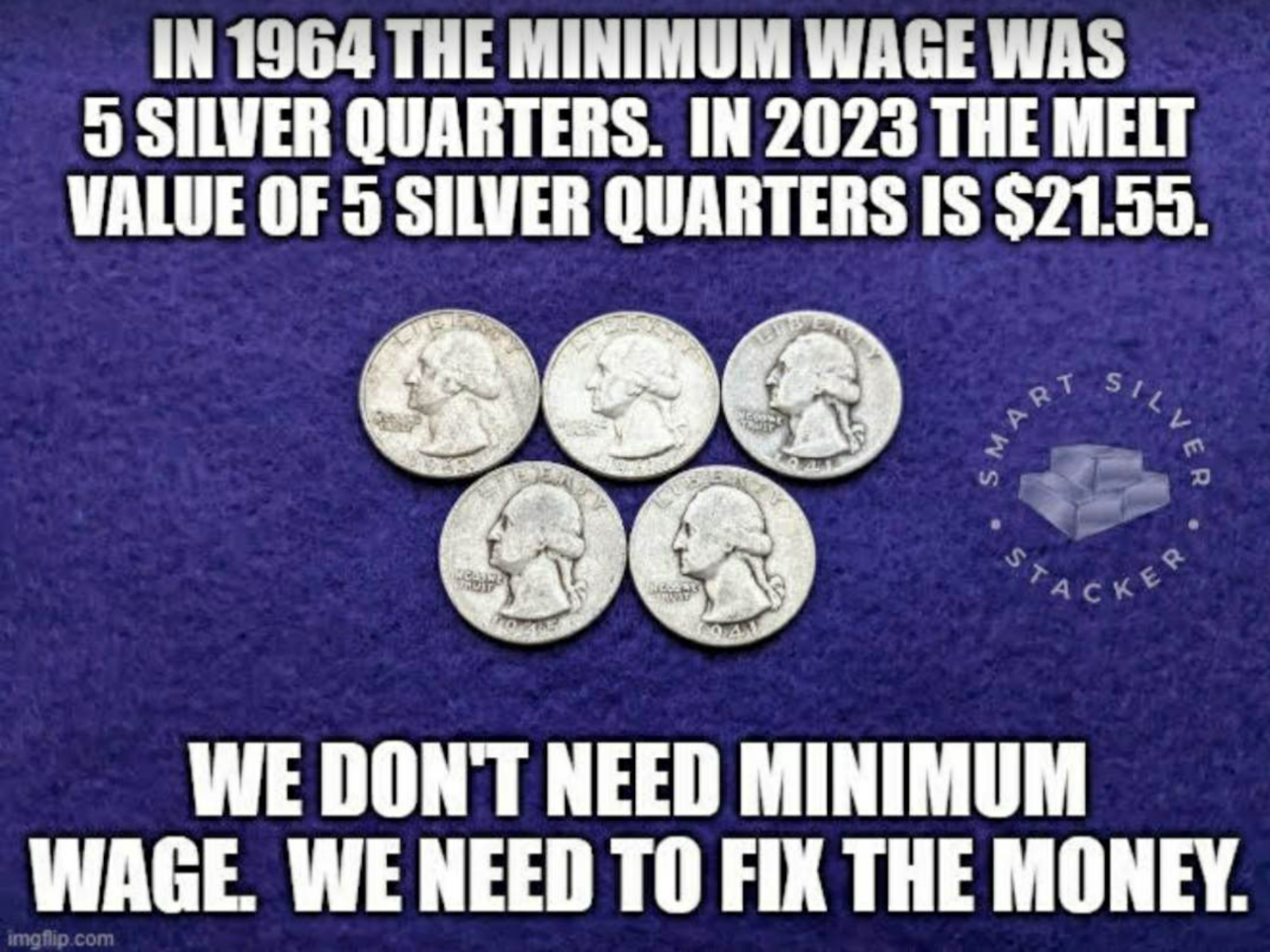
I recently stumbled upon this picture. 

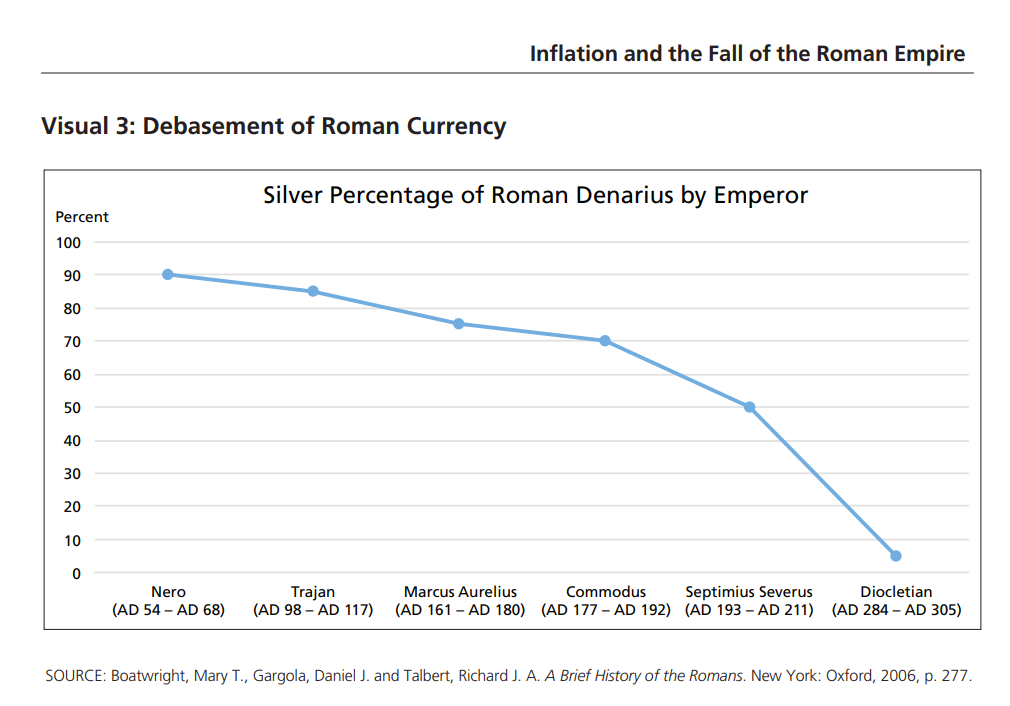
Through 1964 American quarters and dimes were made of 90% silver. Starting in 1965 the inner core is pure copper and the outer covering is copper mixed with nickel. I was discussing this with some friends so I decided to look up some history I recalled about Rome’s debasement of their currency. The first link I found was the below comment and this link to a FEDERAL RESERVE BANK OF ST. LOUIS work book for kids grade 8-12.  

“Commodus (AD 177–AD 192) debased the Roman denarius to about 70 percent silver. Septimius Severus (AD 193–AD 211) debased the Roman denarius to about 50 percent silver. With the added currency, the government could pay for more soldiers and pay existing soldiers more.”

What is incredible is that the Romans “slowly” debased their currency by recalling the money, melting it down and reissuing with a lower percentage of silver. The US government did it quickly by going from 90% to 0% in 1 year! Subsequent dollars were created by adding numbers in the Fed ledger with nothing backing the new money!

Fort Knox holds about 4,580 metric tons of gold which is worth about $250 billion dollars. The US government budget was $6.27 trillion in 2022.

The Government budget deficit in 2022 was $1.38 trillion in 2022.

“A Cantillon effect is a change in relative prices resulting from a change in money supply.” –SWFI

Be Close to the President and Congress

Cantillon also had a theory in which the beneficiaries of the state creating the currency is based on the institutional setup of that state. This essentially means, “he who was close to the king and the wealthy”, likely benefited from the distributional choices of currency through the system. –SWFI

Realizing that the government is constantly creating new money and decreasing the purchasing power of the money you hold in your bank account, what is the average person to do?

See my other posts for a potential answer.

Maintain Purchasing Power

Bitcoin Intrinsic Value