
The Fed has no power to stop government spending, which is the root cause of inflation!

The Fed has no power to stop government spending, which is the root cause of inflation!

Below is a quote from Senator Elizabeth Warren, during a grilling of Fed Chair Jerome Powell

Senator Warren: In other words, you don’t have a plan to stop a runaway train if it occurs. You know, Chair Powell, you are gambling with people’s lives. And there’s a pile of data showing the price gouging and supply chain kinks, and the war in Ukraine are driving up prices. 

You cling to the idea that there’s only one solution: lay off millions of workers. We need a Fed that will fight for families. And if you’re not going to lead that charge, we need someone with the Fed who will. – original link here

What does Senator Warren think he is going to do about price gouging and supply chain kinks, and the war in Ukraine?

The Federal Reserve literally has 1 tool in their tool box, and that is to raise rates. He can’t stop the war in Ukraine. He can’t fix supply chain kinks. While she has identified some things that are nominally impacting inflation, it’s not all of them. There is 1 big one she is missing, which she could impact as a Senator, Government Spending!

To be clear, what the Fed is trying to do is reduce spending by individuals so they aren’t buying so many things. They try to reduce spending by offering higher rates on bonds. The thought is that people will buy bonds paying 5% interest instead of spending their money on goods. The fewer people trying to buy goods, the less money is chasing the same amount of goods and the prices will go down. 

Elizabeth Warren lives in her own kayfabe financial world. She is bullying the Fed Chair, Jerome Powell, to lower interest rates because she thinks he is hurting the economy. She is right that higher rates are one of the things that is likely to hurt the economy in the long run. But the real thing that is driving inflation in the USA is government spending. The US government debt is rising by $1 trillion about every 100 days.

Like I mentioned above, if the goal is to reduce spending in the economy by taking individuals’ money out of circulation by getting them to buy bonds, then the government comes in and is spending $1T, there isn’t less money chasing the same amount of goods, there is more money!

The Fed has no power to stop government spending, which is the root cause of inflation!

More money chasing the same amount of goods causes inflation. It is that simple. 

Think of it as if you are at an auction and you have $100 in your wallet and 5 other people also have $100 in their wallets.. There is another bidder who has a printer who can literally print $100 bills at will and outbid you and all others at anything you want to buy. This bidder with unlimited buying power will bid up the price of things until they are beyond your reach. Are other bidders, who also all have $100 causing the problem? Or is the bidder with the money printing machine outbidding everyone causing the price of things at the auction to go higher?

It’s pretty clear in this situation that the money printer is driving prices higher. People don’t study fiscal policy (use of government spending and taxation to influence the economy) very often. Most people just want to work and then come home and live their lives. Because people don’t study it often, and it’s a pretty big and abstract thing to most people, it’s very hard to wrap their heads around. 

There is also, unfortunately, almost nothing anyone can personally do to impact government spending. 

I can only think of a few things you can do personally.

  1. Learn what is actually causing inflation instead of listening to the news tell you what they think is causing it.
    1. A couple of books I recommend to understand money and its role as a tool
    2. Broken Money: Why Our Financial System is Failing Us and How We Can Make it Better – Lyn Alden
    3. Gold: The Once and Future Money – Nathan Lewis
    4. Principles of Economics – Saifedean Ammous
  2. Have a personally sound balance sheet. Spend less than you make. Invest your excess income in sound assets. Stocks, Real Estate, Gold, Bitcoin. 
  3. Communicate with others about personal finances and government finances. If we all become more fiscally literate we might form a large enough coalition that we can start impacting government spending. But first we need to understand it ourselves. It is my hope that writing this and sharing it helps educate just 1 or 2 others about the topic. 
  4. listen to this podcast – Prices, Interest Payments, & The US Deficit: It’s All Going To Get Worse with Greg Crennan

As an addendum to the above, I have copied the 2023 Congressional Budget Office report below, in case it disappears in the future. It highlights how the government spending is projected to grow as a percent of GDP every year going forward. Do we really want the government spending more and more of our money? Do we think a central authority is better at knowing what we need than we ourselves do? I think not. 

I’ve also linked it below.

https://www.cbo.gov/publication/59014

Each year, the Congressional Budget Office publishes a report presenting its projections of what the federal budget and the economy would look like over the next 30 years if current laws generally remained unchanged. The long-term budget projections typically follow CBO’s 10-year baseline budget projections and then extend most of the concepts underlying them for an additional 20 years. This year, the long-term projections are based on CBO’s May 2023 baseline projections but also reflect the estimated budgetary effects of the Fiscal Responsibility Act of 2023 (Public Law 118-5), which was enacted on June 3, 2023.

Deficits

In CBO’s projections, the deficit equals 5.8 percent of gross domestic product (GDP) in 2023, declines to 5.0 percent by 2027, and then grows in every year, reaching 10.0 percent of GDP in 2053. Over the past century, that level has been exceeded only during World War II and the coronavirus pandemic. The increase in the total deficit results from faster growth in spending than in revenues. The primary deficit, which excludes interest costs, equals 3.3 percent of GDP in both 2023 and 2053, but the total deficit is boosted by rising interest costs.

Debt

By the end of 2023, federal debt held by the public equals 98 percent of GDP. Debt then rises in relation to GDP: It surpasses its historical high in 2029, when it reaches 107 percent of GDP, and climbs to 181 percent of GDP by 2053. Such high and rising debt would slow economic growth, push up interest payments to foreign holders of U.S. debt, and pose significant risks to the fiscal and economic outlook; it could also cause lawmakers to feel more constrained in their policy choices.

Spending

In 2023, outlays fall to 24.2 percent of GDP as federal spending in response to the pandemic diminishes. Outlays continue to decline through 2026 but increase thereafter, reaching 29.1 percent of GDP in 2053. (By comparison, from 1993 to 2022, outlays averaged 21.0 percent of GDP.) Rising interest rates and persistently large primary deficits cause interest costs to almost triple in relation to GDP between 2023 and 2053. Spending on the major health care programs and Social Security—driven by the aging of the population and growing health care costs—also boosts federal outlays significantly over the next 30 years.

Revenues

Revenues fall to 18.4 percent of GDP in 2023 and continue to drop until 2026, when the scheduled expiration of certain provisions of the 2017 tax act causes tax receipts to increase. Revenues generally rise thereafter, reaching 19.1 percent of GDP in 2053, as an increasing share of income is pushed into higher tax brackets. (By comparison, from 1993 to 2022, revenues averaged 17.2 percent of GDP.)

Changes From Previous Projections

Measured as a percentage of GDP, federal debt is now projected to be 2 percentage points higher in 2023 and 9 percentage points lower in 2052 than it was in last year’s report. Overall, CBO’s projections of debt have increased through 2042 and decreased in later years.
US Government Debt

A new idea I had the other day (which I’m sure many other people have had before me), was “Remove Fear With Knowledge”. With that idea in mind I am going to start by thinking about removing the fear of the “US Foreign Debt Crisis” by sharing some information about it.

The USA has so much debt!
Our debt has increased to $X trillion dollars.
China owns to much of our debt!

The headlines cry. The topic of debt of a country is no small matter, especially when it’s your own country. We start to talk in trillions of dollars. At that level most people just breeze over the numbers. They just can’t fathom them. Most people probably don’t believe that these numbers have any effect on their lives and that “the system will sort itself out” so they don’t worry abou it too much. But some people do get to thinking about these numbers, usually with incorrect facts. I wanted to read a bit into who exactly owns the US debt. How much debt do we own of other countries? And other thoughts related to debt.


To find the most up to date numbers here is the US DEBT CLOCK. From now on I will be referencing various article for general snapshot from recent points in history but for the latest rough numbers use the debt clock.

Here are the debt clocks for many different countries.

You might ask what exactly is a debt? An debt is a liability that a government owes to another government or person. I personally own about $1,000 in individual EE bonds from the US government. Each bond returns a different interest rate depending on when it was purchased. The reason I own the bonds are because they are helping my money grow. Making my money work for me. This is good because if money is not growing by being in bonds or in some other investment like a stock or if I am not investing it in some other company that money is effectively losing value because of inflation. Inflation is a good thing. It encourages people to spend money and look for ways to make money grow. If you have deflation it leads to people not spending money because it will be worth more the next day. This can lead to an economic death if no one is willing to spend money!

Question:
Why does the USA issue debt?

Answer:
The USA issues debt so it can balance its budget. The US government has a yearly budget (sometimes) that they (usually) exceed. To make up the difference they need to get more money from somewhere. People and other governments actually give their money to the US government to meet this deficit.

Question:
What does the US government do with this money?

Answer:
They pay for roads, schools, military and other services for the US people.  The US government has a budget that is part mandatory and part discretionary. This is an important distinction to understand

“71 percent of our 2015 budget is Mandatory.  Discretionary spending is only 29 percent our total budget.Of our Discretionary spending, half goes to defense.” “ – agenerationempowered

Question:
Why would people give their money to a government that is overspending?

Answer:
People give their money to the government in exchange for a promise of more money in the future. A bond is really a type of loan from you (or another government) to our government.

Question:
Is the USA the only country in debt?

Answer:
NO! There are only 5 (tiny) countries in the world with no debt. The list of all countries by their total debt can be found here.

Question:
Doesn’t China hold all our debt? What will happen if they decide to collect on it?

Answer:
Only ⅓ of our total debt is held by foreign governments or individuals and China only own a fraction of that. In order for “all debt to be collected tomorrow” that would require that the people who hold that debt would have thought of a better way to make money on their investments other than the US debt. It’s unlikely that’d happen all at once so there is little likelihood of all the debt being simultaneously collected at once. Also if something as massive and disruptive as that was proposed we could always just say no. Being the most powerful country in the world it would take a war to get your money back. Luckily the US government is, mostly, trustworthy, and usually pays their bonds back. But not all governments do.

You can read more about Argentina’s debt crisis here.

“He buys debt from countries, such as Peru and Congo-Brazzaville, that have defaulted. He gets this “distressed debt” for pennies on the dollar. Then he tries to force those countries to pay up through international courts. It’s a take-no-prisoners approach to debt negotiations. It’s time-consuming, it’s costly and it can get ugly. But the profits can be huge. In Peru’s case, for example, Singer paid a reported $11 million but won court judgments for $58 million, which the South American republic eventually paid because it had no choice. These tactics have won Singer and other such firms the nickname “Vulture Funds.”’ – Buzzfeed

The US has not hit a point where it is not paying its debts back.

Question:
Who owns US debt?

Answer:
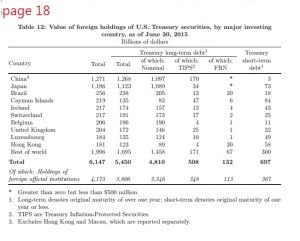
Many individual people and parts of the US government (Social Security) own US debt (of other parts of the US government) (65.6%) ($11.71 trillion dollars) while some foreign governments also hold US debt (34.4%) (totaling $6.147 billion dollars) when the US debt was $17.86 trillion. While these numbers all change slowly over time they more or less remain steady percent wise while overall debt is rising. So any debt we tried to reduce payments on would actually end up hurting our own citizens more than foreign holders of debt.

You can find the link to the table below here for US debt held by foreign countries.

foreign-holdings-of-us-debt

Question:
What debt of other countries does the US hold?

Answer:

Added answer 9-25-02017

I am adding a link to a picture created by Visual Capitalist that shows pictorially how much debt the USA is owed by other countries compared to how much we owe. It also breaks down which countries owe us money vs. which we owe money to.

Original answer:
As you can see from the table below the US holds debt of other countries equal to $9.4 trillion dollars. This is compared to our own total debt of $19 trillion dollars. The debt we hold of foreign countries should be compared to the debt other countries hold of ours.

We owe $6.147 Tillion dollars to foreign governments.

Foreign governments owe us $9.455 trillion dollars.

You can see in this comparison we actually come out ahead $3.308 trillion dollars. That sounds like a good position to be in!

You can find the link to the “Report On U.S. Portfolio Holdings Of Foreign Securities” here. Table shown below.

us-holdings-of-foreign-debt

Question:
Why does the US debt keep going up? Is that ok? When will we have to pay back our debt?

Answer:
To understand why the US debt can keep going up you need to rethink your idea of the US government. The government is not like a family. Ideally, the government will not end. Therefore there is never a time when all the debt will come due. Old debt comes due every day and it is paid. New debt is issued everyday also.

It’s ok for the debt to keep going up as long as the people of the country keep making more. Debt is a count of ability to repay in the future. If the government continues to collect taxes it will continue to pay back its debts. If we are always projecting making more in the future we can borrow more. There is no projected end date for government operation so there is not a need to pay off debt.

Question:
How should we quantify debt?

Answer:
Debt is obviously counted in dollars. But how do we know if it’s a lot of debt or not? Debt is often compared to Gross Domestic Product. This is how much money a country makes in goods each year. I don’t see this as a very useful measure since the government doesn’t get all the money of it’s GDP. Debt would more usefully be compared to the taxes a government takes in since that is the money it is able to use to pay the debt.

“The federal government took in a record of approximately $3.2 trillion in taxes in fiscal 2015 (which ended on Sept. 30), according to the Monthly Treasury Statement released today. That equaled approximately $21,833 for every person in the country who had either a full-time or part-time job in September.” – CSN news

This is compared to the US debt of $19.5 trillion.

You should also realize that each state in the USA has it’s own budget. All states are also in debt.  You can ready more about that here.

It is not useful to be scared of debt. The best reaction is to understand it and what it really means.