
Bitcoin Vs. Cryptocurrencies

Bitcoin – Yes as much as you are willing to go to $0. Expect it to fall at least 50%-80% after you buy it. 

All other Cryptocurrencies and NFT’s – Proceed with EXTREME caution (likely scams). Honestly, probably just don’t buy it. 

For an in depth article about Bitcoin vs. All other Crypto I recommend reading the Fidelity Bitcoin First paper. 

Since I’ve started to post about Bitcoin a little, I wanted to make my stance very clear. Bitcoin, while it has potential to cause disruption to payments and fiat currencies, it is still a speculative asset. I personally have a higher than average income and net worth and as such I am willing to risk a small amount of money on speculative assets that I think have a high return potential. Even as such, I am only betting a very small amount of my assets on Bitcoin specifically. For most finances, savings, investing, I still recommend an asset allocation across index funds as advocated by these people.

The Crazy Man in the Pink Wig

JL Collins

Mr. Money Mustache

If you need more recommendations about what books to read about financial independence and investing for low fees please ask. 

Back to Bitcoin and Cryptocurrencies.

As I said, bitcoin is quite speculative, but most other cryptocurrencies are even more so. Most crypto currencies are thinly disguised, unregulated securities. In this case a security is something like a stock, where it’s like owning a part of a company. Read more here. 

Most cryptocurrencies are controlled by a small number of initial developers. Those developers also award themselves some of their cryptocurrency before they allow others to buy them, giving themselves an advantage to “get the crypto while it’s cheap/free”.

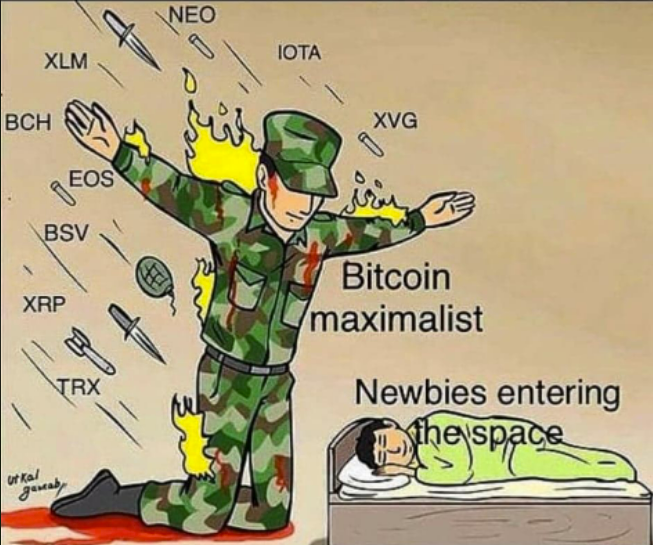
Bitcoin is different. Bitcoin is decentralized. No one got a bunch of bitcoin at the start. It is being mined everyday. No one controls Bitcoin. No one person can change Bitcoin. That is what makes Bitcoin very different from 99% of the other cryptocurrencies out there.

Another technology that is getting a lot of press is NFT’s. NFT = Non-Fungible Tokens. 

“NFTs are individual tokens with valuable information stored in them. Because they hold a value primarily set by the market and demand, they can be bought and sold just like other physical types of art. NFTs’ unique data makes it easy to verify and validate their ownership and the transfer of tokens between owners.” – SimpliLearn

Most NFT’s are either a picture of a GIF. Usually you are literally able to take a screenshot to make a copy or just right click to save. While there may be some minor value in these in general I would just advise beginners to stay far far away from NFT’s. 

In conclusion, do a bunch of research yourself before getting into cryptocurrencies.

Only buy as much as you are willing to lose/have to go to $0. 

This is the same advice as any investment.
Bitcoin As Legal Tender Around The World

One interesting thing about bitcoin adoption is places that allow it to be used either as a legal tender (El Salvador) or for payments (many businesses). I think what is most exciting is the game theory that plays out as more and more nations adopt bitcoin as a legal tender. Being a finite resource, only 21 million bitcoins, will ever be created, there is an incentive to adopt early as a reserve asset. “Getting in on the ‘ground’ floor”. 

Of course, some countries have less incentive to do that. For example, the United States enjoys huge benefits of the USD being the world reserve currency. To adopt bitcoin openly would show lowering faith in the USD, so likely, America will be one of the last countries to openly buy bitcoin. 

El Salvador was the first country to adopt bitcoin as legal tender. It has already given up it’s own currency and all transactions in the country were beign done in US dollars. Adopting bitcoin as a secondary payment method/legal tender really isn’t that big of a deal. 

Now there are a few more small autonomous regions that have started to also allow Bitcoin to be used as legal tenders:

 Lugano, Switzerland

Prospera, Roatan Island, Honduras

Madeira, Portugal

Rio De Janerio (for property tax payments)

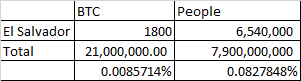
The best number I could find was El Salvador owns 1800 bitcoins. I believe it is a few more as this was in Jan 2022. When comparing their population (6.5 million) to the world population (7.9 billion) and their bitcoin holdings (1800) to total bitcoin available (21 million) they hold about the right proportion relative to the world. But Since they are accumulating more, while the rest of the world doesn’t, they should pull ahead and have the economic benefits of that as the price rises. 

There are a few other more autonomous areas that have also legalized bitcoin. 

“Lugano, Switzerland, has formed a partnership with stablecoin issuer Tether to establish bitcoin, Tether and Lugano’s own LVGA Points token as essentially legal tender in the city.r”

“Rio De Janeiro Is Giving People a 10% Discount to Pay Taxes in Bitcoin”

Honduras’ Roatán Island, Portugal’s Madeira to ‘Adopt Bitcoin’

https://cryptonews.com/news/honduras-roatan-island-portugals-madeira-to-adopt-bitcoin-mexican-senator-sends-bullish-sign-too.htm

More information about what exactly Madeira is. 

More information about what exactly Prospera (Rotan Island, Honduras) is.

Of course, Bitcoin is still quite risky. Then again, everything is risky.

Stocks are risky as any 1 company could go under. 

Holding cash is risky as it can be inflated away as a country prints more of it. This has happened in many countries in history. Just because it hasn’t happened in the USA yet is not a good reason to think it couldn’t! (I recommend this book , Principles for Dealing with the Changing World Order: Why Nations Succeed and Fail -by Ray Dalio, as a very interesting history primer on money).  

There’s also a 1 hour youtube video summary, by the author, if you don’t want to listen to the whole book. 

As always, this is not investment advice or telling you to buy bitcoin. But I believe it is a very interesting technology and certainly worth learning about!

Bitcoin

I’ve been thinking about bitcoin off and on since approximately 2017. More intensely since about Dec 2020. Here is a short distillation of my thoughts. 

My main interest in bitcoin is not bitcoin itself but its characteristics of being “hard” currency. Currency that can not be debased or inflated for use by a central authority. Beyond that, bitcoin itself has very few special properties. Any economic research that is interested in sound monetary policy applies to bitcoin, of which there has been much. 

But Bitcoin does have a few key properties that give it great benefits as a sound monetary unit. 

Bitcoin is much better than gold, the historical hard currency, as a hard currency. 

It has 3 key features. 

One. It can be purchased or transacted from your home, or anywhere else with internet access, to anywhere else with internet access. I can send bitcoin to anyone in China, Haiti or Argentina, or next door. 

Two. It can be split into much smaller pieces than gold. The smallest unit of a bitcoin is a Satoshi. With $1 you can buy ~ 2100 satoshis today (when 1 full bitcoin is worth $~$46,000)  whereas transacting in gold in small useful units is basically impossible. You cannot really buy $1 worth of gold or even $100. 1 oz of gold is nearly $1k. 1 gram of gold is still ~ $60. That is not a useful transaction unit at all. 

The third is that bitcoin has a hard fixed amount that will ever be created. Gold is not truly scarce in the universe. While mining gold is difficult and allows a relatively fixed amount. There is still growth in the total gold supply each year and potential to find new deposits at any time or get a massive amount from asteroids in space. In contrast, Bitcoin is capped at 21 million bitcoins that will ever exist, providing ultimate scarcity. 

For a primer on bitcoin, I recommend the Fidelity Paper “Bitcoin First”. 

“Sound money not only imposes fiscal discipline upon government, impeding reckless federal spending and imprudent warfare, but it also provides a stable unit of account, store of value, and medium of exchange for entrepreneurs, businesses, and individuals.” 

If you have any interest in talking about bitcoin let me know!

The Ministry for the Future: A Novel – And The World Today

I recently finished listening to  “The Ministry for the Future: A Novel” by Kim Stanley Robinson. 

The book focuses on the impacts of climate change in the future. Near the start of the book there is a heatwave that strikes India harder than the rest of the world. 20 million people die.
This makes me think of the link of this event compared to the current wave of covid sweeping through India and what actions they may take as a result?

In the book there are various attacks by environmental terrorist style groups to try to force companies and individuals to reduce their carbon footprint. 

While I don’t condone that type of violence, much of history is driven by violence, and usually the history books are written by the winners, who write their violence off as justified.

This leads me to consider the link between “The Ministry for the Future: A Novel” and another book I am reading now, “Rethinking Humanity: Five Foundational Sector Disruptions, the Lifecycle of Civilizations, and the Coming Age of Freedom (RethinkX Sector Disruption) Paperback –  by Tony Seba, James Arbib”. They are not proposing violence for any change, but they point to how technological change could lead to societal change, and has in the past. And how “Organizational systems” need to adapt to times, or collapse. Historically, they have collapsed, but they are proposing that we have the change to no collapse, this time. I recommend this book to everyone. 

Another development in “The Ministry for the Future: A Novel”  is the carbon coin. This makes me think of a paper written by ARK investment group and Square (the company). It is a very short read (5 pages).

“Bitcoin is Key to an Abundant, Clean Energy Future In this memo, we aim to explain how the Bitcoin network functions as a unique energy buyer that could enable society to deploy substantially more solar and wind generation capacity. This deployment, along with energy storage, aims to facilitate the transition to a cleaner and more resilient electricity grid. We believe that the energy asset owners of today can become the essential bitcoin miners of tomorrow. “ – Link 

The implication is that bitcoin can create an incentive to develop clean energy as long as you can incorporate bitcoin mining as a secondary income source for the green energy when it is not being used by the grid. This would allow a buildup of excess energy supply in the grid that would be used by customers as needed but alternatively used to mine bitcoin, and thus create profit, when there is excess.


I am not aware of this happening yet. Although there are plenty of grid scale battery storage solutions that are replacing “peaker” power plants and providing tremendous payback to their developers. So that is a 3rd option for excess renewable grid buildout. 


There are even more reasons besides temporary surges in use for peaker plants. A coal power plant apparently suffered an explosion in Australia and  a battery plant was able to provide instant backup. 

Various battery plants have also paid back their build cost relatively quickly. 

Back to Bitcoin. The largest risk for Bitcoin is it’s challenge to the sovereignty of Ffat currency of any nation. If it does challenge a nation’s ability to collect taxes in their own fiat currency, it will be outlawed. On the other side though, gold is a current store of value that does not fundamentally topple the current fiat money system, but lives alongside it. If bitcoin were to continue in that manner, it would be fine.

I often call the USD (and all other government issued currency) as “backed by bombs”. This is in reference to any government’s “monopoly on violence”.

Meaning that the threat of violence by the government if you don’t pay your taxes, in their designated currency. 

Various governments have already outlawed Bitcoin, such as the Chinese government, despite a large percentage of Bitcoin mining happening in China.


Other overreaching governments such as Turkey have also outlawed Bitcoin.

What does that mean for Bitcoin in the USA? It is unclear yet. Personally, I hope it is regulated and taxed as a normal currency eventually, (and not as as art or gold, which have very high tax rates as collectibles).