
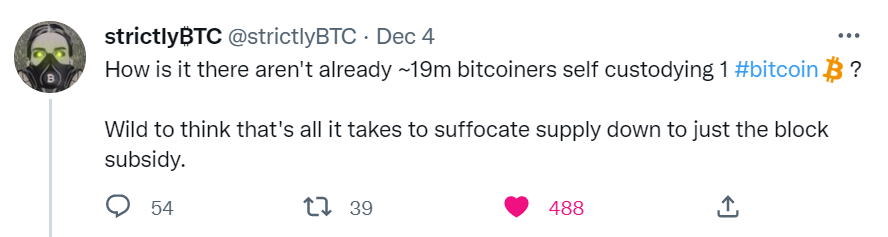
I saw this tweet by StrictlyBTC the other day and it’s really bothering me! For those who don’t know, there are only 21 million Bitcoins that can ever be created.
About 19 million have been created (mined) already and that leaves 2 million left to mine.
About 4 million have been lost. By my math that leaves (19-4)= 15 million bitcoin up for grabs today. There are an estimated 100 million people who have used Bitcoin thus far. A recent estimate has shown that about 1 million Bitcoin addresses are holding 1 BTC.

Now it is very easy for any person to have more than 1 wallet. So the number of people who actually own 1 Bitcoin might be higher or lower. It’s possible there are many people who have 2 wallets and 0.5 BTC in each so they will own 1 BTC. It’s also possible (and likely) that many of the 1 BTC and over wallets are held by the same person. So 2 of the 1 BTC wallets might be owned by 1 person. To keep it simple I am going to continue to estimate that there are 1 million people who hold 1 BTC.
There are 47 million millionaires in the world. There aren’t enough Bitcoins for each US dollar millionaire to own even 1 BTC!
Many of these millionaires are older people, since on average, you accumulate wealth as you age which probably makes it less likely for them to accumulate bitcoin as they don’t understand it or don’t see value in it.
The current price of bitcoin is $17,000/coin. This is down significantly from its previous peak of $69k. If each millionaire was to purchase 1 bitcoin that would be 1.7% of their wealth, for the people who are “merely” $1 millionaires, and if they were to just hold it, as more people would continue to purchase bitcoin that would drive the price up significantly.
Many people would argue that this is possible with any asset, which is partially true. But the main difference between Bitcoin and any other asset is it’s ability to be purchased by anyone in the world at any time, essentially, it’s liquidity.
“They aren’t making any more land” is a commonly heard phrase. Which is not exactly true for many reasons.
The Dutch reclaim land from the ocean regularly.
The United Arab Emirates hired the Dutch to build some new land.
Unproductive land is regularly turned into productive land.
Land has another issue, you usually only buy land locally.
Most other assets have similar issues, or unique issues to each asset, that make them difficult to buy.
There are only ever 21 million Bitcoin and they are the ultimate liquid asset.
For these reasons it is just blowing my mind that Bitcoin has continued to drop in price.
Historically, Bitcoin has gained interest from people, myself included, as its price runs up. When the price is going down, no one cares. I fell victim to this in 2017 when it ran up to $17k and then lost value from 2018-2020. I didn’t pay attention and missed out buying in the $3,000-$5,000 range.
I started reading a LOT more the next time it ran up in 2021 to $69k. As it’s continued into the current crypto winter I have tried to avoid the mistake I made in the last “crypto winter”. I have continued to accumulate. I have been “Orange Pilled”.
Since I’ve read so much I also fell victim to the thinking that everyone else was learning the same stuff I was. Seeing that there are only ~ 1 million people holding 1 BTC I see I am still very early. Bitcoin is early.
But it is legal tender in El Salvador and CAR.
It is gaining more users every day.
There are more Bitcoin conferences every day.
I am very curious to see how Bitcoin adoption continues over the next years!
If you want to learn more about Bitcoin you can contact me via email or comment below!
 MyWheelLife.com