One Way A Basic Income Could Work

There is probably more than one way a basic income could work but I want to share at least one that I have considered to help people see that it might be possible.
First I want you to consider if there are people living with a basic income in today’s society? What provides for their income if they are? Why is there a basic income provided for them?

There are many people living on a basic income today. There are many different groups receiving a basic income and they receive their basic income under different circumstances and provided from by different sources. Analyzing these groups and sources could help us understand the opportunities for more widely possible basic incomes.

The first obvious example of people receiving a basic income is children. They are provided for by their parents because the kids can’t provide for themselves.

Another group is the mentally disabled, again, because they can’t provide for themselves they are provided for by loved ones.

The third group that receives a basic income is those on physical disability from the government. Again, the requirements is that they can’t provide for themselves so they are provided for, this time, not by loved ones but because the government has mandated that it is important for us to take care of others who can’t take care of themselves.

The final group that receives a basic income is the retired. Their basic income is slightly different from the previous groups because they have created their own basic income. The reason they need a basic income is similar, in that many of them might not be able to physically work anymore so they have to create a situation where income is provided for them while they can’t actively create it.

So the similarities between all the groups is that they need money to provide their daily needs and they aren’t working themselves to create the income. The first 2 groups, kids and mentally disabled, are provided for by loved ones.

The physically disabled are provided for by the government and the retired are provided for by themselves.

Which of these is most applicable to a world wide model?

First, the love model? Where does the money for the love model come? The money from the love model comes from working income of the parents or loved ones who care for the disabled or children. The guardians have to continually create new income to cover the needs of those in their care. If they lose their job the basic income provided for the loved disappear. The important idea here is that income comes from continued work/creation of value.

Unfortunately love, doesn’t seem to be working for the world. It doesn’t seem like we’ve produced enough love to take care of all the people who need it. Love usually comes from a place of closeness and stems from family ties. I want to believe we are one human family, but by our mass actions, we have shown we are not there yet.

The 2nd way, governmental care, has an income collected from the working class. This class is likely providing for some loved ones already, and are also providing a basic income for another class, the disabled, who they don’t necessarily know personally or love directly. At a fundamental level, the income from the government really comes from the same place as the money from the first group, from working people continually creating value.

The government assistance model for basic income has shown some more success in places that have more government oversight as well as a more robust economy that can handle more being “siphoned” (taxed) from the working populace. The difficulty here is that that the governments money ultimately comes from the working people. They are only able to support so many non-working people. .

The final group, the retired, have their money come from growth or dividends of capital from businesses that they are owners in, stock owners or direct private business owners, that they have accumulated their whole life. Dividends are actually income (value), produced by the first group, the working class, but that is not awarded to the working class! It is awarded to the owners of the business. This is a very important concept because it gives us a glimpse of where we can obtain income if we aren’t working. If you are a business owner you will gain some profits from the business you own.
It is important to understand a business idea here. Your employees must produce at least as much value as you are paying them. Most businesses employees actually produce more value than they cost the company. They have to if the business wants to show a profit!

Think of the business that you work for. You should ask, how does this business make money. Then you should ask “How much profit per employee a year does this business create?” You should also ask “How much profit do I create for the business a year?”

Good businesses know how much profit they make per employee. For example, Facebook makes $188,000 per employee per quarter! That’s $752,000 per employee per year. That is why starting employees at Facebook can make over $100k a year, because they add way more value than that to the company each year. The profit you make over the salary you pay the employees is the extra profit that can be paid to the business owners. They are awarded this extra income for taking the initial financial risk of starting a business, investing in capital, etc. It is just as easy, or even easier, to invest in a business and lose all your money if you are starting from scratch.

The important idea from above, business owners can potentially gain income from a business in which they are solely owners, they don’t have to be doing any work and that is a form of basic income we see today.
Somebody has to do the work, today. These are the workers. Now I am going to ask you to take a mental journey to a future with me where we can envision a business, started by a person where they invest a lot of their money into fully autonomous machines, such that there are 0 people actually working in the factory. There is solar energy provided for the plant. There are autonomous robots creating, whatever product you want and the maintenance is also handled by robots. There are 0 people working in this factory, but the factory is producing a product, something of value, that other people will pay for. In this scenario, there is still a business owner, there is still value being created and income coming in, but there is no work being done by any people. This is exactly the scenario in which a basic income is viable. Now let’s say this person’s autonomous factory makes shirts. Now another person has a 100% autonomous factory where he grows food. These 2 people can create enough food and clothes between them, while neither is physically working himself, to feed and cloth each other. Now consider a 3rd person who has no factory of his own. The 2 autonomous factory owners factories can produce enough that they could feed and clothe this 3rd man but will they? That is the critical question! I believe in an abundance economy, which is what you would have when everything is being created from 100% autonomous work, that the capital owners, the factory owners, would be generous people. My belief stems from some fantastically rich people today, Bill Gates, Warren Buffet, Mark Zuckerberg, who have so much wealth to be in the position of capital owners who have 0 necessity for work and who are working to give it away.

Since we now have one idea for a possibility for how a basic income would work I think it should be pretty obvious that the goal is clear. We should work to invest in factories and other methods of creation that are 100% autonomous.

Once we are creating enough to provide for everyone the desire and ability to distribute the spoils of this abundance should manifest rather quickly from either the care and responsibility we feel towards our fellow humans, when our own survival is not threatened, or from the fear that our survival will be threatened if we keep a large segment of the population under-cared for. Either way, there should be a path for care for all when abundance is possible.

I realize that the thought of fully autonomous factories seems fantastical. But it truly is not! Complete autonomy is just the final step in what has been happening for many years, at least since the start of the industrial revolution. The increase in productivity of any individual is the hallmark of our age. I personally am paid more than the average person because the tools and knowledge I have access to allow me to produce more. Full autonomy is the final act in that progression. Infinite creation with no input. If you can’t see that end you lack creativity. It is the ultimate efficiency, which is what our economy is working towards.

Some examples include the push towards autonomous cars. While there is certainly investment upfront, the final output, value add, work done, autonomously is the obvious outcome. The best thing about the investment is that once the investment is made in full self sustaining autonomy, robots fixing themselves, that is the end of the cycle.

Then the imperative question is, who owns the robots?

How does the value get to the people who don’t own the robots?

These are important questions and ones that must be considered. If you aren’t able to consider that this is a very likely future though, we won’t’ get there and the answers don’t’ matter.

Redistribution Of Wealth Is Not Sufficient To Fix World Poverty

“We as individuals, we must extend peace and knowledge growth throughout the world, for that is the only way we all prosper.” – Axel Hoogland

Redistribution of wealth is not sufficient to fix poverty because there is not yet enough wealth in the world.

There is $217 trillion dollars of valuable stuff in the world.

$217 trillion/ 7 billion people = $30k/person.

Therefore, if you are one of the people reading this who has more than $30,000 in net worth you should consider redistributing your own wealth before you call for Jeff Bezos or Bill Gates (who IS redistribution his wealth) or others to redistribute their wealth.

We need to understand the difference between production and net worth.
This is the issue people, including Oxfam, have and perpetuate when they say “the richest 7 people could end poverty”. To say that a billionaire who “made” $40 billion in a year in capital stock appreciation could “fix poverty” is ignorant.No one is stopping any person from getting rich and giving all their money away. If you have a great idea to start a company, by all means, start it up and give your money away! Show us how it’s done!

Anyone who holds a significant amount of shares of a company likely created that company from nothing. They accumulated wealth because people use their services because their services or products work so we give them money for them. These people take something, add value, and sell it to us, making themselves rich and our lives easier in the process.
Most people are bad at making money or adding value or thinking creativity. That is why we work for companies that tell us how to add value. That is why companies pay us a part of what value we create, because we wouldn’t know how to do it ourselves.

Most people also have excess money from their jobs, which they then re-invest in the stock market or in government bonds because they don’t know what constructive thing to do with their excess money also.
You shouldn’t be mad at Bezos! He created a company, he did an Initial Public Offering (IPO) of stock. During an IPO people say “I have an idea that I think I can make you money.” People then agree with that person and give him the money they worked to earn, in the hopes that he will make them more money with it, because they can’t think of a way to make that money work themselves.

So, if someone has started from very little, made a move to say “I can add value” and people have both freely given them money (working capital) for stock (part ownership of a company) and then that person DID add value and create a very useful company that millions of people use for it’s efficiency, why would you want to then take that money away from that person who you gave it to in the first place? We should give those people more money! Which is exactly what happens in the stock market. The main purpose of the stock market it to get money from people who don’t know what to do with it to people who have an idea of how to add value.

The only way to raise the poor from poverty is to give them better tools to produce more. I am only as successful as the tools I have access to, knowledge being a tool. If you are a person in the middle of Africa, with no access to the knowledge that has been built up for hundreds of years, you are at a distinct disadvantage, through no fault of your own. This is one reason I like “One Acre Fund”. They are helping people learn to produce more, not just handing out charity. The old “teach a man to fish” axiom. That being said, there are many even more efficient ways to farm than these people are being taught. These other methods are initially capital intensive and lead to fewer workers to produce more goods, creating lower prices.

The other thing to note is that the world GDP is only $17,300 a year. As I mentioned above, the only way for everyone to be on a level playing field is to raise the worldwide GDP. How do we do that? Through investment in technology and innovation. As I said, you are only as good as the tools you have and the value you create. The more knowledge people have, the more tools they can use and the more value they can create. You can see some companies are very good at creating profit per employee like Facebook and Google. Others are not so good. We should continue to work to improve the profit per person which comes down to value created per person. People can only create more value with better tools!

Another thing we should learn about investment of capital comes from Norway and Venezuela. Both countries discovered oil and the oil was at least partially drilled by the state. What they did with the profits after that is instrumental though. Venezuela used the money to subsidize many things and pay for the government to run. This worked, as long as there was always more oil and people willing to pay for it. But once it ran out, bad times.

Norway took a different approach. They also saw the oil as belonging to the people, they could have paid each person some of the oil money (but they didn’t) but they did something (also somewhat socialist) but at least it involved long term thinking. They continued to collect taxes from the people but they used the profits from the oil sales to invest in real estate and businesses around the world! This will provide them income for many years to come. In fact the Norwegian Oil Fund, which holds assets around the world, has $1 Trillion dollars of assets! This is about 1% of the world stock markets! They own 0.5% of Apple, the company! I bet you didn’t know that. It is good that Norway has tied it’s success to the success of others. That way they are less likely to fight with anyone, as a decline in value of anything around the world negatively impacts them also. The Oil Fund holds about $200,000 per Norwegian. I bet Venezuela wishes they had that kind of money saved up, instead of having spent it.

I believe that this is a good way to see world relations. I am personally invested around the world also, via International and Emerging Market index funds.

Of the top 10 holdings in the Emerging markets fund, 7 of the businesses are in China, 1 in Russia, 1 in Brazil and 1 in South Africa. As you can see, it is in my benefit for the rest of the world to do good as I have invested in them also!

If you look in your 401K or other investments I bet you will find you also have holdings in other countries. It’s time to realize we are one world, one economy, we can’t win by hurting others because there are no others, we are all in this together.

Sovereign wealth funds (like the Norwegian oil fund) are basically a step towards Universal Basic Income. They use assets (oil minerals) that should be for everyone, if found on public lands, and invest the proceeds for the good of everyone. I mentioned at the very start of this post that if you split up the whole world’s assets there would be $30k per person. But Norway has $200k per person in this fund, from public land. Now we could ask if they should share that money with the rest of the world? I would argue no at this point, although it would be an interesting debate. But the facts are that would open it up to every country being obligated to giving away all it’s goods. I believe there is value to trade, but I think that this type of discussion should happen in all countries related to their assets. What we need to do is create more assets. Then each person could have more. $30k per person is not sufficient!

The USA does not have a sovereign wealth fund, but some states do. Texas is one. It is also funded by oil revenues and land. They use it to fund their public schools. A good use of basic income money and the point I am trying to make with this whole post, that education is important! It sounds like they need a little more in their fund to completely pay for school though.

“Although the FSP constitutes a majority of the funding received by public schools, public schools receive other funding, such as state and federal grant funds, and that funding is not described in this manual.” – Funding of Texas Public Schools

People need to realize that the world is so interconnected that we don’t win by making others lose. The Sovereign wealth fund of Saudi Arabia invested money in Uber, as well as many other things. Did you know you are making money for Saudi Arabia each time you use an Uber? We need to realize that the pie is not of finite size. Through education and innovation we can make the pie grow and it has to to make enough for everyone.

I can see why foreign governments are skeptical of any help by outsiders, as I wrote in a short story that I didn’t publish, yet. Many countries believe other countries don’t have the best wishes for each other. That has certainly been the case in the past. There has been a lot of exploitation of countries by each other in the past. We, young and old, need to realize that we have the greatest opportunity for collaboration in history! We can connect with literally anyone else on the planet! Learn what hardships and joys they have.We can learn that other people don’t really hate us and we don’t really hate them.

I am personally helping a young man in Haiti attend college there. I converse almost daily with him via Facebook and I am in contact with his school to try to learn what opportunities they have to help make their country better.

In your neighborhood, you want your neighbors house to look good, and you want your neighbor to be successful. You don’t think, I need to take my neighbor’s job because there is only 1 job in town. That is how we need to think about other countries.

It will be difficult. There are people who want to kill us. There are people who are born into societies and brainwashed to believe things that are not true. We need hard men and women to protect us from those people and countries. But as individuals, we must extend peace and knowledge growth throughout the world, for that is the only way we all prosper.

What Color is the Sky? A Book Celebration (and review)

“It’s a wonderful thing to behold when you see someone take control of their finances AND their life.” – Finley

I finished my 2nd read of “What Color is the Sky” this weekend. What Color is the Sky is the 2nd book by a personal friend of mine, Michael Finley. As I said in the title, this is both a review and a celebration of a great book. I believe it is one of the best investment books available because it delivers useful, actionable, information instead of vague concepts. Because of this I have personally bought and given away over 40 copies of this book to friends and family  (and I hope to give more in the future, and that people read them!). A great feature of this book is that each chapter is 2 pages long and covers 1 topic. The book delivers a wealth of information in a short enough read for the average person. The average person doesn’t want to or have time to read 30 pages about stock market bubbles, timing the market or index investing. Finley delivers concise, precise, useful information that shouldn’t tax your attention span.

There are 5 stages in the book.

Stage 1 is simply Finley giving you a pep talk. He wants you to know that you are able to manage your own investing, or at least that you should be able to find someone to help you along but who won’t screw you (like 95% of financial “advisors” (salesmen) these days).

Stage 2 includes a lot of chapters informing you about what smart investing is NOT.
Smart investing is not trying to guess which one stock will do good each month.
Smart investing is not listening to your uncle who is not educated on investing.
Smart investing is not trying to find the best managed mutual fund and changing it each year or two.
Smart investing is not  investing in something because everyone else is (housing bubble, tech bubble, tulip mania).

Stage 3 includes a many chapters informing you about what smart investing IS.
Smart investing is investing in index funds (or target date funds which are made of index funds).
Smart investing means you are diversified through various classes of investments (US, international, bonds, REITS).
Smart investing is understanding opportunity cost, the rule of 72, taxes and different types of account you can save money in (401k, 403b, 529, IRA, ROTH or traditional).
You could skip right to stage 3 of the book if you are really bursting to get the knowledge of what you should do, but if you do you need to go back and read the start of the book. This whole book needs to be read, by everyone and I will buy it for you, if you need me too. As Mike often mentions in the book, he is not paid by Vanguard to promote their product, he just believes they are doing what they do the best. Similarly, I believe Mike is providing the most unbiased, useful, actionable (helps you actually make investment decisions) advice in an easy to understand format.


Stage 4 builds on stage 3 with more practical actionable advice.
Discusses buy and hold (vs selling constantly to buy “winners”), different asset classes such as large capitalization stocks, small capitalization stocks, REITS and bonds.
Discusses international vs domestic stocks.
It also discusses rebalancing your portfolio, asset allocation as well as one of my favorite topics the 1 and done fund, the Target Date Fund.

Stage 5 is rather short. It encourages you to continue your financial education with recommendations of some good books. It encourages you to seek fee-only advisors if necessary.

Finley also uses a chapter to provide his vision for the future. He speaks about institutional investors, who are collectively losing million of our dollars to fund “managers”. Many large state and company investment funds offer poor funds. He wants to change that. We must demand the change and to do that you must be informed.
Finally, Finley encourages you to share what you have learned. As is his life goal, educating and empowering others to become the best they can be, he encourages the readers to help others learn more about investing and personal growth. That is part of what I am trying to do by writing this blog and this post, teaching others what I have learned in hopes that it will make their lives better and ultimately, make the world a better place. Active fund “managers” are generally providing negative value to the world and we need to stop that, so do your part, learn, become educated, get rich and live a rich, fulfilling life.

You can find Finley’s book here on Amazon (as I said I get nothing from this, he doesn’t even know I wrote this until he will see it on Facebook). I will buy you the book if you don’t think you can afford it. Leave a comment below if you’d like me to buy you a copy. You can’t afford to not read this book and I can’t afford for you to not read this book! Changing the way the whole market operates is in my, your and the world’s best interest. Forward to a better future!

My IRRATIONAL Fear – Short term market collapse

You NEED to understand that the market is risky, in the short term, but so is every other place to put your money, including under your mattress (inflation risk!). – Axel Hoogland (yes I quoted myself)

My IRRATIONAL fear is a short term stock market collapse (meaning stock prices go down for a year or 2, similar to 2008 market collapse) (Learn about what the stock market is here).I am afraid of this because I am continually telling people to invest their money in the stock market. Most people are already invested in the stock market (but don’t know how their money is being managed or what exactly they are invested in). Some are only invested in bonds (which is risky as you are losing money to inflation). Some will pull their money out of the stock market at the first sign of trouble or market dip, which happens often (dips) but usually the market recovers quickly and they would lose on the gains. When investing in the market people should always ask themselves “What do I need this money for?” You NEED to understand that the market is risky, in the short term, but so is every other place to put your money, including under your mattress (inflation risk!).

My greatest fear is being wrong. I hate to give people incorrect information. It is ok to be wrong on some things. If you recommend someone eat at a restaurant they will be upset with you if they don’t enjoy it they will choose to never eat there again and might just stop taking your advice on restaurants.

If you recommend something to do with investing people’s money, something that they don’t completely understand themselves, and they seem to lose money (even if it is only for a short time and then it comes back in a year or two) they may hate you forever. People will be sure that there was a better option for them to invest their money in. They will not know what that option was, but they will be sure it was better than following your advice.

Someone is is almost always better at doing something for you than you will be at doing it for yourself. Some things require training to learn how to do. Many people do not feel comfortable fixing their own car. They take it to an expert, a mechanic. They don’t feel they have access to the right tools or knowledge (and that’s often true) so they pay someone to do it for them.

Unfortunately many people are happy to let an “expert” manage their money, for a large fee! The problem is these people are not experts, they are “salespeople”! You don’t let the car salesman fix your car and you shouldn’t let a “financial salesman” manage your money. The truth is that as a whole all fund managers will underperform the stock market. This is because of the fees they charge and because they are bad at guessing (yes they are guessing) which companies will perform better than average on any given year. Whenever someone sells a stock remember someone is on the other side of that deal guessing that that stock is going up! As a whole, all managed money will underperform (measured by percent returns to clients after fees) the total amount of unmanaged (index funds) market. Certainly some money managers will pick good and outperform the market and many will underperform and pick worse stocks than the market average, but all charge high fees. That is why index funds generally are the best place to put your money. To further diversify you should put your money in a Target Date fund which automatically transfers your money to bonds (safer investments) as you reach retirement.

A question people often ask is

Q.The stock market is high, should I pull money out of the market?

A. I ask them “What will you do with your money it if you do “pull it out” of the stock market?” The stock market should always be at the highest it’s ever been because the world is growing in population, thus businesses are making more products to sell.

As Mr. Money Mustache recently posted about, there is always a recession coming, so instead of worrying about it, it is better to understand what might bring it about, understand what you are investing in and why, and ride the storm out. A benefit of all this is that if people understand what causes recessions, over spending followed by underspending, we (may) be able to avoid wild cycles and instead keep a nice steady rise in abundance in the future, that is my hope by helping to educate people on “The Stock Market”.

Now that I’ve shared my fear with everyone, and why it’s not a rational fear, you should continue to learn about investing and why it is probably one of the most important things you can understand for yourself and for the world. You can learn more about Target Date Funds (where everyone should start investing) from this post or this video.

Paris Climate Agreement

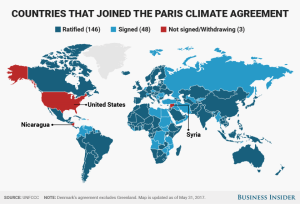
The USA is “leaving the Paris Climate Agreement”, in about 4 years, President Trump has declared by executive action. Many countries had ratified the agreement, meaning their leader and likely some congress/senate or other governing body agreed. About ¼ of the countries in the world signed it (including the USA) which means that probably just their leader agreed to it. That being the action that Obama took. That was a mistake on his side (although probably all he was able to do as there was likely no way Congress would have ratified it, being Republican at the time). Because of that, it was easily un-signed by Donald Trump.

(Picture from Business Insider)

As far as I can tell there were not really many actual ramifications to signing the Paris Agreement or leaving the Agreement for the USA from the rest of the world. You can read the Paris Agreement by clicking the link. You can also read the 5 page document the USA sent sharing what our plans were to meet the agreement.

Here are the important sentences along with an easy to understand graph.

“The United States intends to achieve an economy-wide target of reducing its greenhouse gas emissions by 26%-28% below its 2005 level in 2025 and to make best efforts to reduce its emissions by 28%.”-  USA First NDC (nationally determined contribution) Submission

“ The United States has already undertaken substantial policy action to reduce its emissions, taking the necessary steps to place us on a path to achieve the 2020 target of reducing emissions in the range of 17 percent below the 2005 level in 2020. “ – USA First NDC (nationally determined contribution) Submission

These were self professed goals to work along with other countries in the world to reduce all our emissions together.

The US is the world’s second-largest carbon emitter, after China. Together, the countries accounted for 45% of the world’s carbon dioxide emissions in 2014.” – Business Insider

The USA is near the top of emissions per capita.

http://www.wri.org/sites/default/files/uploads/per_capita_emissions.png

If you take the time to read (Framework Convention on Climate Change) FCCC/CP/2015/L.9/Rev.1  document, better known as “The Paris Agreement”, you wil lfind reference to the “Warsaw International Mechanism” which is another body of individuals that appears to be around to provide some guidance to help make decisions related to climate change.

There is a reference to “$100 billion dollars” “from developed countries to developing countries” that some people seem to think the US is on the hook for. That is false. Here is the statement regarding $100 billion.

“”54. Also decides that, in accordance with Article 9, paragraph 3, of the Agreement, developed countries intend to continue their existing collective mobilization goal through 2025 in the context of meaningful mitigation actions and transparency on implementation; prior to 2025 the Conference of the Parties serving as the meeting of the Parties to the Paris Agreement shall set a new collective quantified goal from a floor of USD 100 billion per year, taking into account the needs and priorities of developing countries; “ – Paris Agreement

There is no set plan where that money comes from or how it is counted for. Some of it is in foreign aid, some is hoped to be in private loans. Basically, it is just a hope at the moment and certainly not something the USA is on the hook for.
What we have done is Contribute $1 billion since Dec 2015 (when the treaty was signed by Obama) to the “Green Climate Fund”. This was ⅓ of a pledged $3 billion from Obama. Trump has canceled the rest of that money.

As Trump mentioned later in his speech, the United States has given the Green Climate Fund $1 billion already. President Barack Obama pledged a total of $3 billion to the fund by 2020 as part of a global goal of $10 billion, but Trump promised not to finance it as a candidate and Congress has not made further contributions since the election.” – NBC news

The whole $3 billion represented about $9/person in the USA (over 5 years) and only a very small percent of our $40+ billion in foreign aid each year. (US budget for 2016)

(picture from Washington Post)

Another source of money for the developing countries is the Least Developed Countries Fund (LDCF) which is administered by the GEF (Global Environment Facility unites 183 countries in partnership with international institutions, civil society organizations (CSOs), and the private sector to address global environmental issues while supporting national sustainable development initiatives. Today the GEF is the largest public funder of projects to improve the global environment. An independently operating financial organization, the GEF provides grants for projects related to biodiversity, climate change, international waters, land degradation, the ozone layer, and persistent organic pollutants.- Wikipedia)

So now that we’ve established that the Paris Agreement:

  1. Was not costing the USA anything financially
  2. The Green Climate Fund (separate from the Paris Agreement, was costing the USA very little, $2 billion as part of $40+ billion in foreign aid)
  3. Emissions reductions were self imposed at 17% currently planned and a projection of up to 28% reduction (compared to 2005 levels in the USA) by 2025.
  4. Was definitely abandoned by Donald Trump personally but not by individuals and businesses.

What do we do about that?

Assuming you believe in climate change (rising temperatures) and that it could have negative implications for people related to damaged crops, damaged houses and is already happening now, what can you do about it?

I actually hope Donald Trump abandoning the Paris Agreement is a good thing. I (naively) believe that maybe people will start to take individual actions to offset their own carbon footprint instead of thinking the government will do it.

Here are a few things you can do to offset your own carbon footprint.

  1. Support carbon offset companies/non-profits. Read this great article from Mr. Money Mustache about companies that do that.
  2. Plant trees! (You also don’t have to do that personally). Here is a company (OneTreePlanted) you can pay $1 to plant 1 tree or $100 to plant $100 trees! WOW. (I am not sure how effective they are at this yet. They seem pretty new, but maybe they’ll contact me after this mention, or maybe I’ll contact to them to get more information about their work.)
  3. Buy a more efficient vehicle!

The people of the USA need to get over the idea that what the President of the USA does has much direct impact on their lives.

While the President can certainly create policies which affect your life one way or another a few thousand dollars, the fact is that what the government is doing is really not that intrusive on your life, especially not related to how you personally pollute! Not in the USA. What people need to realize is that  people have power. We can choose to influence how businesses create products and we can vote for people who will represent our beliefs. If we choose to specify to pay a little more for renewable energy, companies will create it. You can do that for many electric companies.

You can do the same with businesses. You can “vote” with your dollar, instead of just your political vote. Vote every day.

Many business CEO’s and city Mayors in the USA have pledged to keep their businesses and companies to the Paris Agreement. That is laudable and it is really what they should do also. Why should a company start polluting more just because Donald Trump says he is going to? Many companies are already on the energy efficient path (which is inherently green anyway) due to cost savings. So that should not really be an issue. It is unfortunate that the global warming thing has been “sold” to people as “saving the earth”. Most people I know don’t care that much about it. But if it was sold as “saving you money” people would be all over it. Being more efficient is saving you money AND saving the earth at the same time. Let’s try to focus on that, individually, and collectively. Hopefully other countries, companies and individuals continue on that path, largely ignoring what Donald Trump says. As I have said, he really has little power in the arena of what most people and businesses do personally. I suspect that history will look back on him poorly for this action.

I really don’t know what Trump is thinking overall. He is certainly connecting with people who have a certain mindset, that the USA is somehow getting “screwed” by the whole world. I just do not see that. Would you feel “screwed” if you were helping a family member through a tough time? The whole world is our family, and it’s the only one we have and some of them are going through pretty tough times. We should be ashamed that a large percentage are starving while some are living in luxury. Some of the starvation is related to the damage we’ve done to the environment with our many years of technological advancement and our gluttonous use of fossil fuels for energy and transportation. Some is related to corrupt governments (which is something I’m thinking about also and I acknowledge it’s a BIG issue, but not the topic of the day, yet).  Once we all get on a path to being more efficient we will be doing everyone else a great service as well as future generations.

Mark Zuckerberg – Basic Income

Upsate 7-24-02018

It looks like UBI potentially funded by “the 0.01% is being discussed again.

Update 9-22-02017

It looks like Y-combinator is embarking on a basic income  experiment similar to what I proposed Mark Zuckerberg do. This is a good thing as it’s still an individual/private group doing experimentation that government can’t/won’t do.

“YC will select 3,000 people across two states and divide them into two groups. The first group will include 1,000 people who will receive $1,000 a month for up to five years. The second group of 2,000 people — which the study will consider its control group — will receive $50 a month.”

Original 5-29-02017

Mark Zuckerberg gave a speech for the Harvard commencement ceremony this year (2017). In it he advocated for a universal basic income, which is something I’ve been thinking and reading about for a few years. The most important question about a basic income is “Who pays for the basic income?” Some people have thought about this more than I have. You can read about how one guy thinks we should pay for a basic income here. There have even been a few basic income programs in the past. You can read about one happening in Finland here, as well as in Kenya here.  

When you have an idea as big as a basic income you need a path to get there. You don’t just implement a basic income to a whole country. I am often trying to figure out how to implement ideas fast, not necessarily perfectly.

I am excited that someone with as much wealth (from Facebook stock ownership) as well as a desire to change the world for the better (as self reported by Zuckerberg multiple times) is interested in a basic income. Luckily Mark Zuckerberg is a billionaire and his stock is rising, literally. Facebook is worth more every year. This gives Zuckerberg the rare opportunity to implement his own basic income study! No one can stop him! And if it goes well he will be able to prove to people that a basic income is a good thing that should be implemented wider.

If Zuckerberg owns $63 billion in Facebook stock. it should grow at at least 4% a year, which means he could sell $2.5 billion a year, and use that to provide a basic income. Which means he could give 25,000 people a basic income of $100k a year!

Since this is a test and that’s a lot of money and this is supposed to be a basic income, he could provide an income of  $30k to say 500 people, this would be $15 million a year, a pittance that Zuckerberg wouldn’t even notice! I think he should do this for say 5 years, and see what happens with those people.

We need this kind of leadership to show us that this type of program could work.

$30k*500 people =$15 million *5 years = $75 million over 5 years.
How much to manage this program? $25 million maybe? (maybe way less!) For a cool $100 million over 5 years.

Until someone is willing to run this type of program and shows that the people who receive the money come out more successful than otherwise, and that they aren’t just being lazy, it won’t receive large scale acceptance.

I believe this is a program Zuckerberg should take on with his new Chan Zuckerberg Initiative LLC (not a charity, which is fine, I think businesses can potentially make more changes in the world than charities, or at least it takes all kinds!). If he wants to contact me to discuss further why I think he should do this he can find me at hooglandaxel@gmail.com

Alternatively, he could contact the nice people at Give Directly, who I mentioned earlier. They seem more versed in administering something like this and could probably run the program for less than $25 million!

Millions Could Die From Drought/Starvation

I read “The Last Hunger Season” in 02016 about the NGO One Acre Fund, who is working in Africa to provide seed, fertilizer and planting techniques to help farmers there produce more.

I am currently listening to the book “Enough: Why the World’s Poorest Starve in an Age of Plenty” which is talking about how providing seed and fertilizer is not enough, if the farmers there can’t sell their food into a developed market, they will have to sell when the price is low which puts the farmers in basically the same place they were before all the help.

The Last Hunger Season was published in 2013 and Enough was published in 2010. I figured that it’d been enough time that maybe the actions being taken by the people would be having an effect in Ethiopia, Kenya and other countries in Africa that they are working in.

Imagine my surprise when the first article I find when searching “Are Africans hungry” yielded the below headline “United Nations issues ultimatum as millions face starvation” and with this comment in the article “More than 30 million people need food assistance in Yemen, South Sudan, Nigeria and Somalia due to conflict and drought….Wars in Yemen, northeastern Nigeria and South Sudan have devastated households and driven up prices, while a drought in east Africa has ruined the agricultural economy.

I like to think I keep a pretty close watch on major news. I had not heard any ultimatum about millions of people starving in Africa lately, have you?

After I continued searching for a few more topics related to Kenya, Ethiopia, Africa, etc and getting in a short Facebook discussion with a relative about what causes a country to have a lack of food, greedy leadership, actual lack of food, etc, I found the below articles.

Looming ‘catastrophe’ in East Africa proves why world must tackle climate change, says Oxfam

Issuing a “desperate” appeal for the international community to meet a request from the United Nations for about £1.5bn of aid, the charity also said the worst drought in living memory demonstrated why the world must act to reduce global warming. While some still deny the severity of climate change and question the need to combat it, others are struggling for their lives as climate change makes a bad situation worse,” Oxfam said.

Kenya: Do Not Be Fooled, Food Shortage the Result of Misrule and Graft

“Anyone with a modicum of education today knows that while drought may, indeed, be a natural calamity, famine is man-made, an outcome of mismanagement, incompetence and criminal dereliction of today.”

I get pretty sick of seeing articles from fellow Americans that are discussing their “problems” like too many GMO foods or how they think climate change is not real because of a bad snow storm. I’m also frustrated by people driving gas guzzling trucks around while you have a perfectly good option of buying a Prius or even better a Nissan Leaf! Now I am not a perfect person myself. I own a few old vehicles that are not particularly environmentally friendly. I am still not sure what exactly to do with them. We don’t talk much about “how to make the world a better place for everyone” and I am not sure why we don’t do that? Why is the 3 year drought in Africa not a headline?

I watched this great video by NubmersUSA.org and Roy Beck about immigration. After that short presentation it’s pretty simple to understand that immigration is not the answer to helping most people in the world improve their situation.  

On a positive note, and recognizing someone who seems to be trying to help in Africa, I want to highlight Akon Lighting Africa. Akon, a rapper turned businessman, is working to provide solar lights, which can lengthen working and learning (productive) hours, provide safety (lighter places are safer) available to the people he is helping.

I also want to recognize Mobius Motors, a company that is working to provide rugged, durable, vehicles, built for the African market.

Are these entrepreneurs, working to solve problems and still make a profit, the right answer to solve all the problems in Africa? If so, how can we in the developed world help these types of companies accelerate their growth and impact? Is it even our problem to consider helping people in foreign countries? Shouldn’t we worry about all the problems we have in our own country?

I will admit that I don’t have the answers to these types of questions. But I think about them a lot. I think the best thing I can do for now is raise awareness of these issues and get other people thinking about them also, and that’s why I wrote this post.

What do you think?
Did you know there was a 3 year drought in Africa causing starvation to 30 million people?
Do you think entrepreneurs are a more effective way to solve problems than charity?
Do you help support anyone in a foreign country through Charity (Children International or Imagine Missions) or loans (kiva.org).
Do you think we should intervene militarily to displace bad governments or should we let people solve their own problems?

The Inevitable

“Man can and must prevent the tragedy of famine in the future instead of merely trying with pious regret to salvage the human wreckage of the famine, as he has so often done in the past. We will be guilty of criminal negligence, without extenuation, if we permit future famines.” – Normal Borlaug, 1970 Nobel Lecture

What things are inevitable? Some technologies might be inevitable but they may also be difficult to see from a distance in time. Some events might also be inevitable and they may also be difficult or impossible to see coming. But some are not impossible to see coming. Some inevitable we can predict and if they are positive things, we should consider how to advance their arrival.

I want to look at a few things that were achieved that seemed impossible at one time but later became inevitable and finally happened. I want to use those past occurrences to consider what future things might be inevitable, and what we can do to accelerate their coming.

The two things that I want to highlight that happened in history are the moon landings and the eradication of smallpox. How incredible are those 2 things? How often does the normal person think about them? I suspect not very often. I only think about the moon landings a lot recently in light of the recent explosion in popularity in space stuff. I am looking to them for inspiration for what I believe to be an inevitable occurrence, the landing of a human being on Mars during my lifetime.

The eradication of smallpox from the world is another incredible achievement. I suspect before the first vaccine was discovered there was little realistic thought about eradicating a disease. The average person probably didn’t really think that there was a way to beat smallpox or any other disease. They probably hoped and prayed they didn’t get it and that was that. Now that we have eradicated smallpox and rinderpest (I’d never heard of it either) and almost eradicated polio, what is next?

I propose that we should fight the easiest to eradicate problems, those problems for which we already have a cure. Problems we don’t have to invent new cures to fight. The easiest is hunger. You and I are probably not hungry. We have plenty of food available to us down the street but many places don’t.

We often think of Africa when we think of third world countries. We see videos of people starving and are asked to send money to help. It’s good to help those types of things and the claims are true. The people need help. But what is the right type of help? We could send food aid but as the old saying goes “Give a man a fish and you’ve fed him for a day, teach a man to fish and you’ve fed him for a lifetime.” I am a fan of organizations like One Acre Fund which works with farmers in Africa to provide them with high yield seeds and planting techniques to increase the yields of their small farms (usually less than one acre) from less than enough to feed a family to enough that they are able to save some for their families as well as produce some food to sell at a market.

I believe it is inevitable that one day there will be no hungry people in the world. We already produce enough food that we could feed everyone in the world if it was distributed evenly. Unfortunately, it is not. Some people have access to $300 meals every night. Some people live on $300 a year.

I hate making comments about “the rich”. Many have accumulated their wealth through creating products, businesses and jobs which provide for the people that buy the products and livelihoods for the people who work  in their businesses.

I also don’t like to criticize people who save for retirement. It’s great to save for retirement, usually through investments in businesses, via the stock market, or by starting your own business.

I am trying to think about how to encourage the average person to think about the people who are in dire need more. I have read a number of books that I believe will bring a sense of urgency related to helping others to anyone who reads them.

The Life You Can Save: Acting Now To End World Poverty – Peter Singer

Enough: Why the World’s Poorest Starve in an Age of Plenty  –  (Audible) Roger Thurow, Scott Kilman

Operating Manual For Spaceship Earth – R. Buckminster Fuller

Strangers Drowning: Impossible Idealism, Drastic Choices, and the Urge to Help  –  (Audible) Larissa MacFarquhar

Clay Water Brick: Finding Inspiration from Entrepreneurs Who Do the Most with the Least  –  Jessica Jackley

I hope after reading this you will be encouraged to learn more about the hungry of the world and how we might be able to help them.

There are many thoughts on why people are hungry and I am never focused enough to talk about just one. I always try to encompass every reason and contingency and consider if I’m wrong. This often leads to inaction and I hope that I can work on myself to be more willing to invest in ways that I think will lead to the reduction and eventual elimination of starvation in our world.
You may want to read this article that will get you thinking about some big issues related to hunger that you might not have considered yet.

10 of the Most Common Ways World Hunger Is Misunderstood Could the way people think about hunger be the greatest obstacle to ending it?
There is also a book (which i haven’t read yet) that is related to the list above.

North Korea – Some Thoughts After Reading “The Great Leader and the Fighter Pilot”

I listened to the book  “The Great Leader and the Fighter Pilot: The True Story of the Tyrant Who Created North Korea and The Young Lieutenant Who Stole His Way to Freedom

Let me start by saying that some information I learned listening to this book was shocking and incredible to me. It feels like I have a more concrete grasp of history now, but perhaps if I went back even further I would find something even more shocking that would lead me to rethink the latest revelations even? With that caveat, I will begin.

Today’s North Korea may be the most repressive country to live in today, at least that’s what we are told and I’m rather inclined to believe that. We are told that “If you don’t learn your history you will be forced to repeat it.” While this usually seems to lead to people learning about what happened during a war I think it misses a more important thing, what led to the start of a war. It is a lot harder to find a book that focuses on the causes of any war, likely because there are often a lot of causes and it’s usually pretty complex, which can lead to boring writing.

I decided to listen to the book “The Great Leader and the Fighter Pilot” after listening to books about Russia and China. This book seemed to give more history about North Korea than either of the other books did about their respective countries. I actually am looking for a book about what the Chinese government was before Mao and the communists took over. Was it even worse?

The fighter pilot, No Kum-sok, mentioned in the book has a pretty amazing story. He basically pretends to be a communist in North Korea, the whole time plotting to escape to South Korea and when he gets his chance he does. He is still alive and lives in Florida. That is all I will mention about him but his story in fascinating as is the rest of the book. I really recommend it.

The first thing I learned, which may or may not be news to others, was that prior to WWII, between 1905 and 1910, Japan had occupied Korea, at that time one country. It sounds like the Japanese may have invested in some infrastructure there to produce more goods, but it also sounds like most of those goods were exported to Japan, thus taking advantage of the Koreans. The Koreans also were encouraged/made to change their names to Japanese names in 1940.

Because of the occupation, naturally some Koreans were fighting against the Japanese who were occupying their land. One of these Koreans was Kim Il-sung, the Grandfather of current North Korean Leader, Kim Jong Un. As the old saying goes “The enemy of my enemy is my friend” and that is how Kim Il-sung became a friend of the USSR and Chinese Communists.

Kim Il-sung spent his youth being educated in China and performing anti-Japanese military acts in a guerilla group. He later was part of the Soviet Army until the end of WWII.

When the Soviets and the USA divided Korea at the end of WWII Kim was able to maneuver to become leader of North Korea. He was also interested in reuniting with South Korea, which seems like it would make sense since it had originally been part of one Korea.

To me it seems that Korea really got the shaft when it was split up arbitrarily by the Allies (USA and USSR). It also sounded, from the book, like a lot of the fighting on the North Korean side of the Korean War was done by Chinese soldiers and Russian fighter pilots, thus making it even less about the reunification of the Koreas and more a game being played by the USSR and China to mess with America.

My point in this is that I am actually a tiny tiny bit sympathetic to Kim Il-sung. What would you do if your country was occupied by a foreign force (the Japanese)? Surely you’d fight them? And who would you ask for help? Anyone willing to help, which it seems to me is how he got stuck with the Communists. Now if you spend any time with anyone, you are likely to become more like them. My guess is that is how Kim Il-sung learned to be such an effective dictator, by learning from Mao in China and Stalin in the USSR.
I am in no was trying to justify what has happened in North Korea for the last 60+ years, simply trying to understand how we got where we are and how we could make it better for the people who live there. That leads to the next thoughts I have.

As I mentioned we are told that the people of North Korea are some of the most repressed in the world. They have little access to food, electricity or internet. They are forced to believe and support the one political party in their country or they could be shipped to a prison camp where they are likely to die.

Hopefully we all want this insanity to stop. North Korea is currently lead by Kim Jong Un, the grandson of Kim Il-sung. There are varying reports of him killing up to 340 of his own people (publicly, plus all the people in camps) since the start of his holding power in North Korea in 2011 after the death of his father.

One of the latest developments is North Korea working on developing nuclear bombs. They have claimed to have tested up to a 10 kiloton bomb (the Hiroshima bomb was about 15 kilotons). It does make sense why North Korea (or at least Kim Jong-un) would want to develop increased nuclear weapons capabilities and hold the 4th largest army, by people, in the world (and first relative to population). If they believe they are still in a fight with the USA, which the leaders act like they are, it makes sense.

If we really want to get the North Korean people out of the situation they are in how do we do that?

“Assuming Kim wanted to give his people more freedom (which is a big assumption), How would he even go about it?” Is that even possible? Is it possible without him being killed? How could we, the USA or the rest of the world, help him help them? Is it more important to us that we punish Kim Jong-un or provide more freedoms for North Koreans? Why does Kim Jong-un act the way he does, killing people etc? Is it likely a result of how he was brought up? How do we counteract 30+ years of programing to think that America is evil? Is it even possible?

What I am looking for is a win-win situation, the win for Kim Jong-un being that he wouldn’t be killed and for the North Korean people that they would have more freedom to travel, grow their own food, have access to world markets, etc.

Two similar situations that could shed some light on the situation would be China and the USSR. Stalin and Mao were both on par with the Kim family as far as being terrible leaders to their people, repressive, etc. Neither was killed by their people. Subsequent leaders of those countries made them more free. Mikhail Gorbachev was even the last leader of the USSR and he wasn’t killed when it fell so I think there is some hope for the North Koreans and Kim Jong-un. I think it’s this type of win-win thinking that will get us out of these types of situations and smaller conflicts in our daily lives. Here’s hoping that the US government will work in the next 4 years and beyond to help free the North Koreans.

Update 7-8-02017

Scott Adams, who I think is a smart guy, wrote a similar thing with a little more detailed plan on how to make this a win-win situation.

http://blog.dilbert.com/post/162632490866/solving-the-north-korea-situation


02016 Year End Review

You can read my 02015 year end review here, which I did in November 2015. Wow. For 02016 I am waited until the actual end of the year to complete it.  

Here is my 02016 year in review. You can check the contents below if you just want to skip to one section
YouTube
Simple Solar

Finances
Charities I Donate To
Microloans
            Kiva
            Zidasha
Books
Personal things I did this year
YouTube:
Earlier in the year as part of my quest to share information that I think will have a positive effect on the world I made a few videos about investing and money. They can be found on my Youtube Channel here. For 2016 I had a total of 680 views coming to 814 minutes or 13 hours and 34 minutes.  While that is not a record for YouTube by any means, it was an interesting experiment for me. I will continue to think about YouTube this year and see if there is any more interest on my part in using it.

02016youtubeviews

Simple Solar:

I believe almost 2 years ago I heard about a potential solar field that would be built by my local electricity provider. They called it Simple Solar. I really liked it for a few reasons.

  1. You could buy as many or as few shares as you wanted.
  2. You didn’t have to do your own maintenance (which most people don’t want to do, simple is better!)
  3. It would move with you if you moved houses, as long as you were in their provider area still. Not possible with a $20,000 home solar system.
  4. You didn’t have to worry about metering back into the grid it’s already part of the grid. This takes away a bit of hassle that you may have with a personal solar setup at your home.

The way it works after we purchased the credits and the field was build was that the shareholders will be credited each month on their bill for 20 years the amount that their shares produced when averaged over the whole solar field. There is no specific panel I own in the solar field.

I started receiving payments on my monthly bill in approximately July 2016. I also started paying for my panels, 4 shares of the whole project at $270/share for a total of $1080 or $90/month paid over 12 months. My monthly pay back rate is  $0.055002/KWH.  (Kilowatt hour). My 4 shares each generated 14.28 KWH in December (a not very sunny month). The normal rate I pay is $0.0579/KWH. While that is only $3.14 this month other months I have seen a payback of $6 or $7. Assuming a monthly payback of $5 = $60/year = $1200 over it’s lifetime. This just covers the $1080 investment. So at first it may not seem to be great money investment. $1,080 returning 7% a year for 20 years would be $3,869.  My calculation doesn’t take into account any raise in the electricity price that will surely happen over 20 years. It also doesn’t include a calculation for how much pollution is being reduced. Because of those reasons I see the money I put in this solar field as investing in the future. I see this as just as important as investing in your retirement accounts or perhaps even more important!

Here is an interesting website that shows the instantaneous and lifetime, and other facts, output of the solar field. Here is a video of the field.

I wrote 17 posts for www.MyWheelLife.com You can find the list of all posts here.

Finances:

Near the end of 02014 I was introduced to Mike Finley AKA “The Crazy Man In The Pink Wig”. He can be found here. He helped me learn a lot about investing and money management. One thing he encouraged was a yearly net worth statement. Here is what I’ve done over the year related to that.  

Start of Year 02016– 1-1-02016
401K – $60,383
HSA – $4,119.76  (none invested)
Vanguard – $14,268.47 ($3,000 to be part of 2016 ROTH $5,500 limit)
Bonds – $853
Total – $79,624.23

End of Year 02016 – 12-31-02016

401K -$85,896.34 (Change +$25,513.34)
HSA -$6,527.75 ($2,799.24 invested)   (Change +$2,407.99)
Vanguard -$17,933.78 (Change +$6,665.31)
Bonds – $882.01 (Change +$29.01)
Total – $111,239.88

My total 401K deferment was $17,399.20 between my own money and my company’s match. My personal ROTH IRA deferment was $5500, the max for someone under 55 years old. My HSA investment was $3350 but some of that was spent for health expenses, that’s why that is not $3,350 higher than the start of the year.

This gives a total of $22,899.20 into retirement accounts (401K + ROTH IRA).

You can see that my 401K balance rose more than the money I put in. This is due to growth of the economy. This is why it’s good to save money in the market, it grows faster than the market. You can see a great graph from Mr. Money Mustache here about how the market is always growing (over the long haul). If you checked the markets everyday, like I did, you will realize that most of the growth in stocks came after November 11th. Previous to this the return was hovering around 2% or 3%. This just goes to show that it is hard to know when to put money in which is why dollar cost averaging is a good strategy. With this strategy you don’t try to time the market. You just buy when you have money. This is how most 401K investments are set up if you have money deferred from a paycheck anyway since that is a regular payment.

On 7-6-02016 I purchased $2600 of FUSEX (a S&P 500 index fund) through my Health Savings Account which is held at Fidelity . The expense ratio is .09% or $0.90/$1,000 invested (Meaning if I have $2,600 total invested in that account I pay $2.34 per year to have that money in that investment. At the end of the year that $2,600 had grown to $2,799.24, which is a growth of $199.24/$2,600 = 7.6% growth. The Mad Fientist has a great post about the benefits of a HSA and investing it.

Digging further into my financial laundry, I will report that I do not own a house nor am I saving up for one. I am enjoying the limited amount of home repair time and cost that an apartment affords me. For most people you could include a house in your net worth calculation but you’d also have to include it in a debt calculation. I have no debt from vehicles, student loans or a house which puts me in a fairly good situation.

As for savings, I have a relatively small amount in cash at any one time. I do have my HSA which can cover any medical bills and the principle of my ROTH IRA can function as emergency cash at any time if I am in a real bind. If I need thousands of dollars in cash for anything besides a car or home loan I am probably in trouble. With my salary and  credit history and showing I have assets in a ROTH and 401K I should be able to secure a loan at any time with little down. This may not be an option for everyone but I believe it works for me.

I have a life insurance policy through work by default (2X my salary) and one extra one through work for $30,000 that costs about $2 a month. I have been meaning to cancel that but I have to physically send in paperwork and haven’t yet. Being a single male with no dependents I don’t see much need for life insurance on my part.

I wanted to share this information because a lot of people do not talk about money or retirement, but a lot of people are anxious about it. The less you talk about something the more anxiety comes from it because the less you know about it. I believe in the free sharing of information. I also believe if you don’t control your money it will control you. I understand that some people measure the value of others by how much money they have or make. This is true for people who don’t make or have a lot assuming that those who do have stolen it from them or others. It is also true for people who make or have a lot thinking that those who don’t are lazy or stupid. Both stereotypes are mostly wrong. Open dialogue between people would help clear up those misunderstandings. I also believe that knowing what you have should help you realize that you probably have more than you need. You can compare yourself to the rest of the world at the website “Global Rich List”. I found that (according to investments) I am in the top 7.6% of people in the world. That certainly makes you think.

global-rich-list

One thing that I am unsure about is how I am supposed to balance saving vs. spending vs investing in myself or others. I think about how selfish it is to consume so much energy, food, entertainment myself when there are many who are unable to get enough to eat. That lead me to read the book “Strangers Drowning: Impossible Idealism, Drastic Choices, and the Urge to Help”. While I am no saint, I wish I was better. One friend I talked to about this this year said that we should all do our best at whatever we are “called” to do. He thinks that if you are “called” to be the best race car driver in the world you should pursue that with passion. I am a bit skeptical if anyone is called to be the best race car driver. I understand that we can’t always be focused on helping others or we’ll get burned out or cynical. But how much more should we be trying to help others who are in a worse spot than us solely based on where they were born?

The tough thing about this line of reasoning is that you eventually end at that you shouldn’t have any fun and you are never doing enough because there is always someone else to help. At least that’s what others have told me. I want to take a bit more hopeful view of it. I hope for a time when we each care about one another more. We provide for those who don’t have enough and we aren’t to wrapped up in our own small lives. The book “Looking Backward” by Edward Bellamy has a pretty interesting outlook on this future.

In light of that, and while I am probably saving more than many people, I am also interested in many charities. Here is some information on those.

Charities I Donate To:

I read the book “The Life You Can Save”. You can read my review of that book here

That goal is possible. Here’s a seven point plan that will make you part of the solution to world poverty.

  1. Tell others what you have done. Spread the word in any way you can: talk, text, email, blog, use whatever online connections you have. Try to avoid being self-righteous or preachy, because you’re probably no saint, either, but let people know that they, too, can be part of the solution. Peter Singer (page 168 The Life You Can Save).

In working with that message, here is my list of charities for 2016 and a bit of justification for each.

Wikipedia – I uses this nearly every day. I appreciate that donating to charities allows you to choose how much you value it yourself and also allows you to pay as much as you can while not limiting access if you can’t pay.

Partners in Health – I read the book In the Company of the Poor: Conversations with Dr. Paul Farmer and Fr. Gustavo Gutierrez at the end of 2015 and into January 2016 at the request of a friend. I appreciate that Dr. Farmer is working to help those in need get basic services that we take for granted in the developed world.

Alternatives Pregnancy – Based in Waterloo, Iowa. This is a Christian based non-profit that helps women who are pregnant. They are a pro-life organization. I appreciate that they are working to help those who can be in a tough position (unplanned pregnancy) instead of just telling them to have a  baby but not supporting them.

St Augie – Platteville, WI – This is the church I went to in college. They asked me to donate to them so I do now since I didn’t have a lot of money in college. (This is a relatively small monthly amount).

Long Now Foundation – This is a non-profit dedicated to long term thinking. They are where I picked up the idea of using 02016 instead of 2016 for a year date. I like them because they are inherently selfless, planning for long after they are gone. ($8/month = minimum membership).

End 7 (sabin vaccine) – Similar to Partners in Health.

“Most people have never have heard of diseases like elephantiasis, river blindness, snail fever, trachoma, roundworm, whipworm or hookworm. But nearly one in six people globally, including more than half a billion children, have these diseases. Without treatment, NTDs can lead to lifelong disabilities and suffering. Just 50¢ can treat and protect a person against all seven of the most common NTDs for up to one year.” – From their site.

Focus – Being Catholic I supported a friend’s girlfriend and future spouse (now spouse) who was doing Focus at the time. Now I support one of her friends.

One Acre Fund – I read their book, The Last Hunger Season, and a few pages into the book I donated to their charity. Here is my review of their book. Their philosophy of giving a man (or woman) the tools and knowledge to take care of themselves vs. handing out charity is a great idea to me. This is supporting both immediate needs (within one growing season people get more food) as well as helping them provide for themselves long term.

Imagine Missions – A woman started an orphanage in Haiti. I went to a friends church one day this year and she was speaking there so I decided to donate to them. $25-$50 a month provides for a child’s education and food. They also make a Facebook post daily so you can keep up with what they are doing.

The Job Foundation – I both mentor kids through this local program and donate to them. I see it as an investment in the future. This is a local and long term program.

NPR – I had grown up listening to NPR and was on a resurgence about a year or 2 ago. Eventually I have transitioned to listening to audiobooks almost all the time when I’m driving but continue to contribute (a little) each month to NPR in the likely event I start listening to them in the future again. I also listen to some public radio content via podcasts so supporting my local NPR station is another way to support those. Similar to Wikipedia, if you can pay for something and you use it you should to help subsidise it for people who may not be able to afford to pay for it. I know I listened to NPR in my life when I couldn’t pay for it and others were.

Children International – This charity allows you to sponsor individual kids who otherwise wouldn’t be getting the schooling and some healthcare. This is an international and long term program.

House of Hope – This is a local charity that is helping women and children who are in a tough place. I like that it gives them 2 years to get back on their feet as well as helping with education. I think this is very similar to the idea of a basic income (in a limited capacity).

Charity:Water – This charity is working to provide clean water to people by providing wells. Clean water can provide so many benefits since it stops a lot of other issues related to dirty water. It also gives more free time since people shouldn’t have to walk as far to get water.

Give Directly – This is a charity interested in seeing what happens when you provide people with a basic income. I read the study, “Household Response to Income Changes: Evidence from an Unconditional Cash Transfer Program in Kenya”  about some people who received help from them. I am interested in what happens when a basic income in provided. Will people work harder at something they enjoy? I am interested in what would happen for a basic income if it was applied to everyone. It’s cheaper to provide that for people who have a lower standard of living to start out with. They are working on a basic income program this year in Kenya.

Cedar Valley Gearheads – I don’t donate to this charity but I was the Vice President this last year. I see their work as good for effecting a short term immediate need of some local residents. Each charity has it’s own focus, long or short term, local or distant. Ultimately all need support so we should just identify which we can help the most and do that.

Microloans:

Kiva

I had heard about micro-loans and microfinance for a while. I finally took the plunge and put my first $100 into Kiva January 28th, 2016. Since then I have put in a total of $608. Some of that was donated to Kiva for their own expenses. I have made a  total of 37 loans this year of $25 each for a  total of $925 loaned. That is one interesting thing about Kiva is that that money is not donated but only loaned. You can also pull that money back out of Kiva anytime after it’s been repaid to you. The money comes back but you don’t receive interest on it. I had one person die who I’d provided a loan to so that money was lost, but since it’s $25/loan (unless you choose to do more) it’s not a big loss. A much sadder loss for the man’s family that his life was lost.

kiva

I also read the book “Clay Water Brick: Finding Inspiration from Entrepreneurs Who Do the Most with the Least” which was sort of a memoir of one of the founders of Kiva.

Kiva is interesting because it gives you a lot of stats. You can keep track of how many countries you’ve loaned to (28 of 79 available countries to loan to for me this year). This could be a bit of a result of the gamification of everything. Another interesting aspect of their gamification is you can join lending teams. Fittingly the 2 largest teams with their stats are:

(A+) Atheists, Agnostics, Skeptics,… 36,404 members have lent $29,751,725 in 1,024,874 loans

We loan because… We care about human beings and understand that it takes people to help people.

And

Kiva Christians 18,557 members have lent $28,448,925 in 611,093 loans

We loan because… Pure and undefiled religion before God the Father is this: to care for orphans and widows in their misfortune and to keep oneself unstained by the world. (Jam. 1:27)

A little further down the list is Kiva Mormons 1,747 members have lent $3,877,725 in 111,031 loans

To spare you the math, and just for fun, that’s an average of $1533.06 from each Christian and $817.27 for each Atheists, Agnostics, Skeptics….
The Mormons come to $2219.65/person.

Another fun thing that Kiva will do for teams is make various graphs. For example the Kiva Christians seem to fund more loans by men (by some percentage) while the Atheists seem to fund loans to women by approximately 4x!

kiva-athiests-men-women

kiva-christians-men-women

Kiva’s microloan dollars are distributed by local banks and credit union partners in the countries it operates in. The lenders, such as myself, are only the capital. Some of the partners charge interest, others do not. The lenders (like me) do not get any interest though.

I am often quick to make a judgement about something like charging an interest rate to those who are asking for such small loans. To help offset some of those thoughts here is a FAQ page from Kiva. This can be seen as similar to the One Acre Fund policy of lending partners (people they are helping) money to purchase seed, fertilizer and other stuff from One Acre Fund and expecting to have that loan paid back. The borrowers are better off since they are able to produce more food for themselves and to sell. It is good for them to give that money back so someone else like themselves can receive that loan the next year. They are also free to get another loan from One Acre Fund to purchase more feed/fertilizer. Since they are likely to produce excess to be able to pay back the loan and have more for themselves overall the loan is a good thing. I believe the way Kiva’s partners operate with charging interest if they have to to survive may not always be a bad thing.

I am interested if Kiva and microloan is the right thing to do in general. I certainly believe that those people are probably being helped but one question is if the people who don’t receive loans are actually being hurt by the competition they are receiving from someone backed by a loan? Are the people receiving the loan getting an unfair advantage? I am not sure.

Another question I wondered was “Would there be an opportunity for ‘regular’ lenders like banks to make money from lending and gaining interest from a typical microloan user?” Again, perhaps but they may be more likely to lend at even higher rates than if the capital is coming from a relatively “rich” backer from Kiva. (Relatively rich since a typical loan on Kiva is a few hundred dollars compared to thousands or even hundreds of thousands for a typical USA loan for a car, house or education.

Kiva is also interested in other types of loans, such as their 0% loans available in the US here. Perhaps they are also available in other places?

Zidasha

I loaned my first money via Zidasha on August 21st, 2016. It is similar to Kiva (it was started by a former Kiva employee) in that it does micro loans. I can’t tell you exactly what is different. The way I have it set up it auto relends money as low as $1 (although you can go in and set it to relend at a certain date to allow more to get paid back to you for a larger loan to any one person). I sort of like have a little more ($25 vs $1) in each loan, but I suppose the way Zidisha does it, having even more people participate in each loan, donating as low as $1 spreads the risk out even more for the lenders. If you don’t particularly care which projects/businesses/school education gets your money the auto relending seems fine. It is probably more efficient. I mostly signed up for Zidisha just to see a different system from Kiva. My first loan through Zidisha was for $52 and now through repayments $78 total has been lent to 9 loans. I am not actively adding money to this like I have been to Kiva. I haven’t looked into it enough to determine which I really think is better. Kiva is certainly larger. You can find a lot more information about Zidisha here.

zidisha-dashbaord

Books:

26books_02016

I finished reading 33 books in 2016. I started 2 books that I didn’t finish. Antiquities of the Jews (super long book, I got 100 pages in which is longer than most of the books on this list and Getting Things Done the art of stress-free productivity (2015 Edition) – David Allen This book I just found rather boring. A lot of people in the work group I read this with didn’t finish it either.) I also read 1 kindle book (Time and Regret). I had resisted reading Kindle books because I like being able to highlight in my books and find those references again. I found that it is even easier on a Kindle to do that. I also just like having a book in my hand. Maybe I’m old fashioned. I may try more Kindle books in the future.

I finished 21 audiobooks between audible and CD’s.  I have mainly given up listening to music or news on the radio. Perhaps current news would be good to listen to but I find it usually incomplete. I generally find that I can find more reliable information a few days after some real information is found out. I remember in 2015 listening as the Boston Marathon Bombers were being chased down. It sounded as though I was getting live updates from the officers chasing them. I was getting anxious just listening to it. I don’t really need that up-to-date news. I can hear it in a day or 2. Because of that I am now identifying things that will improve my understanding of how the world came to be as it is and things that will improve me. I read books on history and the future. On technology and religion, about science and pseudoscience and science fiction and a lot of books about space, Mars and astronauts! I listened to books about the governments of China, Russia and North Korea. I read a few books about the work certain nonprofits were doing (Kiva and One Acre Fund). I purchased 33 books from Amazon but only read 20 of them. I didn’t read 13 of the books I purchased (for myself to read). Of the other 12 books I did read some must have been purchased the previous year, some were purchased in person, a few came from a book study at work and at least a few were gifted to me by other people. I listened to 2 books by Walter Isaacson, read 2 by C.S. Lewis, 2 by Oliver Sacks and 3 by Scott Adams, one by Albert Einstein and one about him, 2 by astronauts (1 by Buzz Aldrin and 1 by Chris Hadfield) and one about the experiences of a lot of astronauts (The Overview Effect) and 2 books about Kiva (one by a person who started it and one by a man who loaned a lot of money via Kiva and interviewed some of the people who received that money).  I also read one book for the third time, Operating Manual For Spaceship Earth by Buckminster Fuller.

My complete reading list over the past few years can be found here.

Personal things I did this year:
In January I attended the Detroit Auto Show. One of my favorite vehicles shown there was the 3 wheel, 2 person Elio. It is not in production yet but I hope it eventually is!
In June I attended a wrestling Camp with my younger brother. He is a freshman this year.
Later in June I visited a friend in Texas. We went to the Johnson Space Center, 2 Lamborghini dealers and a Hindu Mandir (temple) in Houston.
In July I attended a family reunion where we celebrated the 100th birthday of one of my father’s aunts.
In July I also became a Godfather for the 2nd time.
In November I visited a friend in Chicago and went to the Museum of Industry and Science. The German U-boat there was incredible!
I visited the Performance Racing Industry Trade show in December 2016.

elio_detroit_jan2016

mandir_houston

u-boat-chicago