The Wrestler

“Once you’ve wrestled, everything else in life is easy.” – Dan Gable

Axel Hoogland, Donny Stork, Conference 2007

Axel Hoogland (Orange), Donny Stork, Conference 2007

I attended tiny feeder elementary and middle schools with one class per grade and between 8 and 20 kids per class. The only sport was basketball and I was a pretty aggressive basketball player. I fouled out of most of my games my 8th grade year and didn’t score many points. Once I got to high school I was basically funneled to the wrestling program by default, basically by small comments from my dad, uncles and wrestling coach. My father and uncles had been wrestlers. I don’t recall much push to be a wrestler growing up but I do remember attending one wrestling match that an older cousin was wrestling in.

I remember my freshman year of wrestling there were 7 or 8 freshmen on the team. Most of them had wrestled before and some of them were pretty good. They would wrestle and joke with the older kids. The older guys were Gods as far as I was concerned. Since I was new to the larger school I didn’t know many people, especially older kids.  I had never wrestled and I got my butt kicked, even by the worst guys. I was 125 lbs.

The day before the first wrestling match I had to ask the assistant coach a serious question.

“Am I supposed to wear a cup during the match?”

“No.” He laughed.

I don’t remember my first wrestling match, or my second, or third. From my freshman year I do remember wrestling at a Junior Varsity (JV) tournament. For wrestling, there are some JV only tournaments. I think there were 2 a year. The varsity guys didn’t go to those matches, they got the weekend off. I had to wrestle a girl at this particular tournament. I beat her. I was happy it was over quickly. Wrestling girls for a freshman guy in high school can be extremely awkward. You are around that point where maybe you’re sort of interested in girls. Likely your buddies made a few jokes that maybe they didn’t even know what they meant and the older guys had said some things about girls while in the locker room you didn’t understand yet. But you definitely don’t want to have to beat a girl up in front of a lot of people.

I beat 5 kids all by the same reach back head lock from the referee’s position. That’s just a garbage move that will get you pinned if you’re wrestling anyone good. Regardless I won the tournament. I was pretty ecstatic. I remember my dad saying that one guy had remarked “That kid is built like a brick shit house.” That sure made me feel good. Tough. Strong.

I wrestled my first varsity match. at a team tournament in Stratford, WI. I was a sophomore at 135 or 140 lbs. Our varsity guy was sick or gone. In a team tournament there are multiple full teams wrestling one team against another, as opposed to a bracket of individuals at the same weight wrestling each other. I got matched with up a guy who was also a JV guy being bumped to varsity. I beat him. It was a sweet victory. I ended my sophomore year on the JV team.

Living on a farm I was always working. We’d make hay, pick rocks from the field and work in the barn. Obviously stacking hay is a physical workout as is picking up rocks. One of the chores in the barn was mixing feed for the cows and feeding the calves. Both of these entailed carrying around 5 gallon buckets of feed. I’d take the time to walk slower and do curls with the buckets.

The summer after my sophomore year was the first summer I attended any type of wrestling camp outside of season. This is where good wrestlers are made. Everyone in the state puts in the 2 hours after school at wrestling practice. If you want to be better than everyone else you have to put in more time. This simple principle can be applied to all areas of life. My brother and I attended the Camp of Champs put on by John and Ben Peterson.

My junior year I finally started to get into the swing of things. Enough people had graduated and I finally had enough experience I had a starting spot on the varsity team, I was a team leader wrestling 152 lbs.

The Northern Badger tournament was the big tournament our team went to each year. It is a 2 day tournament so the goal is always to get to the 2nd day. It starts with a 32 man bracket and the 2nd day is wrestling to “place”. The top 12 people in each bracket wrestle the 2nd day. I ended up winning 2 matches and losing 2 matches which didn’t get me to the 2nd day. I was a bit upset. The last match I lost 12-16 to a sophomore, Larrieu, whose record was 6-3. He ended up 5th, which was pretty good for a sophomore at 152 lbs.

For the tournament our team hosted at our school, our 160 lb wrestler decided he wanted to drop to 152 lbs. He ended up beating me in a wrestle off before our home tournament so he wrestled at 152 and I wrestled at 160. It turned out to be a fortunate break for me because at 152 there was a junior, Lukasko, who was a state champion the previous year and had gotten 3rd his freshman year. I ended up winning at 160. That was my only home tournament win since the next year I wrestled Lukasko and lost.

My junior year I wrestled at conference for the first time as a varsity member.  I remember beating a guy, Stork, who was a senior, but the tournament was very oddly set up so I ended up wrestling him 2x and lost to him the 2nd time we wrestled. That was for 1st place, so I ended up getting 2nd that year in conference.

After conference is regionals, sectionals and state. All wrestlers should want to go to state. In division 3 in Wisconsin wrestling you have to get 1st or 2nd to get from regionals to sectionals, and then 1st,2nd or 3rd in sectionals to get to state. I ended up 1st in my regional of 3 people to go to sectionals. In sectionals I lost to Castorena in the first round and I was out. I was pretty crushed, and looking back there was no good reason I should have lost that match. I lost it 6-8 to a guy who basically had the same record as me. I ended my junior year with a record of 22 wins, 14 losses.

After my junior year I was pretty ready to be a great wrestler. My brother, myself and Casey Williams, another wrestler from our team, decided to go to a bunch of after season wrestling tournaments. Practice makes perfect as they say. The after season tournaments are where all the good wrestlers go to get better. We must have wrestled 30 matches between my junior and senior seasons. That’s nearly a full year’s worth of wrestling. Since I was getting beaten and wrestling a lot of very good competition my skills were progressing rapidly.

One of the matches was at the Badger State games against Larrieu, who I’d lost to at the Northern Badger the year before. I ended up pinning him in the first match. It was a free-style match, but still, to pin a guy who had beaten you previously was great. He was furious, as any good wrestler should be when he’s pinned.

That summer, 2006, I attended many wrestling camps. I went to wrestling practice in Park Falls, a neighboring town, with some of the better guys from that team and a mentor. He was a 30 something judo champion. Wrestling and judo are both contact sports so we did a sort of cross breed between the two. I remember one day I sat on the tractor all day raking hay. I lived on a farm. I took my shirt off because I thought it’d be cool to be more tan, I’m about the whitest guy ever. I ended up with the worst sunburn ever. That night at wrestling I was in tears from all the pain I was getting from the guys touching my back while we were grappling. I did eventually have to stop, the pain was too bad. I never took my shirt off on the tractor again.

My brother and I again attend the Camp of Champs again the summer of 2006 and later a camp at the UW-Oshkosh campus. My brother, Casey and I, 4 guys from Park Falls and 1 from Hurley (neighboring schools, went). Of the 8 of us 6 ended up going to state the next year. That was an intense camp.

Sometime in this summer of 2006 I had started doing a certain number of push-ups each morning. I was up to 50 once September came around and the start of the school year. Since I was on the cross country team in the fall I was already doing running practice so I didn’t really need to do extra, until wrestling season came around. By November, I was running a mile in the mornings, doing my pushups and climbing the 60’ silo on our farm. You hold pretty tight to those ladder rails when it’s icy outside. I don’t necessarily recommend this as a training method, but something similar could be good. After practice I’d spend time crawling up the stairs on my hands while someone wheelbarrowed my legs.

Coming into my senior year I was one of 3 guys who had started from when I was a freshman. The other guys had fallen off for various reasons. Some got tangled in drugs, some for bad grades or behavior, some just moved away. I had avoided all those traps. I had spent lots of time working hard to be a better wrestler. This was my year.

Onto the Northern Badger I came in with a 17-3 record. I got a bye the first round, won my 2nd match and ran into Larrieu again. This is a common occurrence in wrestling, seeing the same guys multiple times. This time I lost 10-8.  After that I lost a match 5-0 to Bonander but I was already in the 2nd day. I ended up winning 2 more matches and Castorena, from the year before, ended up 12th, although I didn’t realize that at the time.

On to my team’s hosted tournament, I ended up in the same bracket as Lukasko, the now 2x state champ. He was undefeated and I went in hard. I actually had him on his back, where most decent wrestlers will tell you they had a great wrestler at some point. I ended up getting pinned. The only time my senior year. I ended up 2nd. After the match I told Lukasko I’d see him at State. I’m sure he didn’t hear and wasn’t really that worried.

Fast forward to Conference. The year before I had got 2nd to Stork. This year his younger brother, Don Stork, was in my weight class. He was having a pretty good year wrestling and I was nervous to wrestle him.  It was a round robin 5 man tournament. There were 3 of us with good records and 2 guys who were just there. I ended up losing the first match to the other guy and then handily beat the next 2 guys. The final match was against Stork. He had beaten the guy who had beaten me first. If I beat Stork I won, if I lost I got 3rd. I ended up beating him. It was great. Finally conference champ.

Axel Hoogland (orange) Donny Stork, Conference 2007

Axel Hoogland (orange) Donny Stork, Conference 2007

Of course, conference didn’t mean much. I moved on to regional’s which I handily won. Moving onto sectionals there were 3 guys who should move on to state and I was one of them, Larrieu was another and there was a 3rd guy. Unfortunately I ended up on the opposite side of the bracket as Larrieu and on the same side as the other state bound guy. I ended up losing to him in 2 overtimes. It was the longest match I’d ever been a part of or seen. We weren’t even sure of the rules towards the end of the later overtime, neither were the coaches. Since I lost that one I had to wrestle back to 3rd to get to state. The first guy I pinned in a minute. The next guy, the guy I had to wrestle to go to state, was Castorena, from sectionals the year before, whom I had lost to. I didn’t remember much of him but I did remember he had beaten me the year before. I was out for vengeance. When he stepped on the mat he looked pretty muscular. I ended up pinning him right at the end of the first period. I was going to STATE!

There is a 12 man bracket for wrestling in state. There are 4 sectionals, 3 guys from each. The guy who gets first ends in the 1 man bracket. The guys who got 2nd and 3rd had to wrestle off each other for the 4 spots left. I ended up pinning the guy I had to wrestle. That was the first day. Later that night I was walking around, looking at the brackets and ran into Bonander, the guy who I had lost to at Northern Badger. He congratulated me on getting to state.
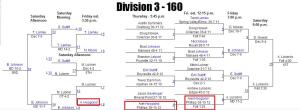
2007 wrestling bracket

The next day my first match in the 8 man bracket was Lukasko. I went in strong again but came up quite short. I ended up losing 2-11. He ended up winning state that year again, undefeated as he pinned his opponents in the semi finals and finals. At least I didn’t get pinned! I still had a chance to place, I didn’t. I ended up losing my next match in overtime 4-2. That was how I ended my high school wrestling career.

State Wrestling 2007

No where will you see as many seemingly tough high school guys crying as at state sport events. I’m not sure about other sports, but wrestling is quite personal. It’s you against the other guy and one of you has to lose. I definitely cried after the match while I was in the shower.

Lukasko went on to play college football at UW-Madison.

Larrieu ended up winning state the next year. Which gave me the chance to talk big the next year, saying I had pinned him, even if it was an out of season tournament, they all count, although admittedly the last match always counts more.

Donny Stork ended up dying in a car crash a few years later.

High School wrestling is definitely not the pinnacle of athletic performance. But it is at a certain point of your life. I put in as much time as I understood I could. You can always make time for important things. I could have put more time in. I could have pushed myself harder. Others could have pushed harder. I’m not sure how I would have responded. I try to remember my road through wrestling whenever I am faced with a new skill that seems difficult. After 2 years of being not very great, I started to develop slowly. Once I started to put in more time I started to succeed faster. There is no good reason I couldn’t have been better sooner, except I didn’t put in the time. If you take time to practice more than the other guy, you will surpass them in skill, knowledge, technique, strength etc. Whatever you do, do it well.

To Fight Or Not To Fight?

“With great power comes great responsibility” – Uncle Ben (Spiderman)

Power is something I have been considering for a long time. What exactly is it? What are your obligations to use your power for, assuming you find yourself in possession of some power? How many types of power are there?

I want to tell a story from when I was in college to demonstrate a misuse of power in from my past and what I learned from that.

Let’s introduce the characters. Myself. John Bro and A.O.B. (Names have been changed to protect the guilty, or innocent as it might be, except for myself).

John Bro was a mutual friend of A.O.B. and myself. I didn’t care much for A.O.B. I considered myself pretty religious at the time (I had a lot to learn), but still, I was put off by much of  A.O.B’s general derogatory comments towards women. He was also much too obsessed with this appearance and tough guy demeanor. So  admittedly I wasn’t coming into this with a very good attitude, but I was overall cordial to A.O.B.

Now he was hanging around our house (John and I lived together) pretty regularly, which was fine. But what was not fine was that A.O.B. had decided that I was a good person to antagonize. Being generally averse to confrontation, I generally shook off his personal attacks. He would “talk smack” at me rather often. He’d also make these ridiculous jab motions towards me like he was going to punch me. You get pretty tired of flinching because you think you’re going to be punched relatively often.

Finally one night I had had it. After yet another fake punch and some more harsh than usual smack talk I decided to end it that night. I challenged A.O.B. to a fight. Now I was a pretty decent wrestler in high school and I’m also 6’1”and relatively muscular. A.O.B. was probably 5’8”, a little pudgy but was also on the college wrestling team (for a short time) and had been an (amateur) boxer. He had also grown up in a tough neighborhood, from what I understand, or at least that’s what he said.

The fight was quite uneventful except for my first (and last) attempt at some smack talk “Do what you do!” I shouted at him as we were scuffling. Not my most enlightened sentence, then again, I obviously wasn’t doing much clear thinking as I was in the middle of a fight that I had (more or less) initiated.

The fight was over rather quickly. As is oft to happen when a wrestler fights a boxer, we were on the ground in less than a minute, I had secured a rear-naked choke hold and he had tapped on my arm signaling he was giving up and I immediately set him go. I walked in the house smugly, sure I had seen the last of our problems.

Two seconds later I was made aware how wrong I was by a fist hitting me in the back of the head. Turns out people who walk around insulting others and generally being antagonistic are pretty poor losers. A.O.B. had punched me in the back of the head, after I had won! What the heck?!?!? At this point our mutual friend John Bro threw A.O.B. out of the house. He didn’t come back for a long time. Seems like overall that was a win for me right? Well that night I spent most of the night wondering what other retaliatory action A.O.B. would take against me. Would he destroy my car? I was (and am still) a pretty huge car guy. Would he get his gang members and come beat me up? He was allegedly in a gang. Luckily no more retaliatory actions were ever taken and I also never really had to see A.O.B. again.

So what were the outcomes of that fight? Well my main goal on not having A.O.B. around demeaning me verbally or making fake jabs at me was fulfilled. This is definitely not a guaranteed outcome in situations like this. It’s just as likely that he could have beat the hell out of me and as was shown by his post fight antics, he likely would not have stopped if he had gotten me in a compromising situation like I had him. I had put my personal safety in peril. That was dumb.So while the outcome was arguably good in this situation it could have turned bad.

One outcome was I was physically exhausted and had received a punch in the back of the head and a cut from the fight. Definitely not a preferred outcome.

Another outcome as I mentioned was that I was nervous for months that A.O.B. would be after me or my property. This was an unintended outcome and one I had not considered before the fight. Also a bad outcome.

It is a pretty safe bet that A.O.B. did not learn anything from that fight. I didn’t show him the quote that I shared at the beginning of this article, “With great power comes great responsibility.” Instead, I reinforced that the strong take and do what they want and the weak suffer. That was not that lesson that I meant to teach him. This was a third undesirable outcomes.

So for a total of 1 arguably good outcome (that could have ended a much different way) and 3 bad outcomes, lets consider other ways that I could have handled that situation.

One way would have been avoidance. I simply could have made myself scarce whenever A.O.B.  came around. This is generally a cowardly way to live and not necessarily a very reasonable one.

I could have approached A.O.B. myself with reason and conversation. I could have tried to share with him why I getting pretty fed up with his act. This would have saved me from being in a life threatening situation in the first place, a lot of paranoia afterwards, a punch to the head and it would have taught A.O.B.  that there are better ways to solve a problem than fighting. 4 for 4 good outcomes again.

The best way would have been to get John Bro, our mutual friend, as an ally on my side. I think I could have convinced him that via his mediation he could create a calm that would make the time we spent together more cohesive. Bringing a mediator in between 2 disagreeable parties, preferably a fair mediator trusted by both parties is always a great way to solve conflict. I could have shared the same things but with an ally that A.O.B. trusted instead of just by myself. There is power in numbers.

So now you know a story from my life. I was in a fight. I learned that there are better ways to solve problems than fighting. If that simple message could get out to the world at large, I think we’d be on a pretty good track.

Fat vs. Fat Wads Of Cash

Entitlement and bad math skills.  These are two reasons people have so many problems these days. We feel entitled to have it our way (thanks to Burger King) and we expect it now. Also people are choosing to be awful at math, I guess I could blame this on the schools but I am more apt to blame it on bad parenting. It’s not hard to teach your kids math. 2+2=4 is pretty simple. Unfortunately you can’t pick your parents. I would also blame some of this on the government and their lack of keeping to a budget. What kind of example is that to the people? What should you expect the average person to maintain a budget surplus when you don’t yourself?

Let me start with a few simple equations relating to the title here.

Calories In < Calories Out = weight loss  – Preferred
Calories In > Calories Out = weight gain

For those of you whose parents haven’t taught them what < mean that means “less than”. You can remember that because < looks similar to a L. > means “greater than”.

The cool thing about equations is that you can affect different parts of them differently. For example you could reduce your calories in by eating less and thus make it less than calories out yielding weight loss. You can also increase calories out, for example by exercising, and thus make it more than calories in, leading to weight loss again. You have options.

The simple reason why diets don’t work is that people only affect one of those parts of the equation (calories out) and only for a short time. If you revert to the state that lead to the situation, by quitting your “diet” you should not be surprised at the weight gain.

As Einstein said (allegedly) – Insanity: doing the same thing over and over again and expecting different results.

Onto the fat wads of cash equations.

Money In < Money Out = Debt
Money In > Money Out = Savings (Fat Wads Of Ca$h) – Preferred

By now you should understand the equations as they are the same equations. Notice that which on if the prefered equation is different though. You want excess in the money equations, you don’t want excess calories in in the weight equation.

Now onto the entitlement thought of the day. The problem with these 2 sets of equations is that you have to sacrifice things to come out on the preferred side. If you want to lose weight you will have to sacrifice some temporary comfort, either in the way of being a little hungry sometimes (not even starving, eat one less donut!) or less comfortable in the way of spending some time doing some physical activity. Gasp!

On the money side. You are required to make some sacrifices as well. Do you want to eat out every week for lunch that’ll be $50+. Do you want to make your own meals, probably will be $25 or < (that’s that less sign again). Do you want a new car and recurring payments for 72 months! Let me just tell you that no you don’t. You can probably continue driving your old car and banking that $500+ a month. Savings!

So that was on the savings side. On the “Increase income” side you have plenty of options as well. Take a look at where you are now. What’s your income? Are you happy with that? Then disregard this completely. If you are unhappy then maybe take some time to research what jobs will pay you more. Then you can investigate what is required to take you from where you are to that job. Let me tell you, it’s not likely going to be a fast journey and that’s where the entitlement problem comes in. “I want it all and I want it NOW” as Queen says is the mentality we have these days.

That needs to change. Some people have very low self esteem or low motivation. I’m here to tell you that “You can do it!” Sometimes that’s all people need to hear is someone giving them positive reinforcement. Today is the best time to start. New year, new you right? The only thing is you need to maintain the new attitude or habit. Don’t give up 1 week later like most New Year’s resolutions.

You will notice that I mentioned creating good habits. That starts small and you will likely not see results immediately, but over time, much like compound interest, small changes add up. One pound lost a week over a year is 52 lbs! $10 saved a week (don’t drink 2 coffees a week?) is $520 a year! Small change over a long period time is the only sustainable way to do things.

I heard a story one time where a person said
“I want to run 3 times a week to lose weight.” – John
That person was asked “How’s that going?”. – Jen
“Not well, I don’t have time.” – John
“Well, why don’t you run one time a week?” -Jen

“What good will that do?” – John
You can recognize the  fatal flaw of entitlement. John expects himself to go from 0 to 3 times a week running with no effort. Remember when I said “You can DO it.” The key there is DO. Action often drives passion. If you can rouse yourself to go to the gym, or avoid buying a $5 coffee one time, you are more likely to do it the next time. Actions breeds passion.

My challenge to you is to choose one action in your life that you are not particularly happy with and change it this year. Start small. Set some actions that you can follow that will reinforce the new habit. Put a dollar in a jar each day if you want to save money. Do one push up before you get in the shower each day, or more if you can. Start small, but don’t forget to ramp it up as you progress. Have a happy and successful 2014!

Darin McClure – cover photo – Flickr Creative Commons

Trust. Government Regulation. Guns and Income Inequality (Oh And Of Course Smoking)

I have been wanting to write about gun control and income inequality recently but as I’ve been researching and talking with people I have come across some interesting similarities between both topics that I feel the need to expound upon.

The basic idea shared by both these topics is how much government regulation should be exercised over each issue? I think it’s important to try to understand what is really being said, despite the words used. When a person says I want more government regulation, what they are really saying is “I trust the government to make better choices for my life than I can for myself.”

I am completely ok with that statement if some people want to make it. In fact, it’s probably quite accurate for the majority of people, not because the government is incredibly smart, but because people are often incredibly self centered and ignorant of how the world works. I would never make this statement myself. I am the architect of my own future.

For every regulation you think the government should make you should also be arguing for more taxes. OOOOOOOOOOHHHHHHHHHHH NNNNNNNNNNOOOOOOOOOO. I’m not paying more taxes, you say. Ah. Herein lies the problem. People can’t see the world beyond the walls of their own home and they think that the government should take care of them, but they don’t want to pay for it. People expect someone else to pay for it and this is the problem with arbitrarily raising the minimum wage.

How do you conduct your shopping? If you are like most people out there you first ask “What is the cheapest way I can get this?” If that includes buying things from Walmart, which you are very vocal about not liking on Facebook, or buying a burger from a fast food joint because it’s fast, cheap and therefore convenient, you are part of the problem. If you wanted to do something active to make companies listen to you you need to start talking with your wallet. Read this article about Moo Cluck Moo. It is a semi-fast food joint in Michigan that pays its workers $15/hour. Here is the important part for you lazy people who won’t read it “In order to make this model work, customers have to pay a little more.” If you go to McDonalds because it’s faster or cheaper but then argue that McDonald’s should raise their minimum wage, you are part of the problem. That is called internet activism my friends and it’s as useless as a knife at a gun fight.

The same principle has been enacted in the argument for smoking. People are arguing that the government can remove someone’s free choice to smoke and your free choice to avoid establishments that endorse smoking because you think the government is smarter than you. If you are in the NRA you should also be trying to help smokers get back their choice to smoke in places that business owners think it is beneficial for their business (public places like gas stations and hospitals where it’s inherently dangerous excluded). Read my article on smoking if you want to understand that more. If however you are in the NRA but you think that it’s ok to deny restaurants the right to choose if they will have smoking or not, you are really saying that you DO trust the government to make good choices for you and all your arguments for no gun registration is as worthless as a gasoline engine on the moon. (For those of you who don’t understand this, an engine running on gasoline needs oxygen to run, of which there is none on the moon.)

So let’s recap. The question is how much do you trust your government? If you say, unequivocally but argue against higher taxes, you are a liar. If you say I don’t trust the government at all (NRA people and anti-gun registration folks) but argue for some regulation like seat belt laws and smoking laws I also call you a liar.

This is my challenge to you. Let’s start taking a little responsibility for ourselves. Do the right thing! If you think you can make good life choices for yourself lets see you do that. If you don’t think you are capable of making good life choices for yourself, please give your whole paycheck to the government and let them tell you exactly what you should be doing for a job, where you should live, what you should eat etc.

Mark Rain Flickr Creative Commons, cover photo

Dawn Of The Planet Of The Apes – Movie Review

I believe watching movies can help us reflect on current situations in our society. I recently watched the movie “Dawn Of The Planet Of The Apes”.

The first thing I do when watching a movie is to identify the motivations of each character. It is also useful to identify what power each character or group has.

Malcolm is the main protagonist in the movie on the human side.His goal is to get the dam working again to provide power for the humans but also work with the apes for peace.

Dreyfus is the main antagonist on the side of the humans. He refuses to see the apes as intelligent or capable of reason. He is prejudiced against them as animals despite evidence showed to the contrary. His drive is to provide power to the city as they are running out of gasoline so their main goal is to restart the hydroelectric dam. He has power because he is ex-military and started the human city. He has provided protection for others so they trust him.

Caesar is the leader of the apes and the main protagonist of peace in the movie, even more so than Malcolm. He is constantly asked to trust the humans despite the continued disobedience of his conditions, by certain individuals, mainly Carver early in the movie.

Koba is the #2 ape, antagonist and main war monger. He refuses to listen to Cesar’s leadership and calls for peace. He is influenced by his past of being a lab animal and having humans do many painful experiments on him. His main flaw is looking at everything from a self-centered point of view and holding on to hatred from his past to a group of people (scientists) and applying that hate to the new group of people who had nothing to do with that. He eventually resorts to nefarious means to attain his agenda.

The humans main power comes from technology and knowledge.

The apes main power comes from being physically stronger than the humans. One of the characters also mentions that the apes are stronger because they “Don’t need electricity.” They are more resilient to nature.

The movie starts with a brief review of the history of how the humans were negatively affected by the testing that had been completed on the apes. Then it moves to the community in the woods that the apes have established. Caesar and Maurice (an orangutan and close friend of Caesar’s) are discussing the humans and how they have not seen or heard of them in 2 years.

Of course, the next thing that happens a few apes wandering around the woods stumble upon Carver, who’s with a party of humans looking to restart the hydroelectric dam to supply power to the city. Carver immediately feels threatened, because he is afraid of the apes and lacks knowledge about them. He ends up shooting Ash, one of the apes. The rest of the apes descended on Carver and the rest of the humans, Malcolm being part of that group. Caesar uses his wisdom to allow the humans to leave peacefully despite Koba’s insistence of punishing the humans. The apes retrieve Malcolm’s notebook and bookbag at the site of the attack.

Pondering what to do next the apes decide a show of force is necessary. They march down to the human’s city in a show of force. They return the bookbag to Malcolm and issue a warning for the humans not to return to the forest.

What follows from here is some trust building and breaking among the humans and apes as a small contingent, including Malcolm, return to the apes to ask them to be allowed to work on the dam. Cesar again complies in believing that working together is the only way to help both species.

It is around this point it becomes obvious that most of the characters on each side are quite trusting of the other side and willing to work together. It is also obvious that there are some characters on each side who are irrationally afraid of the other side. Carver being the human and Koba being the ape who are most guilty. This is an important point that should be considered and applied to the world at large. Most people are good decent people, but there are just a few violent or ignorant people who choose to make the world a bad place.

Koba eventually steals a gun and shoots Caesar. He makes it look like a human killed Caesar. With no investigation he works the apes up into a frenzy and they attack the city. This is another very important turning point of the story. There is absolutely no investigation by the apes to see if it was indeed a human who killed Caesar. They take Koba’s word because he was the 2nd in command, but he is a twisted individual and has chosen to use his power for evil. Can you think of any situations in the modern world where people jump to conclusions way before any evidence has been shown? Have you ever done this yourself?

Meanwhile, Malcolm has found Caesar and learned that Koba was the real killer. He starts nursing Caesar back to and brings him back to the city.

During his attack on the city Koba shows signs of a dictatorship. He imprisons any apes that are still loyal to Caesar and his ideals of peace. At one point during the attack one ape refuses to kill a human, saying that’s not what Caesar would have wanted. Koba responds by killing that ape.

Malcolm finds Caesar’s son, Blue Eyes, and brings him to see his father. Blue Eyes shares the information that “Fear makes the other apes follow Caesar”. Does Koba’s reign of terror remind you of any point in history? How about any current regimes? Nazis? North Korea? U.S.S.R?

The end of the movie includes the triumphant return of Caesar to power and his ousting of the evil that is Koba.

Overall I thought this was a great movie when thinking of how it applies to current situations such as when groups of people react irrationally and with a lack of information.

It also shows how a few bad people can really affect humanity negatively by using misinformation and hate to lead good people to do evil.

I encourage you to start thinking in these types of terms both when you are watching movies and in your own life. What power do you wield? How do you use it to affect those around you? When you learn of a situation, do you jump to conclusions quickly or do you take time to think through rationally and understand what is really happening?

Ross Elliott – cover photo, Flickr Creative Commons

Smoking. Why It Should Be Legal.

I am not a smoker, but I think it should be legal in certain places. Many people I have talked to have been more than happy that smoking has been outlawed in public places, at least in the midwest for around a decade now. I am going to tell you why that’s not a good reaction.

Lets start by saying this is not an article promoting smoking. I understand that scientifically there is a lot of evidence that says smoking is unhealthy for the smoker. There is also evidence that says that smoking is unhealthy for those who regularly breathe 2nd hand smoke. For that reason I do not advocate that anyone should smoke in their home if they have any non-smokers in the house, this meaning anyone with kids. There is not evidence, that I know of, that says that someone who walks within 20 feet of a smoker once a month will develop significant lung problems. I personally have asthma so I think I qualify in the group that is hard of breathing.

Why do people smoke in the first place? Usually it’s started as a way to be “cool”. The older kids smoke. Your parents don’t want you to smoke. Naturally the thing to do is smoke. Later people can become addicted to the nicotine. At this point it gives them a relaxing feeling to smoke, as they are getting their “fix”.

How to stop cigarette smoking? Like most things, I think the most effective way to stop smoking is through education. If you show kids pictures of smokers lungs they are pretty unlikely to start smoking. Have you seen the scary  anti smoking commercials? Effective. It’s probably not common knowledge that most smokers actually want to quit. But it’s a difficult road to break any addiction.

So now that I’ve thoroughly painted the picture that I am not advocating smoking, let me tell you why I’m also not trying to outlaw it. Smoking was outlawed because it was unpopular. Not because it was unhealthy, but because it was unpopular. This is a bad precedent to set. People wanted to go to a bar, restaurant or bowling alley and breathe clean fresh air. While that is fine and dandy, I have yet to read in the Constitution where you have the right to go to a privately owned restaurant. The people who want to go to those places have a choice. They can go to those privately owned places or not. They are not entitled to it. The key here is privately owned establishments. Don’t write me telling me how it should be illegal to smoke in a hospital, I agree, because there is a captive audience there who can’t choose to leave and medical equipment that shouldn’t be smoked around.

People have more power than they recognize. While they have demonstrated that they have the power to band together to ban things they don’t like, perhaps we should step back and think if this is a good road to go down. Think of things you like. Alcohol? Soft drinks? Burgers? Riding a bicycle without a helmet. Driving a motorcycle without a helmet. Driving a car without a seat belt? All of these things can be dangerous and I’m sure you can tell me why I shouldn’t do any of them, but I am here to tell you that me wanting to do any of these things doesn’t inhibit your ability to choose to not do them. Some of these things have been made illegal and come back from it. Prohibition. Some are currently illegal in certain places, riding a motorcycle without a helmet. Some are not yet illegal but certain people are trying to make them illegal, drinking more than a certain volume of soft drink. Thanks Michael Bloomberg. Basically by outlawing things you are running to the teacher and telling on someone. That’s childish.

So what do I think would have been a more effective way to get people to stop smoking in a place you wanted to be? Perhaps talk to the owner of the establishment. Tell him directly that if he doesn’t choose for his place of business to have it smoke free, you won’t give him your money. Money talks. Now this being the owners place, he could comply, if he thinks he’d get more business that way, or if he thinks he’d get more business by allowing patrons to continue to smoke that’s completely fine by me also and it should be ok with you also.

So what do you think? Will you continue to make criminals of people who aren’t doing anything wrong? Or will you continue to advocate to outlaw things as long as you disagree with them?

Let me expose you to a speech by Martin Niemöller.

First they came for the Socialists, and I did not speak out—

Because I was not a Socialist.

Then they came for the Trade Unionists, and I did not speak out—

Because I was not a Trade Unionist.

Then they came for the Jews, and I did not speak out—

Because I was not a Jew.

Then they came for me—and there was no one left to speak for me.
Now let me interpret that for you by substituting things you might care about.

First they came for the smokers, and I did not speak out—

Because I was not a smoker.

Then they came for the soda drinkers and I did not speak out—

Because I was not a soda drinkers.

Then they came for the coffee drinkers, and I did not speak out—

Because I was not a coffee drinkers.

Then they came for me—and there was no one left to speak for me.

And finally a thought by David Allen Green.
So my challenge to you is to think bigger. Don’t think “How will X impact me?” But think “How will X impact the world?”

Credit Francisco Karm for cover photo. Flickr Creative Commons.

Understanding. Can We Have A Reasonable Discussion?

Understand – Verb
perceive the intended meaning of (words, a language, or speaker)

Perceive – verb
interpret or look on (someone or something) in a particular way; regard as

interpret – verb
explain the meaning of (information, words, or actions).

If you take the time to type each of those definitions into Google, you will find that usually one of the definitions (there are usually 2) references one of the other words, which is very unhelpful.

As you drill down though, you see that understanding is an action that requires effort on your behalf that is supposed to help you know why something happens, how it happens or in the case of ideas, what someone is trying to explain to you.

Understanding is something that takes time. It is a process and is very difficult in today’s instant gratification society. We don’t take the time to explain things that we believe to others and we take even less time understanding what other people are trying to explain to us. One reason could be that we don’t actually have very well developed beliefs ourselves. Try a small thought experiment for me. Try to answer this question “My beliefs on homosexuality are….” Try to think beyond the “It’s wrong.” or “I agree with it.” Why do you think those things?” What other questions can you ask yourself about it? Do you support homosexual couples passing on their inheritance to each other after they die? Do you support homosexual couples being able to adopt children? Do you support homosexual couples having the right to having messy divorces when they decide it won’t work, much like many heterosexual couples these days? What is your definition of a marriage? Is it a spiritual bond? Is it a legal entity?

I’ll continue this thought later in the article.

In order for me (or anyone else) to determine if I am actually for or against your viewpoints, on anything, I need to understand your beliefs. I need to understand what drives you. This can only happen with discussion and usually pointed, deliberate, tough conversation. It is not always fun and often it gets cut short when people find a point they disagree on, or think they disagree on.

The problem is we each perceive the intended meaning of many things when we hear a word. I will explain my perceptions or what I think other’s erroneous perceptions are of 3 topics below.

Feminism

When I hear the word feminism I automatically think of my own definition of radical feminism, which is hard to define and that cop out on my behalf is definitely not progressing understanding.  I will point to this video, that seems to try to shock people into thinking that if we teach young girls to swear and act in ways that wouldn’t be acceptable in a school setting or at home we are somehow empowering them. That seems radical enough to me.

Now I think you can agree that many people will be turned off by this vulgar display which from now on could be the idea that I would when I think “feminism”. Trying to work past my biases, and looking up the definition of feminism “the advocacy of women’s rights on the grounds of political, social, and economic equality to men.” I think we get a much different message and we can ask ourselves some questions.

Do I support women being paid equally, assuming they are equally qualified to perform any task. Of course.
Do I support women being giving the same backing on political issues and same doors to be a candidate if they so choose. Of course.

Do I support teaching kids it’s ok to say bad words to sell T-shirts. No.

So if you ask me if I’m a feminist, I’d argue, yes. If you ask me if the FCKH8 people are feminists, I’d argue no, because they are alienating their cause to the public. They are being bad stewards of feminism.

Another topic that is rampant with misunderstanding.

Gay Rights. Homosexual Agenda. Gay Marriage.

Whatever other terms you want to describe this.

This is a topic that has much of the world split into about 100 different factions, as evidenced by my not knowing what to call it even without being unbiased. There are those who are promoting gay marriage as the exact same as heterosexual marriage. You have those who insist that gay unions will ruin heterosexual marriage. You have those that just oppose it because they feel it’s wrong. (This one I have no argument for, it’s completely illogical, at least provide some argument!) You have those that oppose gay marriage on the basis of religion.

There is so much misunderstanding in this debate it’s not even fun to laugh at.

Speaking to several homosexual people and to several who are opposed to gay unions I see they are working on such different premises it’s no surprise that there is so much debate on this topic.

Let me present the arguments as I think each side wants to see them.

Homosexuals –  We want validation that our unions are legally binding. This is the most simple explanation. Here is a question from this article.

“Why do we need governments and courts to involve themselves in creating rules and tax codes for some provisional alliance between two (or three or 57) adults who merely wish to live together (or apart, or whatever they want) and ‘love each other?”

This gets to the root issue many people have with gay marriage. They want a definition of what is and isn’t included in the marriage. But what comes with legally binding? Do they get tax breaks or tax increases, as some married couples get? Do they want to right to adopt kids? Do they want hospital visitation and and the right to pass on belongings to spouses after they have passed.

Heterosexuals – Many I have talked to simply disagree with gay marriage because it’s not something they are familiar with. I think that’s a cop-out, a bad argument, etc. But that’s why we need to foster discussion.

Marriage as it happens in many churches is both a religious and legal contract. Many feel that if they legally validate gay unions and call it a marriage, it somehow degraded the sanctity of their religious marriage.

I find it a bit humorous that as many heterosexual couples choose to not get legally married that many homosexuals are looking for a legal marriage. Why don’t homosexuals choose to live together and not get married, much like many heterosexual couples. Then when they break up it’s not as big a deal. No lawyer, etc. Many who argue against homosexual marriage argue on the basis of religion. They don’t want their church to have to perform homosexual marriages in their churches. You might think, “that sounds silly, the state can’t force the church to do something.” Yet. Is my reply. Read about this happening elsewhere in the world. Good work Denmark.

Getting to a completely different topic which is being used to demonstrate the the importance of understanding.

The Catholic Church. I can’t imagine there is anything that has been so misunderstood in history as the Catholic Church. I recently read a book, Muscle and a Shovel, which I wouldn’t recommend. Based on it having completely incorrect information. Multiple times in the book it uses an argument that “The Pope is seen as God by the Catholic Church so it can’t be the church of Jesus.” To put it bluntly, this is completely and utterly false. I read this book because a good friend recommended it to me. After I reached that point, about ⅓ of the way into the book, I was tempted to put it down, but in the interest of understanding where he got these thoughts, I pushed through, and was exposed to the same thought at least 2 more times. Each time I thought, this is completely illogical, why is this book able to be sold at all?

The point being, obviously the author of that book (and anyone who reads and agrees) took a total of no time to understand the Catholic Church. He had an opinion, he wrote it down, sans thinking or understanding. If you have an opinion about something, take the time to discuss with people who hold views opposed to yours. You might find that you don’t actually understand the circumstances or that you actually even have the same views, just you didn’t take the time to understand it.

In all these situations, and many others around the world, there is rampant misunderstanding that I think with a little conversation and effort by both sides, could be cleared up. One thing we need to be aware of is that disagreement is not equal to hatred. I am allowed to think you are doing something wrong without hating you as a person. I think that that is something that has been lost in the world. If you aren’t for us you’re against us, seems to be the rally cry,and that just isn’t the case. I hope anyone reading my articles can engage in understanding and not just argument.

credit Nick Webb, cover photo

“Love, No Matter What” – A Rebuttal of Andrew Solomon’s TED talk

In this post I’d like to discuss the TED talk given by Andrew Solomon called Love, No Matter What. (See the link for the YouTube video). I enjoy TED talks very much because they offer a perspective on topics that you often haven’t thought about or if it is a topic you think about it could offer a different perspective. This talk titled “Love, No Matter What” seemed to have potential. I was hoping he’d talk about the good that can come from love. What I found was not exactly that. There were some good points, which I will let you listen to the talk to find, but one small point near the middle (11:56 minutes in the transcript) which caused me to seek the transcript, listen multiple times and finally rebuke Andrew’s comments with this post.

Here’s the YouTube description of the talk.

“What is it like to raise a child who’s different from you in some fundamental way (like a prodigy, or a differently abled kid, or a criminal)? In this quietly moving talk, writer Andrew Solomon shares what he learned from talking to dozens of parents — asking them: What’s the line between unconditional love and unconditional acceptance? – Youtube description TED talk “Love, No Matter What”

This talk was good in that it talks about how it can be hard for a parent to understand a child who is different from the parent. The examples Andrew uses are a child who is deaf, has dwarfism, is gay or has Down Syndrome. This group presents an interesting, and seemingly completely arbitrary smattering of different things that people can be identified as, which brings up an interesting thought on identity, that I have made a note to think of at a later date. But I digress,

Here is the point that confused me at starting at 11:56.

“We live at a point when social acceptance for these and many other conditions is on the up and up. And yet we also live at the moment when our ability to eliminate those conditions has reached a height we never imagined before. Most deaf infants born in the United States now will receive Cochlear implants, which are put into the brain and connected to a receiver, and which allow them to acquire a facsimile of hearing and to use oral speech. A compound that has been tested in mice, BMN-111, is useful in preventing the action of the achondroplasia gene. Achondroplasia is the most common form of dwarfism, and mice who have been given that substance and who have the achondroplasia gene, grow to full size. Testing in humans is around the corner. There are blood tests which are making progress that would pick up Down syndrome more clearly and earlier in pregnancies than ever before, making it easier and easier for people to eliminate those pregnancies, or to terminate them.” – Transcript.

Read the last line again or better yet watch the video.

“There are blood tests which are making progress that would pick up downs syndrome more clearly and earlier in pregnancies than ever before making it easier and easier for people to eliminate those pregnancies or to terminate them. So we have both social progress and medical progress.” – Andrew Solomon

This prompted my thought to change the title of the talk to “Love Your Child No Matter What, (Unless They Have Down Syndrome, Or Any Other Disease Or Deformity That I think Can’t Be Cured At This Time)”

Here are my thoughts and questions on this.

Later in the talk Andrew says

13:35 – “We have to think about how we feel about cures altogether. And a lot of the time the question of parenthood is, what do we validate in our children, and what do we cure in them?” – Andrew Solomon

Why is the only thing he mentioned that he’d validate in your child was homosexuality, although he didn’t actually say that, it was more implied. In fact, he didn’t mention homosexuality at all in the talk (at 11:56) about how he’d “fix” the issues that could be detected in a child.

He mentions BMN-111 treat dwarfs to make them “normal”.

He mentions hearing implants for deaf children to make the child “normal”.
And then his solution is to murder (abortion) a child who MAY have down syndrome. We can share numerous stories of people who were supposed to have been aborted, Tim Tebow for one, whose parents were brave enough to tell the doctor’s “Abortion is not an option.”

Andrew mentions a total of 0 “cures” for homosexuality. I’m not promoting that he should be or shouldn’t be promoting a “cure” for it, but when he goes through all the other situations he presented but doesn’t mention homosexuality that’s raises questions in my head of what his motives are for the talk. It seems his thoughts are 2 fold.

  1. Normalize homosexuality. I really think this is the underlying point of the whole talk, and if Andrew wanted to disagree with me on that point that’s ok.  (I am not trying to be biased for or against that, I have complex views on homosexuality and haven’t researched enough to form a complete arguing opinion. Look for future articles. This in not what I want to address in this post.)
  2. Promote abortion of children who could have developmental disorders. I honestly think this was not high in his mind at all while writing this talk. I think Andrew could have left this point out completely and he would have been just as happy. I think that he so nonchalantly mentions it, and then that people applaud him, show the state our society is in. I have researched a great deal on abortion and I am adamantly against abortion.

It seems Andrew is biased. I wonder what the Robart’s (the people he interviewed for his book who’s son has Down Syndrome) thought about that statement. Here’s what Tom Robart had to say.

“I think if we lost everyone with downs syndrome it would be a catastrophic loss.” – Tom Robart

So why then, is Andrew’s solution for children (who are people definitely by the time the fertilized egg has implanted in the uterus wall, and really in my mind likely at conception, but I’ll save that for a future post after more research), to abort them at the chance of an issue, when even the father of one of those children said that it would be a “catastrophic loss”? I have enjoyed many TED talks, but this one has caused concern for me. If you want more thoughts on abortion, please read and share my post related to the subject.

Thank you to Amy Entwistle at Flickr Creative Commons for the cover photo.

Abortion

Now that I’ve gotten your attention with a title that screams controversy, I hope you’ll stick around while I pose some rational questions. I recently watched the Andrew Solomon TED talk which I wrote an article about. In the article I was disputing his “solution” to women who are pregnant with children who have been identified as potentially having Down Syndrome. His solution was an abortion. I completely disagree with that as a solution. Delving into research there was much more information than I could fit in that one article, so I will share some of it here. I looked further and found another TED talk about abortion by Diana Whitten which I can only call radical and also feel the need to address later.

Definitions are important so I will share a few before I get to the meat of this article.

Pregnancy begins when a fertilized egg implants in the uterus. – From Planned Parenthood

Abortion – the deliberate termination of a human pregnancy, most often performed during the first 28 weeks of pregnancy. – Google

Using these 2 simple definitions should allow us to avoid all conversation about moment of conception, implantation, fertilization, zygotes, fallopian tubes, etc. and other things that come up  before the point of pregnancy, defined by Planned Parenthood.

So working with this definition of pregnancy and abortion we can look at some facts of this pregnant woman and her baby. Technically called a blastocyst at this point but from here on out we will understand that when I say baby, I am referring to a fertilized egg that has been implanted in the uterus.

One of the main arguments that anti-life people use if that “It’s my body It’s my body and I’d rather not have anyone telling me what to do with it.” – As this anti-life advocate put it so eloquently. I agree. Do what you want with your body. Unfortunately that baby in you is not your body. The baby has it’s own DNA. That’s enough evidence for me right there. Of course there are many other arguments showing that the baby is in fact it’s own entity, such as the development of measurable brain activity, eyes, heartbeat, etc.

The baby is protected (from everyone but it’s own mother!) by the Unborn Victims of Violence Act of 2004 (Public Law 108-212) which basically says that if anyone kills a pregnant woman, they get charged with 2 murders. But if the mother chooses to kill the baby (abortion), it’s not murder? That’s just ridiculous double-speak legal jargon. You tell me why that makes any sense.Hopefully you are reasonable enough to say that you’d never kill your already born child at least? Apparently I can’t even make that as a blanket statement if you consider the document published by the Journal for Medical Ethics. (seems they need a rename to the Journal of Questionable Ethics). While I completely support their right to publish an article like this, I completely disagree with their findings, but it (hopefully) helps me make a case to end abortions.

“They preferred to use the phrase “after-birth abortion” rather than “infanticide” to “emphasise that the moral status of the individual killed is comparable with that of a fetus”.

As far as I know it’s always been illegal to kill a child once they are born. Working back from birth, what is fundamentally different for the child at 1 day before he or she is born? Nothing. There is the discussion of viability. What is the definition of viability? From my understanding it’s a pretty general term of when the baby would have a chance to survive outside the mother’s womb (with no life support, etc). The reason this has no importance in the discussion of abortion is there is no reason the child would need to be outside the womb. The baby is right where it needs to be in that phase of it’s life. And also, the baby isn’t viable by itself once it is born, iit still needs someone to care for it once it’s outside the womb, which is what the Journal argues above is a good reason for infanticide! In fact, very few people in the world are viable all by ourselves. You are? Did you build the car you drive to work every day? Did you make the computer you are reading this on? Did you grow all the food in your house? Did you build your house? No. Civilization is founded on community, not killing anyone who can’t take care of themselves. So if viability is your argument for abortion, please reconsider your stance.

One question I’ve always had for the abortion people is “Why is abortion the solution?” In our society we know what happens when 2 people have sex, you can get pregnant. Shouldn’t we focus on having strong families that will raise and love children, instead of having as much sex as we want and destroying any life that comes from it?

I’d like to highlight some abortion statistics from the Guttmacher Institute below.

Women in their 20’s account for more than half of all abortions: Women aged 20–24 obtain 33% of all abortions, and women aged 25–29 obtain 24%.

Forty-two percent of women obtaining abortions have incomes below 100% of the federal poverty level ($10,830 for a single woman with no children).

Here are some statistics from the CDC.

In 2010, unmarried women accounted for 85% of all abortions (CDC).

Black women were 3.7 times more likely to have an abortion in 2010 than non-Hispanic white women (CDC)

Do you fall into any of those categories?

Do you think you might actually be being targeted for abortions?

Abortion happening any time after pregnancy (as defined above) is wrong.

I want to close with a few quotes

“It is easier to believe a lie that one has heard a thousand times before than to believe a fact that one has never heard.” – Robert Lynd (Maybe, quotes are notoriously misattributed, but that doesn’t take away from their truth.)

The lies I’m referring to here are

  1. Abortion is ok.
  2. A baby is not a person.

“I’ve noticed that everyone who is for abortion has already been born.”

Ronald Reagan (The actor, and former President of the United States)

Thank you to Amy Entwistle at Flickr Creative Commons for the cover photo.

Muscle And A Shovel – Book Review

Review (and thoughts on) “Muscle and a Shovel – By Michael Shank” By Axel Hoogland.

I read the book Muscle and a Shovel on the urgings of a friend. I was asked to read the book for about 6 months (starting August 2013) before I finally bought it around February 2014. Then it took me until October 14th 2014 to start reading it. I was finished by October 25th. Not because it was a great book, but just because that’s the kind of person I am. I hope to finish books in a reasonable amount of time. This was while taking notes and looking up bible verses and doing a bit of reflection. I’m intending to do more reflection as I write this review.

I have decided that it’s beneficial to take notes before reading a book to see how your perceptions and prejudices change as you read. My notes before this book are below and thus begins my book review of Muscle and a Shovel.

“I am going into this book skeptical as it’s written to be promoting the Church of Christ, from what I understand but I am interested to read the story.”

Immediately the book begins with 2 quotes.

“The Matrix is a system, Neo. That system is our enemy. But when you’re inside, you look around, what do you see? Businessmen, teachers, lawyers, carpenters. The very minds of the people we are trying to save. But until we do, these people are still a part of that system and that makes them our enemy. You have to understand, most of these people are not ready to be unplugged. And many of them are so inured, so hopelessly dependent on the system, that they will fight to protect it.” – Morpheus, The Matrix

The 2nd was a quote I had never heard before and is a recurring theme in the book.

“It is easier to believe a lie one has heard a thousand times before than to believe a fact one has never heard before.”

I was definitely influenced by The Matrix quote as I grew up in the era where the Matrix was one of the movies for nerds. I am also Catholic. Some would argue it’s a system. I’m aware of my biases to thinking that that is the one true church of Christ. I tried to check my ego at the beginning of the book and read on.

The next page is basically a challenge to the reader and a warning that their views could be challenged or even changed by this book. I viewed this as basically a way to try to get readers to keep reading when they encounter something they disagree with. Sort of a “bet you can’t do this” challenge which some people fall for. I thought this was a bit childish. Then next page was the blue or red pill scenario from The Matrix again so I was once again content.

The book tells the story of Michael Shank (the author’s) conversion from lukewarm Baptist to baptized Church of Christ member. It starts with him about to be baptized (in March 1988) but then jumps back to tell the story of how he got there starting with him moving with his new wife to Nashville for his new job as an engineering technician for a printer company, starting in August 1987 so the book covers 8 months. He quickly meets the other main character in the book Randall, who works in the shipping department of the same company.

I was already much more interested in the book than when I started it since I could connect with Michael as we’re both engineers and he’s on a journey to find “The Truth”. The book is basically a cycle of questions by Randall, followed by searching for the answers by Michael. Michael usually thinks he finds the answer from some pastor and returns to be corrected later by Randall. The first question from Randall that stuck out to me was “Have you obeyed the gospel of our Lord?” The second was “How were you saved?” These were (and still are) questions that have been in my mind lately. The first has been more phrased as “Who goes to Heaven?”, which leads to “How do you get to Heaven?”, which in my mind leads to “Obey God” which leads to “What does it mean to obey God’s word?” I think this last one is the important one. It seems many people are able to ask the question, but not many are able to answer it. Despite how easy everyone seems to think it is to read the Bible and interpret, I challenge that it’s not inherently easy, partially because I think the Bible is a written in a way that can be difficult to interpret at times. It even mentions this in 2 Peter 3:16 about the writings of Paul

“He writes the same way in all his letters, speaking in them of these matters. His letters contain some things that are hard to understand, which ignorant and unstable people distort, as they do the other Scriptures, to their own destruction.”

I believe this is because a lot of peoples judgements are clouded by their sin or by others.
The 2nd question “How were you saved?” is interesting because it is a question I hear a lot from those outside the Catholic church, but not often inside.

Chapter 3 is important as it starts discussion on baptism. This is a prevailing theme in the book as it starts with Mike and his wife about to be baptized and ends with their baptism.

The next interesting revelation came at the beginning of chapter 4 from Mike “My friends and I all wore the label of Christian, but there was little difference between my lifestyle and the world around me.” This is a thought that was interesting to me as it’s something that I was confronted with in 2012 by a new friend at the time. It definitely started me moving on a new path, but it has definitely been a bumpy road and I’m still on it.

A page later another revelation, “My ultimate goal was to become a software CEO in the Silicon Valley with a seven-figure salary and stock options.” This by Mike. It spoke to me again as i’m wrestling with my goals. By the end of the book Mike learns that money is not the ultimate satisfier.

Chapter 6 is titled “Am I going to hell?” in my version. From what I understand chapter titles have been removed in newer version of the book. I am very interested in the question above if you reference my thoughts earlier in this post. This is a question I ask often, although usually I ask “Who gets to go to heaven?” One thought a friend pointed out to me was that heaven and hell aren’t referenced often in the bible but the “Kingdom of God” is referenced very often. Interesting.

Next thought “All denominations teach conflicting doctrines”therefore, it isn’t possible that all of them are biblically correct.” is a statement not far into Chapter 6.

Again a profound statement that I’ve thought myself. This is one of the first parts I’d like to propose a question. Not all are biblically correct.This is a nice straightforward way to ask “Do you believe is Sola Scriptura?” At this point in my life, and acknowledging my Catholic upbringing, I have to say no. Referencing this page, #10 “When all is said and done, Protestants who accept sola scriptura as their rule of faith appeal to the Bible. If they are asked why one should believe in their particular denominational teaching rather than another, each will appeal to “the Bible’s clear teaching.” You can read up on Sola Scriptura yourselves and think on it. You know my stance that the Bible isn’t as clear as people act like it is, or we wouldn’t have 30,000 denominations arguing with each other.

Another thought I had on this point was the history of the Bible. It didn’t appear by itself. In fact, the church assembled the bible, picking from many books available and assembling them, guided by the Holy Spirit. Here is an article on the history of the Bible.

Probably the most directly confrontational quote in the book appears at the end of chapter 6. “If you’re a member of any denomination … that Jesus Christ did not establish and buy with His blood, there’s no question that you’re headed toward eternal damnation.” This was from Randall.

I will freely admit that I have not had a ton of conversation with other denomination pastors (although probably more than most people, which would only require one, and I’ve had more than that). In chapter Michael asks a Baptist Pastor who started the Baptist church. The pastor replies, John the Baptist. Michael starts to search for this in the bible but eventually can’t find it, much like the cycle of many things in the book. Now this point was pretty quickly dismissed by Randall as completely false and proven with a quick look through the bible and history to understand that the Baptist church was actually started in the Netherlands in the early 1600’s. So I’m not sure if this was really what some people thought in the 1980’s. Since they didn’t have the magic of the internet it is possible that the pastor was really taught incorrectly so I’ll give him the benefit of the doubt. With the internet, it should be easy to look up simple facts like this these days, I wish Michael Shank would have done that with some of his facts later in the book.

Skipping some more to chapter 13 “Cutting off the end of the ham” In this chapter Michael’s tells an old story of a wife making a ham who cuts the end of it off and throws it away. The husband asks why and she says because that’s how her mother did it. Eventually it gets around to that the grandmother had a pan that was too small to fit a full size ham. The point of the story is that traditions or “how we’ve always done it” definately need to be questioned at times. If your teacher’s can’t give you a straight answer, maybe it’s time to move on, or ask a more clear pointed question. This was something that I have grown better at by talking with those who have different beliefs than myself. Often if we get in the rut of believing only what were taught, we don’t actually understand why we believe it. Ask questions, it helps you grow.

Chapter 14 “Feelings…Nothing More Than Feelings” brings a few interesting thoughts. First is Michaels confession that he was sure he was saved when he was 8 because he felt a great peace when he said the Sinners Prayer. Randall points out that this could have been a placebo effect of a young boy being told he was saved by those in power or perceived to be in power. Of course you could say it was also the Spirit. Hard to argue things of feelings! The next thought comes shortly after when Michael mentions a personal relationship with Christ. This was another thing that I was not particularly exposed to until much later in life as that’s not something that is often said in the Catholic Church. This article I read while researching to write my post mentions a lot about knowing God but mentions that many people are surprised to hear that “personal relationship with Christ” is not actually found in the bible anywhere. What it does mention is knowing God.

Formerly, when you did not know God, you were in bondage to beings that by nature are no gods; but now that you have come to know God, or rather to be known by God, how can you turn back again to the weak and beggarly elemental spirits, whose slaves you want to be once more? (Gal. 4:8-9)

It goes on to discuss the signs that you know God, mentioned how you will act. Works? I will take this opportunity to share James 2:17 “Thus also faith by itself, if it does not have works, is dead.”

Repeated throughout the book is the quote “It is easier to believe a lie one has heard a thousand times before than to believe a fact one has never heard before.”

Moving to chapter 17 is the thought “If you know you’re going to be die and be judged, doesn’t it make sense to find out what you’ll be judged by?” Pretty sound advice.

The next important thought in chapter 17 is “There’s some truth in every denomination.”

Randall states that he’s not there to criticize others, but only to refute their false doctrines. This is where the most fatal flaw in the whole book comes in. He points to some of the “beliefs” of the Catholic church and he is very careless with definitions. He says that Catholics see the Pope as God on earth. This is the absolutely most incorrect thing I’ve ever read. It honestly made me question the whole rest of the book and Michael and Randall’s research skills. They undoubtedly had access to a Catholic priest. If they had taken a day to talk to a priest to understand what the Catholic Church teaches they could have had and accurate book instead of one that promotes lies. The Catholic Church does not teach that the Pope is God.

The second practice referred to by Randall is praying to Mary. Now this is something I’ve been investigating lately and here’s what I found. If you look at the definition of prayer it is 2 fold. One involves worship which is prayer to God. The other is a simple request, which is prayer to saints or Mary. The confusion in definitions is what leads to many disagreements between those who would otherwise be on the same side of a discussion. So synopsis. Catholics do pray to Mary and Saints. Catholics do not worship Mary or the Saints.

Which my confidence shattered I considered stopping here. But in keeping with my promise to my friend, in acknowledging that I had already gotten a lot of good out of this book (at least it got me to open my bible to check some verses) and in keeping with the thought that there’s some truth in every denomination, I read on.

A particularly confusing part came in came in chapter 18 when they began to talk about the word baptidzo and it’s translation to english. They contend that the history of baptidzo always means immersion. If you read here that obviously an oversimplification, referencing other parts of scripture. Again, I am becoming uneasy about Michael and Randall’s research abilities.

In chapter 20 Michael has made the decision to leave his current church. He states he is faced with either Catholicism or Protestantism. This is a pretty narrow minded statement.  I’m making an assumption here that when he said Catholic he was referring to the Roman Catholic church, which is the only Catholic church most people in the English speaking world know. He completely ignored the Orthodox Catholic church (more often called the Eastern Orthodox church) which had broken away from the Roman Catholic church earlier than the Protestants, based on Constantinople being the political power of the day and not generally for any reasons dealing with faith.Then he makes a broad statement that “Protestantism” is his other option. With many many different denominations, and more appearing every day based on new divisions, thats not really a bucket. Michael points to the hours he spent at the local library researching different denominations as proof that he was sure Catholicism was wrong. It’s too bad he didn’t save himself that time by talking to a priest for a total of 5 minutes. He could have been set straight on all the things he’s gotten wrong, some of which I pointed out earlier.

A few pages later he brings up a thought on original sin. This is one that makes me pause and think. He states “Children are, until they come to an age whereby they fully understand right from wrong (and are able to choose between the two), innocent and free from the spiritual consequences of sin.” I believe this one is pretty easily disproven by a little biblical research. Romans 5:18 “Therefore just as one man’s trespass led to condemnation for all, so one man’s act of righteousness leads to justification and life for all.” This seems to make it pretty clear that original sin as taught by the Catholic church is real. Read here for further thoughts on the topic.

A funny thing does happen later in chapter 20. Michael is “kicked out” of a bible study for referencing the bible.

I didn’t find much out of the normal discussion on topics until chapter 24 in which Michael asks himself “Why had I never questioned what I’d been taught in religion?”. This is a profound statement. It is one I’ve been embracing laterly. As Michael has found, sometimes you will find there are no answers or as I’ve found, there are answers.

I found another interesting fact in chapter 27. The Church of Christ does not use musical instruments.

Chapter 29 “Killing the One-Man Pastoral System”, is a chapter dedicated to proving that a church having one pastor can lead to rogue pastors. I can agree with him on this topic. There are many one-off churches that people are drawn into because of the charismatic nature of one pastor. When that pastor dies, moves or otherwise stops preaching, the church can wither. This is too bad. In contrast, we have the Catholic church which is fully in communion with the Magisterium, the teaching authority of the Catholic church. If a priest were to go rogue, he’d be reigned in quickly.

Jumping to chapter 38 and near the end Michael makes the decision to turn away from sin. “The pleasures of sin must be sacrificed in order to follow Christ. My smoking, drinking , cursing, lewd jokes, the lust of the flesh, the lust of the eyes and the pride of life – all of these things had to be turned away from in order to follow the One that offered eternal life.”

This is a point that Michael and I can again be reconciled on.
Then he and his wife are baptized, again since they had each been baptized in their youth. This is a point of contention I am still researching.

A final thought of the book was sharing the “secret” of Randall. How he was able to rattle off so many bible verses. He would memorize one verse a year. Write it on a note card and carry it with you and memorize it for a week. Then write another verse the next week. Review the cards periodically and you’ll be far ahead of most people. Practice makes perfect just like any other skill.

My final thoughts on the book are as follows. It was a good book overall in the fact that it challenged me to read my bible more and research more. I commend Michael in his efforts to seek the Truth. I’m not sure of his resolve though. He seems to have done a lot of half research and at some point just accepted what he found or was told. I sympathize with him as just taking the time to write this review was trying on my patience at times. I hope he comes upon this review and it challenges his thoughts. If you read this far in my review you probably understand that I take issue with a lot of what is taught in the book, as you should also based on the fact that there are some blatantly wrong “facts” stated. I hope this challenges you to read farther into your faith. Read this book if you desire. Let it challenge your beliefs. The time you take to research to prove or disprove your beliefs will be the best way to grow.

Visit us on Facebook

Thank you Phil for the cover image.