
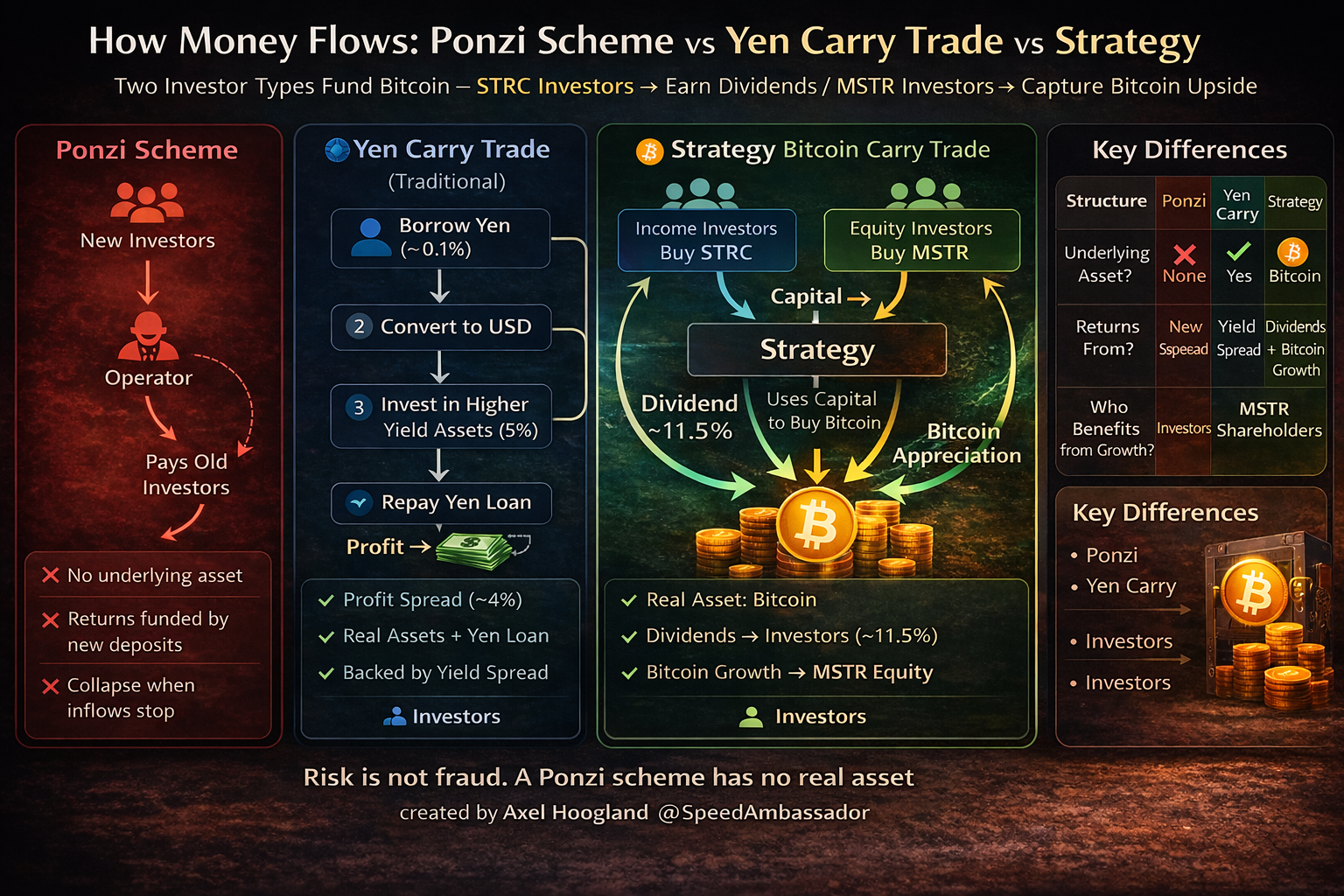
Understanding Ponzi schemes, Bitcoin carry trades, and how new financial instruments are evolving
Recently there has been a wave of posts online claiming that MicroStrategy and securities like STRC are “Ponzi schemes.”
That claim misunderstands both what a Ponzi scheme actually is and how these instruments work.
Before labeling something a Ponzi scheme, it helps to start with a clear definition.
What Is a Ponzi Scheme?
A Ponzi scheme is a fraudulent investment structure where:
- Investors are promised returns
- Those returns are not generated by real economic activity
- Early investors are paid using money from new investors
- The scheme collapses once new inflows stop
The defining characteristics are:
- No real underlying asset
- No productive activity generating returns
- Fabricated account statements or hidden losses
- Mathematical collapse once new money stops coming in
The most famous example is Bernie Madoff, who fabricated account balances while paying existing investors with money from new clients.
If there is no real asset and no real economic activity, you may be looking at a Ponzi scheme.
An Interesting Contrast: Social Security
Ironically, one of the closest structures many Americans participate in that resembles a Ponzi-style payment system is **Social Security Administration’s Social Security program.
Social Security works by:
- taxing current workers
- using those taxes to pay current retirees
There is no large invested pool backing the system. Instead, it relies on a continuous stream of new contributors to fund previous participants.
Government projections show the trust funds are expected to become depleted within the next decade, after which benefits would have to be reduced or taxes increased to maintain payouts.
This is not fraud — it is a demographic funding system created by law — but it illustrates an important point:
Money flowing from new participants to previous participants does not automatically make something a Ponzi scheme.
A Ponzi scheme specifically requires deception and fake returns.
Now let’s look at MicroStrategy.
What MicroStrategy Actually Does
MicroStrategy is a publicly traded company that:
- issues equity and debt securities
- uses the proceeds to purchase Bitcoin
- holds that Bitcoin on its balance sheet
The underlying asset is Bitcoin, which is publicly verifiable on the blockchain.
Investors buying MicroStrategy securities know exactly what they are purchasing.
Nothing is hidden.
Nothing is fabricated.
The underlying asset exists and can be independently verified.
You may disagree with the strategy.
But it clearly does not meet the definition of a Ponzi scheme.
What STRC Actually Is
STRC is a preferred stock issued by MicroStrategy that pays a monthly dividend currently around 11.5% annually.
The capital raised from selling STRC is used to purchase additional Bitcoin.
Conceptually, the structure resembles a carry trade.
A Bitcoin Carry Trade
For decades global investors used the Yen carry trade.
The strategy worked like this:
- Borrow Japanese yen at extremely low interest rates
- Convert yen into higher-yielding assets (often U.S. dollars)
- Capture the yield difference
STRC works in a somewhat similar way — but with Bitcoin.
Instead of:
Yen → USD
The structure is effectively:
USD → Bitcoin
Investors provide capital and earn roughly 11.5% yield, while MicroStrategy accumulates Bitcoin.
What the Market Has Actually Shown
STRC began trading in July 2025.
Around August 2025, Bitcoin traded near $120,000.
Since then Bitcoin has experienced significant price volatility.
Yet STRC has generally continued trading near its $100 reference price.
That doesn’t prove the structure will work forever.
But it does show something important:
So far, the instrument has functioned roughly as designed.
Financial markets tend to expose broken structures quickly.
The Lindy Effect
There is a concept known as the Lindy effect.
The Lindy effect suggests:
The longer something survives, the longer it is likely to continue surviving.
We see this with technologies, institutions, and financial instruments.
Gold has survived thousands of years.
Stock markets have survived more than a century.
Bitcoin itself has now survived multiple boom-bust cycles.
Each month that STRC:
- maintains its price near $100
- pays its dividend
- continues operating normally
…the probability that the structure works increases slightly.
What Are the Real Risks?
None of this means STRC or MicroStrategy are risk-free.
But the risks are often misunderstood.
The real risks are tail risks — low-probability but high-impact events.
For example:
1. Catastrophic failure of Bitcoin
If Bitcoin were somehow fundamentally broken — a critical cryptographic flaw, catastrophic protocol failure, or a coordinated global ban that destroyed liquidity — the entire thesis behind MicroStrategy’s balance sheet would be undermined.
2. Corporate catastrophe unrelated to Bitcoin
Another possibility would be some major event affecting the company itself:
- fraud inside the company
- regulatory disaster
- management misconduct
- or some unforeseen corporate collapse
These risks exist for every public company.
3. Extreme financial system disruption
In a severe financial crisis, credit markets can temporarily freeze. Any company that relies on capital markets — including MicroStrategy — could be affected.
Risk Is Not Fraud
The irony in many of these debates is that the word “Ponzi” often gets used as a general insult for anything people don’t understand.
Real Ponzi schemes involve deception, fake assets, and fabricated returns.
MicroStrategy and STRC involve transparent securities backed by a publicly verifiable asset.
Whether someone believes in Bitcoin or not, the structure is visible to everyone.
In fact, one of the broader trends of the past decade has been the opposite of a Ponzi scheme: systems where the underlying asset is more transparent than ever before.
Bitcoin’s supply is public.
Bitcoin’s transactions are public.
Bitcoin’s monetary policy is fixed.
Financial instruments like STRC are simply new ways that traditional capital markets are interacting with that asset.
You may think the strategy is aggressive.
You may think the trade will fail.
But the difference between risk and fraud still matters.
And confusing the two only makes it harder to understand what is actually happening in financial markets today.
 MyWheelLife.com