💡 Money Isn’t What You Think It Is
Most of us think of money as the bills in our wallets or numbers in our bank accounts. But money isn’t a physical thing—it’s a system of IOUs. It’s how we track value we’ve created, whether that’s building a fence, baking bread, or writing software.
Here’s the key insight: money itself doesn’t hold value.
If it did, you’d want to hoard it. But you don’t. You probably try to get rid of your dollars by putting them into stocks, real estate, or gold—anything to escape inflation.

🧱 A Story About a Fence (and a Broken System)
Imagine this:
You build a 100-foot fence for someone. They pay you $100. One year later, you ask them to build a fence for you. They say, “Sure, but now it’ll cost $105.”
Why? Inflation. Your money didn’t hold its value. The effort you gave last year is worth less this year.
And while the U.S. has “low” inflation, other countries—like Argentina—see 100% inflation annually. In places like that, people rush to convert their paychecks into food, bricks, or U.S. dollars just to preserve value.
But let’s be honest: the U.S. dollar and Argentine peso aren’t fundamentally different. Both are government-issued currencies that lose value over time due to overspending and excessive money printing.
⚙️ Enter Bitcoin: Fixed, Transparent, and Decentralized
Bitcoin was designed to fix this exact problem.
- There will only ever be 21 million bitcoins.
- Each one can be divided into 100 million sats (Satoshis).
- Bitcoin is basically a global, digital IOU ledger that nobody controls—but everyone can verify.
Think of it as an open-source Excel spreadsheet that tracks who owns what. But instead of one person controlling it, thousands of computers (nodes) maintain the same list and agree on changes only when a valid transaction is made.
🔨 How Bitcoin Transactions Work
- You send a transaction using your app or wallet.
- It enters the mempool, a kind of digital waiting room.
- Miners select and bundle transactions into a block.
- They solve a math puzzle to earn the right to add the block to the chain.
- Once added, it’s permanent—and verified by the entire network.
Each block takes about 10 minutes to process. Miners are rewarded with both newly “unlocked” bitcoin (currently 3.125 BTC) and small transaction fees—typically less than 1%, cheaper than credit cards.
🆚 Bitcoin vs “Altcoins”
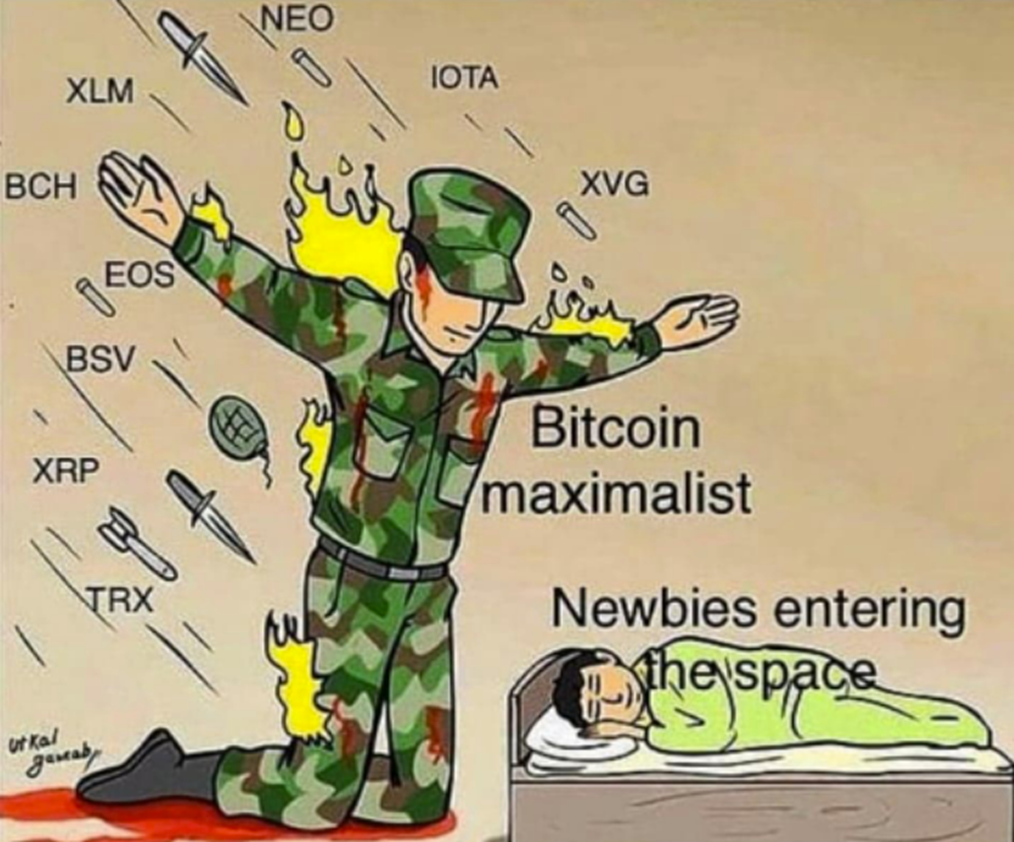
Bitcoin has no premine, meaning the creator didn’t secretly give themselves coins before anyone else could buy them. Most altcoins (alternative cryptocurrencies) do. That makes many of them less like open money and more like disguised businesses.
Ask yourself: What real problem is this altcoin solving?
The answer is likely that the coin is built around a company structure, because it can’t solve the store of value problem. Bitcoin already solved that problem.
💸 How to Buy Bitcoin Today
Option 1: Brokerages
- Buy FBTC, the Fidelity Bitcoin Trust, just like a stock or ETF
- Available through Fidelity, Schwab, and others
- Small fee: ~0.25% expense ratio
Option 2: Direct Purchase
- Use apps like Strike, River, or Cash App
- You can hold your own Bitcoin (self-custody) or keep it with the app
📈 Why Bitcoin Could Hit $13 Million
There are $750 trillion in global assets.
| Asset Category | Estimated Value (USD) |
| Real estate | ~$360 trillion |
| Equities (stocks) | ~$110 trillion |
| Bonds (debt markets) | ~$135 trillion |
| Broad money (M2) | ~$100 trillion |
| Gold (above ground) | ~$14–15 trillion |
| Private businesses, art, collectibles, etc. | ~$20–30 trillion (est.) |
If even $273 trillion of that (stocks, real estate, bonds, money supply) flows into Bitcoin, that’s:
$273 trillion ÷ 21 million BTC = $13 million per coin
This isn’t speculation—it’s about monetary premium, the extra value people add to assets (like real estate or art) just because they don’t trust cash.
Bitcoin is absorbing that value because it’s better money.
🧠 Strategy: It’s Not Too Late
A $10,000 investment today could get you 0.1 BTC.
If Bitcoin hits $13 million, that’s worth $1.3 million.
Of course, you shouldn’t invest money you can’t afford to lose. But for many, $10K is a small bet with a big upside.
Bitcoin isn’t just about price—it’s about a fundamentally better way to store and transmit value.
🎯 Final Thought: We’re All Fish in Fiat Water
You’ve lived your whole life in a system where money loses value. It feels normal, but it’s not natural.
Bitcoin is a new kind of money: scarce, digital, decentralized, and global.
Once you understand what money really is, it becomes clear: Bitcoin is not just better money—it’s the future of value itself.
 MyWheelLife.com